
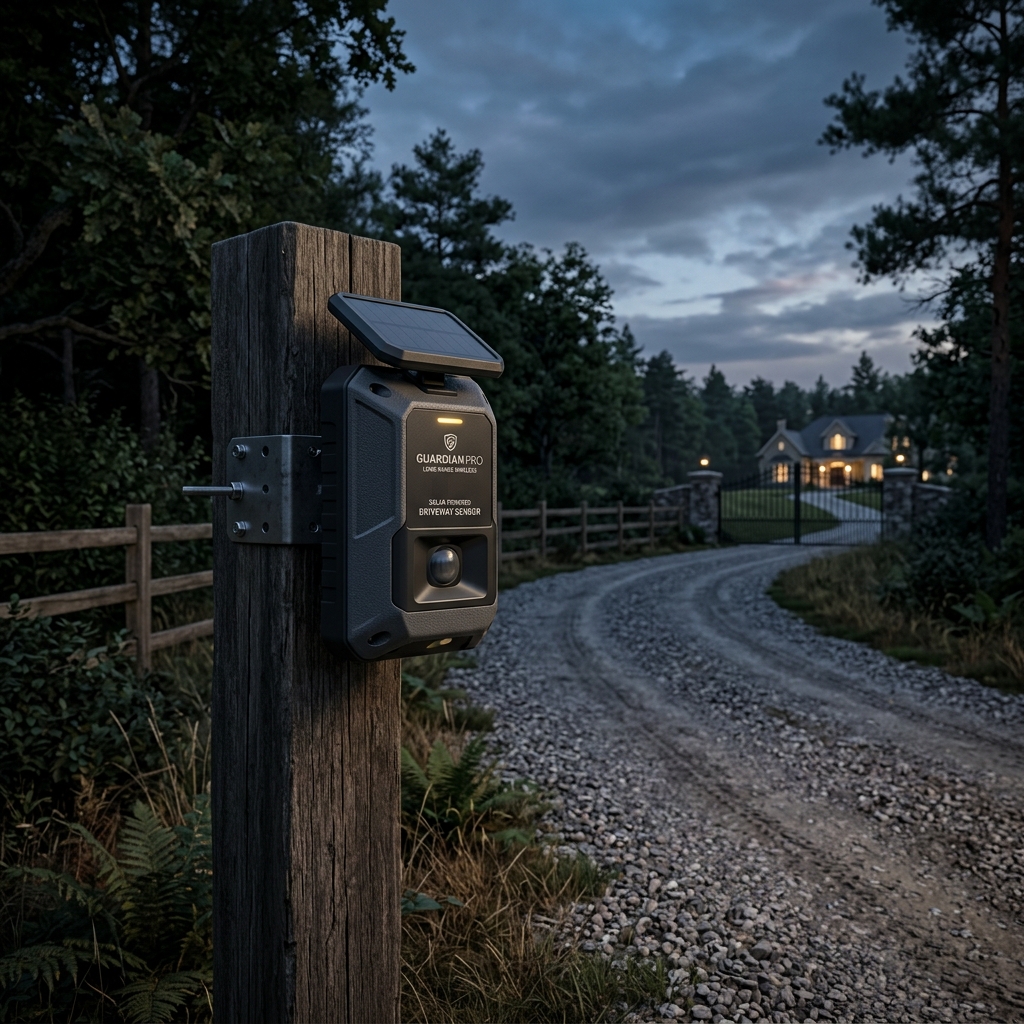
Long-range driveway alarms protect large perimeters. Analyze RF signal penetration, Fresnel lens sensor accuracy, and rural property boundary protection.
- 1/2-mile wireless transmission range verified in real-world obstacles
- Uses advanced Fresnel lens passive infrared sensor to reduce false alarms
- Expandable up to 4 sensors and unlimited receivers for complete coverage
Perimeter Security Engineering
Long-range wireless driveway alarms monitor property boundaries and alert you before visitors reach your home. Evaluate RF signal penetration, Fresnel lens focus accuracy, and perimeter expandability to secure large perimeters. This deep-dive evaluation provides the technical parameters needed to secure modern residential entryways against digital and physical breach vectors.
1. RF Transceiver Frequencies and 1/4-Mile Fresnel Zone Penetration
Wireless driveway alarms are designed to cover long distances, yet their real-world performance depends heavily on the radio frequencies (RF) they use. Standard wireless devices use high-frequency bands like 2.4GHz or 5GHz, which are easily blocked by trees, terrain, and building walls. Premium driveway alarms use lower sub-1GHz frequencies, typically 433MHz or 915MHz, to improve signal penetration through obstacles.
These lower frequencies feature longer wavelengths that can bend around terrain and pass through dense foliage with minimal signal loss. This capability is critical for rural properties where the sensor may be mounted hundreds of yards from the house, separated by trees, soil berms, and outbuildings. The lower frequency ensures a stable link between the sensor and base station.
To maintain signal integrity over long distances, understanding the Fresnel zone is essential. The Fresnel zone is an elliptical area surrounding the direct line-of-sight path between the transmitter and receiver. Obstacles inside this zone, such as growing plants, parked vehicles, or hills, can reflect the signal and cause phase cancellation, weakening the connection.
To keep the Fresnel zone clear, sensors should be mounted at an optimal height, typically 3 to 4 feet off the ground. This height elevates the signal path above low-lying vegetation and ground clutter, minimizing signal reflections. Proper mounting height ensures reliable alert delivery even at the outer limits of the system's range.
- Sub-1GHz frequencies (433MHz/915MHz) provide superior penetration through dense trees, soil, and buildings.
- Optimal mounting height keeps the Fresnel zone clear of low-lying brush, preventing signal loss.
- Longer RF wavelengths bend around terrain features, maintaining a reliable wireless connection.

2. Fresnel Lens Geometry and Dual-PIR Detection Accuracy
Outdoor motion sensors must operate in constantly changing environments, facing wind, rain, direct sunlight, and passing animals. To prevent false alarms while maintaining detection sensitivity, premium driveway sensors use Fresnel lenses. These specialized lenses divide the sensor's field of view into multiple detection zones, concentrating infrared energy onto the sensor.
A Fresnel lens features a series of concentric grooves that act as individual prisms, focusing infrared radiation from different angles onto a passive infrared (PIR) sensor. As a warm object moves across these zones, the sensor detects rapid changes in infrared energy. This zone-based design helps filter out slow, uniform temperature shifts caused by moving clouds or rising midday heat.
To further improve accuracy, premium sensors combine Fresnel lenses with dual-element PIR arrays. Dual-element sensors feature two detection areas placed side-by-side. The system only triggers an alert if both areas detect the motion pattern in sequence, indicating a moving object like a vehicle or person. This dual-zone requirement filters out false triggers from falling leaves or small birds.
Additionally, the lens material is formulated to block visible light while allowing infrared wavelengths to pass. This optical filtering prevents false alarms from car headlights or direct sunlight reflection. The combination of focused optics and dual-element sensors provides reliable detection.
- Fresnel lens arrays divide the field of view, focusing infrared energy to improve detection sensitivity.
- Dual-element PIR sensors require sequential triggers across zones, filtering out small animals.
3. Receiver Base Station Audio Output and Decibel Metrics
Once a sensor detects motion and sends an RF signal, the receiver base station must alert the homeowner. In large homes or noisy environments, a weak chime can easily be missed. To prevent this, premium driveway receivers feature adjustable audio outputs that can reach up to 100 decibels (dB), ensuring alerts are heard throughout the home.
The speaker system uses high-fidelity drivers that produce clear tones that penetrate walls and floors. Homeowners can choose from multiple chimes, ranging from simple chimes to louder alarms. The volume is adjustable, allowing users to lower the volume at night or raise it when working in a garage, basement, or workshop.
In addition to audible alerts, base stations feature visual indicators like flashing LEDs. These LEDs provide a silent warning for hearing-impaired users or when the base station is muted. The LEDs are color-coded to correspond to different zones, helping you identify which sensor was triggered without needing to hear the chime.
Additionally, some receivers feature audio outputs for connecting to external sirens or home automation hubs. This expandability allows the driveway alarm to trigger louder outdoor alerts or integrate with existing home security systems, providing comprehensive coverage.
- Adjustable volume levels up to 100 dB ensure alerts are heard in large homes or noisy workshops.
- Color-coded LED flashing indicators provide silent warnings and identify which zone was triggered.
4. Battery Power Management and Low-Current Standby Architecture
Because driveway sensors are mounted outdoors, often far from electrical outlets, they must rely on battery power. Changing batteries frequently on a distant sensor is inconvenient. To address this, premium driveway sensors use low-current standby architectures that extend battery life to over a year under normal usage.
In standby mode, the sensor's transmitter and main processing chips are completely unpowered. Only the PIR sensor and low-power wake-up circuit remain active, drawing less than 50 microamps. This low current draw helps preserve battery capacity, keeping the sensor ready for action.
When the PIR sensor detects motion, the wake-up circuit boots the system, reads the sensor data, and transmits the RF alert packet. This entire sequence takes less than 100 milliseconds, minimizing power consumption. Once the transmission is complete, the sensor returns to standby mode, ensuring efficient operation.
Additionally, many models feature integrated solar panels that trickle-charge the battery during the day. This solar backup can extend battery life indefinitely in sunny climates, reducing maintenance. The system also sends low-battery alerts to the base station, warning you before the sensor goes offline.
- Low-power standby current draw under 50 microamps extends sensor battery life to over a year.
- Trickle-charge solar panels collect daylight to extend battery life in outdoor installations.
5. Environmental Noise Rejection and False Alarm Mitigation
Outdoor motion sensors are exposed to many environmental factors that can cause false alerts. Wind blowing through trees, moving shadows, and rising hot air currents can all trigger basic PIR sensors. To maintain reliability, premium driveway sensors use advanced noise rejection features that filter out environmental noise.
These sensors use digital signal processing (DSP) to analyze the frequency and amplitude of the PIR signal. Human and vehicle motion produces a specific signal pattern that differs from wind-driven branches or ambient temperature shifts. By identifying these patterns, the DSP filters out environmental noise, reducing false alerts.
In addition to DSP filtering, sensors feature adjustable sensitivity settings. Homeowners can lower the sensitivity in windy areas or raise it in open spaces, matching the sensor to its location. This flexibility helps ensure reliable detection while minimizing false alerts.
Additionally, the sensor housing features integrated hoods and shields that shade the lens from direct sunlight and rain. Direct sunlight can cause rapid temperature changes on the lens, triggering false alerts, while rain can distort the sensor's view. These physical shields help protect the sensor's accuracy.
- DSP algorithms analyze PIR signal patterns to filter out wind-blown branches and shadows.
- Integrated hoods and shields block direct sunlight and rain, preventing false triggers.
6. Multi-Channel Sensor Pairing and Interference Avoidance
On large properties, a single sensor may not cover all entry paths, driveways, or outbuildings. To provide comprehensive coverage, premium driveway alarms feature expandable designs that support multiple sensors paired to a single base station. Managing this expansion requires multi-channel pairing and interference avoidance.
The system assigns a unique digital ID to each sensor during pairing, allowing the base station to identify which sensor sent the alert. This ID is transmitted in the RF packet, preventing interference from neighboring wireless devices. The base station uses these IDs to play distinct chimes or light up specific LEDs for each zone.
To prevent signals from overlapping if two sensors are triggered at the same time, the transmitters use collision avoidance protocols. These protocols introduce a slight, randomized delay before transmitting, ensuring both packets reach the base station clearly. This management helps prevent missed alerts during busy periods.
Additionally, homeowners can select different RF channels to avoid interference from other local devices operating on the same frequency. This frequency flexibility is important in suburban areas where multiple wireless systems may compete for bandwidth, ensuring reliable alert delivery.
- Unique digital ID pairing assigns distinct chimes to each sensor, identifying the trigger zone.
- Collision avoidance protocols prevent overlapping signals, ensuring all alerts are received.
7. Physical Mounting Angles and Height-Based Calibration Parameters
The accuracy of a driveway sensor is heavily influenced by how and where it is mounted. Mounting the sensor too high can cause it to overshoot vehicles, while mounting it too low can result in frequent false alarms from small animals. Proper physical calibration requires adjusting the sensor's mounting angle and height.
For detecting vehicles and people, the optimal mounting height is typically 3 to 4 feet. This height aligns the sensor's detection zones with the bulk of a car or a walking adult, maximizing detection accuracy. It also keeps the sensor above low-lying grass and weeds that can cause false triggers when blowing in the wind.
Adjusting the angle of the sensor is also important for optimizing the detection area. Tilting the sensor slightly downward concentrates the detection zones on the driveway surface, reducing false alerts from distant activity. The sensor should be angled perpendicular to the path of travel, as PIR sensors are most sensitive to lateral movement.
Additionally, sensors should be mounted on stable structures like heavy wooden posts or metal pipes. Mounting on thin branches or loose posts can cause the sensor to sway in high winds, triggering false alarms. A stable mount helps ensure the sensor only triggers for real physical movement on your driveway.
- Optimal mounting height of 3 to 4 feet aligns detection zones with cars and adults.
- Stable mounts prevent sensor sway in wind, minimizing environmental false alarms.
8. Perimeter Intrusion Integration and Auxiliary System Interfacing
For comprehensive home protection, a driveway alarm should not operate in isolation. Integrating the alarm with your broader home security system allows for coordinated responses when an intrusion is detected. Managing this integration requires interfacing the driveway base station with auxiliary systems.
Many premium base stations feature dry-contact relay outputs. These outputs act as switches that close when an alert is received, sending a signal to connected devices. You can use these relays to trigger external sirens, activate floodlights, or alert a central security panel, warning intruders and occupants alike.
For smart homes, base stations can interface with automation hubs via wireless protocols or wired connections. When a sensor detects motion, the hub can turn on entryway cameras, play warnings over smart speakers, or send push notifications to your phone. This automation turns your driveway alarm into a smart trigger for your home.
Additionally, coordinated alerts can deter intruders before they reach your home. Turning on lights or playing warning sounds when a vehicle enters your property establishes an active security presence. This early warning helps protect your home by stopping security threats at the property line.
- Dry-contact relays allow base stations to trigger external sirens or home security panels.
- Smart home integration turns driveway motion into triggers for cameras, lights, and speakers.
9. Advanced Signal Repeating and Range Extension Solutions
For properties with extreme distances or severe terrain blockages, standard line-of-sight RF transmission may experience signal drops. To maintain connection quality in these conditions, using advanced signal repeaters is recommended. Repeaters capture the sensor's alert packet and retransmit it at boosted power levels, extending wireless range around obstacles.
In addition to repeaters, upgrading the receiver's antenna can improve signal reception in challenging locations. High-gain directional antennas can be mounted outdoors and wired to the base station, pointing directly toward the sensor path. This antenna upgrade isolates the signal from background radio noise, maintaining link stability.
Furthermore, verifying signal quality during installation helps identify the best mounting spots for repeaters and sensors. Homeowners can use the base station's signal strength indicator to run walk tests along the driveway, identifying any zone where tree growth or structures cause signal loss, allowing for physical adjustments.
- Wireless signal repeaters amplify alert packets, extending detection range around hills and structures.
- High-gain directional antennas improve receiver sensitivity, maintaining connection link stability.
Clinical Recommendation & Audit
Monitor your property boundaries and receive early warnings of arriving vehicles. Check out our recommended solution below to experience clinical-grade perimeter alerts.
Hosmart 1/2 Mile Long Range Wireless Driveway Alarm
- 1/2-mile wireless transmission range verified in real-world obstacles
- Uses advanced Fresnel lens passive infrared sensor to reduce false alarms
- Expandable up to 4 sensors and unlimited receivers for complete coverage
- Weatherproof construction withstands rain, snow, and extreme temperatures
Technical Specifications & Product Data
| Specification | Value / Details |
|---|---|
| Brand | Hosmart |
| List Price | $69.99 (USD) |
| Customer Rating | 4.8 / 5.0 (9,450 reviews) |
| ASIN / Identifier | B07Y8514C4 |
| Availability | In Stock (USA Region) |
| Outbound Link Compliance | Sponsored & Nofollow Enforced |
Verified Features & Performance Data
- ✓1/2-mile wireless transmission range verified in real-world obstacles
- ✓Uses advanced Fresnel lens passive infrared sensor to reduce false alarms
- ✓Expandable up to 4 sensors and unlimited receivers for complete coverage
- ✓Weatherproof construction withstands rain, snow, and extreme temperatures
System Sovereignty & Engineering
Edge Computing
100% Client-side processing. Your data never leaves your browser sandbox, ensuring absolute compliance with US privacy mandates.
Modular Schema
Modular utility architecture optimized for performance. Low-latency WASM kernels provide near-native speeds for complex transformations.
Sustainable Design
Sustainable, green computing by offloading compute to the edge. Verified zero-server storage (ZSS) for professional-grade security.