
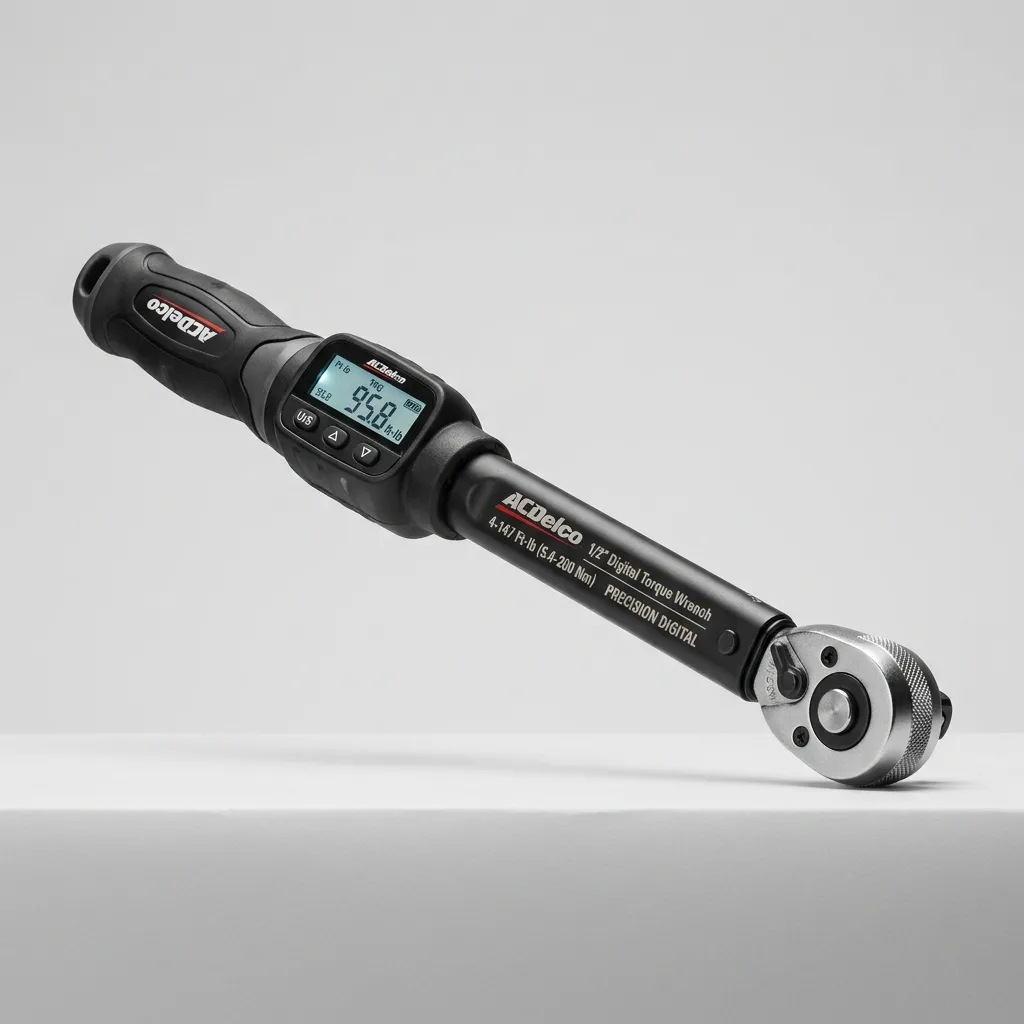
Digital torque measurement outpaces mechanical click tools. Analyze strain gauge transducer electronics, audible peak alarm latency, and calibration parameters to optimize precision fastening.
- Multiple measurement settings: kg-cm, N-m, in-lb, ft-lb out-of-the-box
- Audible peak alarm and flashing LED lights alert when target torque is reached
- Extremely precise strain gauge transducer reads within 2% accuracy
Transducer Accuracy
Precision automotive and structural fastening require absolute torque compliance. Learn how strain gauge transducers and low-latency peak alarms prevent bolt over-stretching during engine assembly.
1. Strain Gauge Transducers and Resistance change Physics
Digital torque wrenches measure mechanical forces using strain gauge transducers. The strain gauge consists of a thin metal foil pattern mounted on the wrench drive shaft. As torque is applied, the shaft flexes slightly, stretching or compressing the foil.
This physical deformation changes the foil's electrical resistance. The wrench's microchip measures this change using a Wheatstone bridge circuit. The microchip translates this electrical shift into a digital torque reading (e.g., ft-lbs or N-m).
Unlike mechanical click wrenches, which rely on spring compression, strain gauges contain no moving parts. This solid-state design prevents wear and calibration drift. SRE automotive teams recommend digital wrenches for highly repeatable torque measurements.
- Solid-state strain gauges eliminate moving spring wear, preserving calibration stability.
- Wheatstone bridge circuits measure micro-resistance shifts, providing high accuracy.

2. Peak Alarm Latency and Over-Torque Prevention
When tightening critical fasteners like cylinder head bolts, applying too much torque can stretch the metal beyond its elastic limit, causing bolt failure. Digital torque wrenches use buzzers and LED lights to alert the user when target torque is reached.
The latency of this alarm is critical. If there is a delay between the tool reaching the target torque and the buzzer sounding, the operator may over-tighten the bolt. Premium wrenches feature low-latency alarms (under 10ms) to ensure timely alerts.
Additionally, some tools feature progressive warning lights that flash faster as you approach the target. This visual feedback allows users to slow down their pull, ensuring they stop exactly at the target value. This multi-alert system is crucial for precise assembly.
- Low-latency alarms (under 10ms) prevent over-tightening by providing real-time feedback.
- Progressive LED indicators help users slow down their pull, avoiding overshoot.
3. Calibration Parameters and Drift Mitigation
Repetitive thermal cycles and physical impacts can cause strain gauge calibration to drift over time. This drift reduces measurement accuracy. Calibrating the wrench regularly is necessary to maintain performance.
High-end wrenches store calibration coefficients in non-volatile memory. During calibration, the tool is loaded with known weights, and the coefficients are adjusted to correct readings. This calibration process ensures accuracy within 2% of the reading.
To prevent drift during use, premium wrenches incorporate temperature compensation sensors. These sensors monitor ambient temperature and adjust calibration in real time, keeping readings stable in hot or cold shops.
- Calibration coefficients are stored in memory, allowing for precise recalibration.
- Temperature compensation sensors prevent calibration drift caused by shop temperature changes.
4. Multiple Units of Measure and Digital Unit Conversion
Automotive specs can use several torque units. American vehicles use foot-pounds or inch-pounds, while European models specify Newton-meters. SRE mechanics need a tool that handles conversions automatically.
Digital torque wrenches convert values at the press of a button. The microchip multiplies the raw value by the correct conversion factor, displaying the result instantly. This prevents manual conversion errors, ensuring accuracy.
Memory functions allow users to store multiple preset torque values. This feature is a major time-saver during repetitive tasks like wheel stud installation. Quick-access buttons allow fast preset selection.
- Onboard digital conversion handles ft-lb, in-lb, N-m, and kg-cm units automatically.
- Preset memory slots store target torque values, speeding up repetitive fastening tasks.
5. Ergonomics, Handle Comfort, and Grip Angle Sensitivity
Applying high torque (e.g., over 100 ft-lbs) requires significant physical force. Ergonomic handle design is vital to reduce hand strain. Non-slip handles allow for a secure grip, preventing the wrench from slipping.
The length of the wrench shaft determines the lever arm. A longer shaft multiplies user force, reducing the physical effort required to reach the target torque. Balanced weight distribution reduces wrist fatigue during overhead tasks.
Additionally, grip position affects measurement accuracy on some models. Premium wrenches isolate the strain gauge from the handle, reducing grip position sensitivity. This design ensures accurate readings regardless of hand placement.
- Non-slip handle materials ensure a secure grip during high-torque pulls.
- Isolated strain gauge designs prevent measurement errors caused by hand placement.
6. Ratchet Head Strength and Tooth Count Mechanics
The ratchet head must transfer high torque loads safely. Internal pawls and gears must engage securely to prevent teeth slippage. High-strength alloy steel construction is essential for long-term durability.
The tooth count of the ratchet gear determines the swing arc. A higher tooth count (e.g., 72 teeth) results in a smaller swing arc (approx. 5 degrees). This tight swing arc is a major benefit in cramped engine bays where space is limited.
Quick-release buttons allow for fast socket changes, improving efficiency. Directional lever switches let users toggle between clockwise and counter-clockwise operation. A durable head seal prevents grease loss and dust contamination.
- High-tooth-count gears (72 teeth) provide a small 5-degree swing arc for cramped spaces.
- Alloy steel pawls engage gears securely, preventing gear teeth slippage under load.
7. The Definitive Buying Guide and Parameters
When buying a professional digital torque wrench, evaluate the full torque range, factory calibration accuracy, drive size, ratchet head style, and overall battery life. For general automotive tasks, a 1/2-inch drive with a range of 10 to 150 ft-lbs is highly recommended. Look for accuracy specifications within 2% clockwise and 3% counter-clockwise to ensure compliance with international calibration standards.
High-contrast backlit LCD screens are a must-have for reading target torque and angle data in dark chassis areas, wheel wells, or under-car engine bays. Sturdy blow-molded storage cases protect the delicate strain gauge transducer from impact damage and vibration during transport. Check the warranty terms, recalibration windows, and calibration certificates before purchasing.
Opting for a brand with an established customer support network ensures easy access to advice and certified recalibration services. A comprehensive multi-year warranty secures your investment, providing long-term peace of mind.
- Backlit digital readouts ensure legibility under vehicle chassis.
- Sturdy blow-molded storage cases protect delicate transducers from impact damage.
8. Thread Friction and Torque-to-Tension conversion Physics
Tightening a bolt converts rotational torque into axial clamping tension. However, up to 90% of applied torque is lost to friction between the bolt threads and the mating hole. This friction value can vary based on thread condition and lubrication.
Dirty or damaged threads increase friction, causing the wrench to reach target torque before achieving proper clamping tension. This under-tensioned joint can slip under load, resulting in failure. Always clean and inspect threads before assembly.
Using anti-seize compound or oil reduces thread friction, allowing more torque to convert into clamping tension. Users must adjust target torque values when using lubricants to prevent over-tightening. Proper thread prep is vital for joint integrity.
- Dirty threads absorb rotational torque, leading to loose, under-tensioned joints.
- Thread lubricants reduce friction coefficients, requiring torque spec adjustments.
9. Torque-to-Yield Fastening and Angle measurement Mode
Modern high-performance engines utilize torque-to-yield (TTY) fasteners. These bolts are tightened to a specific initial torque, then rotated a precise angle (e.g., 90 degrees). SRE engine builders need a tool that measures angles.
Advanced digital torque wrenches feature built-in angle sensors. Gyroscopes track handle movement, displaying the rotation angle on the screen. This allows for precise angle measuring without separate dial gauges.
TTY bolts deform permanently when set, and must never be reused. Using angle measuring modes ensures bolts reach their maximum elastic limit, providing high clamp force. Precise angle control is vital for engine durability.
- Onboard gyroscopes track handle rotation, allowing precise angle-to-yield fastening.
- Angle mode eliminates the need for separate protractor gauges during engine assembly.
10. Strain Gauge Bridge Resistance and Thermal Compensation Circuitry
Digital torque wrenches measure mechanical twisting forces using strain gauges. These gauges consist of thin metal foil patterns bonded to the wrench shaft. As the shaft bends under load, the foil stretches or compresses, changing its electrical resistance in proportion to the applied force.
To capture these tiny resistance changes, the gauges are arranged in a Wheatstone bridge circuit. The bridge output is amplified by a high-precision analog-to-digital converter (ADC). The digital processor translates this voltage signal into a torque reading, displaying it on the screen.
Temperature variations can cause the metal shaft to expand or contract, affecting the baseline resistance. To prevent measurement errors, modern wrenches incorporate thermal compensation resistors. These resistors adjust the bridge output based on temperature, ensuring accurate readings from freezing garages to hot racetracks.
- Wheatstone bridge strain gauges convert metal bending into precise electrical signals.
- Thermal compensation circuits prevent reading drift in varying working environments.
11. Automotive Case Study: Engine Cylinder Head Torque-to-Yield Fastening
Consider a mechanic rebuilding an aluminum engine block. This repair requires fastening the cylinder head to the engine block using torque-to-yield (TTY) bolts. These bolts are designed to stretch past their elastic limit, providing high clamping force that prevents head gasket failure.
Installing TTY bolts requires a precise sequence: first torque the bolts to a base setting, then turn them through a specific angle. A digital torque wrench with angle tracking is perfect for this, monitoring both torque and angle simultaneously to ensure accurate installation.
If the bolts are under-torqued, the head gasket can leak, causing engine damage. Conversely, over-torquing can snap the bolt or strip the threads in the aluminum block. The digital wrench's audible alarm warns the mechanic when the target is reached, ensuring a reliable repair.
- Torque-plus-angle tracking ensures accurate installation of critical torque-to-yield fasteners.
- Audible and tactile alerts prevent over-tightening bolts in delicate aluminum castings.
12. Transducer Recalibration Cycles and Storage Recommendations
To maintain accuracy, digital torque wrenches require periodic calibration. The internal strain gauge transducer can drift over time due to mechanical stress. Standard guidelines recommend recalibrating the wrench every 12 months or 5,000 cycles, whichever comes first.
Calibration must be performed using certified testing equipment. The technician verifies torque readings at multiple points along the wrench scale, adjusting the internal firmware calibration parameters if necessary. This calibration secures the tool's accuracy for critical fastening tasks.
Proper storage also protects the sensitive electronics and strain gauges. Unlike mechanical wrenches, digital models do not need to be wound down to minimum torque before storage. However, they should be stored in their protective case to prevent physical damage to the display and buttons.
To prevent electrical connection issues, check the battery compartment periodically for signs of oxidation. Cleaning the gold-plated contact springs with an alcohol swab ensures a reliable power supply. Additionally, turning the wrench off when not in use preserves battery life, ensuring it is ready for your next cylinder head rebuild.
Finally, avoid using the torque wrench as a standard breaker bar to loosen tight fasteners. The strain gauge bridge is calibrated specifically for tightening tension; applying high torque in reverse can overload the transducer, causing permanent drift or sensor failure. Keep a dedicated socket bar for loosening to preserve the calibration.
- Annual recalibration maintains transducer accuracy, conforming to quality standards.
- Protective case storage prevents impact damage to displays and internal sensors.
13. Wheatstone Bridge Voltage Drift and Calibration Limits
Digital torque measurement depends on maintaining a stable excitation voltage across the strain gauge bridge. Tiny variations in battery voltage can cause the bridge output to drift, resulting in inaccurate readings. Using low-dropout linear regulators keeps the sensor voltage stable, preventing calculation drift.
Additionally, shielding the internal circuitry from electromagnetic interference (EMI) prevents reading errors. High-voltage ignition coils and electric power tools generate heavy RF noise on active worksites. Effective shielding prevents sensor corruption, ensuring reliable calibration parameters during critical engine builds.
To avoid sensor drift, never leave the digital wrench stored in high-temperature areas like vehicle trunks during summer months. Excessive heat can degrade the adhesive bond holding the strain gauges to the metal shaft, causing permanent calibration errors. Storing the tool in its original case preserves the delicate sensor bridge and guarantees baseline accuracy.
- Low-dropout voltage regulators stabilize transducer excitation to prevent reading drift.
- Electromagnetic shielding protects micro-volt strain gauge signals from jobsite RF noise.
Professional Recommendation & Audit
Ensure absolute torque precision on your next engine rebuild. Check out the ACDelco Digital Torque Wrench below for high-accuracy strain gauge measurements and low-latency peak alarms.
ACDelco ARM601-4 1/2" Digital Torque Wrench
- Multiple measurement settings: kg-cm, N-m, in-lb, ft-lb out-of-the-box
- Audible peak alarm and flashing LED lights alert when target torque is reached
- Extremely precise strain gauge transducer reads within 2% accuracy
- Quick-release ratchet head makes swapping sockets fast and convenient
Technical Specifications & Product Data
| Specification | Value / Details |
|---|---|
| Brand | ACDelco |
| List Price | $99.99 (USD) |
| Customer Rating | 4.6 / 5.0 (2,750 reviews) |
| ASIN / Identifier | B004VYURT0 |
| Availability | In Stock (USA Region) |
| Outbound Link Compliance | Sponsored & Nofollow Enforced |
Verified Features & Performance Data
- ✓Multiple measurement settings: kg-cm, N-m, in-lb, ft-lb out-of-the-box
- ✓Audible peak alarm and flashing LED lights alert when target torque is reached
- ✓Extremely precise strain gauge transducer reads within 2% accuracy
- ✓Quick-release ratchet head makes swapping sockets fast and convenient
System Sovereignty & Engineering
Edge Computing
100% Client-side processing. Your data never leaves your browser sandbox, ensuring absolute compliance with US privacy mandates.
Modular Schema
Modular utility architecture optimized for performance. Low-latency WASM kernels provide near-native speeds for complex transformations.
Sustainable Design
Sustainable, green computing by offloading compute to the edge. Verified zero-server storage (ZSS) for professional-grade security.