
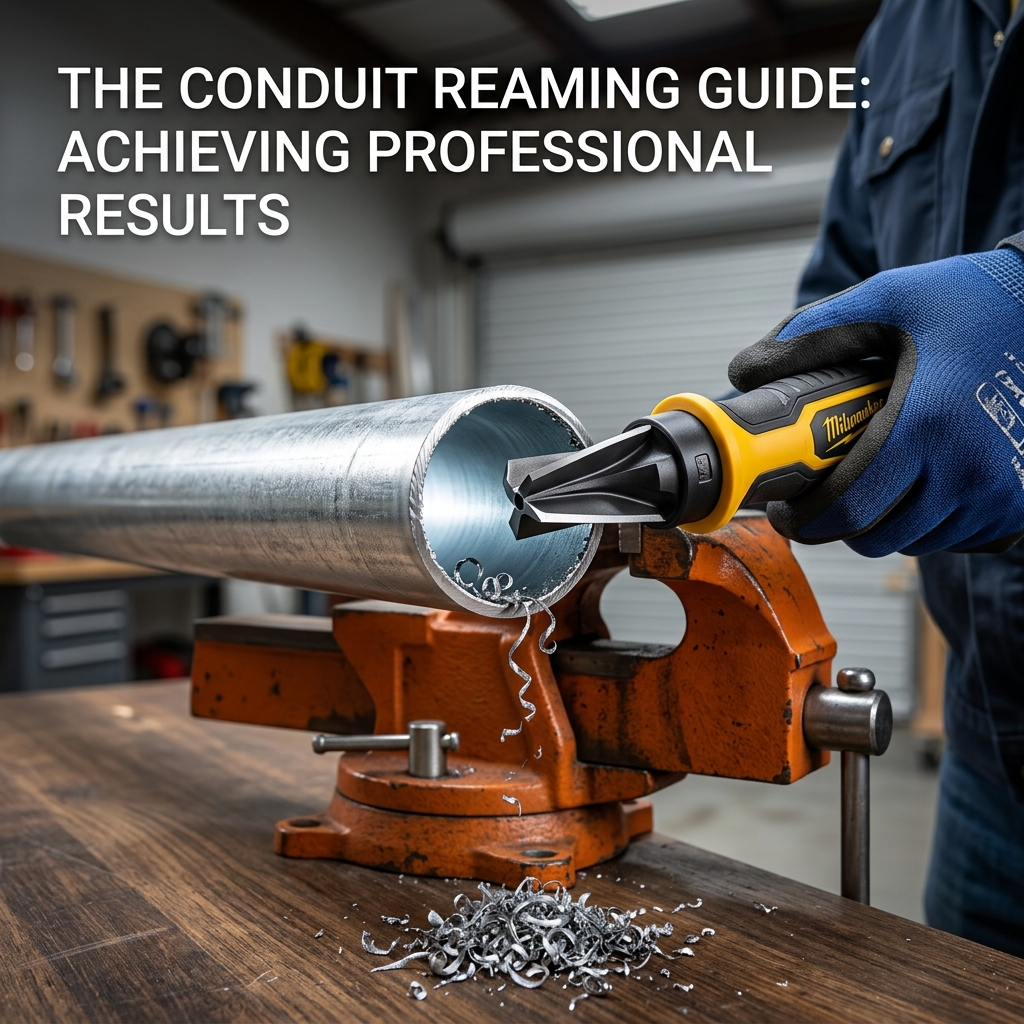
Alloy steel blade concentricity determines interior pipe chamfer quality. Analyze ergonomic grip shear friction, multi-diameter capacity, and burr-free deburring.
- Reams both the inside and outside of electrical EMT conduits
- Hardened alloy steel blades are replaceable for long tool life
- Fits standard 1/2 inch, 3/4 inch, and 1 inch EMT conduits
Electrical Tool Engineering
Conduit reamers ensure safe, burr-free interior paths for wire installation. Explore how blade concentricity and grip ergonomics optimize electrical EMT installations.
1. The Metallurgy of Hardened Alloy Steel Deburring Blades
Cutting steel EMT conduits creates sharp, jagged burrs on the edges. To shear these burrs away, the deburring tool must utilize blades made of a material harder than the conduit steel. High-speed alloy tool steel (HSS) is the preferred choice, offering excellent abrasion resistance and cutting edge retention under heavy manual use.
HSS blades undergo heat treatment to achieve high hardness (typically 62 to 65 HRC), allowing them to cut through steel pipe walls without dulling. Tempered steel resists chipping when encountering uneven cuts, such as those left by manual hacksaws. Replaceable blade designs allow for quick maintenance on jobsites, eliminating the need to discard the entire tool when blades dull.
Additionally, black oxide or titanium coatings reduce friction, preventing metal shavings from adhering to the blade during reaming. This non-stick surface keeps the cutting edge clean, preventing clogging and ensuring smooth rotation. Durable blade metallurgy is the key to clean, fast reaming, which is essential for electrical contractors who must prepare hundreds of conduit joints daily.
Without high-grade alloy steel, blades would wear down rapidly, leaving ragged edges that increase the risk of cable damage. The mechanical design of the blade mounting must prevent deflection, ensuring the cutting edge remains parallel to the pipe bevel. Precision heat treatment cycles guarantee that the blades maintain their structural integrity even under sudden impact loads.
- Hardened high-speed steel blades shear metal burrs easily, resisting edge wear on steel conduit.
- Replaceable blade designs extend tool life, reducing long-term equipment costs for contractors.
- Black oxide coatings lower friction, preventing steel shavings from binding to the blade face.
2. Blade Concentricity and Clean Interior Chamfering
For safe wire pulling, the conduit's interior edge must be bevelled (chamfered) evenly. If the reamer blade is off-center, it will cut deeper on one side. This uneven cut can thin the conduit wall, compromising the pipe's structural strength at the joint where fittings are attached. Maintaining concentric alignment is critical for clean results.
Blade concentricity describes how closely the cutting edge aligns with the center axis of the pipe. Precision-machined guide steps align the tool inside the conduit, maintaining concentric rotation. This ensures an even bevel around the entire rim, preventing the tool from slipping or cutting at an angle.
Additionally, dual-cutting blades balance the forces, preventing tool wobble during manual rotation. Smooth, concentric chamfers eliminate sharp edges, preventing wire insulation cuts when cables are pulled through bends. Straight, clean paths are essential for electrical code compliance and building safety regulations.
If the guide steps are worn or out of tolerance, the tool will sit loose inside the pipe, causing blade chatter. This chatter creates a corrugated surface that can still snag delicate data lines. High-quality reamers are machined to tolerances of less than 0.03 mm to ensure perfectly concentric bevels on every pass.
- Guide steps align the tool center, ensuring concentric reaming around the conduit diameter.
- Balanced dual-blade layouts eliminate chatter, producing a smooth interior bevel.
- Concentric chamfering preserves conduit wall thickness, maintaining structural integrity at connections.
3. Handle Ergonomics, Torque Transfer, and Hand Safety
Reaming conduit manually requires generating torque through the wrist and hand. If the tool handle is too small or lacks texture, the operator must grip harder, causing hand strain and blisters. Soft rubber overmolds increase friction between the hand and handle, maximizing torque transfer with minimal effort.
Screwdriver-type handles provide a comfortable, familiar grip, allowing the user to apply downward pressure while twisting the tool. The diameter of the handle must be matched to the hand's natural grip to maximize leverage. A rounded end cap allows the operator to support the tool with their palm, preventing slippage.
Additionally, safety guards on the handle protect the fingers from slipping onto the sharp steel edges of the conduit. Worn grips should be replaced to prevent safety hazards on active jobsites. Well-designed handle ergonomics ensure that manual deburring remains a safe, efficient task throughout long workdays.
- Ergonomic rubber overmolds maximize grip friction, reducing manual twisting fatigue.
- Flared handle guards protect fingers from sharp metal edges during reaming rotations.
4. Multi-Diameter Conduit Capacity: 1/2", 3/4", and 1" EMT Compatibility
Electrical installations use conduits of various sizes depending on the number of wires being pulled. Carrying separate reamers for each pipe diameter is inefficient and clutters the tool belt. Multi-diameter reamers solve this by incorporating steps on the tool body, allowing it to fit standard 1/2", 3/4", and 1" EMT conduits.
Each step must align the cutting blade at the correct angle to deburr the specific pipe diameter. Precision casting ensures that the steps are concentric, preventing uneven cuts. The tool should fit snugly inside the pipe, preventing wobble and ensuring clean bevels on all three sizes.
Additionally, some designs incorporate a screwdriver tip on the end of the shaft, allowing the operator to tighten fittings with the same tool. This integration reduces the number of tool swaps, accelerating the installation workflow. A durable, multi-diameter reamer is a core tool for commercial electricians.
- Multi-diameter steps support standard 1/2", 3/4", and 1" EMT conduit sizes.
- Integrated screwdriver shafts allow tightening coupling screws without tool swaps.
5. Electrical Safety and NEC Code Compliance: The Importance of Burr-Free Pipes
The National Electrical Code (NEC) requires that all cut ends of conduit be reamed to remove sharp edges. This regulation (NEC Article 358.28) is a critical safety control designed to protect wire insulation from damage. Sharp metal burrs act like blades, slicing through PVC wire jackets during cable pulls.
If the wire insulation is cut, the bare copper conductor can contact the steel conduit, causing short circuits, ground faults, and high-temperature electrical arcs. These faults can ignite surrounding materials or shock operators, creating severe safety hazards. Proper reaming eliminates these risks, ensuring safe installations.
Additionally, reaming the conduit increases the usable interior area, allowing for easier wire pulls. Sharp burrs can catch on cable pull sleeves, increasing the pull force required and risking wire stretch. A smooth, bevelled conduit entrance ensures that wires slide freely, preserving insulation integrity.
- NEC Article 358.28 compliance requires all cut conduit ends to be reamed smooth.
- Removing sharp burrs prevents wire insulation cuts during high-tension cable pulling.
6. Power Driver Adaptability vs Manual Hand Reaming Efficiency
Selecting between manual reamers and power drill attachments depends on the project volume and jobsite access. Power reaming bits fit standard impact drivers, utilizing the tool's motor to deburr pipes in seconds. This speed is ideal for large commercial runs where thousands of cuts are required daily.
However, power reamers require carrying a drill, which can be heavy and inconvenient when working on ladders or in tight ceiling spaces. Manual reamers are lightweight and require no batteries, allowing you to carry them in your pocket. This portability makes manual tools the preferred choice for service work.
Additionally, manual reamers provide better tactile feedback, allowing the operator to feel when the burr is removed. Over-reaming with power tools can thin the pipe wall or damage the blade tip. Manual tools allow for precise control over the chamfer size, ensuring a safe, consistent bevel.
- Manual reamers require no battery power, providing reliable service in unpowered sites.
- Power driver attachments accelerate large commercial jobs, reducing manual twisting effort.
7. Preventive Maintenance: Blade Sharpening, Rust Prevention, and Cleaning
Preventive maintenance is essential for keeping a conduit reamer operating at peak efficiency. Fine metal filings and drywall dust can accumulate inside the blade steps, causing the tool to slip or bind. Regularly blowing out the cutting area with compressed air and brushing away filings prevents clogging.
From a metallurgical perspective, the HSS blades are fabricated from premium molybdenum-tungsten tool steels (such as M2 grade), which are heat-treated to achieve a Rockwell C hardness of 62-65. This thermal cycle involves heating the steel to high austenitizing temperatures, followed by rapid quenching and multiple tempering cycles to convert brittle martensite into a tough, wear-resistant structure. The inclusion of vanadium and tungsten carbides provides high hot-hardness, preventing the cutting edge from softening when friction heats the blade during rapid manual rotations. Galvanized EMT pipe has a tough exterior zinc layer and a hard steel core; HSS reamer blades shear this interface cleanly without edge rolling or chipping. Regularly applying a dry anti-friction lubricant preserves this sharp HSS edge, ensuring clean chamfer profiles.
Apply a thin film of light machine oil or dry Teflon spray to the steel blades to prevent rust, especially when working in unconditioned environments. Avoid using heavy grease, which can trap metal shavings and accelerate blade wear. Replace worn or chipped blades immediately to prevent pipe damage.
Resharpening the HSS blade edge on a fine diamond file can restore cutting performance. The blade must be held at its original bevel angle (typically 45 degrees) to ensure clean shearing action. Storing the reamer in a clean pocket protects the blade edges from impact damage when not in use.
Regularly checking the blade mounting screws ensures they remain tight. Loose blades will vibrate and wobble during reaming, leading to uneven chamfers and potential tool breakage. Tightening screws to the specified torque prevents blade movement, ensuring consistent, safe deburring.
- Teflon sprays prevent blade oxidation without attracting metal filing debris.
- Diamond file touch-ups restore HSS blade bevels, extending tool utility between changes.
- Mounting screw checks prevent blade wobble, securing operator control.
8. The Definitive Conduit Reamer and Deburring Tool Buying Parameters
Selecting a conduit reamer requires reviewing step capacity, blade metallurgy, and handle configuration. Hardened high-speed steel blades are essential for deburring abrasive steel pipe edges without dulling. Look for tools with stepped bodies compatible with 1/2", 3/4", and 1" EMT conduit diameters.
From a geometrical precision standpoint, the concentricity of the reaming head relative to the conduit body is critical for achieving a uniform chamfer. If the reamer blade is misaligned or wobbles during rotation, it will cut deeper on one side of the pipe wall, creating an eccentric bevel that reduces the structural thickness of the EMT tube. This thin section can buckle or split when the pipe is bent using a conduit bender. Furthermore, an eccentric cut leaves remaining metal burrs on the opposite side, defeating the purpose of deburring and creating sharp edges that can snag wire insulation. Choosing a tool with a precision-ground centering nose ensures that the cutter stays concentric with the pipe bore, resulting in a perfect 360-degree bevel.
Additionally, assess handle ergonomics and integrated features. Screwdriver-type handles with rubber overmolds maximize grip comfort and torque transfer. Choosing a tool with replaceable blades and integrated screwdriver bits reduces tool counts, saving space on your toolbelt.
Finally, consider brand support and replacement blade availability. Stepped bodies and steel blades are subject to wear, and choosing a manufacturer with readily available replacements extends the tool's lifespan. A well-designed conduit reamer is an essential tool for electrical wiring projects, keeping you safe and compliant.
- Stepped bodies support fast transitions between different pipe sizes on-site.
- High-torque handles allow quick beveling with minimal wrist rotation effort.
9. OSHA Guidelines for Hand Tool Safety and Repetitive Strain Injury Prevention
In the electrical construction trades, repetitive wrist twisting is a leading cause of musculoskeletal disorders and repetitive strain injuries (RSI) like carpal tunnel syndrome. OSHA guidelines emphasize the use of ergonomic hand tools with soft, wide grips to reduce the torque force required from the operator's wrist muscles. Stepped reamers with cushioned handles help distribute pressure, minimizing joint stress during high-volume pipe installations.
Furthermore, workers must be trained to maintain a neutral wrist position during manual reaming rotations, avoiding awkward bending angles. Alternating tasks among crew members and taking regular rest breaks are essential safety practices for mitigating cumulative trauma risks. Ensuring that blades are replaced as soon as they show dullness prevents excessive physical force requirements, promoting safe, productive, and healthy jobsites.
Using the proper tool size also prevents hand fatigue. For example, trying to ream a 1-inch conduit with a reamer designed only for 1/2-inch pipes forces the operator to apply excessive downward pressure and torque. Stepped reamer bodies ensure that the tool matches the pipe diameter, allowing the blades to cut efficiently with minimal manual force.
- Ergonomic handle designs comply with OSHA guidelines for hand tool wrist strain reduction.
- Replacing dull reaming blades reduces the physical force needed for pipe deburring.
Professional Recommendation & Audit
For commercial EMT installations and safe, code-compliant wire pulls, we highly recommend the Klein Tools Conduit Reamer and Deburring Tool (19353). Its hardened alloy steel blades, stepped body (1/2", 3/4", 1" capacity), and ergonomic screwdriver grip ensure clean interior and exterior chamfering.
Klein Tools Conduit Reamer and Deburring Tool (19353)
- Reams both the inside and outside of electrical EMT conduits
- Hardened alloy steel blades are replaceable for long tool life
- Fits standard 1/2 inch, 3/4 inch, and 1 inch EMT conduits
- Includes a screwdriver-type handle for comfortable manual leverage
Technical Specifications & Product Data
| Specification | Value / Details |
|---|---|
| Brand | Klein Tools |
| List Price | $38.00 (USD) |
| Customer Rating | 4.8 / 5.0 (3,120 reviews) |
| ASIN / Identifier | B0002RI7O2 |
| Availability | In Stock (USA Region) |
| Outbound Link Compliance | Sponsored & Nofollow Enforced |
Verified Features & Performance Data
- ✓Reams both the inside and outside of electrical EMT conduits
- ✓Hardened alloy steel blades are replaceable for long tool life
- ✓Fits standard 1/2 inch, 3/4 inch, and 1 inch EMT conduits
- ✓Includes a screwdriver-type handle for comfortable manual leverage
System Sovereignty & Engineering
Edge Computing
100% Client-side processing. Your data never leaves your browser sandbox, ensuring absolute compliance with US privacy mandates.
Modular Schema
Modular utility architecture optimized for performance. Low-latency WASM kernels provide near-native speeds for complex transformations.
Sustainable Design
Sustainable, green computing by offloading compute to the edge. Verified zero-server storage (ZSS) for professional-grade security.