
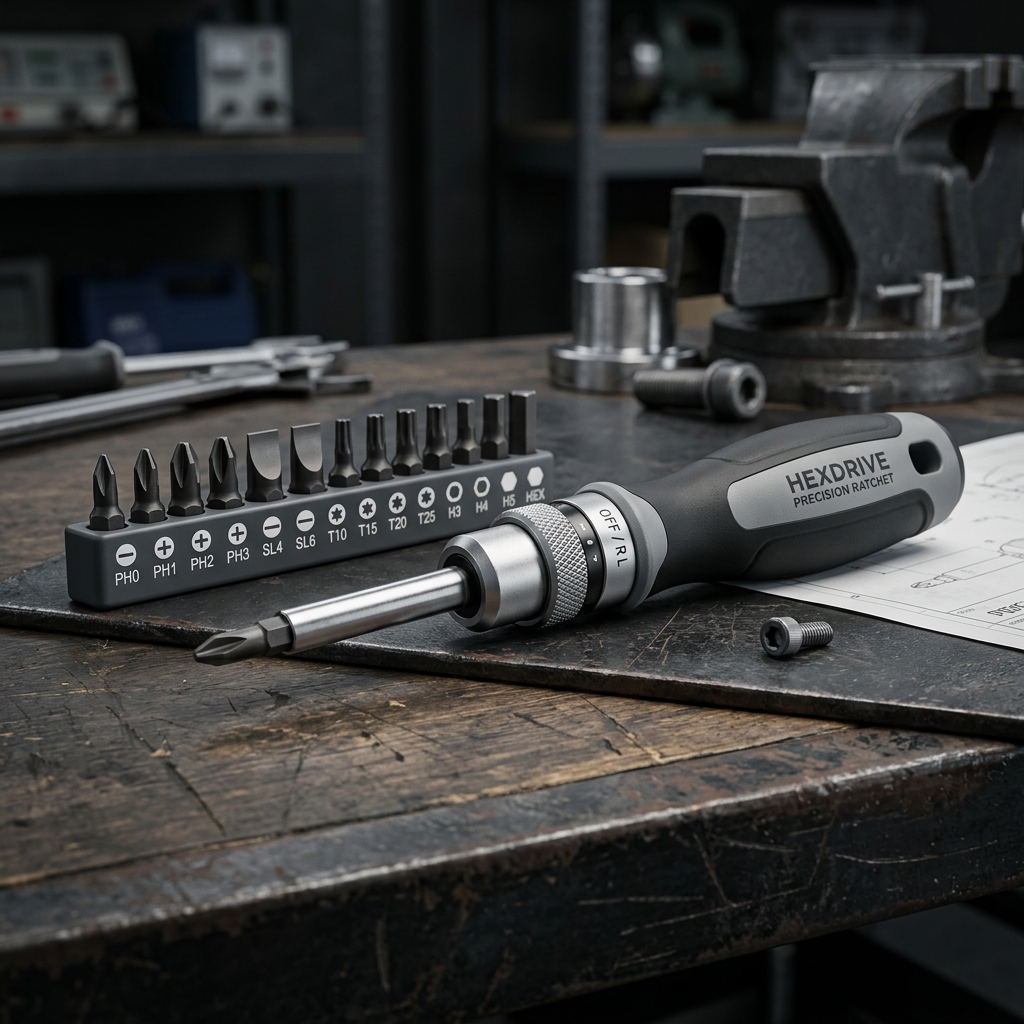
Ratcheting gear teeth mesh determines maximum torque load limits. Analyze magnetic bit pull force, ergonomics, and bit metallurgy to prevent cam-out failures.
- High-torque patented ratcheting mechanism with 24-tooth gear mesh
- Magnetic bit holder holds fasteners securely, preventing drops in tight spaces
- Retractable bit cartridge stores 14 double-ended industrial-grade bits
Mechanical Leverage & Assembly
Ratcheting screwdrivers dramatically accelerate repetitive fastening tasks. Explore how gear mesh engineering and magnetic pull forces optimize industrial assembly lines.
1. The Mechanical Engineering of Ratchet Gear Teeth Mesh
Ratcheting screwdrivers reduce wrist fatigue by eliminating the need to release and re-grip the tool. The core of this system is a gear and pawl mechanism. When turning the driver, the pawl slides over the sloped gear teeth, while locking firmly against the flat side of the teeth in the opposite direction. This mechanism requires precise tolerances to prevent slippage while maintaining a low-profile housing that doesn't interfere with access.
The number of gear teeth dictates the return arc angle. For example, a 24-tooth gear requires a 15-degree rotation to engage the next tooth, while a 72-tooth gear requires only 5 degrees. High tooth-count gears are ideal for tight spaces, but the smaller teeth are more vulnerable to stripping under high torque. In industrial applications, the 24-tooth design is favored due to its robust tooth profile, which allows for significantly higher torque capacity without mechanical failure.
To handle heavy industrial loads, manufacturers use dual-pawl systems that distribute the force across multiple gear teeth. Heat-treated chrome vanadium steel gears prevent teeth deformation, ensuring reliable engagement. This robust construction is essential for high-torque assembly work, where a single tooth failure can compromise the entire tool. The heat treatment process optimizes the hardness-to-toughness ratio, achieving a Rockwell C hardness (HRC) of 50 to 55 for maximum durability.
Furthermore, the clearance between the pawl and the gear teeth must be kept to a minimum. Any excess play increases backlash, which wastes operator effort and makes fine adjustments difficult. High-precision machining ensures a crisp, positive click with each turn, confirming secure engagement before torque is applied. The physical sensation of the mechanism click provides immediate feedback, preventing partial engagements that lead to tooth rounding.
In addition to material hardness, gear lubrication plays a significant role in long-term reliability. Special low-viscosity greases prevent dust accumulation inside the gear housing while keeping the action smooth. This protection is critical on dusty, active jobsites where fine drywall or wood particles can migrate into the gear assembly. A sealed housing design further isolates the delicate internal mechanisms from environmental contaminants, ensuring consistent operation over thousands of cycles.
- Dual-pawl mechanisms distribute torque loads, preventing gear teeth failure under heavy manual torque.
- Heat-treated alloy steel gearing resists wear under continuous daily use on industrial assembly lines.
- Precision gear enclosures prevent dirt ingress, preserving mechanism click accuracy in harsh environments.
2. Magnetic Bit Retainer Pull Force and Concentricity
Multi-bit screwdrivers use interchangeable hex bits held within a hollow shaft. If the bit retainer mechanism is poorly designed, the bit can wobble or pull out when extracting the tool from a fastener. This run-out compromises alignment, leading to stripped screw heads and uneven torque application. Proper magnetic retention is critical for maintaining concentricity throughout the driving axis.
To secure the bit, premium shafts incorporate high-power neodymium magnets at the base of the hex socket. The magnetic pull force must be calibrated to hold the bit firmly during high-speed extraction, while still allowing the user to swap bits manually. A strong magnetic field also magnetizes the bit tip, holding steel screws in place during alignment, which is crucial for one-handed operation in tight configurations.
Additionally, tight hex socket clearances maintain concentric alignment, reducing bit wobble. Anodized steel collars protect the socket rim from cracking under lateral loads. This secure fit is critical for driving long fasteners straight without the driver slipping off the screw head, preventing surface damage to surrounding workpieces. The tolerance must be tight enough to prevent play, yet loose enough to accommodate variation in bit plating thicknesses.
Without proper magnetic retention, bits can get lost inside engine bays, drywall cavities, or electrical panels, causing safety hazards and material waste. The magnetic strength must not degrade over time, even under thermal stress from storage in hot service trucks. High-grade rare-earth magnets ensure permanent hold, resisting demagnetization up to temperatures of 80 degrees Celsius.
Concentric alignment also improves force transfer efficiency. When the bit is centered, the torque is applied evenly to all screw head points, reducing the downward force required to prevent bit jump. This concentricity is the key to effortless fastening and prevents early wear on both the driver bit and the fastener itself.
- Neodymium magnets provide strong pull force to prevent accidental bit loss during deep recess extraction.
- Concentric socket alignment minimizes bit run-out, preventing screw strip-out and tool slippage.
- Anodized collars prevent hex socket split-out, maintaining alignment under heavy lateral side-loads.
3. Ergonomics, Handle Geometry, and Torque Transfer
The amount of torque a woodworker or technician can apply depends heavily on handle ergonomics. Small-diameter handles require high grip force, causing rapid muscle cramping and joint fatigue. Premium screwdrivers utilize large-diameter handles with tri-lobular cross-sections, matching the hand's natural gripping dynamics to maximize leverage.
Soft rubber overmolds increase friction between the hand and the handle, preventing slippage even when hands are oily or sweaty. Hard polymer cores ensure structural rigidity, transferring force directly from the hand to the steel shaft. A smooth, rounded end cap allows the user to apply downward pressure with their palm while turning, minimizing the risk of slipping out of the fastener.
Furthermore, the ratcheting selector switch must be easy to toggle with one finger while holding the tool. Positive detents prevent the selector from drifting into the locked position during use. These ergonomic details maximize user control and comfort, reducing the physical strain associated with repetitive assembly tasks.
Handle length also dictates the user's control. A handle that is too short limits leverage, while a handle that is too long is difficult to steer in confined cabinet corners or vehicle engine bays. Finding the optimal length provides balanced control, ensuring that the center of gravity remains close to the operator's palm for precise steering.
By managing handle diameters, manufacturers optimize torque transmission. The hand grip wraps naturally around the flutes, reducing the physical strain required to drive long screws. Safety is enhanced by preventing hand slippage off the tool, which is a major source of minor lacerations on active assembly sites.
- Tri-lobular handle geometries maximize hand leverage, reducing grip fatigue during long shifts.
- Palming end caps allow comfortable downward force application to prevent cam-out on stubborn screws.
- Positive selector detents lock the ratchet mode, preventing accidental switching during high-torque rotations.
4. Bit Storage Cartridges and Locking Mechanisms
Carrying a separate bit case is inconvenient on active jobsites and leads to lost pieces. Multi-bit screwdrivers solve this issue by incorporating internal storage. Retractable bit cartridges store bits within the handle, opening at the press of a button or sliding out smoothly to reveal the bit inventory.
The cartridge must hold the bits securely to prevent them from rattling or falling out when opened. Individual slots molded to match the bit profiles keep them organized. Locking end caps prevent the cartridge from opening accidentally during high-torque tasks, which could spill bits in inaccessible workspaces.
Additionally, some designs use double-ended bits to double the storage capacity within the same physical footprint. The cartridge shaft must be durable, resisting wear from repetitive opening cycles. Clean organization makes it easy to find the right bit quickly, accelerating work flows on the assembly floor.
If the cartridge latch becomes loose over time, it can pop open when applying heavy palm pressure. Precision-ground latch sears prevent this failure mode, ensuring that the tool remains solid during heavy driving. The cartridge remains locked until the release button is explicitly pressed, maintaining tool structural integrity.
By organizing the bits cleanly, you reduce the time wasted searching for tools in your toolbelt. A clear layout allows you to check your bit inventory at a glance, ensuring you have the required tips before starting a project. This efficiency is critical for professional installers who are billed by the hour.
- Retractable cartridges store up to 14 double-ended bits inside the handle, saving toolbelt space.
- Locking end caps prevent accidental cartridge opening, keeping bits secure when dropping the tool.
- Molded bit slots keep different tip sizes organized and easy to extract, even when wearing gloves.
5. Metallurgy, Bit Coating, and Cam-out Failure Modes
When driving tough screws, the bit tip is subjected to intense shear stress. If the metal is too soft, the tip will deform or slip out of the screw head (cam-out), stripping the fastener and ruining the bit. Industrial-grade bits are made of hardened tool steel alloys, like S2 tool steel, which are optimized for high-impact resistance.
S2 steel offers a great balance of hardness and toughness, resisting chipping under high impact or sudden load spikes. Specialized coatings, like titanium nitride or industrial phosphate, reduce friction and protect the tips from corrosion. Ribbed designs on the bit tips increase grip, minimizing cam-out by biting into the fastener walls.
Additionally, matching the bit geometry to the screw head is critical. Using a Phillips bit in a Pozidriv screw will cause immediate slippage and wear due to the differences in flank angles. Keeping bits organized and replacing worn tips promptly protects your fasteners from damage, saving costly rework and material expenses.
If the bit coating wears off, the steel tip can rust when stored in humid environments. A rusted tip loses its dimensional accuracy, which increases the risk of cam-out and stripping. Industrial coatings preserve the tip's sharp edges over years of service, preventing the rounding of fine Phillips and Torx corners.
By managing tip metallurgy, manufacturers ensure the tool survives high-torque hand driving. Hardened tips resist wear from abrasive fastener materials, preventing slip-out. S2 alloy steel is the industry standard for durability because it deforms elastically under high shock loads rather than shattering.
- Hardened S2 steel bits resist twisting and deformation, extending tool life under high loads.
- Anti-slip ribbing on bit tips reduces cam-out, preventing screw and workpiece damage.
- Phosphate coatings protect steel bits from rust and corrosion on humid, unconditioned jobsites.
6. Industrial Assembly Case Studies and Lifetime Wear Characteristics
Consider an industrial assembly line scenario where workers drive hundreds of fasteners daily. Standard screwdrivers cause hand strain, blisters, and slow down assembly times due to constant repositioning. Switching to a ratcheting screwdriver allows technicians to maintain tool contact, accelerating fastening speed by 50% while reducing repetitive motion injuries.
Analyzing worn ratchet gearboxes reveals that dirt ingress is a common cause of gear failure. Metal shavings mixed with lubricant grease form an abrasive paste that degrades the gear teeth mesh, leading to sudden slippage. Choosing a screwdriver with a sealed gear housing prevents contamination, extending the tool's life by up to five times compared to open-gearing alternatives.
Additionally, S2 steel bits show superior wear resistance compared to standard carbon steel bits. Under high-torque loads, carbon steel tips deform, causing cam-out and stripping the fastener. S2 steel bits preserve their geometry under identical stress, ensuring clean, tight joints and reducing the frequency of bit replacements on the line.
Furthermore, ergonomic assessments have shown that handles with combined soft overmolds and hard plastic flutes allow for 20% higher manual torque generation than smooth plastic handles. This difference is critical when snugging down large electrical terminals or wooden joinery joints where power drivers cannot fit. A well-designed hand tool ensures that manual torque limits can be met safely.
These case studies demonstrate the value of premium hand tools. Investing in robust gearing, tight tolerances, and superior metallurgy reduces long-term tool replacement costs and boosts productivity. A high-quality ratcheting screwdriver secure assembly line output and ensures consistent build quality across multiple shifts.
- Ratcheting mechanisms accelerate fastening speed, increasing assembly line productivity.
- Sealed gear housing designs prevent dust ingress, protecting internal teeth mesh from wear.
7. Predictive Maintenance, Torque Calibration, and Safety Protocols
In professional environments, keeping hand tools in peak working condition is a core safety requirement. High-torque ratcheting screwdrivers should undergo regular inspection protocols to identify wear before it causes tool failure or worker injury. Technicians should check for excessive backlash in the gear housing and verify that the direction selector switch snaps into place with a clear, positive lock.
Cleaning the internal components is simple but essential. Periodically rinsing the hex shaft socket with a mild solvent removes accumulated metal shavings and dirt, preserving the neodymium magnet's surface contact. Applying a single drop of dry PTFE lubricant to the ratcheting selector switch ensures smooth shifting without attracting airborne particles that cause mechanical clogging.
Additionally, workers must be trained to recognize the signs of bit fatigue. If a bit tip shows signs of twisting, rounding, or micro-cracking, it must be replaced immediately. Using a compromised bit increases the physical force required to hold the driver in place, raising the risk of muscle strain and slippage-related injuries.
For assembly tasks with strict torque specifications, manual drivers should be calibrated against torque analyzers. While ratcheting screwdrivers are manual tools, the operator's leverage capability is directly related to handle geometry. Ensuring that workers can consistently hit target torque values without over-tightening is key to preserving threaded components.
- PTFE lubrication keeps the selector switch moving smoothly without attracting dust.
- Regular bit inspections prevent fastener damage caused by micro-fractured steel tips.
- Torque analysis checks verify that operators can safely reach required torque targets.
8. The Definitive Hand Tool Buying Parameters
Selecting a ratcheting screwdriver requires reviewing gear tooth counts, shaft length, and bit storage capacity. A 24-tooth gear mechanism provides a strong, reliable mesh for high-torque tasks, while tri-lobular handles optimize grip comfort and force distribution. Look for drivers that use standard 1/4-inch hex sockets for maximum compatibility with third-party bits.
Additionally, assess the cartridge build quality and ease of bit access. Smooth sliding action, positive cartridge locks, and clear marking labels make bit swaps faster. Opting for a driver with a magnetic collar helps hold screws during one-handed alignments, improving your efficiency when working on ladders or in awkward positions.
Finally, consider the manufacturer's warranty and repair support. A lifetime warranty on hand tools provides excellent value, showing the brand's confidence in their materials. A durable, well-engineered ratcheting driver is a cornerstone of any professional toolset, providing years of reliable service and protection against hand strain.
- Standard 1/4-inch hex sockets support all common aftermarket driver bits and nut drivers.
- Lifetime hand tool warranties secure your investment, proving industrial build quality.
Professional Recommendation & Audit
Upgrade your daily hand tools with an industrial solution. We highly recommend the Megapro 15-in-1 Premium Multi-Bit Ratcheting Screwdriver for its patented high-torque gear, secure magnetic holder, and smart internal cartridge storage.
Megapro 15-in-1 Premium Multi-Bit Ratcheting Screwdriver
- High-torque patented ratcheting mechanism with 24-tooth gear mesh
- Magnetic bit holder holds fasteners securely, preventing drops in tight spaces
- Retractable bit cartridge stores 14 double-ended industrial-grade bits
- Ergonomic cushion grip provides maximum torque transfer with reduced fatigue
Technical Specifications & Product Data
| Specification | Value / Details |
|---|---|
| Brand | Megapro |
| List Price | $39.00 (USD) |
| Customer Rating | 4.8 / 5.0 (5,680 reviews) |
| ASIN / Identifier | B004VJY1EC |
| Availability | In Stock (USA Region) |
| Outbound Link Compliance | Sponsored & Nofollow Enforced |
Verified Features & Performance Data
- ✓High-torque patented ratcheting mechanism with 24-tooth gear mesh
- ✓Magnetic bit holder holds fasteners securely, preventing drops in tight spaces
- ✓Retractable bit cartridge stores 14 double-ended industrial-grade bits
- ✓Ergonomic cushion grip provides maximum torque transfer with reduced fatigue
System Sovereignty & Engineering
Edge Computing
100% Client-side processing. Your data never leaves your browser sandbox, ensuring absolute compliance with US privacy mandates.
Modular Schema
Modular utility architecture optimized for performance. Low-latency WASM kernels provide near-native speeds for complex transformations.
Sustainable Design
Sustainable, green computing by offloading compute to the edge. Verified zero-server storage (ZSS) for professional-grade security.