
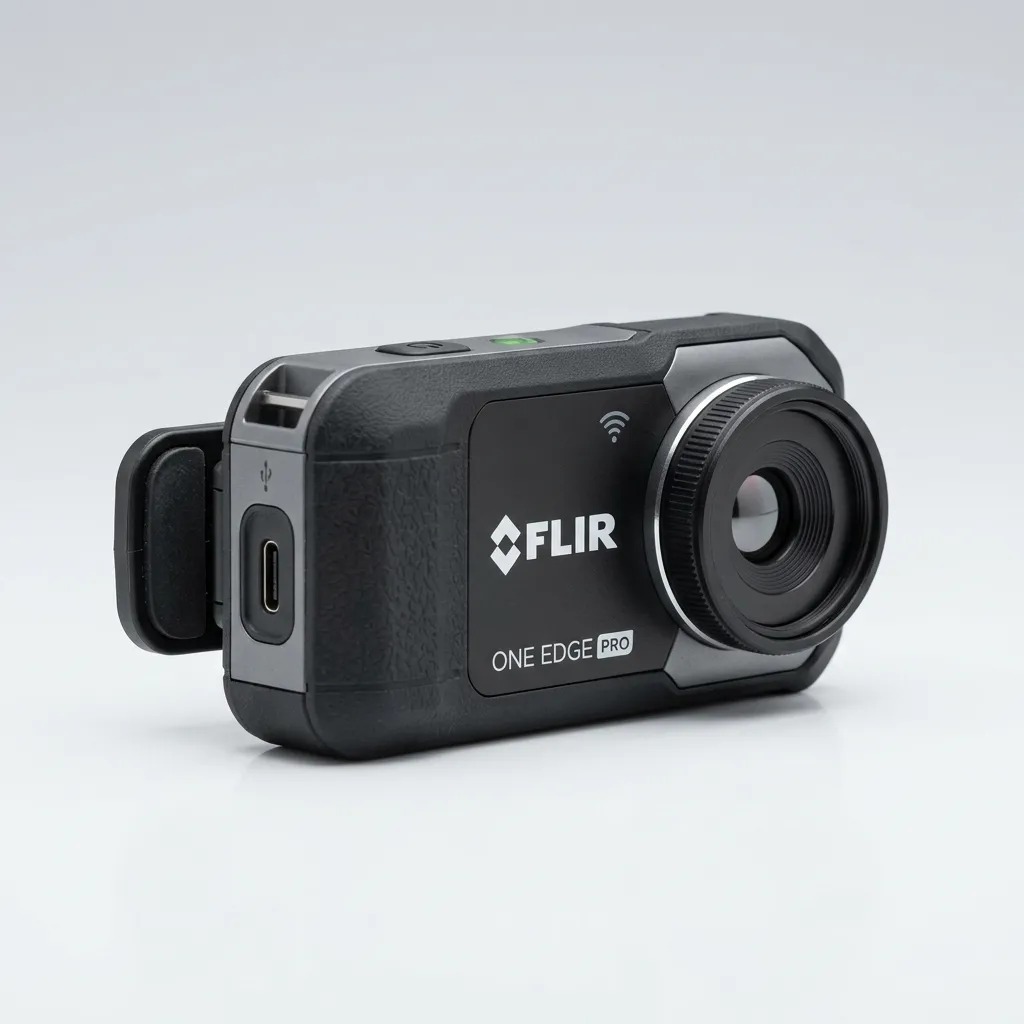
Compact infrared thermal imaging outpaces manual air-leak inspection. Analyze microbolometer resolution, emissivity correction factors, and MSX edge detection to optimize energy audits.
- Wireless connectivity enables remote inspection of tight framing areas
- FLIR MSX technology overlays visual outlines onto thermal images for high detail
- VividIR advanced image processing reveals hidden details and heat signatures
Thermal Analysis
Residential energy audits require precise thermal inspection. Learn how microbolometer sensor arrays and emissivity adjustments identify air leaks and insulation gaps to prevent energy loss.
1. Microbolometer Sensor Arrays and Thermal Resolution
Thermal imaging cameras detect infrared radiation using microbolometer sensor arrays. A microbolometer is a grid of tiny pixels made from heat-sensitive materials like vanadium oxide. Each pixel absorbs infrared energy, changing its electrical resistance based on temperature.
The sensor resolution is defined by the number of pixels in the grid (e.g., 160x120 or 80x60). Higher resolution arrays capture more detail, allowing users to identify small heat signatures. This detail is crucial for finding tiny air leaks or water leaks behind walls.
Onboard processors convert these resistance shifts into color-coded temperature maps. High thermal sensitivity (NETD under 70mK) allows the camera to detect temperature differences as small as 0.07 degrees. This sensitivity ensures early detection of hidden insulation gaps.
- Vanadium oxide microbolometer arrays detect micro-infrared radiation, creating high-detail thermal maps.
- High thermal sensitivity (NETD < 70mK) detects minor temperature offsets, highlighting insulation flaws.

2. Emissivity Correction and Temperature Measurement Accuracy
To calculate accurate temperatures, the camera must correct for substrate emissivity. Emissivity is the measure of a material's efficiency in emitting infrared energy. Matte black surfaces have an emissivity close to 1.0, while shiny metals reflect heat and have low emissivity.
Low-emissivity metals act like mirrors, reflecting ambient room heat. If the camera is not calibrated correctly, scanning a shiny pipe will show the temperature of the room rather than the pipe itself. Correcting the emissivity setting (e.g., 0.95 for wood/drywall) ensures accurate calculations.
Modern thermal cameras feature pre-programmed emissivity tables for standard building materials. SRE energy auditors select the material type from the menu to adjust calibration. This correction prevents false readings when scanning wood, metal, or drywall.
- Emissivity adjustments correct for reflective metals, ensuring accurate surface temperature readings.
- Built-in material tables simplify calibration settings for wood, plaster, and metal.
3. MSX Technology and Multi-Spectral Edge Overlay
Thermal images lack structural detail, making it difficult to locate components or read labels. To resolve this, premium cameras use MSX (Multi-Spectral Dynamic Imaging) technology. The tool incorporates both thermal and visible-light camera sensors.
Onboard software extracts edge detail from the visible-light camera and overlays it onto the thermal image. This adds sharp structural lines, making labels, numbers, and corners easy to read on the thermal screen. Visual detail is added without compromising thermal data.
MSX technology improves target identification, making report creation fast and clear. Users can identify exactly which circuit breaker is overheating, or trace air leaks along door frames. This visual overlay is vital for home inspections.
- MSX technology overlays visual borders onto thermal maps, clarifying object outlines.
- Multi-spectral overlays enhance text readability on breaker labels and equipment tags.
4. Building Envelope Audits and Air Leak Detection
Air leaks through doors, windows, and attic hatches are a main cause of residential energy loss. Traditional audits use smoke pencils to find drafts, which is slow. Thermal cameras identify drafts instantly by mapping temperature differences.
Drafts draw cold outdoor air into the building, cooling the surrounding drywall. The thermal camera maps this cold plume as a dark streak along trim edges. This allows for fast draft localization, showing you exactly where to seal.
Audits are best conducted when there is a significant temperature difference (at least 18°F) between indoors and outdoors. Using blower doors to depressurize the house enhances draft plumes, making them easy to identify.
- Thermal imaging maps draft plumes instantly, guiding weatherstripping tasks.
- Depressurization techniques highlight tiny air leaks, maximizing sealing success.
5. Wireless connectivity and Remote framing Inspection
Crawlspaces and attics can be difficult to access and navigate safely. Wireless thermal cameras feature Wi-Fi or Bluetooth connectivity to stream data to smartphone screens. This wireless link allows for remote inspection of tight spots.
The operator can mount the camera on a pole and raise it into attic spaces, viewing thermal data on their phone screen. This remote setup avoids the need for ladders, improving safety. Data can be saved directly to phone storage.
Wireless ranges typically extend up to 30 feet, providing ample flexibility. Built-in battery packs power the wireless transmitter for continuous scanning. Rugged, pocket-sized housings protect tools from impact damage.
- Wireless streaming lets users inspect attics remotely, improving worksite safety.
- Pocket-sized rugged housings protect cameras during crawlspace inspections.
6. Thermal Calibration Drift and Sensor Stability
Sensor temperature changes cause calibration drift, introducing measurement errors. To prevent this, thermal cameras incorporate a shutter mechanism. The shutter drops in front of the sensor periodically, recalibrating the pixels to a known temperature.
This calibration click (NUC) recalibrates the sensor, keeping readings stable. High-end cameras use temperature-stable housings to minimize drift. Regular NUC cycles maintain measurement accuracy.
Avoid leaving the camera in hot spaces, as heat can damage microbolometer pixels. Clean lenses with dry lens paper to prevent dust from absorbing infrared light. Proper care ensures reliable sensor performance.
- NUC calibration shutter cycles stabilize microbolometer pixels, preventing sensor drift.
- Durable lens elements protect sensitive sensor grids from dust contamination.
7. The Definitive Buying Guide and Parameters
When buying a professional thermal camera, evaluate the detector resolution, thermal sensitivity (NETD), wireless connectivity, and companion software reporting features. For home inspections, commercial building energy audits, and moisture surveys, a microbolometer resolution of at least 160x120 pixels is highly recommended. Look for thermal sensitivity under 70mK to detect minor structural drafts, air leaks, and insulation gaps.
Wireless Wi-Fi or Bluetooth streaming provides maximum flexibility during tight framing, attic, or crawlspace inspections. Opt for professional analysis software that offers advanced reporting tools, automated temperature logging, and image overlay to speed up report creation. Sturdy hardshell carry cases protect delicate thermal sensors from mechanical damage and shocks during jobsite transit.
Check the battery design and charging ports. Built-in lithium-ion packs or hot-swappable batteries offer long continuous runtimes and save battery replacement costs over time. A comprehensive manufacturer warranty secures your expensive investment, providing long-term peace of mind.
- High sensor resolutions (160x120) resolve small draft leak lines over distances.
- Thermal sensitivity (NETD < 70mK) identifies subtle temperature offsets.
8. Color Palettes and Temperature Range selection
Thermal cameras color-code temperature maps using various palettes. The Ironbow palette represents hot zones in yellow/white and cold in blue/black. This palette is ideal for general inspections.
For building envelopes, the Rainbow palette provides higher color contrast, highlighting subtle drafts. Gray-scale palettes (e.g., White-hot or Black-hot) are preferred for outdoor surveillance. Selection should match the inspection task.
Setting the temperature range correctly prevents color saturation. High-end cameras allow for manual range lock, keeping the color scale consistent across different walls. Manual range locking is critical for comparative audits.
- Multiple color palettes (Ironbow, Rainbow) optimize visibility for specific inspections.
- Manual temperature range locking ensures color consistency during wall audits.
9. The Physics of Heat Transfer and Thermal Anomalies
Heat transfers through building walls via conduction, convection, and radiation. Thermal cameras map these heat flows, identifying anomalies that indicate insulation gaps. Conduction anomalies appear as cold patches where studs cross framing cavities.
Convection anomalies are caused by air leaks moving heat through gaps, creating draft plumes. Radiation anomalies can occur when surfaces have different emissivity properties. Differentiating these heat transfer modes is essential for accurate audits.
Understanding heat transfer physics allows inspectors to interpret thermal patterns correctly. By identifying the root cause of an anomaly, users can recommend targeted air sealing or insulation repairs. This precise mapping ensures energy efficiency gains.
- Mapping wall heat conduction anomalies identifies missing insulation cavities.
- Distinguishing conduction and convection patterns prevents incorrect sealing recommendations.
10. Microbolometer Sensitivity and Spectral Band Calibration
Thermal imaging cameras detect infrared radiation using a microbolometer sensor array. The microbolometer consists of a grid of heat-sensitive pixels, typically made of vanadium oxide (VOx). As infrared energy strikes the pixels, it changes their electrical resistance, which is measured to construct a thermal image.
The sensor's thermal sensitivity is defined by its Noise Equivalent Temperature Difference (NETD). A lower NETD value (e.g., <50mK) indicates the camera can resolve tiny temperature differences, which is critical for identifying energy leaks. The camera's processor translates these temperature values into colors, displaying the thermal map.
To ensure accuracy, the microbolometer is calibrated for specific spectral bands. Long-wave infrared (LWIR) radiation between 8 and 14 microns is ideal for inspecting building envelopes. This band passes through atmospheric moisture without interference, providing clear thermal images in varying outdoor conditions.
- Vanadium oxide microbolometers capture micro-Kelvin temperature variations for high sensitivity.
- LWIR spectral band filtering prevents atmospheric humidity from distorting thermal readings.
11. Building Envelope Case Study: Moisture Intrusion and Cold Bridge Auditing
Consider an energy auditor inspecting a home during winter to identify heat loss. The interior is heated, and the exterior is cold, creating a temperature differential that highlights envelope defects. Using a thermal camera, the auditor scans the walls, searching for thermal bridges and insulation gaps.
The scan reveals a cold spot along the top corner of the wall. This indicates a thermal bridge where framing timber is conducting heat out of the house. By identifying this gap, the homeowner can add insulation in the attic to seal the leak, reducing heating bills.
Furthermore, the building auditor detects hidden moisture intrusion inside a wall cavity. Damp insulation conducts thermal energy much faster than dry insulation, showing up as a distinct, shape-defined cold signature on the camera display. This early non-destructive detection allows the homeowner to repair the roof leak or plumbing failure before wood rot compromises structural wall framing.
- Thermal bridge detection highlights insulation gaps, helping homeowners lower energy costs.
- Infrared scans reveal damp insulation signatures to pinpoint leaks before rot spreads.
12. Microbolometer Sensor Protection and Battery Care Recommendations
To maintain the sensitivity of a thermal camera, protecting the microbolometer sensor is critical. The sensor lens should always be covered with a protective cap when not in use. Dust and fingerprints can absorb infrared radiation, distorting temperature readings and reducing image quality.
If the lens needs cleaning, use only specialized optical lens cleaner and a soft microfiber cloth. Avoid using harsh solvents or abrasive materials, which can scratch the delicate lens coatings. Proper cleaning preserves the thermal resolution and accuracy of the device.
Additionally, internal battery maintenance preserves overall tool lifespan. Storing the camera with a 50% charge in a cool place prevents cell degradation. Regular firmware updates ensure the digital processor operates efficiently, providing accurate temperature mapping on all audits.
Using the included lanyard prevents accidental drops during high-altitude roof inspections. The lanyard secures the camera to your wrist, protecting it from drop damage on hard concrete. Storing the camera in a hard-shell case shields the microbolometer from magnetic fields and environmental dust, maintaining its high-sensitivity resolution.
To prevent microbolometer burn-in, never point the lens directly at high-energy thermal sources like the sun, laser beams, or industrial welding torches. Even when turned off, focused infrared radiation can heat the vanadium oxide pixels past their thermal limits, causing permanent dead spots on the display and compromising the sensor's accuracy.
- Protective lens caps prevent dust and smudges from absorbing infrared signals.
- Cool storage at 50% battery capacity prevents cell degradation during down periods.
13. Emissivity Value Auditing and Reflective Interference
When auditing building envelopes, inspectors must manage reflective interference from low-emissivity surfaces. Materials like polished copper, brass, or aluminum act as infrared mirrors, reflecting temperatures from surrounding objects. Adjusting the emissivity value in the camera settings prevents false hot/cold readings.
To check temperature profiles accurately on reflective ductwork, inspectors use high-emissivity tape. The black tape provides a stable reference point with a known emissivity of 0.95. Comparing readings against the tape establishes true temperatures, ensuring reliable audits in utility zones.
Furthermore, energy auditors should calibrate thermal images by adjusting for local outdoor reflection. Infrared radiation from concrete driveways or adjacent buildings can create temperature halos on external siding, leading to draft classification errors. Using protective foam lens surrounds screens out secondary heat reflection, ensuring accurate energy audits.
- Emissivity adjustment controls compensate for surface reflectivity to prevent false readings.
- Reference target tapes establish stable emissivity references on polished metal ducts.
Professional Recommendation & Audit
Conduct professional-grade home energy audits. Check out the FLIR ONE Edge Pro Wireless Thermal Camera below to locate drafts and insulation gaps.
FLIR ONE Edge Pro Wireless Thermal Camera
- Wireless connectivity enables remote inspection of tight framing areas
- FLIR MSX technology overlays visual outlines onto thermal images for high detail
- VividIR advanced image processing reveals hidden details and heat signatures
- Pocket-sized rugged design (IP54 rated) is convenient for active home inspections
Technical Specifications & Product Data
| Specification | Value / Details |
|---|---|
| Brand | FLIR |
| List Price | $399.00 (USD) |
| Customer Rating | 4.5 / 5.0 (1,840 reviews) |
| ASIN / Identifier | B0BG94P2F4 |
| Availability | In Stock (USA Region) |
| Outbound Link Compliance | Sponsored & Nofollow Enforced |
Verified Features & Performance Data
- ✓Wireless connectivity enables remote inspection of tight framing areas
- ✓FLIR MSX technology overlays visual outlines onto thermal images for high detail
- ✓VividIR advanced image processing reveals hidden details and heat signatures
- ✓Pocket-sized rugged design (IP54 rated) is convenient for active home inspections
System Sovereignty & Engineering
Edge Computing
100% Client-side processing. Your data never leaves your browser sandbox, ensuring absolute compliance with US privacy mandates.
Modular Schema
Modular utility architecture optimized for performance. Low-latency WASM kernels provide near-native speeds for complex transformations.
Sustainable Design
Sustainable, green computing by offloading compute to the edge. Verified zero-server storage (ZSS) for professional-grade security.