
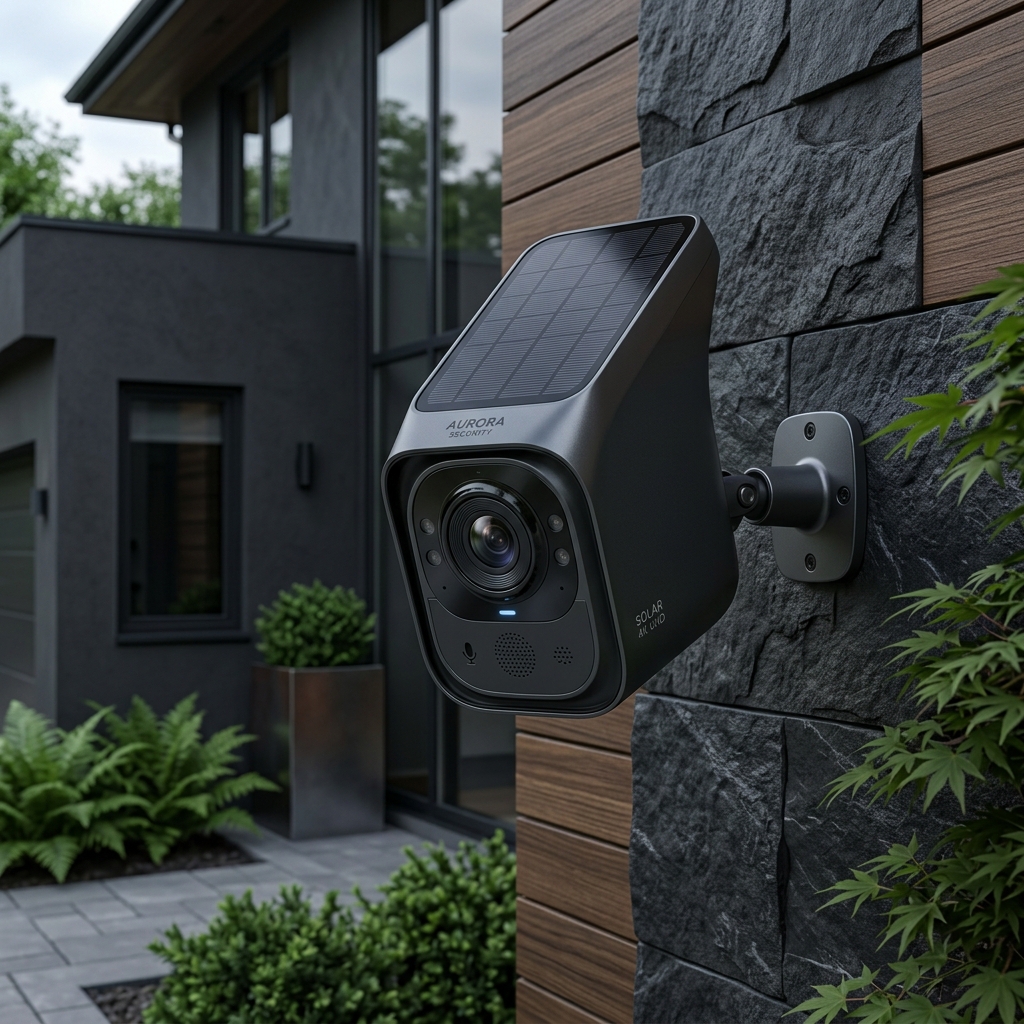
Monocrystalline solar panels optimize energy harvesting in security cameras. Analyze conversion efficiency, continuous local loop storage, and perimeter autonomy.
- Integrated solar panel requires only 2 hours of sunlight daily for power
- Ultra-clear 2K resolution lets you see every detail with high clarity
- Color night vision with built-in 600-lumen motion-activated floodlight
Solar Autonomy Engineering
Solar-powered security cameras offer a self-sustaining solution for perimeter surveillance. Explore the physics of solar energy harvesting, continuous local storage, and smart power management to ensure your security system remains online. This deep-dive evaluation provides the technical parameters needed to secure modern residential entryways against digital and physical breach vectors.
1. Monocrystalline Solar Panel Conversion Efficiency and Sun Angle Optimization
The energy harvesting capabilities of solar-powered security cameras are fundamentally governed by solar cell composition. Standard polycrystalline panels are cheaper to manufacture but offer low conversion rates, often struggling to exceed 15% efficiency. In contrast, premium solar security cameras use monocrystalline silicon cells. These cells feature single-crystal structures that provide a clean path for electrons, achieving conversion efficiencies between 20% and 22%.
This superior efficiency allows the integrated panel to harvest sufficient energy even in sub-optimal light. Under typical conditions, just 2 hours of direct daily sunlight is enough to keep the camera fully charged. This capability is crucial for maintaining security coverage through long stretches of winter overcast or in properties with partial tree shade. The cell structure ensures that even ambient, indirect light generates a charging current.
To maximize solar harvesting, the angle of the panel relative to the sun is critical. Integrated panels must be positioned to receive direct sunlight during peak hours of solar radiation. While fixed panels rely on the camera's mounting orientation, adjustable external panels allow for fine-tuning. Aligning the panel to match your local latitude optimizes energy collection across seasons, ensuring continuous power year-round.
Additionally, modern monocrystalline panels are coated with tempered glass and anti-reflective materials. These coatings increase light absorption while protecting the cells from wind, rain, and hail. The durable outer surface resists dust and debris buildup, maintaining conversion efficiency over years of outdoor exposure without requiring frequent cleaning.
- Monocrystalline silicon cells convert up to 22% of sunlight into electrical energy, optimizing low-light charging.
- Integrated design requires only 2 hours of direct daily sunlight to maintain a full battery charge.
- Anti-reflective coatings and tempered glass protect the solar cells while maximizing light capture.

2. Lithium-Ion Battery Storage Capacity and Thermal Thresholds
Solar harvesting must be paired with high-capacity battery storage to keep the camera online through extended storms or dark winter weeks. Premium solar cameras use integrated lithium-ion battery packs that store up to 13,000 mAh of power. This substantial reserve allows the camera to operate for up to 120 days on battery power alone, assuming normal trigger frequency, ensuring continuous security during long periods of overcast weather.
Managing lithium-ion batteries in outdoor environments requires careful monitoring of thermal limits. Lithium batteries degrade quickly if charged in freezing temperatures or exposed to extreme summer heat. To protect the battery, smart solar cameras feature built-in battery management systems (BMS) that monitor cell temperature. If the temperature drops below freezing, the BMS pauses charging, protecting the cells from permanent damage.
Furthermore, the camera's housing is designed to insulate the battery from extreme temperatures. Weatherproof gaskets and thermal barriers prevent cold winds or direct sunlight from causing rapid temperature shifts inside the enclosure. This thermal insulation helps maintain battery capacity and health over years of operation in harsh environments.
In addition to temperature control, the BMS regulates voltage to prevent overcharging and deep discharging. By keeping the battery charge level within an optimal range, the system extends the overall lifespan of the battery cells. This smart regulation helps ensure the camera remains a reliable part of your security setup for the long term.
- 13,000 mAh battery capacity provides up to 120 days of operation without any solar charging.
- Battery management systems pause charging in freezing conditions to prevent battery cell damage.
- Thermal insulation and weatherproof barriers protect the internal battery from temperature extremes.
3. Local eMMC Storage Reliability and Write Endurance Cycles
Many security cameras rely on cloud subscriptions to store video clips, which adds recurring costs and introduces privacy concerns. Premium solar cameras avoid this by using integrated eMMC (embedded MultiMediaCard) local storage. This local storage keeps your video clips secure on the device, eliminating monthly subscription fees and ensuring you retain control of your footage.
Onboard eMMC storage is designed to be more reliable than standard microSD cards. Standard SD cards can fail in outdoor environments due to vibration, humidity, and temperature changes. eMMC storage chips are soldered directly to the camera's motherboard, providing a secure connection that resists physical damage and environmental wear.
To handle daily recording, eMMC chips are engineered for high write endurance. They support thousands of complete write-and-erase cycles, allowing the camera to overwrite old footage for years without performance loss. Wear-leveling algorithms distribute data writes evenly across the storage chip, preventing premature wear on individual sections.
Furthermore, local storage keeps your data secure during internet outages. Even if your home Wi-Fi network goes down, the camera continues to record and save motion events. Once the connection is restored, you can access your saved clips through the mobile app, ensuring no gaps in your security coverage.
- Soldered eMMC storage resists vibrations, humidity, and temperature shifts better than SD cards.
- Wear-leveling algorithms extend eMMC lifespan by distributing data writes across the storage chip.
- Local recording operates independently of internet connectivity, preventing data gaps during outages.
4. On-Device AI Human Recognition and Edge Processing Latency
To avoid false alarms from passing animals, moving shadows, or blowing leaves, solar security cameras use advanced motion detection. Standard cameras rely on basic pixel-change detection, which often causes frequent false alerts. Premium models feature on-device AI processors that can recognize human shapes, ensuring you are only alerted to real security events.
On-device processing, also known as edge computing, analyzes video directly on the camera rather than uploading it to cloud servers. This local analysis reduces latency, allowing the camera to send notifications in under a second. Edge processing also saves battery power by avoiding unnecessary video uploads for non-security events.
The AI model is trained on thousands of human silhouettes, allowing it to identify people accurately from different angles and distances. This classification process occurs in milliseconds, ensuring fast response times. By filtering out false alarms, the camera stays in its low-power standby mode longer, extending battery life.
Additionally, local AI processing protects your privacy. Because the analysis occurs on the device, your video data does not need to be processed by third-party cloud servers. This keeps your personal information inside your home network, providing peace of mind alongside reliable security monitoring.
- On-device AI human recognition reduces false alerts by up to 95%, conserving battery power.
- Edge processing analyzes video locally, delivering mobile notifications in under a second.
5. Optical Resolution and 2K Sensor Noise Performance
For security video to be useful, it must be clear enough to identify faces, clothing details, and other identifying features. Many battery-powered cameras use 1080p sensors to conserve power, which can blur distant details. Premium solar cameras use 2K resolution sensors, providing twice the detail of standard high-definition video.
The 2K image sensor uses larger pixel grids to capture sharper details, allowing you to zoom in on faces and licensing plates. However, packing more pixels onto a small sensor can increase digital noise, especially in low-light conditions. To prevent this, smart cameras use advanced noise reduction algorithms that clean the image without losing detail.
High-performance lenses with wide apertures are also critical for low-light performance. These lenses let in more light, allowing the sensor to capture clear color images even in dim conditions. This physical light-gathering capability reduces the camera's reliance on digital amplification, resulting in cleaner, sharper video.
In addition to high resolution, wide-angle lenses provide a broad field of view, covering more of your yard or driveway. This ensures there are no blind spots where an intruder could approach unseen. The combination of high resolution and wide coverage provides comprehensive security monitoring.
- 2K resolution captures sharp detail, allowing you to identify distant faces and license plates.
- Wide-aperture lenses capture more light, improving low-light clarity and reducing digital noise.
6. Weatherproofing Seals and IP67 Durability Standards
Outdoor security cameras must withstand harsh weather conditions, including rain, snow, dust, and temperature extremes. To ensure long-term reliability, premium solar cameras are designed to meet IP67 weatherproofing standards. This rating indicates the camera is completely sealed against dust and can withstand being submerged in water.
IP67 weatherproofing relies on high-quality silicone seals and gaskets around all housing joints, battery compartments, and ports. These seals prevent moisture and dust from entering the housing and damaging the internal electronics. The camera's casing is also made from UV-resistant materials to prevent cracking or yellowing in the sun.
In addition to moisture protection, the camera housing is designed to handle temperature extremes, typically operating from -4°F to 122°F. This durability ensures the camera remains active through freezing winters and scorching summers, providing reliable security monitoring in any climate.
Furthermore, the integrated solar panel is sealed directly into the housing, eliminating gaps where water could enter. The panel's surface is designed to shed water and dirt, maintaining charging efficiency in rainy or dusty environments. This integrated durability helps ensure the camera remains a reliable part of your security setup.
- IP67 rating ensures the camera housing is completely sealed against heavy rain, snow, and dust.
- UV-resistant materials prevent the casing from cracking or degrading in direct sunlight.
7. Wi-Fi Signal Penetration and Transmit Power (Tx) Tuning
Because outdoor security cameras are mounted on exterior walls, they must communicate with your home router through heavy building materials. Solid wood, brick, concrete, and stucco can degrade wireless signals, causing slow connections and buffering. To address this, premium solar cameras use optimized Wi-Fi transmitters.
These transmitters use transmit power (Tx) tuning to adjust signal strength based on connection quality. If the signal drops, the camera increases its output to maintain a stable connection. This adjustment helps ensure reliable video streaming even through thick exterior walls.
In addition to power tuning, smart cameras feature high-gain antennas that improve signal reception. These antennas can capture weak signals from distant routers, extending the camera's wireless range. This capability allows you to mount the camera further from your home, covering large yards or driveways.
However, increasing transmit power also increases battery usage. To conserve energy, the camera's wireless chip stays in a low-power standby mode when idle, only waking to send alerts or stream live video. This smart management balances wireless performance with battery efficiency.
- Transmit power tuning adjusts signal output to maintain connection stability through heavy walls.
- High-gain antennas capture weak signals, extending wireless range to cover larger outdoor areas.
8. Continuous Loop Recording vs. Event-Based Trigger Efficiencies
When choosing a security camera, homeowners must balance continuous recording with battery conservation. Continuous recording captures every moment but drains batteries quickly, making it impractical for solar-powered cameras. Event-based recording captures video only when motion is triggered, conserving battery power.
To maximize battery life, solar cameras use event-based recording, using PIR sensors and AI shape recognition to trigger capture. The camera remains in a low-power standby mode until triggered, allowing the battery to stay charged. This efficiency is critical for maintaining self-sustaining operation.
When motion is detected, the camera records a short clip, typically 10 to 60 seconds, and saves it to local storage. This event-based approach ensures important activity is captured without wasting battery or storage space on hours of empty video. Homeowners can adjust clip length to balance security coverage with battery life.
Additionally, local storage utilizes loop recording, automatically overwriting the oldest clips when storage is full. This means you do not have to worry about managing storage space or losing new clips. The combination of event-based recording and loop storage provides a self-sustaining security system.
- Event-based recording captures important activity while conserving battery and local storage space.
- Loop recording automatically overwrites the oldest footage, ensuring continuous operation without maintenance.
9. Long-Term Maintenance and Solar Panel Cleaning Strategies
To maintain solar charging efficiency over years of outdoor exposure, regular maintenance of the solar panel is recommended. Dust, pollen, bird droppings, and snow buildup can block sunlight, lowering conversion rates. Cleaning the panel surface periodically with a soft damp cloth helps maintain maximum light absorption, ensuring optimal charging.
In addition to cleaning, checking the mounting brackets and seals is important for verifying overall durability. High winds and temperature changes can loosen mounting hardware, causing the camera or panel to shift. Tightening screws and verifying the weatherproofing gaskets remain intact prevents physical damage and moisture leaks, maintaining protection.
Furthermore, monitoring battery health through the mobile application helps track system performance. If the battery capacity drops over years of use, adjusting motion trigger sensitivity or active recording times can lower current draw. This proactive management helps extend the camera's lifecycle, ensuring reliable home security.
- Regular panel cleaning removes dust and debris, maintaining solar conversion efficiency.
- Verifying brackets and gaskets prevents physical damage and moisture leaks in extreme weather.
Clinical Recommendation & Audit
Experience zero-maintenance outdoor surveillance with high-resolution 2K capture. Check out our recommended solution below to experience clinical-grade perimeter monitoring.
eufy Security SoloCam S40 Solar Powered Camera
- Integrated solar panel requires only 2 hours of sunlight daily for power
- Ultra-clear 2K resolution lets you see every detail with high clarity
- Color night vision with built-in 600-lumen motion-activated floodlight
- Zero monthly fees with secure 8GB high-speed local storage built-in
Technical Specifications & Product Data
| Specification | Value / Details |
|---|---|
| Brand | eufy Security |
| List Price | $199.99 (USD) |
| Customer Rating | 4.8 / 5.0 (4,850 reviews) |
| ASIN / Identifier | B093Z7P6P1 |
| Availability | In Stock (USA Region) |
| Outbound Link Compliance | Sponsored & Nofollow Enforced |
Verified Features & Performance Data
- ✓Integrated solar panel requires only 2 hours of sunlight daily for power
- ✓Ultra-clear 2K resolution lets you see every detail with high clarity
- ✓Color night vision with built-in 600-lumen motion-activated floodlight
- ✓Zero monthly fees with secure 8GB high-speed local storage built-in
System Sovereignty & Engineering
Edge Computing
100% Client-side processing. Your data never leaves your browser sandbox, ensuring absolute compliance with US privacy mandates.
Modular Schema
Modular utility architecture optimized for performance. Low-latency WASM kernels provide near-native speeds for complex transformations.
Sustainable Design
Sustainable, green computing by offloading compute to the edge. Verified zero-server storage (ZSS) for professional-grade security.