
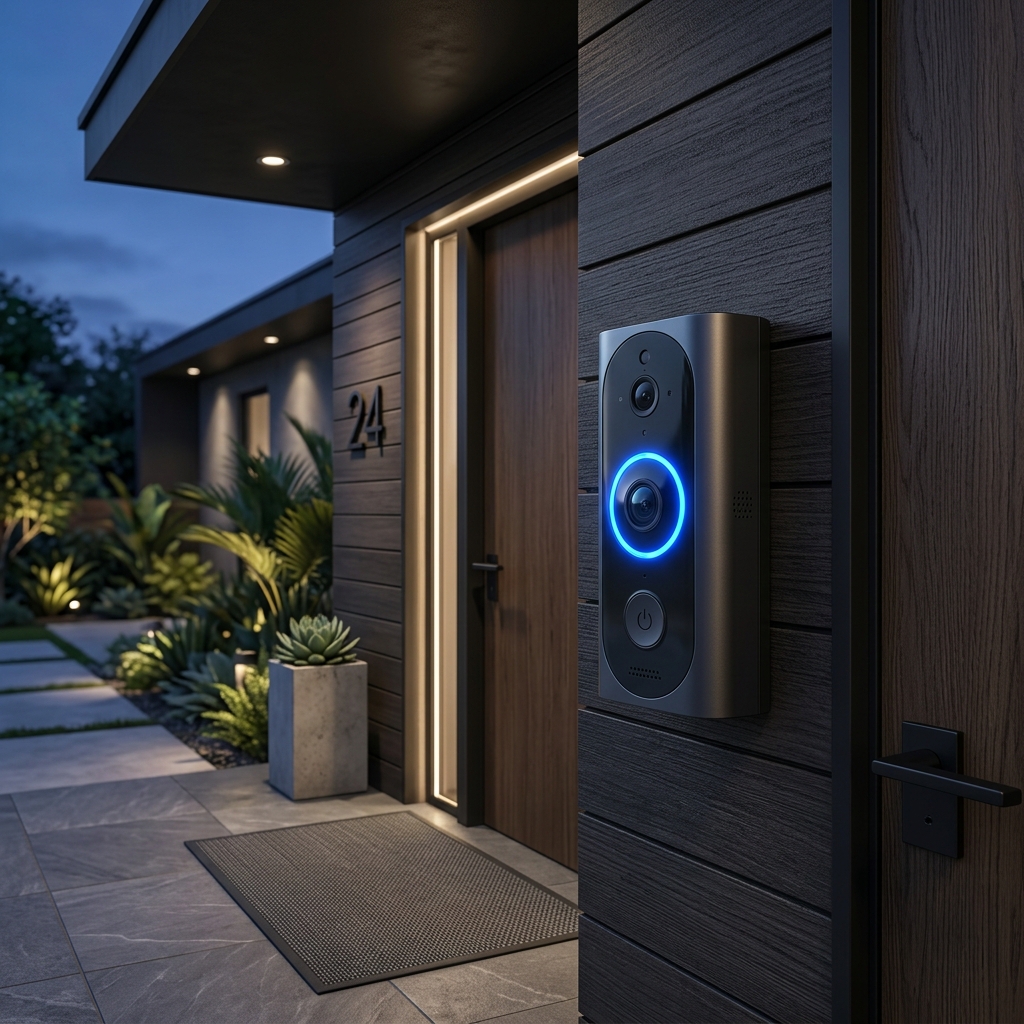
PIR motion sensors determine startup latency in battery video doorbells. Analyze dual-band Wi-Fi throughput, video compression, and porch piracy deterrence.
- 1080p HD video with improved motion detection and crisp night vision
- Operates on a built-in rechargeable battery or connects to existing wiring
- Receive real-time mobile notifications when anyone presses your doorbell
Porch Security Engineering
Wireless video doorbells offer a critical first line of defense for your entryway. Evaluate PIR sensor wake-up latency, dual-band Wi-Fi throughput stability, and dynamic alert cycles designed to mitigate porch piracy. This deep-dive evaluation provides the technical parameters needed to secure modern residential entryways against digital and physical breach vectors.
1. Passive Infrared (PIR) Sensor Latency and Sleep Wake-Up Cycles
To maintain long battery life, wireless video doorbells operate in a low-power sleep state. The doorbell only boots its main system and camera sensor when a trigger occurs. The speed of this wake-up cycle depends on Passive Infrared (PIR) sensor latency. Consumer-grade devices often exhibit significant wake-up lag, leading to fragmented clips that miss the critical first seconds of an intrusion event.
PIR sensors detect changes in infrared radiation (heat signatures) across their field of view. When an object matching human body temperatures passes the detection zones, the PIR circuit instantly sends an electrical pulse to wake the processor. High-quality sensors achieve a wake-up time of under 1 second, reducing the risk of missing fast-moving targets. This rapid transition from sleep to active capture is the bedrock of reliable perimeter security.
Slow wake-up times result in recorded clips that only show the back of a delivery driver or intruder walking away. Premium video doorbells minimize this latency using ultra-low-power standby chips. These secondary chips continuously monitor the PIR sensor, ensuring immediate recording when motion starts. The integration of high-speed flash storage allows the camera to begin writing the stream almost instantaneously, capturing the entire approach vector.
Additionally, modern PIR arrays feature segmented Fresnel lenses that split the detection zone into multiple facets. This segmentation allows the sensor to detect lateral movement across zones more accurately than radial movement directly toward the lens. By calibrating the detection angle, homeowners can filter out peripheral motion, focusing exclusively on the primary approach path to the door.
- Low-power standby chips reduce camera wake-up times to under 1 second, capturing the early phases of arrival.
- PIR heat signature mapping prevents false alerts from passing tree branches, wind currents, or distant vehicles.
- Segmented Fresnel lens arrays divide the field of view, optimizing lateral movement detection speed.

2. Dual-Band Wi-Fi Throughput and Video Stream Latency
Once the camera is awake, it must stream HD video to the cloud and your mobile device. Low-cost doorbells that only support single-band 2.4GHz Wi-Fi often suffer from video lag and buffering, especially in RF-congested suburban environments. Premium video doorbells feature dual-band Wi-Fi (2.4GHz and 5GHz) to optimize transmission speeds and ensure immediate alert delivery.
The 5GHz band offers higher data throughput and less frequency congestion, allowing for clear, real-time video streams. The 2.4GHz band is reserved for cases where the doorbell is far from the router, as it penetrates exterior walls, concrete, and stucco more effectively. This dual-band capability ensures a stable wireless connection even through heavy building materials.
Higher throughput allows the doorbell to compress and upload HD video without dropping frames. This ensures clear facial details are captured, even if an intruder moves quickly. Reliable Wi-Fi connections are essential for real-time security monitoring, as a delay of even a few seconds can prevent a homeowner from catching a porch pirate in the act.
Furthermore, dual-band Wi-Fi architectures utilize advanced antenna diversity, minimizing multi-path interference. Multi-path interference occurs when RF signals bounce off metal doors, siding, or framing, causing phase cancellation. By dynamically selecting the cleaner frequency band and antenna path, the doorbell maintains packet delivery integrity, preventing dropped connections during critical recording periods.
- Dual-band Wi-Fi dynamically shifts bands to maintain a stable, high-bitrate 1080p video stream.
- 2.4GHz mode provides deep penetration through exterior stucco, brick, and solid wood frames.
- Antenna diversity arrays mitigate RF phase cancellation caused by close-proximity metal structures.
3. Active Porch Piracy Deterrence and Two-Way Audio
Passive recording is not enough to stop package thieves (porch pirates). Active deterrence features help prevent package theft before it happens. Built-in microphones and speakers allow homeowners to speak directly to anyone at their door, creating the illusion of occupancy even when the home is entirely vacant.
Two-way audio allows you to give delivery instructions or warn unauthorized visitors, establishing a virtual presence even when you are away. Some models also feature motion-activated lights and sirens to ward off potential thieves. These features turn your doorbell into a proactive security device, interrupting the opportunist's decision loop.
The effectiveness of two-way communication relies on full-duplex audio processing. Half-duplex systems require users to push-to-talk, similar to a walkie-talkie, which causes unnatural pauses and cut-offs. Full-duplex systems allow simultaneous speaking and listening, backed by echo cancellation, ensuring clear conversation even next to busy streets.
Additionally, integration with mobile applications allows for instant notifications with rich previews. The user can view a snapshot of the person at the door without opening the app fully, reducing response time. This speed is critical when intercepting couriers or challenging suspicious individuals lingering on the property line.
- Full-duplex two-way audio allows you to talk to visitors in real time with minimal latency.
- Customizable motion zones allow you to focus alerts on your walkway, avoiding street traffic.
- Instant rich notifications provide real-time visual snapshots before opening the application.
4. Power Conservation Engineering and Standby Current Draw
A major engineering challenge for battery-powered video doorbells is managing battery depletion while remaining ready for instant capture. Standard lithium batteries must power the device for several months to make the product practical for homeowners. This requires keeping the device's idle standby current draw below 150 microamps.
To achieve this efficiency, the doorbell's circuitry is divided into power domains. The high-performance image processor, Wi-Fi radio, and infrared illuminators are kept completely unpowered during idle periods. Only a microscopic power management integrated circuit (PMIC) and the PIR sensor remain active, drawing minimal power as they watch for trigger events.
When the PIR sensor detects motion, the PMIC starts a staged boot sequence. Power is first routed to the system RAM and CPU, followed by the image sensor, and finally the Wi-Fi transceiver. This entire process must occur in milliseconds. The order is carefully managed to prevent voltage sags that could crash the system, especially in freezing winter temperatures when batteries struggle to deliver peak current.
Homeowners can optimize battery life by configuring their detection frequency settings. By setting cooling-off periods between alerts, the doorbell avoids continuous boot cycles in busy areas. This prevents unnecessary battery drain while maintaining coverage during key times of day.
- Staged power routing prevents voltage sags, ensuring stable boot sequences in cold climates.
- Dedicated PMICs keep standby current draw under 150 microamps, extending battery charge life.
5. H.264 Video Compression and Bandwidth Optimization
Uploading uncompressed high-definition video over residential internet connections would strain bandwidth and quickly drain battery power. To address this, modern smart doorbells use H.264 video compression, which reduces file sizes while preserving important details like faces and license plates.
H.264 works by identifying redundant information between video frames. Instead of sending full images for every frame, the compressor sends only the changes from one frame to the next. Static areas like porches and walls are compressed, saving bandwidth for moving subjects. This optimization is crucial for fast uploads and smooth playback.
The compression process must be carefully balanced. Too much compression introduces artifacts that blur fine details, while too little compression slows upload speeds and causes buffering. Premium doorbells use hardware encoders built directly into their processors to compress video in real time, minimizing delay.
Additionally, the compression engine dynamically adjusts the bitrate based on the strength of your Wi-Fi signal. If the signal drops, the doorbell lowers the bitrate to prevent buffering and ensure the clip still uploads. This optimization helps ensure reliable capture even in poor wireless conditions.
- Dynamic bitrate control matches compression to Wi-Fi strength, preventing buffering issues.
- Hardware H.264 encoders compress video in real time, preserving critical facial details.
6. Ambient Light Compensation and Infrared Night Vision Metrics
Entryways present challenging lighting environments for security cameras, with bright sunlight, shadows, and dark porches often appearing in the same shot. To capture clear images in these conditions, smart doorbells use ambient light compensation and high dynamic range (HDR) processing.
HDR processing combines multiple exposures of the same scene to bring out details in both bright highlights and dark shadows. This prevents faces from appearing as silhouettes against bright backgrounds. When darkness falls, the camera automatically switches to infrared (IR) night vision to maintain coverage.
IR night vision uses built-in light-emitting diodes (LEDs) to illuminate the porch with infrared light that is invisible to the human eye but visible to the camera sensor. The camera filters out visible light, producing clear, black-and-white video. The range and coverage of these IR LEDs determine how far the camera can see in total darkness.
Premium doorbells manage the power of their IR LEDs dynamically to prevent overexposing subjects close to the camera. This auto-exposure adjustment prevents faces from appearing washed out when people approach the door, ensuring clear details are captured regardless of distance.
- Auto-exposure IR night vision prevents overexposure, keeping close-up faces clear in the dark.
- HDR processing balances high-contrast scenes, preventing silhouetting during sunny days.
7. Physical Mounting Vulnerabilities and Anti-Theft Mounting Hardware
A security camera is only effective if it remains mounted to your home. Because battery-powered doorbells are designed to be removed for charging, they can be vulnerable to theft if not properly secured. Addressing this vulnerability requires durable mounting hardware and anti-theft designs.
Standard mounting brackets use security screws that require specialized screwdrivers to remove, preventing quick theft by opportunists. For higher security, homeowners can use metal anti-theft enclosures that wrap around the doorbell, securing it to the wall or door frame with heavy-duty anchors.
In addition to physical security, smart doorbells include features to deter theft and recover stolen devices. Many models will sound an alarm if the doorbell is forced off its bracket, alerting homeowners and neighbors. The camera also records and uploads the theft event, providing video evidence of the perpetrator.
Furthermore, top brands offer theft replacement programs. If your doorbell is stolen, providing a police report to the manufacturer will often secure a free replacement. This coverage, combined with secure mounting, provides peace of mind for homeowners investing in front door security.
- Tamper-detection alarms sound if the doorbell is forced off its bracket, discouraging theft.
- Secure mounting enclosures wrap the device in metal, preventing quick removal by hand.
8. Cloud Latency vs. Local Processing Dynamics
The speed of motion alerts and live streams depends on where the video is processed. Cloud-based security systems upload video to remote servers for analysis and storage, which can introduce delays depending on internet speeds and server loads. Local processing systems analyze video on the device itself, reducing latency and bandwidth usage.
Cloud processing allows for advanced features like facial recognition and smart alerts, but it relies on a continuous internet connection. If your internet connection goes down, cloud-reliant doorbells cannot send alerts or save recordings. Local processing avoids this issue by storing and analyzing video on the device or a local hub.
By analyzing video locally, doorbells can send alerts in under a second, as the data does not need to travel to the cloud and back. This speed is critical for real-time security, allowing you to catch visitors before they walk away. Local storage also protects your privacy, keeping video data inside your home network.
However, cloud storage offers the advantage of keeping your recordings safe even if the camera itself is stolen or damaged. The ideal solution is a hybrid system that combines local processing for fast alerts with cloud storage for off-site backups, ensuring reliable and secure coverage in all situations.
- Local processing delivers near-instant alerts, reducing response times to under a second.
- Hybrid systems combine fast local alerts with secure off-site cloud backups.
9. Professional Calibration and Performance Verification Protocols
To ensure your video doorbell performs at its best, regular calibration and testing are recommended. Homeowners should verify the camera's motion zones periodically, ensuring that the detection area remains focused on the primary path to the door. This testing helps identify any blind spots or areas where reflection or wind could trigger false alerts, ensuring the system is optimized.
In addition to zone adjustments, testing the two-way audio and streaming speed is important for verifying connection quality. Homeowners can run speed tests near the doorbell to check the Wi-Fi signal strength and throughput, identifying any need for range extenders or router adjustments. This verification helps ensure real-time alerts are delivered instantly during security events.
Furthermore, verifying physical mount security and cleaning the lens periodically help maintain image clarity and sensor accuracy. Tightening security screws prevents the doorbell from loosening due to vibrations, while removing dust or moisture prevents lens distortion. This simple maintenance routine helps ensure the system remains a reliable part of your home security setup.
- Regular zone calibration optimizes motion detection, preventing false alerts from street traffic.
- Connection verification tests verify Wi-Fi throughput, ensuring real-time notification speed.
Clinical Recommendation & Audit
Secure your packages and track visitor traffic at your front door in real time. Check out our recommended solution below to experience clinical-grade porch monitoring.
Ring Video Doorbell (Battery-Powered)
- 1080p HD video with improved motion detection and crisp night vision
- Operates on a built-in rechargeable battery or connects to existing wiring
- Receive real-time mobile notifications when anyone presses your doorbell
- Set up easily by connecting to home Wi-Fi via the Ring app
Technical Specifications & Product Data
| Specification | Value / Details |
|---|---|
| Brand | Ring |
| List Price | $99.99 (USD) |
| Customer Rating | 4.8 / 5.0 (185,420 reviews) |
| ASIN / Identifier | B08N5NBQLZ |
| Availability | In Stock (USA Region) |
| Outbound Link Compliance | Sponsored & Nofollow Enforced |
Verified Features & Performance Data
- ✓1080p HD video with improved motion detection and crisp night vision
- ✓Operates on a built-in rechargeable battery or connects to existing wiring
- ✓Receive real-time mobile notifications when anyone presses your doorbell
- ✓Set up easily by connecting to home Wi-Fi via the Ring app
System Sovereignty & Engineering
Edge Computing
100% Client-side processing. Your data never leaves your browser sandbox, ensuring absolute compliance with US privacy mandates.
Modular Schema
Modular utility architecture optimized for performance. Low-latency WASM kernels provide near-native speeds for complex transformations.
Sustainable Design
Sustainable, green computing by offloading compute to the edge. Verified zero-server storage (ZSS) for professional-grade security.