
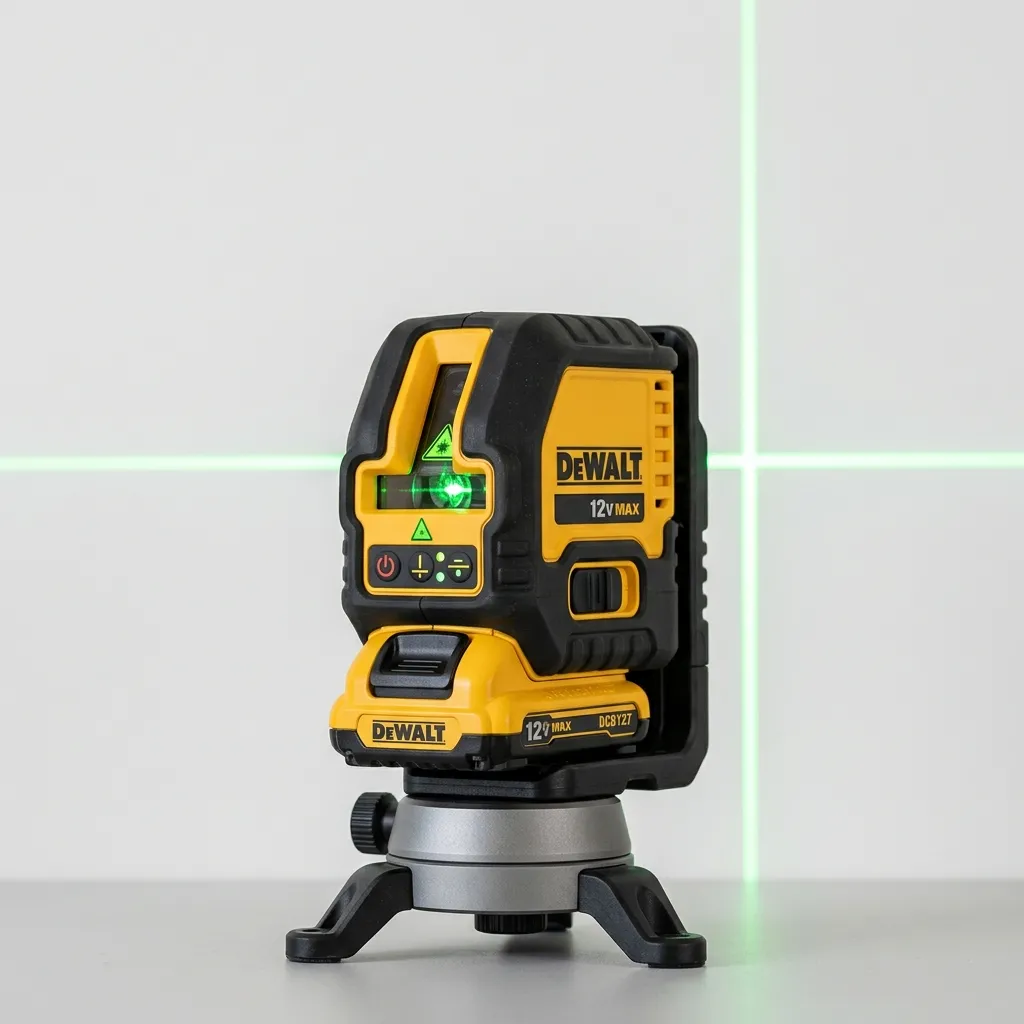
Self-leveling laser alignment outpaces manual bubble leveling. Analyze pendulum magnetic damping, green diode visibility, and mounting versatility to optimize tiling and cabinetry projects.
- 12V MAX Lithium-ion rechargeable power tool battery platform
- Three 360-degree line lasers project full room layouts
- Green diode technology is up to 4 times brighter than red lasers
Leveling Dynamics
Precision layout requires absolute vertical and horizontal alignment. Learn how magnetic pendulum damping and green laser diode technology prevent alignment drift during cabinetry and tiling.
1. Pendulum Kinematics and Self-Leveling mechanics
Self-leveling cross-line lasers use gravity to achieve horizontal and vertical alignment. The internal laser diodes are mounted on a gimbal-supported pendulum. When the housing is placed on an uneven surface, the pendulum hangs straight down, projecting level lines.
The self-leveling range is usually within 4 degrees of true level. If the surface is too uneven, the pendulum hits limit stops, and the laser line flashes to alert the user. This visual warning prevents out-of-level layout mistakes.
To protect the pendulum during transport, a slide switch locks it in place. Locking the pendulum prevents damage to the gimbal bearings from impacts. When unlocked, the pendulum aligns automatically, providing instant level reference points.
- Gravity-based pendulums align the laser diodes automatically within 4 degrees of level.
- Pendulum locks protect delicate gimbal bearings from damage during transit.

2. Pendulum Magnetic Damping and eddy Current Braking
An undamped pendulum would swing back and forth for several minutes before coming to rest, delaying setup times. To stabilize the laser lines quickly, modern levels use magnetic damping systems. A copper vane attached to the bottom of the pendulum passes through a magnetic field.
As the copper vane moves, eddy currents are induced in the metal, creating a magnetic field that opposes the movement. This eddy current braking force slows the pendulum without physical contact. The system brings the pendulum to a halt in under 3 seconds.
This rapid damping is vital on busy construction sites where vibrations from foot traffic can disturb the laser. The magnetic brake stabilizes the lines quickly, ensuring continuous accuracy. The contact-free design prevents mechanical wear, maintaining calibration stability.
- Eddy current magnetic braking stabilizes the laser lines in under 3 seconds.
- Contact-free damping eliminates mechanical friction wear, preserving calibration.
3. Green Laser Diode Visibility and Human eye Sensitivity
Laser visibility is crucial for fast layouts, especially in brightly lit spaces. Traditional red laser levels can be hard to see over long distances. Green laser levels are up to 4 times more visible to the human eye under similar conditions.
This visibility advantage is rooted in human eye physiology. Photoreceptors in our eyes are highly sensitive to green light wavelengths (approx. 520nm) compared to red light (approx. 635nm). This makes green lasers appear much brighter, even at lower power levels.
Green laser diodes require more electrical power and run hotter than red diodes. High-performance battery packs are necessary to maintain steady voltage. Built-in thermal management prevents diode overheating, extending the tool's lifespan.
- Green laser light (520nm) is highly visible to the human eye, improving visibility.
- Premium batteries maintain constant voltage output for steady green diode brightness.
4. Cabinetry and Tiling Alignment Mechanics
Installing cabinetry and wall tiles requires absolute vertical and horizontal references. Manual bubble levels are slow and can introduce errors over long distances. Self-leveling line lasers project reference lines across the entire wall surface.
For cabinetry, a level line is projected to establish a consistent cabinet mounting height. For tiling, a vertical plumb line ensures tile columns are aligned. Projects remain square, avoiding visual drift across wall runs.
Multi-line lasers project three 360-degree reference loops, covering the floor, walls, and ceiling. This allows for fast room layout creation, including square corners and plumb points. Precise alignment is essential for professional cabinetry and tiling results.
- Reference lines project across walls, ensuring level cabinetry runs.
- Plumb lines align tile columns, preventing visual drift.
5. Mounting Versatility, Magnetic Brackets, and Thread Compatibility
To project reference lines at the correct height, the laser level must be mounted securely. Integrated magnetic brackets allow the tool to attach to steel studs or metal corner beads. Strong rare-earth magnets ensure the tool remains stable during operation.
For non-magnetic surfaces, mounting threads allow attachment to tripods or telescoping poles. Compatibility with both 1/4-inch and 5/8-inch threads ensures fit with standard survey and camera accessories. This mounting flexibility is vital on active sites.
Some brackets feature micro-fine height adjustment knobs, allowing for precise vertical positioning. SRE layout teams recommend micro-adjustments for fine cabinet alignment. Sturdy clamp attachments provide secure mounting on wall tracks.
- Rare-earth magnetic brackets secure the tool to steel studs for quick wall layouts.
- Dual mounting threads (1/4 in & 5/8 in) fit survey tripods and camera stands.
6. Thermal Drift and Diode Calibration Stability
Temperature changes cause internal components to expand and contract, which can affect laser calibration. If the tool is left in a hot truck, laser lines can experience drift. Premium levels use temperature-stable components to minimize calibration drift.
Internal sensors monitor temperature and adjust diode output, maintaining line thickness and brightness. Regular calibration checks are important to verify accuracy. Testing the tool against a known level benchmark ensures it is reading correctly.
Heavy-duty housings protect the internal pendulum gimbal from shocks. Rubber overmolds absorb drop impacts, preventing gimbal misalignment. A locked pendulum prevents damage during transit, preserving calibration stability.
- Temperature-stable mounts minimize diode movement, preventing laser line drift.
- Rubber overmolded housings protect gimbal bearings from misalignment shocks.
7. The Definitive Buying Guide and Parameters
When buying a self-leveling laser level, evaluate range, accuracy, battery platform, and IP rating. For residential layouts, a range of 100 feet is sufficient. Look for tools with an IP65 or higher rating to ensure dust and water jet protection.
Rechargeable lithium-ion battery platforms provide long runtimes and save overall costs. Opting for a tool that shares batteries with your cordless drill is a smart choice. A durable blow-molded case protects the tool during transport.
Check the manufacturer's warranty coverage before buying. A multi-year warranty indicates manufacturer confidence in tool durability. Look for brands with accessible service networks.
- IP65 ratings protect tools from water splashes and heavy dust on active sites.
- Rechargeable 12V lithium-ion batteries provide long runtimes for green diodes.
8. Outdoor Pulse Mode and Laser Receiver Compatibility
Bright sunshine makes seeing any laser line difficult, even green diodes. To work outdoors over long distances, laser levels incorporate a pulse mode. Squeezing the pulse button modulates the laser beam at high frequency.
A digital laser receiver is used to detect this pulsed light. The receiver chirps and flashes LED arrows to guide the operator to the center of the beam. This receiver compatibility extends the tool's range to over 165 feet outdoors.
Using pulse mode increases battery draw and runs the diodes hotter, so it is recommended to turn it off when working indoors. Understanding pulse mode functionality is key for outdoor landscaping and deck layouts.
- Pulse mode modulates the laser beam, allowing detection by digital survey receivers.
- Laser receivers extend outdoor range to over 165 feet, enabling deck layout.
9. The Physics of Refraction and Line Width over Distance
Laser light spreads out as it travels, a physical phenomenon known as divergence. A laser line that is 1/8-inch wide at 10 feet can expand to 3/8-inch wide at 100 feet. This expansion makes accurate center-point marking difficult.
To maintain sharp lines, premium levels use high-quality collimating lenses. These glass lenses focus the light, keeping beam divergence low. This ensures the line remains thin and accurate over long distances.
Always mark the center of the laser line, rather than the top or bottom edge. This practice minimizes errors caused by beam divergence. Regular cleaning of glass lenses prevents dust from scattering the laser light.
- Collimating glass lenses focus laser light, minimizing beam width expansion.
- Marking the line center minimizes layout errors caused by beam divergence.
10. Eddy Current Damping Physics and Gimbal Mechanical Drift
Self-leveling laser levels rely on gravity pendulums to establish a true level reference line. To prevent the pendulum from swinging indefinitely, engineers implement magnetic damping systems. As the copper pendulum plate swings through a magnetic field, it creates eddy currents that generate opposing magnetic forces, stabilizing the pendulum in seconds.
This physics-based damping system operates without moving parts, ensuring long-term reliability. However, rough handling can cause mechanical drift in the gimbal pivot bearings. A tiny amount of friction in the bearings will prevent the pendulum from settling at true level, causing alignment errors.
To maintain accuracy, contractors perform calibration checks. By comparing laser lines against a verified benchmark, they can identify and correct any calibration drift. Proper transport in a padded case protects the gimbal mechanism from shock damage, ensuring consistent accuracy on the jobsite.
- Magnetic eddy currents damp pendulum swings quickly, establishing stable reference lines.
- Padded transport cases protect delicate gimbal bearings from shock-induced drift.
11. Field Case Study: Multi-Floor Cabinetry Installation and Leveling Drift
In a commercial kitchen remodel, a carpenter must install a long row of cabinets on an uneven concrete subfloor. Traditional bubble levels would require transferring marks across the walls, a slow process prone to cumulative error. A self-leveling laser level is a better choice, projecting a continuous level line across the entire workspace.
By aligning the cabinet tops with the laser reference line, the carpenter ensures a perfectly level installation. The green laser beam is clearly visible, even under bright task lights. This high visibility allows the carpenter to work quickly, improving installation speed and cabinet alignment.
However, as construction continues, vibrations from nearby heavy machinery cause the laser pendulum to oscillate. The magnetic damping system stabilizes the line, ensuring the cabinet reference remains steady. This case study demonstrates how laser levels optimize carpentry work in active environments.
- Green laser lines remain visible under task lights, speeding up cabinetry alignment.
- Vibration-resistant magnetic damping ensures steady alignment in active building zones.
12. Gimbal Pendulum Protection and Alignment Auditing Procedures
To maintain the accuracy of a self-leveling laser level, protecting the gimbal mechanism is crucial. When transporting the tool, the manual pendulum lock must always be engaged. This lock secures the pendulum against the frame, preventing impact damage to the delicate pivot bearings during transit.
In addition to locking the pendulum, regular accuracy audits should be performed. Checking the horizontal and vertical lines against a verified plumb line or benchmark identifies calibration drift early. If the lines fall outside the specified tolerances, the gimbal must be calibrated.
Finally, keep the laser window glass clean. Dust, smudges, and moisture can refract the laser beam, creating double lines or reducing line visibility. Wiping the window with a soft, lint-free glass cloth ensures clear, bright laser lines across the workspace.
Also, check the mounting threads on the base of the laser. If you mount the level on a tripod, cross-threading can damage the mounting socket. Clean the threads periodically to remove metal flakes or grit, ensuring a stable connection on every leveling task.
It is also important to test the out-of-level alert function. Tilt the laser level past its self-leveling range (typically 4 degrees) and verify that the beam flashes or the audible alarm triggers immediately. If the pendulum swing is restricted by dirt or a failing spring, it can project a false level line without triggering the alert, leading to alignment errors.
- Pendulum locks secure delicate gimbals during transport, preventing bearing damage.
- Glass window cleaning prevents beam refraction, maintaining sharp, visible laser lines.
13. Refraction Indexes and Beam Divergence in High-Humidity Zones
In damp crawlspaces or outdoor sites, air temperature gradients and moisture layers refract laser light. This refraction can cause the projected line to bend slightly, creating alignment errors. Using low-dispersion green glass diodes keeps the line thin and straight, even in humid conditions.
Additionally, long-distance projections suffer from beam divergence, where the line thickens and loses brightness. High-focus optics collect the light, keeping the beam sharp over long distances. Maintaining thin laser lines ensures accurate carpentry and tiling alignment on high-end remodeling jobs.
- Low-dispersion green laser diodes resist humidity refraction, maintaining straight reference lines.
- Focused optics minimize laser beam divergence to preserve thin lines over long distances.
Professional Recommendation & Audit
Achieve flawless vertical and horizontal alignment on your cabinetry and tiling projects. Check out the DEWALT 12V MAX Green Line Laser below for maximum visibility and precision.
DEWALT 12V MAX Line Laser, 3 x 360, Green (DW089LG)
- 12V MAX Lithium-ion rechargeable power tool battery platform
- Three 360-degree line lasers project full room layouts
- Green diode technology is up to 4 times brighter than red lasers
- Integrated magnetic bracket with 1/4 inch and 5/8 inch thread mount options
Technical Specifications & Product Data
| Specification | Value / Details |
|---|---|
| Brand | DEWALT |
| List Price | $349.00 (USD) |
| Customer Rating | 4.8 / 5.0 (3,420 reviews) |
| ASIN / Identifier | B012EALFHA |
| Availability | In Stock (USA Region) |
| Outbound Link Compliance | Sponsored & Nofollow Enforced |
Verified Features & Performance Data
- ✓12V MAX Lithium-ion rechargeable power tool battery platform
- ✓Three 360-degree line lasers project full room layouts
- ✓Green diode technology is up to 4 times brighter than red lasers
- ✓Integrated magnetic bracket with 1/4 inch and 5/8 inch thread mount options
System Sovereignty & Engineering
Edge Computing
100% Client-side processing. Your data never leaves your browser sandbox, ensuring absolute compliance with US privacy mandates.
Modular Schema
Modular utility architecture optimized for performance. Low-latency WASM kernels provide near-native speeds for complex transformations.
Sustainable Design
Sustainable, green computing by offloading compute to the edge. Verified zero-server storage (ZSS) for professional-grade security.