
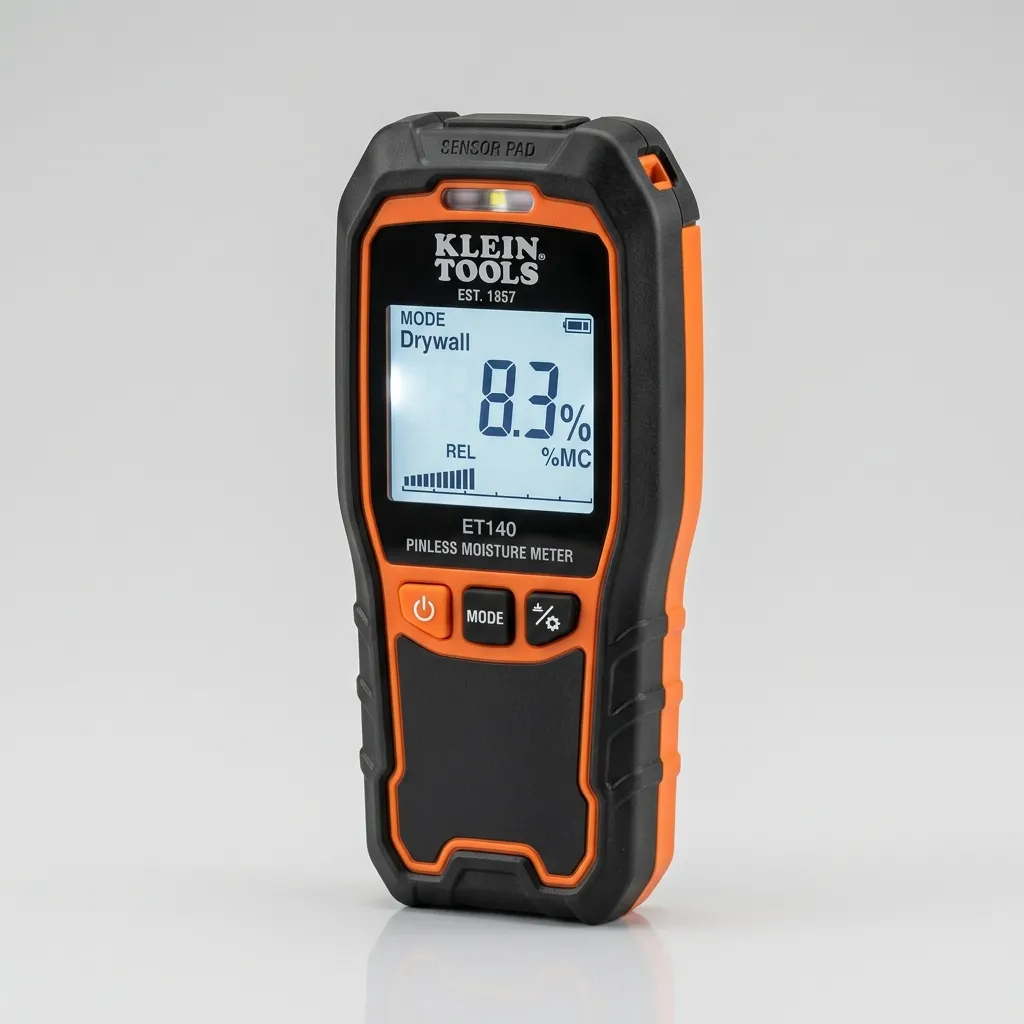
Pinless electromagnetic scanning outpaces manual pin probing. Analyze sensor depth limits, calibration parameters, and moisture density metrics to prevent wood and drywall rot.
- Pinless electromagnetic sensor design detects moisture up to 3/4 inch deep
- Easy-to-read bright LED bar graph indicators and reverse-contrast display
- Selectable modes for drywall, masonry, hardwood, and softwood
Dielectric Monitoring
Structural inspection requires non-destructive moisture monitoring. Learn how electromagnetic field scanning and density calibration identify hidden moisture to prevent drywall rot.
1. High-Frequency Electromagnetic Fields and Dielectric constants
Pinless moisture meters use high-frequency electromagnetic signals to scan substrates. The sensor pad emits an electric field into the material, creating a capacitive circuit. The tool measures the material's dielectric constant, which is heavily influenced by water content.
Water has a very high dielectric constant (approx. 80) compared to dry wood (approx. 2 to 5) or drywall. Therefore, even small amounts of moisture create a measurable change in the dielectric constant. The onboard processor converts this capacitance shift into a relative moisture percentage.
The advantage of electromagnetic scanning is its non-destructive nature. Unlike pin meters, which leave holes in the surface, pinless meters slide smoothly over drywall or finished wood. This allows for fast scanning of large areas without causing damage.
- Electromagnetic sensors detect moisture without leaving marks or pinholes in finished surfaces.
- High sensitivity to water's dielectric properties allows for early detection of hidden leaks.

2. Sensor Scanning Depth and Substrate Thickness
The depth to which a pinless meter can scan depends on sensor design and field strength. Most consumer-grade pinless meters scan to a depth of roughly 3/4 inch. This depth is optimized for typical drywall thickness and wood framing members.
However, if the material is thinner than 3/4 inch, the electromagnetic field will pass through it, scanning whatever is behind. For example, scanning 1/2-inch drywall on wood studs can return high readings if the studs are wet, even if the drywall is dry. Users must consider substrate thickness when interpreting readings.
To prevent back-side interference, some advanced meters allow users to select scanning depths. This ensures the field does not penetrate beyond the target material, improving accuracy. Understanding the sensor's depth profile is critical for reliable inspections.
- A 3/4-inch scanning depth detects moisture hidden behind drywall and wall coverings.
- Awareness of scanning depth prevents false readings caused by wet studs or back-fill.
3. Material Density Calibration and Substrate Modes
Different construction materials have distinct physical densities, which affect their dielectric constant. For example, dense hardwood has a higher baseline constant than softwood, even when both are dry. To ensure accurate readings, moisture meters must be calibrated for specific materials.
High-end meters feature selectable material modes, adjusting calibration curves for drywall, masonry, softwood, and hardwood. Selecting the correct mode ensures the onboard processor uses the proper density values. This calibration prevents false positive readings in dense substrates.
Using the wrong mode can lead to inaccurate measurements. For instance, scanning softwood in hardwood mode will return artificially low moisture values. Taking time to select the correct material setting is crucial for accurate inspections.
- Selectable material settings calibrate the sensor for drywall, masonry, and wood.
- Proper density adjustments prevent false moisture readings in dense hardwoods.
4. Structural wood and Drywall Rot Prevention
Persistent moisture in walls provides a breeding ground for wood-decaying fungi and mold. If left unchecked, this moisture leads to structural wood rot, compromising the building's integrity. Drywall also loses structural strength when wet, turning soft and crumbly.
Using a moisture meter to scan walls allows home inspectors to identify leaks before visible mold appears. Early detection is key to preventing expensive remediation. Finding a leak behind a shower wall can save thousands in repair costs.
Drywood moisture content should remain below 15% to prevent fungal growth. Drywall readings should be close to zero, or within the 'dry' green zone on the meter's scale. Keeping building materials dry prevents rot and mold growth.
- Regular scanning detects leaks early, preventing structural rot and mold buildup.
- Maintaining wood moisture levels below 15% prevents fungal decay.
5. Temperature Compensation and Calibration Stability
Substrate temperature affects material density and dielectric constants, which can introduce errors in moisture readings. In cold basements or hot attics, the actual moisture content can vary from the raw reading. High-end meters feature built-in temperature compensation.
The tool measures ambient temperature and adjusts the calibration curve, ensuring stable readings. Calibration blocks are also helpful for verifying accuracy on site. Testing the tool against a known reference block ensures it is reading correctly.
Keeping the sensor pad clean is vital for calibration stability. Dust, oil, or drywall residue on the pad can block the electric field, introducing measurement errors. Regular cleaning with a damp cloth maintains performance.
- Built-in temperature compensation maintains accuracy across extreme hot and cold zones.
- Calibration check blocks confirm sensor accuracy before starting critical scans.
6. Display Interface and Reverse-Contrast Readout Visibility
Dark basements and unlit crawlspaces make reading standard LCD screens difficult. Moisture meters with reverse-contrast displays feature bright white or color digits on a dark background, ensuring readability. This layout is highly visible in dark environments.
LED bar graphs also help improve visibility on site. Color-coded lights (e.g., green for dry, yellow for damp, red for wet) provide a clear visual indicator of moisture levels. This allows for fast scanning without needing to read exact digits.
High-contrast screens are readable in bright sunlight, preventing glare. Durable housings with rubber bumper frames protect tools from drops. An ergonomic shape allows for comfortable scanning of large areas.
- Reverse-contrast displays ensure reading visibility in unlit basement framing.
- Color-coded LED indicators provide quick visual feedback during scans.
7. The Definitive Buying Guide and Parameters
When buying a pinless moisture meter, evaluate sensor depth, calibration settings, and durability. For drywall and framing, a 3/4-inch depth is recommended. Look for models with a drop-resistant housing to handle worksite falls.
A clear, easy-to-read screen with backlit features is a must-have for dark areas. Sturdy carry pouches protect the sensor pad from damage during storage. Check the warranty terms before purchasing.
Opting for a brand with an established customer support network ensures easy access to advice. A comprehensive multi-year warranty secures your investment, providing peace of mind.
- Drop-resistant designs protect tools from impact damage on active worksites.
- Selectable substrate modes optimize calibration for accurate drywall scans.
8. Wet vs. Dry Benchmarks and Threshold Limits
Understanding wet and dry benchmarks is vital for interpreting moisture meter readings. Dry wood framing should display moisture levels under 12% to 15%. Anything over 19% is considered wet, indicating a high risk of fungal decay.
For drywall, dry readings should remain under 0.5% or within the 'dry' green zone. Readings above 1% indicate dampness that requires immediate drying. Visual indicators on the display help simplify evaluation.
Always establish a baseline reading on a known dry section of the wall before scanning the target area. This baseline helps confirm the tool is reading correctly. Keeping a record of readings is helpful for tracking drying progress.
- Dry wood framing should register moisture levels under 15% to prevent decay.
- Drywall moisture content exceeding 1% indicates hidden water leaks.
9. The Physics of Material Permeability and Moisture Migration
Moisture moves through building materials based on permeability and humidity gradients. Wet framing wood transfers moisture to surrounding drywall, creating damp patches. Identifying these migration paths is key to finding the leak source.
High-permeability materials allow water vapor to pass through quickly, while low-permeability materials trap moisture. Trapped moisture leads to wood rot, compromising structural joints. Scanning both sides of a wall helps map migration paths.
Understanding migration physics allows inspectors to track water movement behind finished walls. By following moisture gradients, users can trace the water back to its entry point. This precise mapping ensures thorough repairs, preventing recurring rot.
- High material permeability allows water to migrate from framing to drywall.
- Tracking moisture gradients helps pinpoint the leak source behind finished walls.
10. Dielectric Constant Analysis and High-Frequency RF Signal Penetration
Pinless moisture meters operate using electromagnetic waves to scan the substrate. The sensor sends a high-frequency RF signal into the material, creating an electromagnetic field. By measuring the capacitance of this field, the meter calculates the material's dielectric constant, which varies based on moisture content.
Water has a high dielectric constant (approx. 80 at room temp) compared to dry wood (between 2 and 5). Consequently, even small amounts of water cause a measurable increase in the overall dielectric constant. The meter's microchip translates this capacitance change into a relative moisture percentage.
The depth of the RF field determines the scanning depth, which is typically up to 3/4 inch. If the substrate is thinner than this depth, the sensor may capture readings from the air or backing materials. Understanding these physical limits prevents false positives when scanning thin drywall or plywood paneling.
- RF capacitance sensors measure dielectric changes to calculate relative moisture content.
- A 3/4-inch penetration depth allows scanning behind drywall without surface damage.
11. Field Case Study: Mold Remediation and Post-Flood Structural Wood Auditing
In a post-flood restoration project, a home inspector is auditing structural framing studs for moisture damage. Water has receded, and the drywall surface appears dry, but hidden framing lumber may still contain high moisture levels. A pinless moisture meter allows the inspector to scan the walls quickly, mapping the damp zones.
The inspector scans the bottom plate of the walls, discovering a localized pocket of high moisture. This finding indicates that water has traveled behind the drywall, saturating the wood. By identifying this hidden dampness, the contractor can remove the dryrot sections before mold spores begin to colonize.
Pinless scanning preserves the integrity of the drywall, avoiding unsightly holes. The inspection data helps document the drying progress, providing verification for insurance claims. This case study demonstrates how non-destructive moisture testing saves repair costs and protects indoor air quality.
- Non-destructive moisture scanning maps damp studs behind finished drywall.
- Moisture mapping documents drying progress to support insurance verification claims.
12. Sensor Protection and Reference Calibration Routines for Moisture Meters
To ensure consistent readings, the sensor plate on a pinless moisture meter must be kept clean. Gypsum dust and surface dirt can form a layer over the sensing area, interfering with electromagnetic field propagation. Wiping the sensor plate with a damp cloth after use keeps it clear of contaminants.
Inspectors also use calibration verification blocks to confirm the meter's baseline readings. These blocks provide a stable reference material with a known density and moisture profile. Comparing readings against this block verifies that the internal calibration remains accurate.
Additionally, protecting the tool from mechanical shocks preserves the integrity of its electronic components. Dropping the meter can damage the internal RF oscillator, leading to inaccurate readings. Storing the meter in a padded carrying case protects it from jobsite impacts.
Inspectors should also be aware that thick layers of vinyl wallpaper or oil-based paints can act as moisture barriers, trapping humidity underneath. Scanning from the reverse side of the wall or using pin electrodes (if equipped) helps verify readings in these areas. Storing the meter at stable room temperatures prevents component calibration drift.
When assessing structural timber in unconditioned crawlspaces, let the moisture meter acclimatize to the ambient air temperature and humidity for ten minutes before starting measurements. Rapid changes in relative humidity can cause condensation on the internal circuit boards, distorting the capacitance readings. Performing scans with a stable tool ensures reliable records.
- Wiping the scanning plate prevents dust buildup from blocking electromagnetic fields.
- Padded storage cases protect high-frequency RF oscillators from drop-induced shock.
13. Dielectric Drift and Substrate Density Compensation
Different wood species, from lightweight soft pine to dense structural oak, exhibit varying baseline dielectric properties. If the inspector fails to adjust the meter's density settings, the calculated moisture percentage will be inaccurate. Calibrating the meter to match the specific substrate density prevents measurement errors.
Additionally, ambient air humidity can cause moisture condensation on the substrate surface, creating false surface readings. Wiping the surface dry and letting the tool adjust to local humidity levels improves reading accuracy. This calibration step is critical for auditing structural integrity in damp environments.
- Density calibration tables match sensor capacitance to specific wood species profiles.
- Acclimatizing tools to local humidity prevents surface condensation from corrupting data.
Professional Recommendation & Audit
Protect your home from hidden water damage with our recommended scanning tool. Check out the Klein Tools ET140 Pinless Moisture Meter below to scan for moisture behind drywall and framing.
Klein Tools ET140 Pinless Moisture Meter
- Pinless electromagnetic sensor design detects moisture up to 3/4 inch deep
- Easy-to-read bright LED bar graph indicators and reverse-contrast display
- Selectable modes for drywall, masonry, hardwood, and softwood
- Rugged, drop-resistant design withstands up to a 6.6-foot fall
Technical Specifications & Product Data
| Specification | Value / Details |
|---|---|
| Brand | Klein Tools |
| List Price | $47.50 (USD) |
| Customer Rating | 4.6 / 5.0 (5,230 reviews) |
| ASIN / Identifier | B07S1V7FGD |
| Availability | In Stock (USA Region) |
| Outbound Link Compliance | Sponsored & Nofollow Enforced |
Verified Features & Performance Data
- ✓Pinless electromagnetic sensor design detects moisture up to 3/4 inch deep
- ✓Easy-to-read bright LED bar graph indicators and reverse-contrast display
- ✓Selectable modes for drywall, masonry, hardwood, and softwood
- ✓Rugged, drop-resistant design withstands up to a 6.6-foot fall
System Sovereignty & Engineering
Edge Computing
100% Client-side processing. Your data never leaves your browser sandbox, ensuring absolute compliance with US privacy mandates.
Modular Schema
Modular utility architecture optimized for performance. Low-latency WASM kernels provide near-native speeds for complex transformations.
Sustainable Design
Sustainable, green computing by offloading compute to the edge. Verified zero-server storage (ZSS) for professional-grade security.