
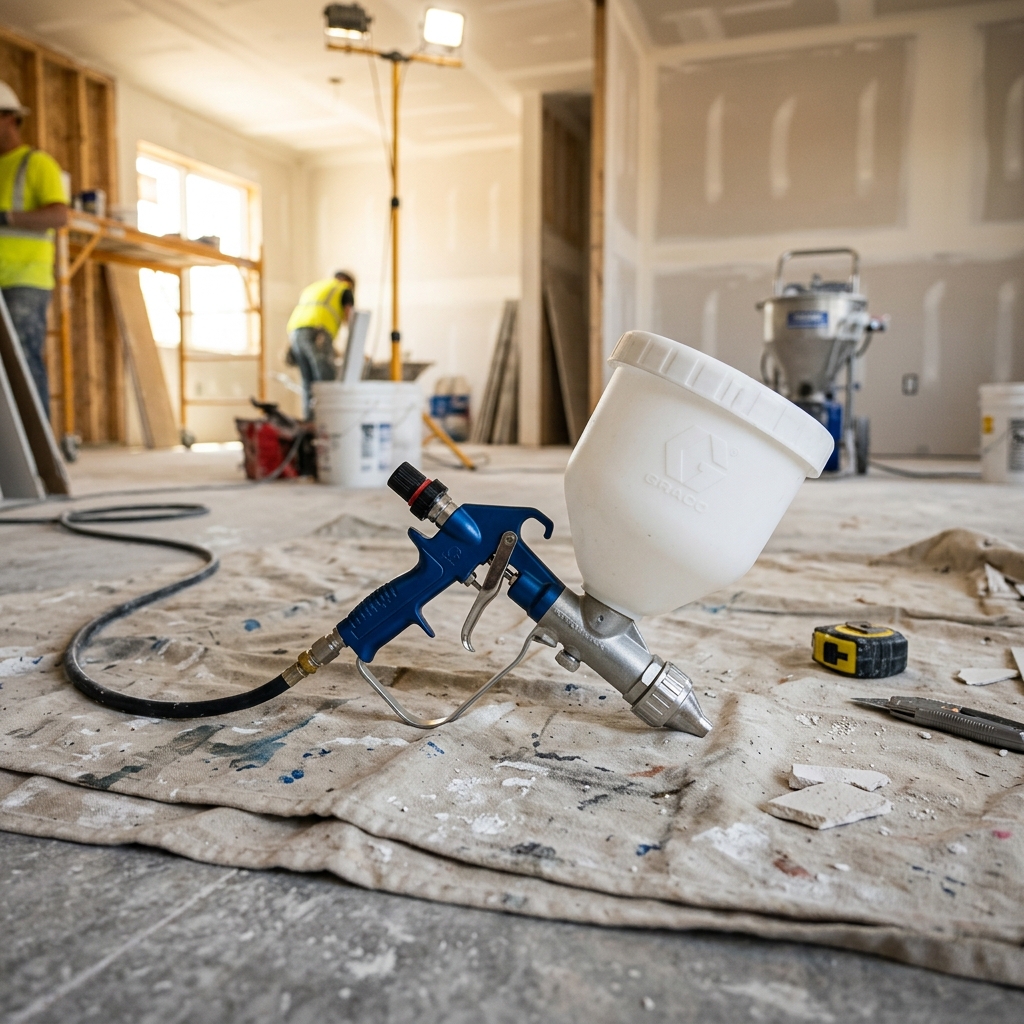
Pneumatic fluid orifice atomization determines drywall texture quality. Analyze hopper gravity feed uniformity, viscosity behavior, and orifice sizes for knockdown textures.
- Heavy-duty plastic hopper with 1.3-gallon capacity and built-in handle
- Includes 3 solid brass nozzles: 3/16 inch, 1/4 inch, and 5/16 inch
- Trigger control handles let you regulate spray volume and pattern
Pneumatic Spraying & Blending
Drywall texture hopper guns allow rapid application of orange peel and knockdown finishes. Explore how pneumatic atomization and gravity feed dynamics optimize wall blending.
1. The Physics of Pneumatic Fluid Orifice Atomization
Applying drywall texture requires breaking up thick joint compound into small, discrete droplets. In a pneumatic hopper gun, compressed air is injected into the fluid stream as it exits the nozzle orifice. This high-velocity air shears the mud, causing it to atomize into droplets. This shearing action must be carefully controlled to produce a uniform pattern across large surface areas.
The size of the atomized droplets depends on the air pressure, air volume, and nozzle orifice diameter. Higher air pressures break the mud into finer droplets, producing a light orange peel texture. Lower air pressures result in larger droplets, ideal for knockdown or splatter finishes. Maintaining steady air pressure is critical for avoiding pattern variations across the wall.
Additionally, nozzle concentricity is critical for a uniform spray pattern. Off-center nozzles cause the spray to drift, resulting in heavy patches on one side. Precision-machined brass nozzles maintain perfect alignment, ensuring even texture distribution. This concentricity prevents high-pressure air from venting asymmetrically around the fluid stream.
If the air nozzle is misaligned, the air jet will strike the mud stream off-center, causing sputtering. This sputtering creates uneven clumping on the wall, ruining the orange peel finish and requiring scraping and re-spraying. Concentric alignments are crucial for high-quality drywall blending and patch repair work on high-end jobs.
By managing air-to-mud ratios, painters control the texture density. Fine air adjustments allow you to match the original texture of existing walls during repair. This accuracy is essential for patching drywall seamlessly, ensuring that repair patches are invisible after painting. The atomization physics must be adjusted dynamically as the ambient temperature changes the mud's behavior.
- Compressed air shearing atomizes thick drywall mud, creating consistent droplets for blending.
- Precision brass nozzles resist abrasion, maintaining uniform spray patterns over thousands of square feet.
- Concentric air nozzles prevent fluid sputtering, ensuring uniform droplet size distribution.
2. Hopper Gravity Feed Uniformity and Viscosity Behavior
Gravity-fed hopper guns rely on the weight of the mud to feed it down into the gun chamber. If the mud is too thick, it will bridge across the hopper neck, stopping the flow. This causes the gun to sputter and spray dry patches on the wall, leading to uneven texture patterns. The hopper's shape must feature steep internal angles to prevent mud from sticking to the sides.
To ensure smooth flow, joint compound must be mixed with water to the correct viscosity. The mud should flow like thick pancake batter, allowing gravity to feed it consistently. A smooth, sloped hopper walls reduce friction, preventing mud buildup and allowing the operator to use every drop of mixed compound without dry pockets.
Furthermore, larger hopper capacities (typically 1.3 gallons) reduce the frequency of refills, allowing for continuous spraying across larger ceiling areas. Built-in handles on the hopper allow the operator to support the weight with both hands, improving control and reducing back strain. This additional support is essential when carrying the full weight of wet plaster.
If the mud viscosity is too low, the sprayed droplets will flatten and run down the wall, losing their texture and creating drips. Viscosity must be measured using a flow cup or by checking the mud consistency manually with a mixing paddle. Correct mixing is the key to repeatable patterns, and operators must keep batches consistent.
By utilizing high-density polyethylene plastics, hoppers resist deformation under the weight of the mud. The smooth interior surfaces are easy to wash, preventing dried crusts from peeling off and clogging the nozzle. Clean hoppers ensure reliable gravity feed and prevent dried bits from contaminating fresh texture batches.
- High-density polyethylene hoppers resist mechanical impact, maintaining structural rigidity.
- 1.3-gallon capacities balance material volume with operator load limits to prevent fatigue.
- Steep hopper angles prevent joint compound bridging, keeping the fluid feed consistent.
3. Solid Brass Nozzle Wear Dynamics and Orifice Calibrations
Drywall joint compound contains abrasive materials like calcium carbonate, gypsum, and silica. As this mixture is forced through the nozzle orifice, it acts like liquid sandpaper. Brass nozzles offer superior wear resistance compared to plastic or aluminum, maintaining their orifice diameter over hundreds of use cycles.
Choosing the correct nozzle size (e.g., 3/16 inch, 1/4 inch, or 5/16 inch) is critical for matching the desired texture. Smaller nozzles are used for fine orange peel textures, while larger nozzles are necessary for heavy knockdown splatter. The solid brass construction prevents the orifice from expanding under continuous pressure, ensuring pattern consistency.
If the nozzle material is too soft, the orifice will enlarge, causing the spray pattern to become fuzzy and lose definition. This wear forces the operator to increase air pressure, which can cause overspray and waste material. Solid brass threads also resist stripping when changing nozzles, keeping the assembly tight.
Regularly inspecting the nozzle tip for burs or nicks is essential. Any damage to the inner edge of the orifice will disrupt the air-mud boundary layer, causing the spray to pull to one side. Storing nozzles in a clean, dry container protects the precision-ground brass edges from impact damage when not in use.
- Solid brass construction resists abrasion from calcium carbonate and gypsum muds.
- Three solid nozzle sizes (3/16", 1/4", 5/16") support multiple drywall texture styles.
4. Air Compressor Requirements, CFM Delivery, and Pressure Regulation
Pneumatic texture guns require a continuous supply of compressed air to maintain atomization. The compressor must deliver sufficient cubic feet per minute (CFM) at the required pressure (typically 7 CFM at 25 PSI). If the compressor's output is too low, the pressure will drop during long runs, causing the spray pattern to degrade.
Using a dedicated air regulator at the gun handle allows the operator to fine-tune the pressure without walking back to the compressor. This localized control is critical when matching textures, as minor pressure adjustments can significantly alter droplet size. Clear pressure gauges help maintain consistent settings.
Additionally, air hoses must have a wide internal diameter (typically 3/8 inch) to prevent airflow restriction. Narrow hoses cause a significant pressure drop over long runs, reducing the CFM delivered to the gun. Keeping the air supply clean and free of water or oil prevents mud contamination and keeps the spray clean.
Using inline moisture filters is highly recommended. Water in the air line can dilute the joint compound at the nozzle, leading to runny spots and texture failures on the wall. Ensuring that the compressor tank is drained regularly prevents moisture build-up and keeps the air clean.
- 7 CFM at 25 PSI compressor capabilities prevent pattern degradation during long runs.
- Inline moisture filters prevent water contamination, preserving joint compound viscosity.
5. Drywall Finishing Techniques: Mastering Knockdown and Orange Peel Blending
Mastering texture application requires precise control over gun movement and distance. The gun should be held parallel to the wall at a distance of 12 to 18 inches. Moving the gun in a circular or overlapping pattern prevents heavy build-up and ensures even texture coverage, producing a professional finish.
To execute a knockdown texture, the mud splatter is allowed to dry slightly (typically 10 to 20 minutes) until it loses its wet sheen. A wide, flexible knockdown knife is then dragged lightly across the surface, flattening the tops of the droplets. The angle of the knife must be kept shallow to prevent scraping the mud off.
Orange peel textures require higher air pressure and smaller nozzle sizes to produce fine, rounded droplets that mimic the skin of an orange. This texture is ideal for hiding minor drywall defects and is widely used in residential construction. Matching the texture of existing walls requires test-spraying on scrap cardboard before committing to the wall.
When repairing patches, feathering the edges of the spray pattern is critical. Overlapping the new texture onto the existing wall at a reduced density helps blend the repair. Keeping the gun moving smoothly prevents distinct line transitions, ensuring the patch is invisible after painting.
- Holding the gun 12 to 18 inches away prevents mud piling, ensuring uniform droplet distribution.
- Shallow knife angles during knockdown passes prevent gouging the semi-dry mud.
6. Cleaning Protocols, Preventive Maintenance, and Storage Optimization
Joint compound is highly water-soluble when wet, but it becomes extremely difficult to remove once cured. Cleaning the hopper gun immediately after use is critical. Flushing the gun chamber and hopper with clean water removes all mud residues, preventing dried crusts from forming and clogging the nozzle during future projects.
Disassembling the trigger valve assembly and air nozzle allows for thorough cleaning of the internal paths. Applying a thin coat of light machine oil to the trigger pivot and needle shaft prevents rust and ensures smooth mechanical action. Storing the gun in a dry, dust-free environment protects the components from corrosion.
Additionally, brass nozzles should be cleaned with a soft wire brush to remove mud build-up from the threads and orifice. Avoid using steel tools to scrape the nozzles, as this can scratch the brass and distort the spray pattern. Keeping the air port on the gun body clear of dried mud preserves the airflow, ensuring reliable atomization.
Checking the seals and O-rings for wear prevents air and fluid leaks. Worn seals allow compressed air to bypass the valve, reducing the atomization pressure at the nozzle. Replacing worn O-rings promptly keeps the assembly airtight, ensuring consistent performance throughout the tool's life.
- Immediate water flushing prevents joint compound curing, keeping internal paths clear.
- Light machine oil on trigger needle shafts prevents valve sticking and corrosion.
7. Material Rheology: Non-Newtonian Behavior of Joint Compounds
Drywall joint compounds exhibit shear-thinning (pseudoplastic) rheological behavior. When at rest inside the hopper, the mud behaves as a highly viscous fluid, resisting flow and maintaining its shape. However, when subjected to the high shear forces of the trigger valve and compressed air jet, its viscosity drops dramatically, allowing it to flow and atomize easily.
This non-Newtonian behavior is critical for achieving a clean spray pattern. The compound must be formulated to thin under shear, yet recover its viscosity quickly once it hits the drywall. If the viscosity recovery is too slow, the texture will sag and run, flattening out before it can cure. If the recovery is too fast, the splatter will form sharp, jagged peaks that are difficult to knock down.
Managing this behavior requires adjusting the water content and mixing time. Excessive mixing can break down the polymer binders in the mud, reducing its shear-thinning capability and leading to clogged nozzles. Proper mixing technique preserves the material's rheology, ensuring smooth gravity feed and consistent atomization throughout the project.
- Shear-thinning dynamics allow high-viscosity muds to atomize cleanly under air pressure.
- Viscosity recovery control prevents texture sagging on vertical walls and ceilings.
8. The Definitive Texture Hopper Gun Buying Parameters
Selecting a texture hopper gun requires reviewing nozzle configuration, hopper design, and trigger control. Solid brass nozzles are essential for long-term wear resistance when spraying abrasive joint compounds. Look for guns with steep-walled hoppers made of high-density polyethylene to ensure smooth gravity feed and easy cleanup.
Additionally, assess the CFM and pressure requirements. The hopper gun must be compatible with your air compressor, requiring at least 7 CFM at 25 PSI for continuous spraying. Adjustable trigger limits allow you to lock in the spray volume, ensuring a uniform pattern across the entire jobsite.
Finally, consider handle ergonomics and port placement. Auxiliary handles on the hopper body help support the weight, reducing back fatigue during long ceiling passes. A well-designed pneumatic hopper gun is an essential tool for drywall finishing, providing consistent atomization and clean blending results.
- Brass nozzles resist gypsum abrasion, maintaining precise orifice geometry.
- Adjustable trigger locks ensure uniform droplet volume, preventing pattern drifts.
Professional Recommendation & Audit
For commercial drywall patching and ceiling texture applications, we highly recommend the Hiltex 10105 Pneumatic Air Texture Hopper Gun. Its solid brass nozzles, steep-walled 1.3-gallon hopper, and precise trigger lock system provide consistent atomization and seamless knockdown and orange peel blending.
Hiltex 10105 Pneumatic Air Texture Hopper Gun
- Heavy-duty plastic hopper with 1.3-gallon capacity and built-in handle
- Includes 3 solid brass nozzles: 3/16 inch, 1/4 inch, and 5/16 inch
- Trigger control handles let you regulate spray volume and pattern
- Compatible with most air compressors delivering 7 CFM at 25 PSI
Technical Specifications & Product Data
| Specification | Value / Details |
|---|---|
| Brand | Hiltex |
| List Price | $34.00 (USD) |
| Customer Rating | 4.5 / 5.0 (2,890 reviews) |
| ASIN / Identifier | B0021L95HU |
| Availability | In Stock (USA Region) |
| Outbound Link Compliance | Sponsored & Nofollow Enforced |
Verified Features & Performance Data
- ✓Heavy-duty plastic hopper with 1.3-gallon capacity and built-in handle
- ✓Includes 3 solid brass nozzles: 3/16 inch, 1/4 inch, and 5/16 inch
- ✓Trigger control handles let you regulate spray volume and pattern
- ✓Compatible with most air compressors delivering 7 CFM at 25 PSI
System Sovereignty & Engineering
Edge Computing
100% Client-side processing. Your data never leaves your browser sandbox, ensuring absolute compliance with US privacy mandates.
Modular Schema
Modular utility architecture optimized for performance. Low-latency WASM kernels provide near-native speeds for complex transformations.
Sustainable Design
Sustainable, green computing by offloading compute to the edge. Verified zero-server storage (ZSS) for professional-grade security.