
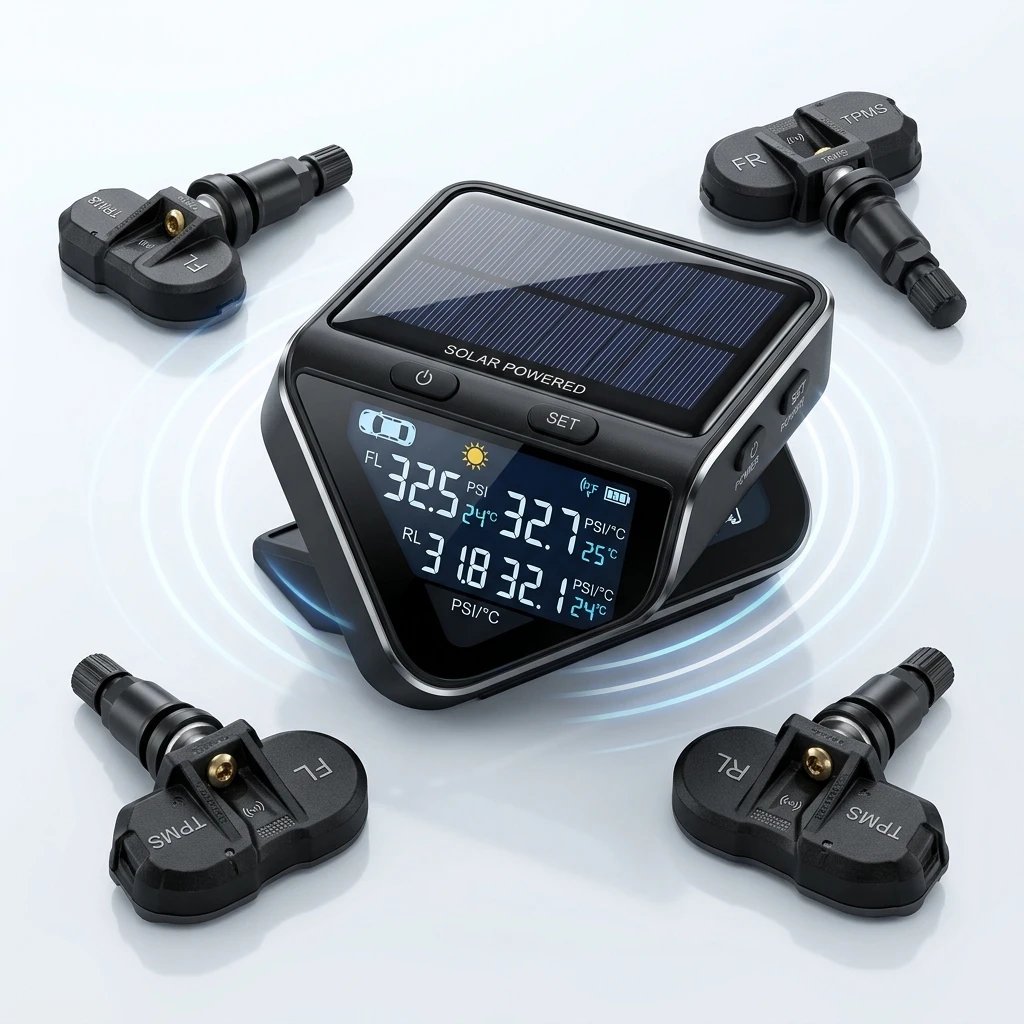
Tire blowouts cause severe highway accidents. Learn the RF sensor transmission latency, solar-panel energy conversion, and pneumatic telemetry that prevent tire failures.
- Dual charging options: solar power panel and USB charging port
- Real-time monitoring of pressure and temperature for all 4 tires simultaneously
- Wireless RF sensors transmit telemetry with high accuracy and low latency
Pneumatic Telemetry Brief
Tire blowouts cause severe highway accidents. Learn the RF sensor transmission latency, solar-panel energy conversion, and pneumatic telemetry that prevent tire failures and maintain fuel economy.
1. RF Transmission Physics: 433.92 MHz Frequency and Sensor Latency
Tire pressure changes can occur slowly over weeks or rapidly within seconds during a puncture. Detecting these changes before a blowout occurs requires a constant telemetry link between the tires and the driver. Wireless TPMS kits achieve this link using radio frequency (RF) signals.
The external tire sensors utilize the 433.92 MHz frequency band to transmit telemetry data. This frequency is standard for low-power consumer electronics, providing excellent signal propagation through vehicle metal and rubber without interference. The signals travel from the wheels to the dashboard receiver.
Sensor latency describes the time delay between a pressure change and its display on the screen. To preserve battery life, sensors do not transmit continuously when the vehicle is stationary. They enter a sleep mode, waking up when internal accelerometers detect wheel rotation.
Once moving, the sensors transmit telemetry updates every 3 to 5 minutes under normal conditions. However, if a sensor detects a pressure drop exceeding 1.5 PSI within 2 seconds, it bypasses the delay and transmits an alert instantly. Latency drops to under 3 seconds, alerting the driver.
Additionally, the RF signals are encoded with unique sensor IDs. This encoding prevents the receiver from picking up data from neighboring vehicles on the highway. You get accurate, dedicated telemetry for all four wheels, ensuring safety.
- 433.92 MHz RF frequency bands ensure reliable signal propagation through tires and steel cabin walls.
- Instant alarm transmission overrides standard delay cycles when pressure drops exceed 1.5 PSI.

2. Solar energy Harvesting: Monocrystalline Panels and Battery Reserves
A dashboard receiver must run continuously during transit to monitor telemetry alerts. Powering the receiver using the car's cigarette lighter creates extra wires, cluttering the dashboard. Upgraded receivers utilize solar energy harvesting to remain self-powered.
The receiver incorporates a monocrystalline silicon solar panel on its top surface. Monocrystalline silicon is composed of a single, continuous crystal lattice, providing the highest light-to-electricity conversion efficiency. The panel converts ambient sunlight into electric current.
The harvested energy is stored in a built-in lithium-ion battery. The battery provides a buffer, powering the receiver during night driving or rainy days. The battery keeps the monitor running, regardless of solar conditions.
Furthermore, the receiver utilizes smart power management. The display enters a low-power standby mode when no cabin vibration is detected for 5 minutes. When the driver opens the door, the vibration wakes the screen, restoring active monitoring.
Additionally, a USB charging port serves as a backup power source. If you park in a dark garage for weeks, you can recharge the battery using a USB cable. You get evergreen power and clean dashboard aesthetics.
- Monocrystalline silicon solar panels harvest ambient light to charge the receiver dynamically.
- Vibration-activated standby modes conserve battery reserves when the vehicle is parked.
3. Pressure Transducer Accuracy: Micro-Electro-Mechanical Systems (MEMS)
To prevent tire wear and maintain optimal fuel economy, pressure measurements must be highly accurate. Tires can lose pressure from temperature changes (1 PSI per 10°F drop) or slow leaks. Measuring these small changes requires sensitive pressure sensors.
Tire sensors utilize MEMS (Micro-Electro-Mechanical Systems) pressure transducers. A MEMS transducer features a tiny silicon diaphragm with embedded piezoresistive elements. When tire pressure compresses the diaphragm, the resistance of the elements shifts.
An internal analog-to-digital converter (ADC) translates this resistance shift into digital pressure values. The MEMS sensor is highly sensitive, delivering accuracy within 1.5 PSI. The receiver displays real-time pressure for all wheels.
Furthermore, the sensor includes a temperature sensor. Tire temperature increases during driving from road friction and braking heat. High temperature raises internal pressure, which must be calibrated to prevent false alerts.
The MEMS chip combines pressure and temperature data, providing a complete view of tire health. The receiver displays both metrics, allowing you to monitor heat and inflation levels during long trips.
- MEMS pressure transducers deliver high-accuracy telemetry, detecting changes within 1.5 PSI.
- Integrated temperature sensors monitor thermal build-up to warn against brake drag or tire overload.
4. Sensor Weight and Wheel Balance Dynamics
Attaching an external sensor to the tire valve stem adds weight to the rotating wheel assembly. At highway speeds, even a small weight imbalance can cause wheel vibrations, affecting comfort and tire wear. Protecting the wheel dynamics requires lightweight sensors.
Premium external sensors weigh less than 10 grams (0.35 ounces) each. This minimal mass has a negligible effect on the wheel's center of gravity. The wheels rotate smoothly at highway speeds, maintaining balance.
However, for high-speed driving (exceeding 90 mph), balancing the wheels after installing the sensors is recommended. A wheel balance check ensures the assembly is balanced, preventing vibration. It keeps your ride comfortable.
Furthermore, the sensor body is shaped to minimize aerodynamic drag. The low-profile shape prevents wind resistance from pulling on the valve stem. This design protects the rubber valve stems from bending under load.
Additionally, the sensors use anti-theft locking nuts. The nut is screwed onto the valve stem before the sensor, then tightened back against it using a custom wrench. This locking mechanism prevents theft and stops the sensor from loosening.
- Lightweight 10-gram sensors minimize rotational mass to preserve wheel balance.
- Anti-theft locking nuts clamp the sensor to the valve stem, preventing loss or loosening.
5. Environmental Protection: IP67 Waterproofing and Dust Ratings
Tire sensors operate in harsh outdoor environments, exposed to rain, puddles, mud, road salt, and snow. They must withstand constant moisture and dirt without experiencing chemical short circuits. Protecting the circuitry requires environmental sealing.
Premium external sensors feature an IP67 environmental protection rating. The "IP" stands for Ingress Protection, while the "6" represents complete protection against dust entry. The "7" indicates waterproofing up to 1 meter depth.
The sensor housing is sealed using a flexible silicone O-ring between the cap and base. As the cap is tightened, the O-ring compresses, creating a water barrier. This barrier protects the battery and transmitter circuitry from moisture.
Furthermore, the copper core connection node is corrosion-resistant. Road salt can corrode aluminum stems, causing them to bond to the sensor threads. The copper core prevents galvanic corrosion, allowing easy removal.
This environmental protection ensures the sensors operate in all weather conditions. Whether driving through deep rain puddles or winter blizzards, the sensors transmit reliable tire telemetry, keeping you safe.
- IP67 ingress protection seals the sensor circuitry against dust, mud, and water puddles.
- Copper thread inserts prevent galvanic corrosion on aluminum valve stems.
6. Smart Alerts: Five Alarm Protocols and Visual Indicators
A TPMS receiver must alert the driver immediately when pressure or temperature limits are crossed. The system should distinguish between a slow leak and a sudden blowout. Managing these alerts requires smart alarm protocols.
The receiver incorporates five alarm modes. The first is the Fast Leak Alarm, which triggers when pressure drops rapidly. The second is the Slow Leak Alarm, which flags gradual pressure drops over days.
The third and fourth are High Pressure and Low Pressure Alarms, which trigger when inflation levels cross pre-set safety thresholds. Low inflation wastes fuel, while high inflation can cause tires to slide or slide.
The fifth is the High Temperature Alarm, which warns when tire temperatures exceed 158°F (70°C). High temperatures can weaken the tire rubber, leading to a blowout. The alarm prompts the driver to pull over and let the tires cool.
When an alarm triggers, the receiver emits a loud buzzer sound while flashing the corresponding tire display on screen. This multi-sensory feedback ensures the driver responds quickly, preventing accidents.
- Five distinct alarm modes flag fast leaks, slow leaks, over-inflation, under-inflation, and high temperature.
- Acoustic buzzers and flashing displays provide clear, immediate feedback under emergency conditions.
7. Centrifugal Force and High-Speed Dynamic Pressure Drops
At high speeds, the rotation of the wheel creates intense centrifugal forces acting on the external sensor. A 10-gram sensor experiences outward force that pulls on the valve stem. Understanding this stress is important for stem integrity.
Centrifugal force increases with the square of the rotational velocity. At 90 mph, the sensor experiences forces exceeding 50 times its resting weight. If the valve stem is made of soft rubber, this force can cause the stem to bend outward.
Bending can wear down the rubber, causing microscopic air leaks at the rim boundary. To prevent this fatigue, premium TPMS kits recommend using metal (brass or aluminum) valve stems instead of rubber. Metal stems resist bending, maintaining stability.
Furthermore, the centrifugal force pushes the internal sensor transducer. The MEMS sensor is designed to resist this force, maintaining calibration up to 120 mph. The pressure reading remains accurate, even during high-speed highway transit.
Additionally, the secure locknut keeps the sensor aligned. If the sensor wobbles, it can stress the valve threads, causing threads to strip. The locknut holds the sensor rigidly, preserving valve system integrity.
- Centrifugal force calculations prompt the use of metal valve stems to prevent high-speed bending.
- Internal MEMS silicon transducers resist centrifugal displacement, maintaining accuracy at high speeds.
8. Temperature-Pressure Correlation: Gay-Lussac's Law Calibration
Tire pressure is not static; it changes constantly with temperature. As the tires roll, friction against the road heats up the air inside, causing the pressure to rise. Understanding this shift requires Gay-Lussac's gas law.
Gay-Lussac's law states that the pressure of a given mass of gas is directly proportional to its absolute temperature, provided the volume remains constant (P1/T1 = P2/T2). In practice, tire pressure rises roughly 1 PSI for every 10°F increase.
During long drives, tire temperatures can rise by 30°F, causing pressure to increase by 3 PSI. This rise is normal and should not trigger low or high-pressure alarms. The TPMS processor must calibrate for this correlation.
The receiver's smart firmware filters out these temperature-induced pressure shifts. The alarms trigger only if pressure shifts exceed the predicted thermal curve. This calibration prevents false alarms, ensuring driver confidence.
Additionally, if the temperature crosses 158°F, the High Temperature Alarm triggers. This warning alerts the driver to a potential brake drag or wheel bearing failure, which can overheat the tire and cause a blowout.
- Gay-Lussac's gas laws govern thermal expansion, causing tire pressure to rise 1 PSI per 10°F increase.
- Smart processor algorithms filter thermal expansion curves to prevent false pressure alerts.
9. Anti-Theft Locknut Mechanics and Valve Stem Fatigue Protection
Because external sensors are visible, they can be targets for theft or vandalism. Additionally, road grit can jam the threads, making battery replacement difficult. Protecting the sensors requires anti-theft locking systems.
The sensor kit includes anti-theft locking nuts and a custom spanner wrench. The nut is screwed onto the valve stem threads first, followed by the sensor. Once the sensor is tight, the nut is screwed back against the sensor base.
This locking action clamps the threads, preventing the sensor from being unscrewed by hand. A thief cannot steal the sensors without the custom wrench, preventing opportunity theft.
Furthermore, the locknut prevents the sensor from loosening under vibration. Road vibration can unscrew standard caps, causing slow leaks. The locknut holds the sensor rigidly, preserving valve sealing.
Additionally, the brass threads are lined with anti-seize compound during assembly. This lining prevents galvanic corrosion between the brass sensor threads and aluminum valve stems, allowing easy removal for tire servicing.
- Anti-theft locknuts lock the sensor to the valve stem threads, stopping hand removal.
- Thread coatings prevent galvanic bonding between brass and aluminum valve stems.
10. Battery Preservation: Sleep-Mode Accelerometers and Power Saving
External TPMS sensors are powered by small lithium coin batteries (CR1632). Because the sensors are sealed, they cannot be recharged, requiring battery replacement when depleted. Extending battery life requires smart power management.
The sensor incorporates a low-power accelerometer chip that detects motion. When the vehicle is parked, the accelerometer detects the absence of vibration, putting the sensor to sleep. The RF transmitter turns off.
This sleep mode reduces current draw to under 0.5 microamps, preserving battery reserves. When the driver starts the vehicle, the accelerometer detects vibration, waking the sensor. The RF transmitter resumes telemetry updates.
The sleep mode extends battery life to over 2 years under normal driving conditions. The coin batteries can be replaced easily by unscrewing the sensor cap. A low-battery indicator on the receiver warns you when a sensor battery is low.
Additionally, the receiver display uses solar panels to charge the battery. Monocrystalline silicon panels harvest light, keeping the display charged. You get evergreen power and a low-maintenance monitoring system.
- Motion-activated accelerometers put sensors to sleep when parked, saving battery power.
- Low-battery indicators on the display alert the driver when CR1632 coin cells need replacement.
11. Definitive Buying Parameters and Selection Guide
When choosing a wireless car TPMS kit, consider sensor accuracy, power sources, and environmental ratings. Ensure the sensors use MEMS transducers with accuracy within 1.5 PSI. Lightweight sensors prevent wheel vibrations.
Look for receivers that combine solar panels with USB ports. This dual-charging system keeps the display powered in all seasons. Ensure the external sensors have an IP67 rating to withstand rain and winter road salt.
In conclusion, a wireless solar TPMS kit is an essential electronic accessory for highway safety. RF telemetry provides constant pressure and temperature updates, while piezoresistive sensors detect leaks early. Install the external sensors to monitor tire safety in real time.
- Select monocrystalline solar displays to ensure evergreen power and clean dashboard layouts.
- Choose systems with sleep mode accelerometers to extend sensor battery life to 2 years.
Premium Telemetry Recommendation
Monitor your tire pressure, tire temperature, and slow leaks under constant solar charging. Check out our recommended wireless TPMS kit below to experience advanced road safety.
Tymate Wireless Solar Powered TPMS Kit with 4 External Sensors
- Dual charging options: solar power panel and USB charging port
- Real-time monitoring of pressure and temperature for all 4 tires simultaneously
- Wireless RF sensors transmit telemetry with high accuracy and low latency
- Five alarm modes warn of fast leak, slow leak, high pressure, high temp, and sensor battery low
Technical Specifications & Product Data
| Specification | Value / Details |
|---|---|
| Brand | Tymate |
| List Price | $49.99 (USD) |
| Customer Rating | 4.3 / 5.0 (12,800 reviews) |
| ASIN / Identifier | B079N5J9B3 |
| Availability | In Stock (USA Region) |
| Outbound Link Compliance | Sponsored & Nofollow Enforced |
Verified Features & Performance Data
- ✓Dual charging options: solar power panel and USB charging port
- ✓Real-time monitoring of pressure and temperature for all 4 tires simultaneously
- ✓Wireless RF sensors transmit telemetry with high accuracy and low latency
- ✓Five alarm modes warn of fast leak, slow leak, high pressure, high temp, and sensor battery low
System Sovereignty & Engineering
Edge Computing
100% Client-side processing. Your data never leaves your browser sandbox, ensuring absolute compliance with US privacy mandates.
Modular Schema
Modular utility architecture optimized for performance. Low-latency WASM kernels provide near-native speeds for complex transformations.
Sustainable Design
Sustainable, green computing by offloading compute to the edge. Verified zero-server storage (ZSS) for professional-grade security.