
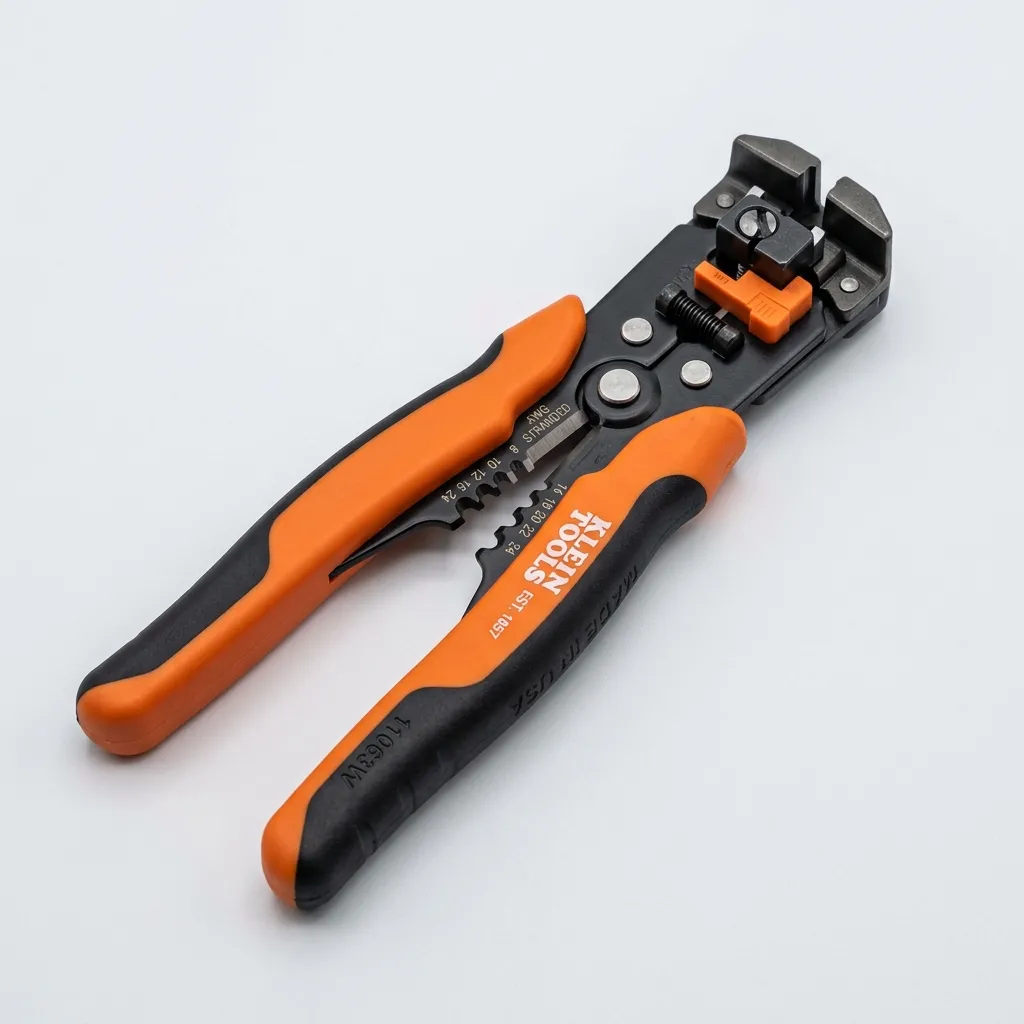
Automatic wire stripping outpaces manual scissor stripping. Analyze self-adjusting jaw tension, clean insulation shear, and ergonomic handle leverage to optimize electrical rewiring.
- Compound action stripping: grips and strips in a single-motion squeezing action
- Precision-machined stripping holes easily remove insulation without damaging wire
- Removes up to 1 inch of insulation layer in a single step
Mechanical Leverage
Residential electrical layout demands fast, safe wire stripping. Learn how self-adjusting jaw tension and precision blade geometry speed up panel termination and protect copper cores.
1. Squeezing Mechanics and Compound-Action Stripping
Traditional wire strippers require manual adjustments and leverage to strip wire. This process is slow and can nick the copper core if not done correctly. Automatic wire strippers use compound-action mechanisms to grip and strip wire in a single squeeze.
Squeezing the handles activates the gripping jaws first, holding the wire firmly. As you continue to squeeze, the cutting blades engage to shear the insulation. Finally, the jaws separate, pulling the insulation sheath cleanly off the wire end.
This compound action reduces hand movement and speeds up stripping. Squeezing forces are multiplied by internal link arms, allowing for effortless stripping of thick insulation. SRE electrical teams recommend automatic strippers to prevent user fatigue on high-volume wiring jobs.
- Compound-action mechanisms grip and strip wire in a single-motion squeeze, saving time.
- Internal link arms multiply hand force, making stripping thick wire insulation effortless.

2. Self-Adjusting Jaw Tension and Insulation Thickness
Wire insulation thickness varies by wire type and gauge. THHN wire features thin, slick nylon skins, while Romex sheath is thick and rubbery. Automatic wire strippers incorporate self-adjusting jaw tension to accommodate different wire types.
The self-adjusting tensioner regulates clamping force automatically. Squeezing the handle applies the correct pressure, preventing the jaws from crushing the wire or slipping on the insulation. This automatic adjustment prevents copper damage during stripping.
For tough insulation, some models feature manual tension adjustment knobs. Squeezing forces can be increased for stiff outer sheaths or decreased for delicate silicone wire. This flexibility ensures clean stripping across all wire types.
- Self-adjusting jaw tension adapts to different wire diameters, preventing copper crushing.
- Tension adjustment knobs allow customizing clamping forces for tough outer sheaths.
3. Blade Geometry and Precision Core Protection
Stripping wire insulation must never damage the internal copper core. Even tiny nicks in the metal can create high-resistance hot spots, increasing fire risks. To prevent this, automatic wire strippers use precision-ground steel blades.
Blade holes are machined to match specific wire diameters, ensuring the blades cut only the insulation. Squeezing the handles closes the blades around the wire, shearing the insulation skin while leaving the copper core untouched.
High-carbon steel blades resist wear, maintaining sharpness over thousands of cuts. Precision alignment of blade holders prevents lateral movement, ensuring clean strips. Regular inspection of blades for nicks is important to prevent wire damage.
- Precision-ground blade profiles match wire diameters, protecting copper cores from damage.
- High-carbon steel construction maintains blade sharpness, preventing insulation tearing.
4. Clean Sheath Shear and Insulation Pull-Off
Slicing through insulation requires a clean cut around the entire wire circumference. Ragged cuts or torn insulation look unprofessional and make inserting wires into terminals difficult. Premium automatic wire strippers deliver a clean sheath shear.
Squeezing the handles closes the blades, slicing the insulation cleanly. The pulling jaws then separate, sliding the insulation cap off the wire end. This clean pull-off leaves the copper strands straight and neatly grouped.
For multi-conductor cables like Romex, some models feature built-in sheath cutters. Squeezing the handles slices the outer jacket, allowing for easy removal without damaging internal wires. This dual-function design saves time during residential rough-in work.
- Squeezing mechanics deliver clean circum-ferential cuts, preventing ragged insulation edges.
- Built-in sheath cutters slice Romex jackets safely, avoiding internal wire damage.
5. Ergonomics, Grip Comfort, and Squeezing Effort
High-volume wiring tasks require repetitive squeezing, which can cause hand fatigue. Ergonomic handle design is vital for reducing strain. Curved handles distribute pressure evenly across the palm, preventing sore spots.
Rubberized overmolds provide a secure grip, preventing the tool from slipping. Dual-material handles combine rigid cores for strength with soft outers for comfort. Tension-loaded grips automatically open the tool, reducing muscle effort.
Reducing required grip force improves accuracy. Electricians can place the wire precisely in the jaw slot, ensuring accurate strip lengths. Lightweight materials like reinforced polymer keep overall tool weight down.
- Ergonomic handle geometry distributes squeezing forces, reducing hand fatigue.
- Tension-loaded grips automatically return the handles to the open position after a cut.
6. Solid vs. Stranded Wire Stripping Mechanics
Solid and stranded wires have distinct physical characteristics. Solid copper wire consists of a single thick core, which resists compression. Stranded wire comprises multiple thin strands, which can spread out under blade pressure.
Squeezing stranded wire requires precision blades to prevent slicing individual strands. High-quality automatic wire strippers are designed to handle both wire types, adjusting blade depth automatically. This prevents strand loss, preserving current capacity.
For solid wire, the blade must cut deep enough to score the insulation without scoring the copper. Proper tension calibration prevents blade contact with the core, ensuring clean strips. Understanding wire mechanics is key to reliable terminations.
- Precision-machined blade holes prevent shearing individual copper strands in stranded wire.
- Tension calibrations adjust blade depth to prevent scoring solid copper cores.
7. The Definitive Buying Guide and Parameters
When buying a professional automatic wire stripper, evaluate the wire gauge capacity, jaw durability, handle ergonomics, and sheath cutting features. For general residential electrical wiring, select a model that covers 10-20 AWG solid and 12-22 AWG stranded wire. Look for hardened steel jaw inserts to ensure long-term durability.
Built-in wire cutters and crimper terminals provide added convenience on the job, saving tool-bag space and reducing tool swaps. Squeezing forces should feel smooth and linear, indicating quality internal gearing and linkages. A robust warranty secures your investment, providing complete peace of mind.
Opting for a reputable brand with an established customer support network ensures easy access to advice, replacement parts, and accessories. A comprehensive multi-year warranty indicates manufacturer confidence in tool reliability and guarantees your investment.
- Wide wire gauge capacities (10-22 AWG) cover all residential branch circuit needs.
- Steel jaw inserts prevent wear, maintaining clamping forces over years of use.
8. Jaw Tension Calibration and Blade Depth adjustments
Repetitive stripping can cause jaw tension to drift, leading to blade slip-out or wire scoring. Checking tension calibration regularly is important to maintain stripping performance. Squeezing the handles should feel firm, without gear binding.
Adjustment knobs allow for precise tuning of blade depth. Turning the knob adjusts the blade holder, compensating for worn blades. Regular cleaning of jaws to remove insulation residue prevents slipping.
Always test the stripper on a scrap piece of wire before starting terminations. Squeezing the handles should strip the insulation cleanly, leaving the core intact. Proper calibration ensures safe terminations.
- Adjustment knobs allow fine-tuning blade depth to compensate for blade wear.
- Testing on scrap wire confirms proper calibration, preventing core damage.
9. The Physics of Insulation Sheathing and Polymer Shear
Slicing through insulation requires applying enough force to exceed the polymer's shear strength. Different insulation types (e.g., PVC, nylon, silicone) have distinct shear properties. PVC is relatively soft, while nylon skins are hard and slick.
To handle hard polymers, the stripper's blades must be razor-sharp. Squeezing the handles applies pressure, slicing the sheathing cleanly. The pulling jaws then separate, sliding the insulation cap off the wire end.
Understanding polymer physics allows manufacturers to design better blade profiles. By optimizing blade angles, they keep required squeezing forces low. This ensures clean strips, even in tough insulation.
- High-sharpness blades slice hard nylon skins cleanly, preventing ragged wire ends.
- Optimized blade angles lower required squeezing forces, reducing wrist strain.
10. Tension Spring Kinematics and Blade Geometry Optimization
The mechanism inside automatic wire strippers relies on complex spring kinematics. When the operator squeezes the handles, a compound linkage drives the clamping jaws and cutting blades simultaneously. The tension springs must deliver precise clamping force to hold the wire without crushing the metal conductor.
The cutting blades use a specialized V-notch geometry to cut through the insulation sheath. The blade edges are sharpened to match the curvature of standard electrical wire gauges. This ensures the blade slices the insulation cleanly, avoiding contact with the inner copper core.
If the spring tension is too weak, the jaws slip, tearing the insulation rather than shearing it cleanly. Conversely, excessive tension can nick the copper wire, creating points of mechanical weakness. Precision-engineered springs ensure the correct force balance, providing repeatable strips across thousands of cycles.
- Compound linkages coordinate clamping and stripping actions in a single squeeze.
- V-notch blade geometry shears insulation cleanly without nicking the copper core.
11. Jobsite Case Study: Whole-House Electrical Panels and Micro-Scratches
Consider an electrician wiring a 200-amp service panel for a new home. This task requires stripping hundreds of solid and stranded copper wires to connect circuit breakers. Manual wire strippers would take hours and cause hand fatigue, but an automatic tool completes the work efficiently.
During installation, the electrician must avoid creating micro-scratches on the copper wire surface. Even minor nicks can increase electrical resistance, causing local heat buildup under load. This localized heating can compromise the terminal connections, potentially triggering breaker trips.
By using a calibrated automatic wire stripper, the electrician shears the insulation sheath without marking the copper. The clean strips ensure solid mechanical connections inside the breaker terminals, complying with safety codes. This case study demonstrates how quality tools ensure safe electrical installations.
- Calibrated automatic strippers prevent copper micro-scratches, preserving wire integrity.
- Efficient multi-wire panel stripping reduces hand fatigue during high-volume jobs.
12. Linkage Lubrication and Blade Cleaning Guidelines for Wire Strippers
Keeping automatic wire strippers in top condition requires periodic cleaning and lubrication. Insulation scraps and copper filings can become trapped in the jaw and cutting blade assembly, causing binding. Brushing out these metal and plastic debris ensures the stripping mechanism functions smoothly.
The mechanical pivot points and sliding tracks also need periodic lubrication. Applying a light machine oil (such as 3-in-1 oil) to these high-friction areas reduces friction and wear. This lubrication preserves the compound linkage action, ensuring clean strips with less physical effort.
Finally, check the condition of the spring linkages. If a spring loses its tension, the jaws will fail to reset properly, slowing down work. Storing the tool in its closed position reduces spring fatigue, extending the service life of the automatic mechanism.
Over long periods of heavy use, the stripping blades may eventually wear down or become nicked. Selecting a wire stripper that features replaceable blade inserts allows you to maintain cutting performance without buying a completely new tool. Keeping a set of replacement blades in your toolbox ensures you are always ready for heavy panel work.
Regularly check the jaw return spring tension by cycling the handles without wire. If the handles do not spring open quickly, apply dry PTFE lubricant to the slide rails and guide pins. Avoid wet lubricants like grease or standard oils, as they attract insulation dust and metal filings, creating a grinding paste that accelerates linkage wear.
- Debris clearing prevents trapped filings from binding the cutting jaws.
- Pivot oiling preserves mechanical advantage, reducing the hand force needed to strip wire.
13. Polymer Shear Energy and Core Notch Prevention
Slicing through insulation sheathing requires applying enough mechanical force to exceed the polymer's shear strength. Different insulation types, like soft PVC or tough nylon, have distinct mechanical properties. The stripper's blades must be razor-sharp to shear these materials without crushing the copper wire.
If the blades graze the internal copper wire, they can create micro-nicks that concentrate electrical resistance. Under heavy loads, these notches can cause heat buildup, compromising the terminal connection. Precision-engineered blades ensure the correct cutting depth, preventing conductor damage on the job.
Additionally, checking that the blade block doesn't collect sticky polymer residue prevents the wire sheath from sticking to the blades after shearing. Wiping the cutting surfaces with an alcohol cloth keeps the edges sharp and ensures smooth stripping action. Storing the tool in a dry bag prevents spring fatigue and preserves tension.
- Razor-sharp stripping blades slice tough polymer skins cleanly without crushing wires.
- Calibrated blade clearances prevent internal copper conductor nicking and mechanical weakness.
Professional Recommendation & Audit
Optimize your electrical toolkit with our recommended wire stripper. Check out the Klein Tools 11063W Katapult below to experience effortless, damage-free stripping.
Klein Tools 11063W Katapult Wire Stripper and Cutter
- Compound action stripping: grips and strips in a single-motion squeezing action
- Precision-machined stripping holes easily remove insulation without damaging wire
- Removes up to 1 inch of insulation layer in a single step
- Tension loaded grips automatically return to open position to reduce hand fatigue
Technical Specifications & Product Data
| Specification | Value / Details |
|---|---|
| Brand | Klein Tools |
| List Price | $29.98 (USD) |
| Customer Rating | 4.7 / 5.0 (14,350 reviews) |
| ASIN / Identifier | B00BD3B812 |
| Availability | In Stock (USA Region) |
| Outbound Link Compliance | Sponsored & Nofollow Enforced |
Verified Features & Performance Data
- ✓Compound action stripping: grips and strips in a single-motion squeezing action
- ✓Precision-machined stripping holes easily remove insulation without damaging wire
- ✓Removes up to 1 inch of insulation layer in a single step
- ✓Tension loaded grips automatically return to open position to reduce hand fatigue
System Sovereignty & Engineering
Edge Computing
100% Client-side processing. Your data never leaves your browser sandbox, ensuring absolute compliance with US privacy mandates.
Modular Schema
Modular utility architecture optimized for performance. Low-latency WASM kernels provide near-native speeds for complex transformations.
Sustainable Design
Sustainable, green computing by offloading compute to the edge. Verified zero-server storage (ZSS) for professional-grade security.