
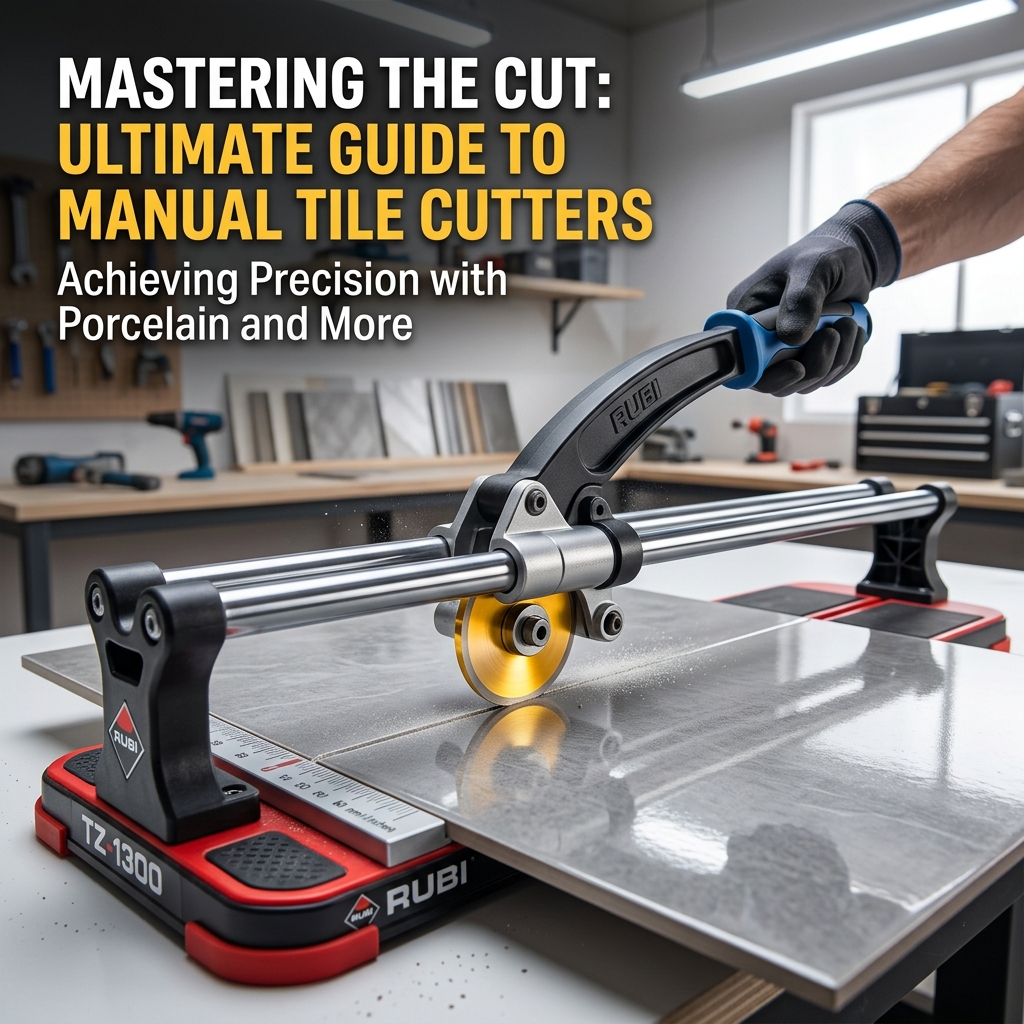
Tungsten carbide scoring wheels determine tile cut cleanliness. Analyze titanium coating benefits, linear rail alignment, and breaker bar leverage to prevent micro-cracks.
- Cuts porcelain and ceramic wall and floor tile up to 24-inches long
- 7/8 inch titanium-coated tungsten carbide scoring wheel for clean scoring
- High-leverage breaker bar snaps tiles easily with minimal effort
Material Science & Flooring
Manual tile cutters provide fast, clean, and dust-free snaps for backsplash work. Explore how scoring wheel metallurgy and rail alignment prevent micro-cracks in porcelain.
1. The Metallurgy of Titanium-Coated Tungsten Carbide Scoring Wheels
Scoring hard glazed porcelain tiles requires a wheel made of a material harder than the glaze itself. Tungsten carbide offers exceptional hardness, but can wear down under the continuous heat and friction of scoring. To extend wheel life, professional cutters coat the wheel in titanium nitride. This thin coating reduces the coefficient of friction, lowering heat buildup and preserving the wheel's sharpness.
Titanium coating lowers friction and increases surface hardness, protecting the tungsten carbide substrate. This allows the wheel to score thousands of tiles without losing its sharp profile. A sharp wheel ensures consistent glaze disruption, preventing jagged snaps. If the scoring wheel edge becomes dull, it will crush the glaze instead of shearing it, leading to micro-fractures along the score line.
Additionally, scoring wheel concentricity is critical for a uniform score line. Wobbling wheels create wavy scores, causing the tile to crack off-line during snapping. Precision-ground steel axles maintain wheel alignment, ensuring straight scores. The clearance between the wheel hub and the axle must be kept under 0.02 mm to prevent lateral play that leads to edge chipping.
If the scoring wheel axis has loose tolerances, the wheel will tilt, resulting in chipped edges during the snap. Hardened steel housings protect the axle pin, preventing wear-induced play. This structural rigidity maintains cutting precision throughout the lifetime of the tool, ensuring clean joint lines on tile backsplashes.
By managing wheel geometries, manufacturers optimize penetration. Standard 7/8-inch wheels provide a good compromise between glide speed and score depth. Larger diameter wheels distribute the pressure, preventing deep glaze fractures. The outer diameter must be matched to the tile thickness to ensure clean cuts.
- Titanium nitride coatings lower friction, extending scoring wheel life on hard porcelain glazes.
- Concentric axle mounting prevents wheel wobble, ensuring straight, parallel score lines.
- 7/8-inch scoring wheels distribute pressure evenly, preventing glaze micro-cracking during snaps.
2. Linear Guide Rail Precision and Ball Bearing Carriages
Manual tile cutters use steel guide rails to steer the handle along the tile. Any flex in these rails causes the scoring wheel to drift, resulting in angled cuts. To prevent deflection, professional cutters feature dual chrome-plated steel rails, which are rigid enough to resist bending under downward handle pressure. The rails must be mounted securely to a heavy cast aluminum base to maintain coplanarity.
The carriage handle slides along the rails using linear ball bearings. These bearings minimize friction, allowing for smooth, continuous scoring pressure. Tight clearances inside the carriage prevent side-to-side play, maintaining alignment. This smooth action is critical when scoring delicate glass mosaic tiles, where any sudden vibration can shatter the glass.
Furthermore, chrome plating protects the steel rails from rust caused by cleaning water. Wiping the rails regularly and applying dry graphite keeps the carriage sliding smoothly. Accurate rail alignment is the foundation of clean, repeatable cuts. The guide rails must remain parallel to within 0.05 mm over their entire length to prevent carriage binding.
If the rails are not parallel, the carriage will bind midway through the score, forcing the user to apply uneven pressure. Precision end-brackets secure the rails, maintaining constant distance. This alignment stability is critical for long-format tile cuts, where minor errors at the start translate to large deviations at the end of the tile.
- Dual chrome-plated steel rails prevent deflection, ensuring straight cuts over 24 inches.
- Linear ball bearings allow smooth, zero-drag carriage glide for consistent score depth.
- Precision guide mounts prevent rail misalignment, reducing carriage binding risk.
3. Breaker Bar Leverage and Pressure Pad Force Mechanics
Once the tile is scored, the glaze stress line is established. Snapping the tile requires applying localized bending force directly under the score line. The breaker bar uses leverage to multiply handle pressure, pressing down on the tile until it snaps along the score. High mechanical leverage is key to clean snaps.
The breaker pad must feature a pivot layout that adjusts to the surface angle of the tile. If the pad is rigid, it can apply force unevenly, causing the tile to crack off-center. Rubber pads protect the tile face from scratches, while the cast steel structure prevents flexing, ensuring direct force transfer to the tile body.
Additionally, the base plate must feature a raised center ridge that aligns directly under the scoring path. This ridge acts as a fulcrum, concentrating the bending force where the glaze is weak. The spring-loaded base plates absorb the shock of the snap, preventing micro-cracking in the porcelain. The mechanical link must be kept lubricated to prevent binding during high-pressure snaps.
- High-leverage breaker bars snap thick porcelain tiles easily with minimal effort.
- Spring-loaded base plates cushion the tile snap shock, preventing micro-cracking.
4. Linear Rail Alignment and Snipe Mitigation on Porcelain Backsplashes
Precision cuts are critical when installing porcelain tile backsplashes, where every joint is visible. Linear rail alignment dictates the straightness of the score. If the rails flex during carriage movement, the score line will be curved, making it impossible to fit the tiles tightly against the kitchen countertops.
Snipe or edge chipping occurs when the scoring wheel enters or exits the tile surface at an angle. To mitigate this, the rails must be calibrated to run parallel to the base plate. Using adjustable guide brackets allows you to fine-tune the rail height, keeping the scoring path parallel along the entire tile length.
Furthermore, when cutting large format tiles, base plate extensions should be deployed to support the overhanging edges. Without proper support, the tile can sag under its own weight, causing the score line to drift or the tile to crack prematurely. Rigid steel extension arms keep the tile flat, ensuring clean snaps across the entire width.
- Adjustable fences maintain 90-degree squareness, preventing gaps at corner transitions.
- Parallel guide rail calibrations prevent curved score paths, ensuring tight grout joints.
5. Material Science of Glass and Porcelain Tile Fracture Mechanics
Different tile materials respond uniquely to scoring forces due to their internal structures. Porcelain is extremely dense and hard, requiring high downward pressure on the scoring wheel to fracture the tough glaze. Glass is highly brittle and can crack easily, requiring a light, single scoring pass to avoid shattering.
When scoring, the wheel creates a localized stress field in the glaze. This stress must penetrate deep enough to establish a weakness line, but not so deep that it fractures the tile body. The angle of the scoring wheel edge is optimized to concentrate this pressure, ensuring a clean fracture propagation along the scoring line.
If the tile glaze is scored multiple times, the stress line will become wide and jagged. This multi-scoring weakens the surrounding glaze, causing the tile to chip and snap unevenly. A single, smooth scoring pass is critical for clean snaps, and operators must keep pressure consistent along the cut. The fracture propagation speed is determined by glaze density and thickness.
- Single scoring passes prevent glaze micro-cracking, ensuring sharp, clean snap edges.
- Glaze stress fields concentrate bending forces, guiding the snap along the score.
6. Wet Saws vs Manual Tile Cutters: Cost, Cleanliness, and Efficiency Audits
Selecting the right tile-cutting method depends on the project scale and shop setup. Wet saws use diamond blades to grind through tile, creating slurry, dust, and high noise levels. Manual cutters score the glaze and snap the tile, producing zero dust and minimal waste, making them ideal for indoor backsplash installations.
Wet saws are necessary for making complex L-cuts or curves around outlets, but they require power hookups and regular water changes. Manual cutters are portable and do not require electricity, allowing you to set up directly in the work area. This portability reduces the time spent walking back and forth to a cutting station.
Furthermore, wet sawing inside a finished kitchen is impractical due to water overspray, requiring the operator to work outside. In cold winter climates, running a wet saw outdoors is extremely uncomfortable and risks freezing water lines. Manual cutters solve this issue by allowing you to work indoors, accelerating project speed.
- Manual tile cutters produce zero dust or slurry, keeping indoor jobsites clean.
- Zero electrical power demands allow setups directly next to the installation walls.
7. Preventive Maintenance: Linear Bearing Adjustments, Cleaning, and Spindle Lubrication
Preventive maintenance is key to keeping a manual tile cutter operating smoothly. Glass and ceramic dust can accumulate on the guide rails, mixing with oil to form an abrasive slurry that increases carriage resistance. Regularly wiping down the guide rails with a dry microfiber cloth prevents this build-up, preserving the linear bearings.
From a physics standpoint, the manual tile cutter operates on Griffith's theory of brittle fracture mechanics. When the tungsten carbide wheel scores the glaze, it creates a line of high stress concentration. When bending force is applied by the breaker bar, this stress causes a crack to propagate downward through the tile body. If the score line is uneven or too deep, it can cause secondary cracks to branch out, resulting in a jagged edge or a ruined tile. A uniform, shallow score line ensures that the tensile stress is concentrated exactly along the desired path, leading to a clean, straight split with minimal force.
Linear ball bearings should be adjusted periodically to eliminate any carriage play. Adjusting the carriage tension screws removes side-to-side slop, keeping the scoring wheel aligned. Worn bearings can be replaced easily, restoring smooth carriage glide and cutting accuracy. Regular calibration extends the cutter's service life.
The scoring wheel axle spindle should receive a drop of dry Teflon lubricant to ensure smooth rotation. Avoid using heavy grease, which can attract abrasive tile dust and clog the wheel axle. If the scoring wheel axle becomes stiff, it will drag instead of rolling, causing gouges and chips along the glaze score line.
Storing the tile cutter in a padded case protects the guide rails and cutting carriage from impact damage during transport. Never rest heavy tools on the rails, as this can bend them and ruin the parallel calibration. Keeping the tool clean and protected ensures it is ready for the next backsplash project.
- Tension screw adjustments remove carriage play, maintaining scoring wheel alignment.
- Dry Teflon lubricants keep the scoring wheel rotating freely without attracting dust.
- Regular rail cleaning prevents bearing wear, preserving smooth carriage travel.
8. The Definitive Professional Tile Cutter Buying Parameters
Selecting a manual tile cutter requires reviewing rails construction, carriage design, and wheel metallurgy. Titanium-coated tungsten carbide scoring wheels are essential for cutting hard glazed porcelain tiles. Look for cutters with solid guide rails and linear ball bearings to ensure smooth travel and straight cuts.
Additionally, assess the breaker bar design and base plate cushions. High-leverage breaker bars and spring-loaded base plates snap tiles easily while preventing micro-cracking in the porcelain. The cutting fence should feature clear markings and angle guides for precise miter cuts around outlets and countertops.
Finally, check the tool specifications for maximum diagonal cutting capacity in addition to straight cut capacity. Many 24-inch cutters can only handle up to 16-inch tiles when cutting diagonally, which is an important limitation to note before buying. Opting for a cutter with a wide base ensures stable support for large formats.
- Solid steel guide rails prevent flexing, ensuring straight cuts on large format tiles.
- Angle guides and fences maintain miter accuracy, preventing gaps at wall edges.
9. Silica Dust Safety Standards and OSHA Compliance
Cutting tile with power saws releases crystalline silica dust into the air, which can cause severe lung diseases like silicosis if inhaled. Under OSHA regulations, wet cutting or active vacuum extraction systems are required to suppress dust on construction sites. Manual tile cutters provide an excellent alternative for compliance because they score and snap the material without generating airborne dust.
By eliminating dust generation, manual cutters protect installers from inhalation hazards and prevent dusty residues from settling inside active households. However, safety glasses must still be worn during the snap to protect against flying glaze chips. Proper clean-up of discarded tile fragments keeps the workspace clean and safe for other trades.
- Manual tile snapping generates zero respirable silica dust, ensuring OSHA compliance.
- Safety glasses protect eyes from sharp glass or ceramic chips during snap actions.
Professional Recommendation & Audit
For dust-free and high-precision porcelain backsplash installations, we highly recommend the QEP 10630Q 24-Inch Professional Tile Cutter. Its 7/8-inch titanium-coated scoring wheel, dual chrome-plated steel rails with linear ball bearings, and high-leverage breaker bar make clean, micro-crack-free snaps effortless.
QEP 10630Q 24-Inch Professional Tile Cutter
- Cuts porcelain and ceramic wall and floor tile up to 24-inches long
- 7/8 inch titanium-coated tungsten carbide scoring wheel for clean scoring
- High-leverage breaker bar snaps tiles easily with minimal effort
- Dual chrome-plated steel rails with linear ball bearings for smooth scores
Technical Specifications & Product Data
| Specification | Value / Details |
|---|---|
| Brand | QEP |
| List Price | $69.00 (USD) |
| Customer Rating | 4.6 / 5.0 (3,750 reviews) |
| ASIN / Identifier | B00318CVDQ |
| Availability | In Stock (USA Region) |
| Outbound Link Compliance | Sponsored & Nofollow Enforced |
Verified Features & Performance Data
- ✓Cuts porcelain and ceramic wall and floor tile up to 24-inches long
- ✓7/8 inch titanium-coated tungsten carbide scoring wheel for clean scoring
- ✓High-leverage breaker bar snaps tiles easily with minimal effort
- ✓Dual chrome-plated steel rails with linear ball bearings for smooth scores
System Sovereignty & Engineering
Edge Computing
100% Client-side processing. Your data never leaves your browser sandbox, ensuring absolute compliance with US privacy mandates.
Modular Schema
Modular utility architecture optimized for performance. Low-latency WASM kernels provide near-native speeds for complex transformations.
Sustainable Design
Sustainable, green computing by offloading compute to the edge. Verified zero-server storage (ZSS) for professional-grade security.