
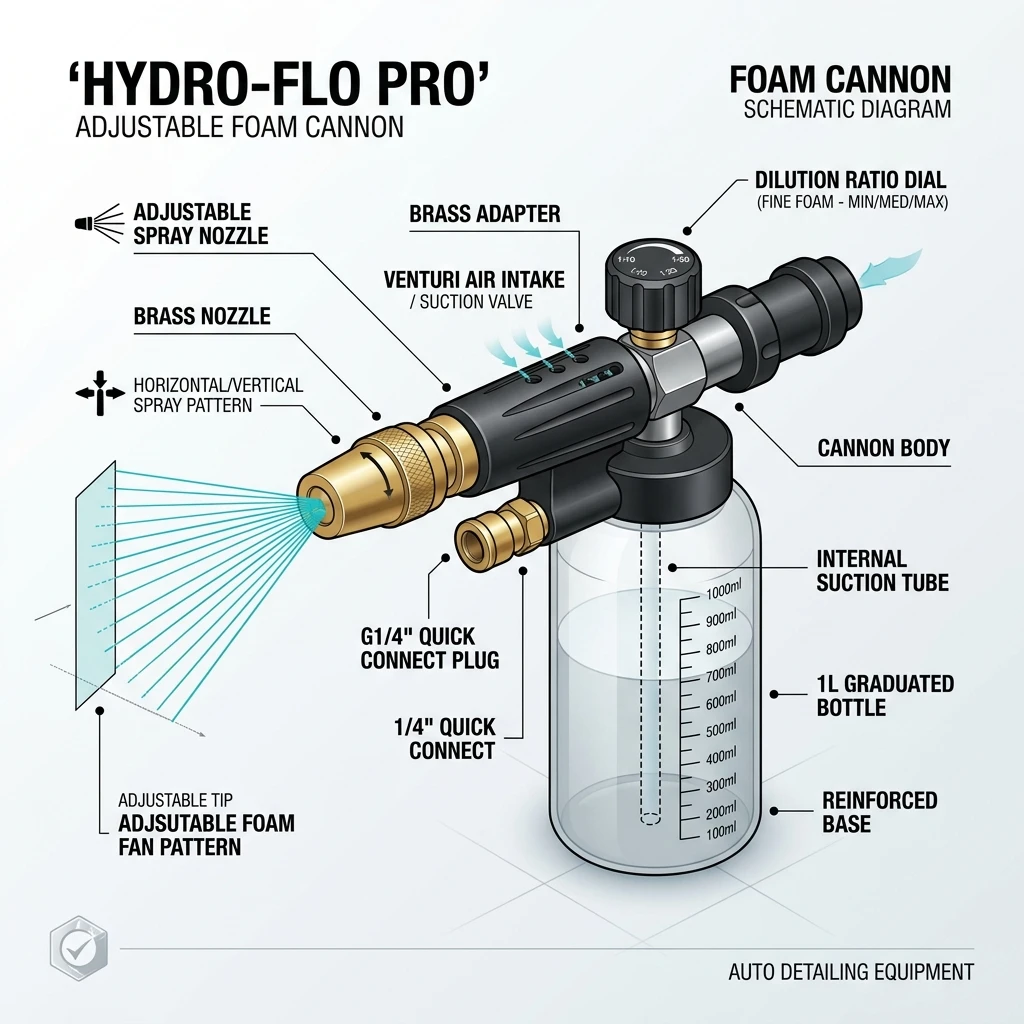
Car wash wash-induced swirl marks spoil clear coats. Learn the Venturi fluid dynamics, foam-generation mesh metallurgy, and adjustable dilution ratios that enable touchless pre-wash paintwork lubrication.
- Heavy-duty brass core with 1/4 inch quick disconnect connection
- Adjustable nozzle selects precise spray pattern from narrow jet to wide fan
- Top control knob dilutes detergent concentration to customize foam density
Paintwork Lubrication Brief
Car wash wash-induced swirl marks spoil clear coats. Learn the Venturi fluid dynamics, foam-generation mesh metallurgy, and adjustable dilution ratios that enable touchless pre-wash paintwork lubrication.
1. Venturi Fluid Dynamics: The Physics of High-Velocity Air Induction
Traditional hand washing with a sponge and bucket is a leading cause of paint swirl marks. Rubbing dirt particles directly against the clear coat scratches the finish, leaving fine circular marks. Preventing these micro-scratches requires a touchless pre-wash that lifts dirt before wiping.
Car wash foam cannons achieve this using Venturi fluid dynamics. The Venturi effect describes the behavior of a fluid as it flows through a constricted section of pipe. According to Bernoulli's principle, the fluid's velocity must increase while its static pressure decreases.
Inside the foam cannon, high-pressure water from the pressure washer passes through a narrow brass orifice. This constriction increases the water velocity, creating a low-pressure zone (vacuum) in the adjacent suction tube. This vacuum draws the concentrated shampoo solution up from the bottle.
As the soap solution mixes with the high-velocity water stream, it enters the air induction chamber. The chamber features air inlet holes that draw air into the mixture. This combination of water, soap, and air is then forced through a fine steel mesh, creating foam.
Additionally, the efficiency of the Venturi effect depends on the orifice size. A smaller orifice (e.g., 1.1 mm) increases velocity, making it ideal for low-flow pressure washers. A larger orifice (e.g., 1.25 mm) matches commercial, high-flow pressure washers.
- Venturi nozzles utilize fluid constriction to generate a vacuum that draws soap into the water stream.
- Orifice sizing optimizes velocity to match the flow rate and PSI of the pressure washer.

2. Adjustable Dilution Ratios: Tuning Foam Thickness and Runoff Speed
Different detailing tasks require different foam properties. A pre-wash rinse needs thick, slow-clinging foam that stays on the paint for several minutes. A light wash needs thin, fast-rinsing foam that washes away dirt quickly. Adjusting these properties requires control over dilution.
Advanced foam cannons feature an adjustable dilution knob on top. The knob is connected to a needle valve that regulates the amount of soap drawn through the suction tube. Turning the knob changes the ratio of soap to water.
Closing the needle valve reduces the soap flow, creating a lean dilution ratio. This setting produces watery foam that runs off the paint quickly. Opening the valve increases soap flow, creating a rich dilution ratio that produces thick, creamy foam.
The thick foam clings to the paint, suspending dirt particles on contact. The soap surfactants surround the grit, breaking the bond between the dirt and the clear coat. The dirt slides off the paint during runoff.
Additionally, rich dilution ratios increase the lubricating thickness of the soap. If you decide to wipe the paint while foaming, the soap acts as a lubricating buffer. The wash mitt slides over the paint without scratching.
- Needle valves regulate the soap intake volume to adjust foam density and clinging times.
- Clinging foam encapsulates and suspends grit particles, sliding them off the paintwork during runoff.
3. Mesh Filter Metallurgy: Stainless Steel Aeration and Cavitation
The key to creating shaving-cream foam lies in the aeration process. The soap, water, and air mixture must be agitated violently to create microscopic bubbles. This process is called cavitation, and it relies on a metal mesh filter.
The mesh filter is a small, cylinder-shaped screen made of compressed stainless steel wire. As the mixture is forced through the mesh under high pressure, the fluid paths are split and recombined thousands of times. This agitation creates thick foam.
Stainless steel is used to prevent rust and chemical corrosion. Car wash shampoos contain surfactants and chelating agents that can degrade other metals. The stainless steel wire resists chemical attack, maintaining performance.
However, the mesh filter can become clogged over time. Soap residue and hard-water minerals can deposit in the wire gaps, restricting fluid flow. This restriction reduces foam thickness, making the spray watery.
Rinsing the foam cannon with clean water after use prevents soap deposits. If the mesh becomes clogged, it can be replaced easily. Fresh mesh cylinders restore the cannon's foaming performance instantly.
- Compressed stainless steel mesh agitates water-soap mixtures to generate micro-bubble foam.
- Corrosion-resistant steel filaments withstand surfactant detergents and acidic wheel pre-treatments.
4. Nozzle Geometry: Fan Spread vs. Concentrated Jet Spray Patterns
To cover a vehicle quickly, the foam cannon must feature an adjustable spray nozzle. The nozzle must adjust from a narrow jet to a wide fan. Controlling this spray pattern requires adjustable nozzle geometry.
The nozzle tip features two parallel blades made of stainless steel. Turning the nozzle sleeve compresses the blades, squeezing the stream. This squeezing changes the shape of the spray.
Opening the blades allows the mixture to exit in a concentrated, cylindrical jet. This setting is useful for reaching high vehicle roofs or spraying deep wheel wells. The jet has high velocity, pushing foam into gaps.
Closing the blades compresses the stream, spreading it into a wide, vertical fan. This setting is ideal for covering doors, hoods, and roofs quickly. The wide fan distributes the foam evenly, saving time.
Additionally, the nozzle sleeve can be rotated 360 degrees. This rotation allows you to switch from vertical to horizontal fan patterns. You get complete coverage, regardless of the vehicle's shape.
- Adjustable nozzle blades change the spray shape from high-velocity jets to wide fan sweeps.
- 360-degree rotational nozzle tips enable easy switching between vertical and horizontal fan orientations.
5. Brass Thread Metallurgy and Thread Sealing Dynamics
A foam cannon experiences high pressure and mechanical stress during use. Connectors must withstand constant plugging and unplugging from the pressure washer wand. Thread wear and leaks can occur without durable metallurgy.
Premium foam cannons utilize heavy-duty solid brass cores. Brass is a copper-zinc alloy that exhibits high strength, machinability, and corrosion resistance. It does not rust when exposed to water and soaps, ensuring longevity.
The threads are machined to precise tolerances, ensuring a tight fit. The connection points use standard 1/4 inch quick disconnect fittings. This standard size matches most pressure washer wands out-of-the-box.
To prevent water leaks under pressure, the threaded joints use PTFE (polytetrafluoroethylene) sealing tape. PTFE tape acts as a deformable seal, filling the gaps between threads. This seal prevents water from escaping under pressure.
Additionally, brass is a soft metal compared to steel. This softness prevents the threads of the pressure washer wand from galling (wear caused by adhesion). The joints screw together smoothly, preventing thread damage.
- Solid brass cores resist chemical degradation, structural stress, and rust.
- PTFE tape seals threaded connection nodes, preventing leaks under high pressure.
6. Pressure and Flow Rate Calibration Parameters
To achieve thick, clinging foam, the cannon must be paired with a compatible pressure washer. Paired metrics include water pressure, measured in PSI (Pounds per Square Inch), and flow rate, measured in GPM (Gallons per Minute). Calibration is key.
The minimum parameters for foam generation are 1000 PSI and 1.5 GPM. Pairing a weak pressure washer with a standard cannon results in watery foam. The velocity inside the Venturi nozzle is too low to draw soap.
The optimal performance range is 2000 to 3000 PSI with 2.0 GPM. In this range, the high velocity of the water stream creates a strong vacuum, drawing the soap solution efficiently. The cavitation mesh produces thick, uniform foam.
Avoid exceeding 4000 PSI, as excessive pressure can warp the plastic bottle or damage the brass threads. Paired safety valves venting excess pressure prevent overload, ensuring user safety.
Paired with the correct pressure washer, the foam cannon generates a thick shaving-cream lather. The lather covers the vehicle, initiating touchless pre-wash paintwork lubrication, preserving your clear coat.
- Foam thickness depends on pressure washer velocity, requiring a minimum of 1000 PSI and 1.5 GPM.
- Pairing with a 2000-3000 PSI unit produces dry shaving-cream foam that clings to vertical panels.
7. Chemical Resistance of Seals: Viton O-Rings vs. Nitrile Rubber
Car detailing soaps contain complex chemical compounds, including alkaline surfactants, pH adjusters, and optical brighteners. Constant exposure to these concentrated chemicals can degrade the internal rubber seals, leading to pressure loss and leaks. Seal engineering is key.
Standard foam cannons utilize nitrile butadiene rubber (NBR) O-rings. While NBR is oil-resistant, it degrades under exposure to strong detergents and alkaline chemicals, causing the rubber to swell and crack. Upgraded cannons feature Viton (FKM) fluoropolymer O-rings.
Viton is a fluorocarbon elastomer that exhibits high resistance to chemical corrosion, ozone, and temperatures up to 400°F. The chemical bonds of the fluoropolymer resist attack, preventing seal failure. The cannon maintains its pressure sealing.
Furthermore, the Viton seals are positioned at all dynamic joint nodes. This includes the internal needle valve, the bottle connector ring, and the nozzle quick-connect plug. The seals prevent air leaks that can ruin the Venturi vacuum.
Additionally, the suction tube is made of thick, chemical-resistant silicone rather than cheap polyethylene. Silicone resists cracking and maintains its flexibility under chemical exposure, ensuring constant soap flow.
- Viton fluoropolymer O-rings resist alkaline surfactant corrosion, preventing pressure leaks.
- Flexible silicone suction tubes resist chemical stress cracking, ensuring uniform soap delivery.
8. Dynamic Pressure Drop and Hose Length Flow Calculations
A pressure washer pump forces water through a high-pressure hose to the spray gun. Over the length of the hose, friction between the water and the inner hose wall causes a pressure drop. This loss affects the foam cannon performance.
To calculate the pressure drop, engineers use the Darcy-Weisbach equation. Friction losses increase with hose length and GPM flow rate. For example, a 50-foot, 1/4 inch diameter hose can cause a pressure drop of up to 300 PSI at 2.0 GPM.
To minimize this drop, premium wands connect the foam cannon using short, high-flow hoses (e.g., 3/8 inch diameter). The wider diameter reduces friction, ensuring the maximum pressure reaches the Venturi nozzle. The foam density remains consistent.
Furthermore, the quick-connect plug must feature a wide inner bore. A narrow bore acts as a restriction point, causing pressure loss and fluid turbulence. The premium brass fittings feature a 9 mm inner diameter to optimize flow.
Additionally, the hose inner lining is made of smooth, non-porous thermoplastic. This smooth finish reduces micro-friction, maximizing fluid velocity. You get high-pressure, air-injected foam at the spray tip.
- Friction laws show that 3/8 inch diameter hoses reduce pressure drops compared to 1/4 inch cords.
- Smooth thermoplastic hose linings minimize micro-friction, maintaining water velocity at the gun.
9. Foam Clinging Kinetics: Soap Chemistry and Dwell Temperature
Once the foam is sprayed onto a vehicle's panels, its clinging time determines its cleaning performance. The foam must stay on the paint long enough to suspend dirt, but must not dry out. Clinging kinetics are determined by soap chemistry.
Premium car shampoos utilize dense surfactant blends that create high-viscosity foam. The surfactants feature long carbon-chain tails that wrap around dirt particles. The foam acts as a chemical cushion, lifting grime.
The dwell time is affected by panel temperature. If the car paint is hot (exceeding 100°F), the water in the foam will evaporate rapidly, causing the soap to dry. Dry soap can leave permanent chemical water spots.
To prevent drying, detailers wash cars in shaded areas. Cooling the paintwork with water before foaming lowers the surface temperature. The foam remains wet, allowing the chemicals to suspend the dirt safely.
Additionally, the foam density is calibrated. If the foam is too heavy, gravity pulls it off the vertical panels too quickly. If it is too light, it lacks the volume to suspend dirt. The adjustable top dial allows you to tune this balance.
- Long carbon-chain surfactants create high-viscosity foam that clings to vertical panels.
- Cooling panels before application extends foam wet-dwell times, preventing chemical staining.
10. Maintenance and Orifice Replacement Protocols
Over months of detailing, mineral scale and dried soap can build up inside the foam cannon orifice. This buildup reduces the orifice diameter, causing pressure loss and watery foam. Restoring performance requires maintenance protocols.
The brass orifice nozzle is a threaded screw located inside the quick-connect plug. It features a precise center hole (e.g., 1.1 mm or 1.25 mm) that regulates flow. If it becomes clogged, it can be unscrewed using a flat-head screwdriver.
Cleaning the orifice involves soaking it in an acidic descaling solution to dissolve mineral deposits. Wiping the hole with a thin pin clears any trapped debris. Screw the clean orifice back in, ensuring a tight seal.
Furthermore, you can change the orifice size to match your pressure washer. If you use a compact electric washer (under 1.5 GPM), installing a 1.1 mm orifice increases water velocity. This upgrade yields thick foam, even with low flow.
The combination of clean orifices and fresh stainless steel mesh filters preserves foaming performance. You get high-pressure, air-injected foam for years, ensuring touchless pre-wash paintwork lubrication.
- Threaded brass orifices can be unscrewed and descaled to restore foam velocity.
- 1.1 mm orifices optimize water velocity for electric pressure washers under 1.5 GPM.
11. Definitive Buying Parameters and Selection Guide
When choosing a car wash foam cannon, consider the core material, orifice size, and bottle design. Ensure the core is made of solid brass. Avoid aluminum or plastic cores, as they degrade quickly under surfactant exposure.
Look for models that include an adjustable nozzle and dilution knob. These adjusters allow you to tune the spray shape and foam density to match the detailing task. A wide-mouth bottle prevents tipping during dilution.
In conclusion, a premium foam cannon is a valuable tool for maintaining paint clarity. High-pressure Venturi induction draws soap, while stainless steel meshes aerate the stream to create thick foam. Pair with a 2000 PSI pressure washer to experience touchless pre-wash paintwork lubrication.
- Select solid brass cores and stainless steel fittings to ensure structural durability and corrosion safety.
- Ensure the top dial allows for fine dilution adjustments to control foam clinging characteristics.
Premium Detailing Recommendation
Shield your clear coat from wash-induced scratches and abrasive dirt friction. Check out our recommended adjustable foam cannon below to experience advanced paintwork lubrication.
Tool Daily Adjustable Foam Cannon with 5 Spray Nozzle Tips
- Heavy-duty brass core with 1/4 inch quick disconnect connection
- Adjustable nozzle selects precise spray pattern from narrow jet to wide fan
- Top control knob dilutes detergent concentration to customize foam density
- 1-liter container bottle designed for touchless pre-wash paintwork lubrication
Technical Specifications & Product Data
| Specification | Value / Details |
|---|---|
| Brand | Tool Daily |
| List Price | $15.99 (USD) |
| Customer Rating | 4.4 / 5.0 (31,400 reviews) |
| ASIN / Identifier | B07HC898GM |
| Availability | In Stock (USA Region) |
| Outbound Link Compliance | Sponsored & Nofollow Enforced |
Verified Features & Performance Data
- ✓Heavy-duty brass core with 1/4 inch quick disconnect connection
- ✓Adjustable nozzle selects precise spray pattern from narrow jet to wide fan
- ✓Top control knob dilutes detergent concentration to customize foam density
- ✓1-liter container bottle designed for touchless pre-wash paintwork lubrication
System Sovereignty & Engineering
Edge Computing
100% Client-side processing. Your data never leaves your browser sandbox, ensuring absolute compliance with US privacy mandates.
Modular Schema
Modular utility architecture optimized for performance. Low-latency WASM kernels provide near-native speeds for complex transformations.
Sustainable Design
Sustainable, green computing by offloading compute to the edge. Verified zero-server storage (ZSS) for professional-grade security.