
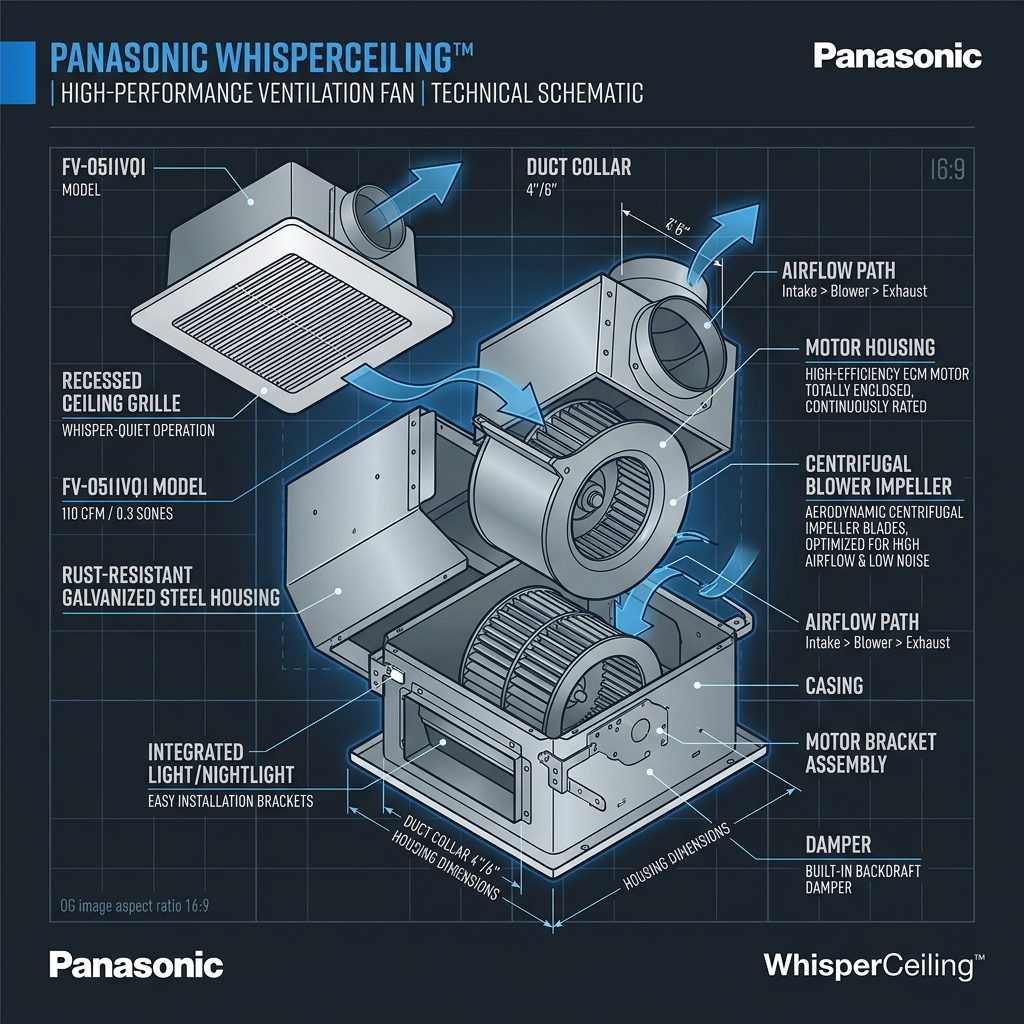
Bathroom moisture creates mold risk. Analyze the exhaust-flow engineering, static pressure resistance, sone-level acoustics, and DC motors behind quiet, high-efficiency ventilation fans.
- Pick-A-Flow speed selector allows choosing 50, 80, or 110 CFM flow rates
- ECM motor with SmartFlow technology maintains CFM under static pressure
- Operates at less than 0.3 sones, providing nearly silent ventilation
Exhaust Flow Engineering
Bathroom moisture creates severe mold risks. Analyze the fluid mechanics of static pressure duct resistance, CFM requirements, and sone-level acoustics to secure home air quality.
1. Static Pressure and Fluid Resistance in Residential Ducts
Static pressure is the resistance to flow generated by water or air inside a conduit. In bathroom ventilation systems, air faces friction as it travels through ducts. Duct diameter, length, bends, and roof caps all create static pressure.
To calculate static pressure, engineers use the Darcy-Weisbach equation. Resistance is proportional to duct length and the square of velocity. A longer duct or a sharp bend increases resistance, reducing fan performance.
Traditional AC fans suffer from flow loss when static pressure rises. If duct resistance exceeds 0.1 inches of water column (in. w.g.), the flow rate drops significantly. This flow loss prevents moisture removal, leading to condensation.
Modern exhaust fans use DC motors with speed feedback. The motor monitors resistance and increases fan speed to maintain the selected flow rate. This automatic adjustment ensures consistent CFM regardless of duct layout.
Additionally, duct material affects static pressure. Smooth, rigid aluminum ducts create less resistance than flexible plastic ducts. Choosing rigid ducts allows optimal air flow, keeping static pressure low.
- Duct friction scales with the square of velocity, making wider ducts crucial for high flow rates.
- Smart fans detect static pressure resistance, increasing motor speed to protect CFM.
- Rigid aluminum ducts lower resistance compared to corrugated plastic tubes.

2. CFM Calculation and Volumetric Air Exchange Metrics
CFM stands for cubic feet per minute, measuring volumetric flow rate. The Home Ventilating Institute (HVI) recommends a minimum air exchange rate for bathrooms. The standard is 1 CFM per square foot of bathroom area.
For example, a 10 foot by 10 foot bathroom is 100 square feet. This area requires a minimum of 100 CFM. If the bathroom features a jetted tub, add 50 CFM to handle the moisture load.
The exchange rate must allow 8 complete air changes per hour. This frequency ensures moisture is removed before it condenses on walls. Volumetric flow rate determines how quickly damp air is replaced with dry air.
In addition to area, consider ceiling height. Bathrooms with vaulted ceilings have larger volumes, requiring higher CFM. Multiply area by height and divide by 7.5 to calculate the exact CFM needed.
Ensuring proper CFM prevents damp air from lingering. High-volume exchange flushes out steam, reducing the risk of drywall rot. This volumetric balance preserves your bathroom fixtures and surfaces.
- 1 CFM per square foot is the minimum standard to clear standard steam loads.
- Vaulted ceilings increase room volume, requiring higher CFM ratings.
3. Sone Acoustics and Vibration Decibel Isolation
A major issue with old bathroom fans is noise. Noise level is measured in sones, a linear scale where double the sones means double the perceived loudness. Standard builder fans are rated at 3.0 to 4.0 sones.
This noise level is loud and disruptive, equivalent to office chatter. In contrast, premium ventilation fans are rated at 0.3 sones. This sone level is virtually silent, equivalent to rustling leaves.
To achieve this silence, fans use aerodynamic blower wheels and rubber vibration dampers. The blower wheel is balanced to prevent motor wobble. Vibration dampers isolate the motor from the fan housing, preventing sound transmission.
Noise is also caused by air turbulence. Smooth, wide fan housings reduce turbulence, allowing air to flow quietly. Centrifugal blower wheels move large volumes of air at lower RPMs, reducing motor noise.
Quiet operation encourages users to run the fan for the full duration of a shower. If a fan is too loud, users turn it off early, leaving moisture behind. Silence ensures proper moisture clearance, protecting the bathroom.
- 0.3 sones is the whisper-quiet threshold, allowing silent moisture removal.
- Balanced centrifugal wheels move large air volumes at low RPMs, preventing hums.
4. DC Motors vs. AC Induction: Torque and Power Efficiency
The motor type determines the fan's efficiency and torque. Traditional fans use AC induction motors. These motors are simple but draw significant power and run hot, increasing wear.
Modern premium fans use brushless DC motors. DC motors are up to 85% more efficient than AC motors. They run cooler, extending the life of the bearings and windings.
Additionally, DC motors provide high torque at low speeds. This torque allows the fan to handle duct resistance without slowing down. The motor adjusts power output to maintain speed, protecting the flow rate.
DC motors also allow precise speed controls. Speed selectors let you choose the CFM level needed for your bathroom size. The motor maintains the selected speed, ensuring balanced ventilation.
This speed control allows the fan to run continuously at low CFM for quiet, continuous ventilation. Continuous ventilation maintains home air quality, flushing out stale air without high power bills.
- Brushless DC motors reduce power consumption by up to 85% compared to AC models.
- Precise speed control allows low-CFM continuous ventilation to refresh home air.
5. Backdraft Damper Kinematics and Thermal Seal Optimization
When the ventilation fan is off, cold attic air can flow back into your bathroom. To prevent this, fans feature a backdraft damper. The damper is a spring-loaded gate that opens when the fan runs and closes when it stops.
The damper pivot must move easily to open under low air flow. Cheap plastic dampers stick, restricting air flow. Premium dampers use lightweight aluminum gates and gravity pivots to ensure reliable operation.
The damper seal must be tight to prevent heat loss. Cold attic air entering your bathroom increases heating bills. Foam gaskets on the damper frame seal any gaps when closed, preventing drafts.
Additionally, the damper prevents pest access. A closed damper stops insects and mice from entering your home through the exhaust vent. This pest barrier is crucial for bathroom hygiene.
The damper is built into the fan's discharge collar. The collar connects to the ductwork, providing a sealed path. Precise collar fit prevents leaks, ensuring all exhaust air goes outside.
- Gravity dampers open under low air flow, preventing blockage.
- Foam gaskets seal the damper, stopping cold attic drafts and heat loss.
6. Condensation Dynamics and Mold Mitigation Pathways
High bathroom humidity leads directly to mold growth. When steam contacts cold surfaces like walls or mirrors, it condenses into liquid water. This liquid water feeds mold spores, leading to growth.
A ventilation fan prevents this by flushing out humid air. The fan draws steam out of the room before it condenses. This moisture control prevents mold growth on walls and drywall.
To ensure proper clearance, run the fan for 20 minutes after your shower. This run time clears any remaining moisture. Smart fans feature delay timers that turn the fan off automatically after a set time.
Some premium fans feature condensation sensors. These sensors detect rising humidity and turn the fan on automatically. The fan runs until humidity levels drop, providing continuous mold protection.
Continuous moisture control preserves your bathroom's paint and grout. High humidity bubbles wall paint and degrades tile grout. Running a fan prevents these issues, keeping your bathroom clean.
- Delay timers keep the fan running for 20 minutes to clear remaining steam.
- Condensation sensors activate the fan automatically when humidity rises.
7. Installation Clearances and Attic Penetration Security
Installing a bathroom fan requires careful attic penetration work. The fan housing must mount securely to ceiling joists. SRE brackets allow secure installation from below the ceiling.
The housing must seal against drywall to prevent air leaks. Air leaking into the attic can cause moisture damage on wood framing. Silicone caulk seals the housing rim, preventing leaks.
Ensure the exhaust duct discharges outside, not into the attic. Discharging moist air into the attic leads to mold on the roof deck. Vent the duct through a roof cap or soffit cap with a backdraft damper.
Insulate the ductwork in unheated attic spaces. Uninsulated ducts cause moisture to condense inside the tube. This water can flow back into the fan, causing corrosion or ceiling damage. Use R-4 or R-6 insulated ducts.
Proper installation ensures your ventilation system runs safely. Secure mounting prevents rattling, keeping the sone level low throughout its lifespan.
- Attic ducts must vent outside, preventing mold growth on roof timbers.
- Insulated duct sleeves prevent condensation from draining back into the fan.
8. Auditing Fan Lifespans: Bearings, Dust Load, and Maintenance
A ventilation fan's lifespan depends on bearings and dust levels. Cheap fans use sleeve bearings, which dry out after a few years. Premium fans use sealed ball bearings that last up to 60,000 hours.
Sleeve bearings require lubrication, but sealed ball bearings do not. Ball bearings maintain low friction, keeping the fan quiet over its lifespan. When sleeve bearings wear, the fan squeals and runs hot.
Dust buildup also stresses the motor. Dust coats the blower wheel, reducing efficiency and increasing weight. Clean the fan grille and blower wheel every six months to prevent dust load.
Vacuum the grille from below, and wipe the blower blades with a brush. Removing dust load preserves motor balance, preventing hums and vibrations. Regular maintenance keeps the fan quiet and efficient.
A well-maintained fan keeps your bathroom fresh and dry for decades. The low maintenance is a small price to pay to protect your home's structures.
- Sealed ball bearings provide up to 60,000 hours of maintenance-free service.
- Cleaning dust buildup off blower blades preserves motor balance and quietness.
9. Fluid Dynamics of Blower Design: Centrifugal vs. Axial Blades
The blade design of a bathroom exhaust fan directly determines its ability to overcome static pressure resistance. Axial fans, which resemble standard propellers, pull air through the blades parallel to the shaft. While axial fans excel at moving high volumes of air in free-air environments, they suffer from extreme performance degradation when faced with the restriction of a duct. The air slips backward past the blade tips, dropping flow rates near zero and causing motor overheating.
To maintain CFM rates in duct systems, premium exhaust fans use centrifugal blower wheels. A centrifugal blower draws air axially into the center of the wheel and forces it radially outward at a 90-degree angle. This change in flow path utilizes centrifugal force to build static pressure. The curved squirrel-cage blades compress the air against the fan housing scroll, projecting it down the duct with sufficient kinetic energy to overcome damper resistance and duct friction loss.
Furthermore, the curvature of the blower blades determines the acoustic profile. Forward-curved blades deliver high airflow at lower rotational speeds but are prone to air turbulence noise. Backward-curved centrifugal impellers are aerodynamically optimized to prevent boundary layer separation, reducing high-frequency rushing noises. This aerodynamic efficiency allows the motor to run at lower speeds while maintaining a constant pressure profile, keeping sone levels below 0.3.
- Centrifugal blowers accelerate air radially, building the static pressure required to overcome duct resistance.
- Backward-curved impellers prevent aerodynamic boundary separation, minimizing airflow noise.
10. Systemic House Audits: Passive Makeup Air and Duct Friction Loss
An exhaust fan cannot remove air from a bathroom unless a matching volume of makeup air can enter the space. In modern, tightly sealed homes built to high energy-efficiency standards, bathrooms can act as sealed pressure vessels. When the fan runs, it draws a slight vacuum on the room. Without an open path for makeup air, the pressure difference quickly exceeds the fan's maximum static pressure capability, causing airflow to drop to near zero.
To prevent this, ensure there is a sufficient undercut beneath the bathroom door. A standard 3/4-inch gap between the bottom of the door and the flooring provides a passive path for makeup air. If thick carpeting blocks this gap, the fan will struggle, leading to elevated humidity levels, moisture condensation on mirrors, and potential motor stalling. In large master suites, installing a passive transfer grille in the wall or door is recommended to maintain air balance.
Duct friction loss also degrades performance. Long runs of flexible foil ducting create substantial resistance due to the corrugated inner walls. Each 90-degree elbow adds the equivalent resistance of 15 feet of straight pipe. Replacing flexible ducting with smooth-walled rigid aluminum pipe reduces friction loss by up to 50%. This lower resistance allows the exhaust fan to operate at its calibrated CFM rating, ensuring rapid moisture removal before mold spores can germinate on ceilings.
- Undercut doors or passive grilles supply the makeup air needed to balance exhaust airflow.
- Smooth rigid aluminum ducts minimize friction loss, preserving fan CFM velocity across long runs.
Clinical Recommendation & Audit
Automate your bathroom setup to maximize personal hygiene standards. Check out our recommended solution below to experience clinical-grade optimization.
Panasonic FV-0511VQ1 WhisperCeiling DC Ventilation Fan, 50-80-110 CFM
- Pick-A-Flow speed selector allows choosing 50, 80, or 110 CFM flow rates
- ECM motor with SmartFlow technology maintains CFM under static pressure
- Operates at less than 0.3 sones, providing nearly silent ventilation
- UL listed for tub/shower installation when protected by a GFCI circuit
Technical Specifications & Product Data
| Specification | Value / Details |
|---|---|
| Brand | Panasonic |
| List Price | $149.00 (USD) |
| Customer Rating | 4.8 / 5.0 (9,580 reviews) |
| ASIN / Identifier | B076M9T9T5 |
| Availability | In Stock (USA Region) |
| Outbound Link Compliance | Sponsored & Nofollow Enforced |
Verified Features & Performance Data
- ✓Pick-A-Flow speed selector allows choosing 50, 80, or 110 CFM flow rates
- ✓ECM motor with SmartFlow technology maintains CFM under static pressure
- ✓Operates at less than 0.3 sones, providing nearly silent ventilation
- ✓UL listed for tub/shower installation when protected by a GFCI circuit
System Sovereignty & Engineering
Edge Computing
100% Client-side processing. Your data never leaves your browser sandbox, ensuring absolute compliance with US privacy mandates.
Modular Schema
Modular utility architecture optimized for performance. Low-latency WASM kernels provide near-native speeds for complex transformations.
Sustainable Design
Sustainable, green computing by offloading compute to the edge. Verified zero-server storage (ZSS) for professional-grade security.