
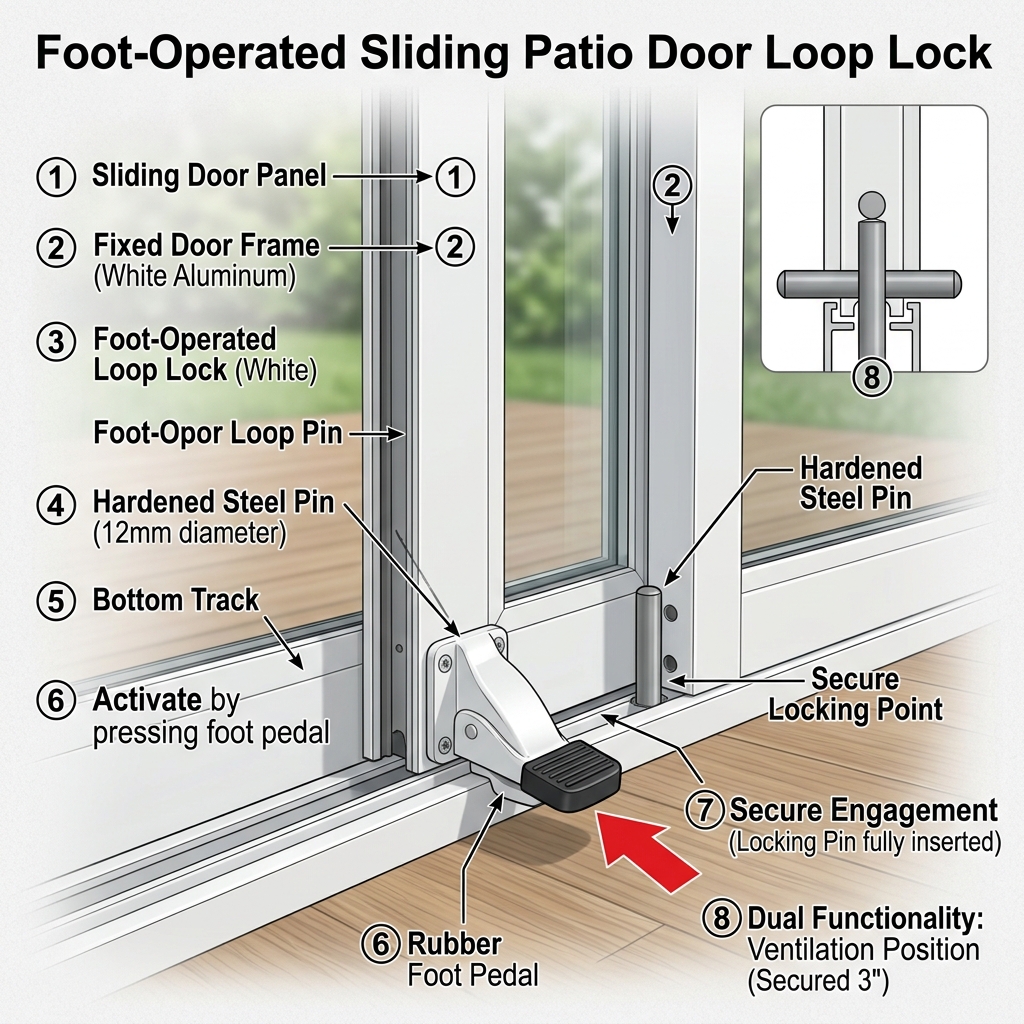
Sliding glass doors are highly vulnerable to prying and lift-out entries. Discover how foot-operated loop locks and hardened steel pins reinforce patio entryways.
- Hardened steel locking pin resists up to 1,000 lbs of lateral shear force
- Rigid extruded aluminum housing blocks pry bar attacks
- Foot-activated latch allows hands-free locking and secondary ventilation gap
Physical Frame Reinforcement
Standard sliding glass patio doors present a significant vulnerability in residential security profiles, primarily due to their susceptibility to simple mechanical manipulation. Intruders frequently exploit the inherent vertical tolerance within the track channels to lift the door panel and disengage the primary latch mechanism. To counter this structural weakness, home security systems must incorporate secondary physical locking devices. Foot-operated loop locks, constructed with hardened steel pins and reinforced housings, provide a robust secondary defensive barrier. This technical analysis evaluates the mechanical shear limits, material rigidity, and installation parameters necessary to achieve high-level resistance against physical bypass techniques.
1. Vulnerability Analysis of Standard Sliding Door Latches
Conventional sliding door installations typically rely on a single, factory-installed latch mechanism that engages with a stamped metal strike plate. These locking mechanisms are vulnerable because they are designed to resist lateral sliding motion rather than vertical lifting or direct horizontal leverage. The internal latch hooks, often fabricated from low-tensile zinc alloys or cast pot metal, exhibit a low yield strength that easily deforms when subjected to dynamic force.
Furthermore, the latch engagement depth is minimal, usually measuring less than one-half inch of vertical contact. This shallow engagement means that any significant displacement of the door frame can cause the latch hook to slip out of the strike plate opening. Intruders exploit this structural tolerance by using pry bars or flathead screwdrivers to flex the aluminum or vinyl frame, easily separating the locking components without shattering the glass pane.
The geometry of sliding door frames creates inherent mechanical leverage points that favor external force application. Because the movable panel sits in a channel with vertical clearance, an upward force applied at the base of the door can raise the entire sash. This lifting motion compresses the upper weatherstripping and spring guides, allowing the bottom latch hook to rise completely out of its matching strike mortise.
To mitigate these physical vulnerabilities, secondary mechanical reinforcement must be anchored at the frame intersections. A robust locking system must physically couple the sliding sash to the main structural header or sill, eliminating both vertical play and horizontal movement. Without this secondary anchor point, standard glass patio doors remain one of the most accessible entry vectors for burglars seeking silent, rapid access to residential interiors.
- Standard factory-installed sliding door latches are fabricated from soft zinc alloys that suffer quick mechanical failure under simple pry tools.
- Intruders exploit the vertical clearance within sliding door tracks to lift the entire door panel and bypass hook latches easily.
- Shallow latch engagement depth offers less than half an inch of purchase, rendering the locking mechanism vulnerable to minor frame deflection.
- Leverage applied to the frame corner forces the flexible vinyl or aluminum profiles apart, causing the latch to slip out.
- Relying solely on primary hook locks leaves the entryway exposed to silent and rapid forced entry methods using common household tools.

2. Hardened Steel Lock Pin Shear Limits
The primary line of defense in a foot-operated loop lock is the cylindrical locking pin, which must withstand severe lateral shear forces. In high-security configurations, this pin is manufactured from hardened steel, often heat-treated to achieve a Rockwell C hardness rating exceeding fifty. This metallurgical hardening process increases the yield strength of the steel, preventing the pin from bending or shearing when subjected to sudden impact loads.
When an external force is applied to the sliding door panel, the load transfers directly to the steel pin at the shear plane. The shear plane is the narrow interface between the sliding door frame and the stationary outer jamb. A high-quality locking pin, typically featuring a diameter of at least three-eighths of an inch, is engineered to resist up to one thousand pounds of lateral force before structural failure occurs.
The mathematical distribution of shear stress across the circular cross-section of the sliding door locking pin follows classic mechanical engineering principles. Under heavy lateral load, the steel pin experiences both bending moments and direct transverse shear stress, with the peak shear stress concentrated at the boundary interfaces. The utilization of hardened carbon steel alloys ensures that the metallic structure does not undergo permanent plastic deformation under these concentrated forces.
In contrast, unhardened steel or brass pins will deform under much lower force thresholds, leading to lock mechanism failure. Once a locking pin bends, the door panel can be forced open far enough to allow entry or to permit tools to reach the inner mechanism. Therefore, specifying a heat-treated, hardened steel alloy for the locking pin is critical for maintaining the structural integrity of the secondary lock.
- Hardened steel pins are heat-treated to a high Rockwell hardness rating to prevent structural deformation under heavy impact forces.
- A minimum three-eighths inch pin diameter ensures a thick cross-section capable of resisting up to one thousand pounds of shear.
- The mechanical shear plane interface between the sliding panel and the outer frame bears the brunt of external prying forces.
- High yield strength alloys prevent the lock pin from bending, which would otherwise allow the door to slide open slightly.
- Choosing heat-treated steel over soft brass or zinc components ensures the lock maintains its physical integrity during forced entry attempts.
3. Extruded Aluminum Housing Rigidity
While the hardened steel pin provides the primary physical barrier, the surrounding housing that contains and guides the pin must possess equal structural integrity. This metal housing must resist severe torsional forces that attempt to twist the lock assembly off its frame mounting surface. To achieve this critical deformation resistance, premium loop locks feature robust housings constructed from extruded aluminum, which offers a superior strength-to-weight ratio compared to typical cast metals.
The extrusion manufacturing process forces heated aluminum alloy through a precision shaped die, creating a uniform metallurgical grain structure free of internal voids or crystalline defects. This specialized manufacturing method yields a dense, exceptionally rigid material that resists cracking and bending even under high tensile stresses. When mounted securely to the door frame, the rigid aluminum housing acts as a solid physical anchor, distributing applied forces evenly across all mounting screws.
Furthermore, the physical geometry of the housing is carefully engineered with internal reinforcing ribs and thick exterior walls to increase the mechanical moment of inertia. This design minimizes structural deflection when the lock is under load, keeping the locking pin aligned with the strike plate holes. If the housing were to flex or deform, the steel pin could easily misalign and slide out of its locking recess, compromising the entire security system.
The interaction between the steel locking pin and the aluminum housing is also critical, as different metals can lead to galvanic corrosion. High-quality security locks address this by using anodized finishes on the aluminum housing and protective coatings on the steel pin. This surface treatment ensures that the housing retains its physical strength and cosmetic appearance over decades of exposure to outdoor humidity and temperature extremes.
- Extruded aluminum housings feature a uniform grain structure that eliminates internal voids and prevents cracking under heavy mechanical stress.
- Thick-walled housing geometry increases the mechanical moment of inertia, preventing structural flex that could lead to locking pin misalignment during attacks.
- The high strength-to-weight ratio of aluminum alloys ensures a lightweight lock body that delivers exceptional resistance to physical attacks.
- Anodized surface finishes protect the aluminum housing from galvanic corrosion and environmental wear when exposed to humid outdoor coastal climates.
- Rigid mounting configurations distribute lateral loads across multiple screw anchor points, preventing the housing from pulling out of the frame.
4. Foot-Actuated Hands-Free Operation
Secondary security hardware is only effective when it is consistently and reliably engaged by the occupants of the home. Standard key-operated or hand-turned locks can be highly inconvenient to operate daily, especially when users are carrying heavy items through the patio door. Foot-actuated loop locks solve this common usability issue by utilizing a simple press-to-lock and press-to-release design that can be operated hands-free using basic foot pressure.
The mechanical linkage inside the lock is designed with a spring-loaded retention system that holds the pin in either position. When the user steps on the top of the locking pin, they compress an internal spring until a detent clicks, locking the pin down. To unlock, the user presses a release lever with their foot, which releases the detent and allows the internal spring to retract the pin.
This hands-free mechanical operation is highly reliable because it does not rely on complex electronics or batteries that can fail. The simple physical design ensures that the lock functions perfectly in all weather conditions, from freezing winters to hot summers. By reducing the physical effort required to secure the door, homeowners are far more likely to engage the lock every time they close the panel.
Additionally, the low-profile design of the foot-operated lock assembly ensures that it does not present a tripping hazard in high-traffic entryways. The lock is mounted directly at the bottom corner of the sliding door panel, keeping it far out of the central walking path. This smart positioning also protects the lock from accidental damage while remaining easily accessible to the user's foot for quick, convenient operation.
- Foot-actuated mechanisms enable hands-free locking and unlocking, making it easy to secure the patio door when carrying heavy items.
- Internal spring-loaded detents hold the locking pin securely in place, preventing accidental engagement or disengagement during door movement.
- The purely mechanical design operates without any electronic components, ensuring reliable long-term functionality in all outdoor weather and temperature conditions.
- Bottom corner mounting keeps the lock assembly out of the central walking path, eliminating potential tripping hazards for residents.
- Ergonomic release levers are designed for easy activation with foot pressure, encouraging consistent lock use throughout the day.
5. Dual Lock Pin Placement for Secure Ventilation
Homeowners often want to leave their sliding glass patio doors slightly open to allow fresh air ventilation while maintaining home security. Standard factory-installed sliding door latches cannot support this ventilation requirement, as they only lock when the door is fully closed. Foot-operated loop locks address this security need by allowing the installation of multiple strike holes along the bottom track of the sliding door frame.
By drilling a secondary locking hole approximately three inches from the closed position, the patio door can be pinned securely in a cracked state. In this semi-open position, the gap is wide enough to permit comfortable airflow but too narrow for any intruder to crawl through. The hardened steel pin continues to prevent the door from being slid open further or lifted out of its track.
This dual-position locking capability is particularly useful during cooler evening hours or when domestic pets are kept inside the home. The ventilation position is mechanically just as secure as the fully closed position, because the hardened steel pin remains engaged in the outer frame. The force required to bypass the lock in the open position is identical to the force required when the door is completely shut.
To install this dual-position system, the installer must ensure precise alignment between the sliding locking pin and both the primary and secondary holes. If the secondary hole is misaligned, the pin will not seat fully into the frame, reducing its shear resistance and overall security. Using a drill guide and verifying the door's travel path ensures a clean installation that provides both comfort and safety.
- Secondary strike holes allow the door to be locked in a partially open position for secure, hands-free ventilation.
- The ventilation gap is restricted to three inches, preventing physical entry while allowing fresh air to flow freely.
- The hardened steel pin provides the same level of shear resistance in the open position as when fully closed.
- Precise alignment of the secondary hole is necessary to ensure the locking pin seats completely and provides maximum security.
- Dual-position locking offers a secure alternative to leaving doors completely unlocked when venting the home during warm days.
6. Anti-Lift Brackets and Track Deflection Mitigation
A major and common vulnerability of sliding glass patio doors is that the entire movable door panel can be lifted vertically within its tracks. Intruders use heavy crowbars to lift the door panel upward, compressing the upper rollers and weatherstripping until the bottom guide wheels clear the lower track. Once the panel is lifted, the bottom of the door can be swung outward, bypassing standard locks entirely.
To mitigate this track lifting technique, residential security installations should incorporate robust anti-lift brackets in direct conjunction with a loop lock. Anti-lift brackets are small blocks or screws installed in the upper track channel directly above the sliding panel when the door is closed. These brackets fill the vertical clearance gap, preventing the door panel from being raised more than a few millimeters under load.
By combining a foot-operated loop lock at the bottom of the door with anti-lift brackets at the top, you create a complete dual-point anchoring system. The loop lock pin prevents horizontal sliding and bottom lifting, while the anti-lift brackets block vertical movement at the header. This physical configuration prevents the door panel from shifting within the frame, even when subjected to extreme external prying forces.
Additionally, track deflection must be carefully considered, as thin aluminum or vinyl tracks can flex easily under load. If the track deflections are significant, the locking pin or anti-lift brackets can slip out of their mechanical engagements. Strengthening the track channel with solid metal inserts or mounting the lock close to the frame corners helps minimize deflection, ensuring the door remains locked under all circumstances.
- Vertical lifting allows intruders to raise sliding panels, causing bottom rollers to clear the track and bypass standard locking systems.
- Anti-lift brackets installed in the upper track channel block vertical travel, preventing the panel from being raised and removed.
- Combining bottom loop locks with top anti-lift brackets creates a dual-anchor system that fully secures the door panel.
- Track deflection caused by flexible frame materials can compromise lock engagement if not reinforced during the installation process.
- Installing solid track inserts and placing locks near structural corners minimizes frame flex and maintains locking alignment under force.
Patio Security Recommendation
To achieve maximum physical security for your sliding glass patio doors, we highly recommend installing a heavy-duty, foot-operated loop lock. Standard factory latches are simply inadequate against determined intruders who exploit frame flexibility and door lifting techniques. By adding a secondary lock with a hardened steel pin and an extruded aluminum housing, you effectively block these common bypass methods. The added benefit of hands-free foot operation and secure ventilation makes this an essential upgrade for any patio door. Browse our recommended sliding door lock model below to secure your home's perimeter and gain lasting peace of mind.
Foot-Operated Sliding Door Loop Lock
- Hardened steel locking pin resists up to 1,000 lbs of lateral shear force
- Rigid extruded aluminum housing blocks pry bar attacks
- Foot-activated latch allows hands-free locking and secondary ventilation gap
- Mounts securely to sliding door corners to prevent lifting and entry
Technical Specifications & Product Data
| Specification | Value / Details |
|---|---|
| Brand | Defender Security |
| List Price | $14.50 (USD) |
| Customer Rating | 4.6 / 5.0 (5,720 reviews) |
| ASIN / Identifier | B005U8RC8Q |
| Availability | In Stock (USA Region) |
| Outbound Link Compliance | Sponsored & Nofollow Enforced |
Verified Features & Performance Data
- ✓Hardened steel locking pin resists up to 1,000 lbs of lateral shear force
- ✓Rigid extruded aluminum housing blocks pry bar attacks
- ✓Foot-activated latch allows hands-free locking and secondary ventilation gap
- ✓Mounts securely to sliding door corners to prevent lifting and entry
System Sovereignty & Engineering
Edge Computing
100% Client-side processing. Your data never leaves your browser sandbox, ensuring absolute compliance with US privacy mandates.
Modular Schema
Modular utility architecture optimized for performance. Low-latency WASM kernels provide near-native speeds for complex transformations.
Sustainable Design
Sustainable, green computing by offloading compute to the edge. Verified zero-server storage (ZSS) for professional-grade security.