
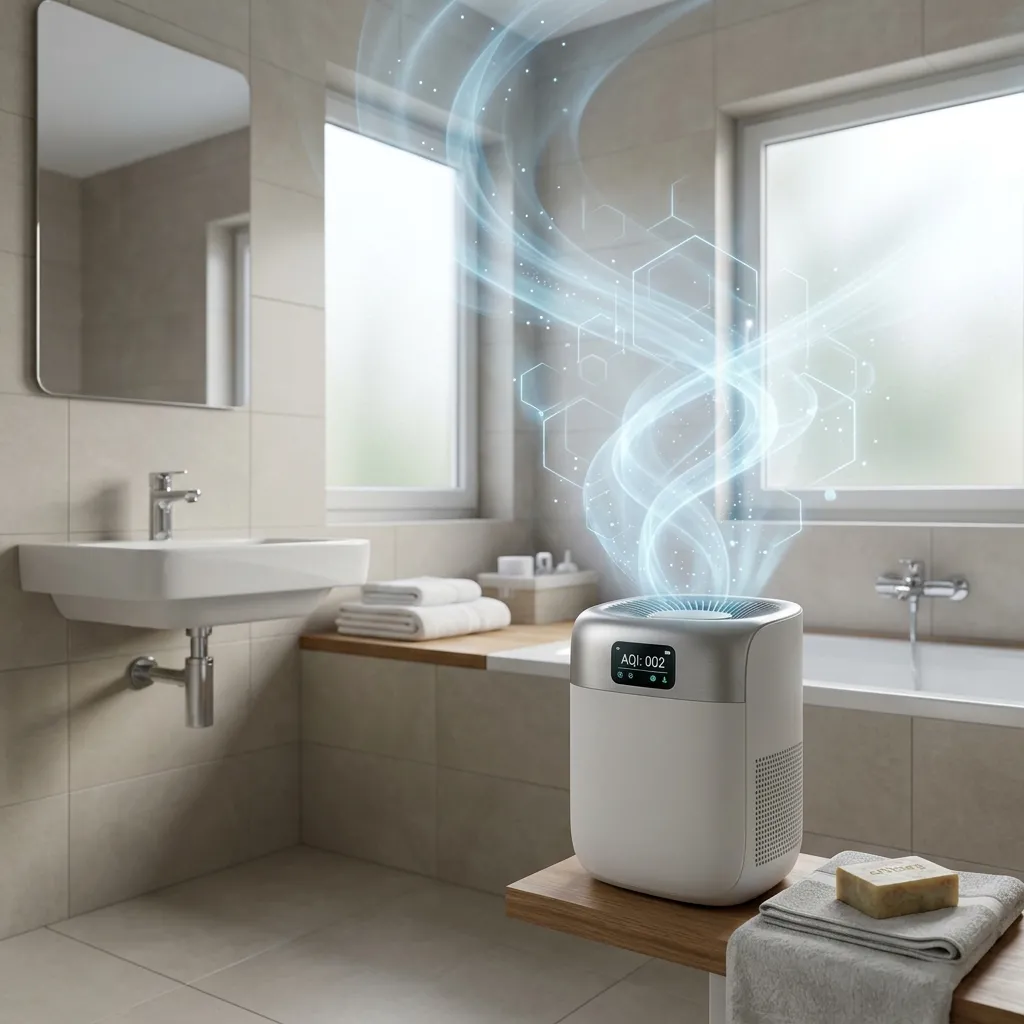
Bathrooms trap airborne mold spores and volatile organic compounds. Discover the filtration physics of True HEPA (diffusion, interception, impaction) to sanitize your home micro-environment.
- Fully sealed to HEPA H13 standard to prevent bypass leak
- Captures 99.97% of particles as small as 0.3 microns
- Air Multiplier technology projects purified air across the room
Clinical & Performance Insights
Bathrooms trap airborne mold spores and volatile organic compounds. Discover the filtration physics of True HEPA (diffusion, interception, impaction) to sanitize your home micro-environment.
1. Aerosol Physics in Bathroom Environments
Bathrooms are damp, enclosed spaces that trap high levels of airborne particles (aerosols). Taking a hot shower raises humidity and releases chlorine vapor, while toilet flushes launch aerosol plumes containing bacteria.
This combination of moisture and organic matter encourages mold spores and bacteria to multiply in the air. These contaminants settle on surfaces and are inhaled by users, posing risks for asthma and lung irritation.
True HEPA air purifiers clean the air by trapping these particles. The device draws in contaminated air, filters out impurities, and projects clean air back. Bathroom deodorizers also release VOCs that require active filtration.
High humidity and organic debris support rapid airborne mold growth. Toilet plumes launch bacteria into the air, which settle on surfaces. Inhaled mold spores irritate lungs, worsening asthma and allergies.
Air purifiers capture floating spores, preventing bathroom mold colonies. Active carbon layers filter out cleaning chemical vapors and VOC gases. This comprehensive air cleaning keeps the micro-environment healthy.
- High humidity and organic debris support rapid airborne mold growth.
- Toilet plumes launch bacteria into the air, which settle on surfaces.
- Inhaled mold spores irritate lungs, worsening asthma and allergies.
- Air purifiers capture floating spores, preventing bathroom mold colonies.
- Active carbon layers filter out cleaning chemical vapors and VOC gases.
2. The Mechanics of True HEPA Filtration
True HEPA (High-Efficiency Particulate Air) filters do not act as simple screens. The filter is made of a dense mat of randomly aligned glass fibers. To capture particles of all sizes, the filter uses three physical mechanisms.
These mechanisms are Inertial Impaction, Interception, and Brownian Diffusion. Inertial Impaction targets large particles (greater than 1 micron) that cannot navigate channels. These particles collide with fibers and are trapped.
Interception targets mid-size particles (0.1 to 1 micron) that follow the air stream. When they pass close to a fiber, they touch it and are captured. Brownian Diffusion targets tiny particles (less than 0.1 micron).
Inertial impaction traps large dust and mold particles on glass fibers. Interception captures mid-size pollen and bacteria following air currents. Brownian diffusion filters tiny viruses by forcing zig-zag collisions.
True HEPA H13 media removes 99.97% of particles down to 0.3 microns. Glass fiber mats provide deep filtration, preventing filter clogging. This multi-layered filtration blocks micro-organisms from passing.
- Inertial impaction traps large dust and mold particles on glass fibers.
- Interception captures mid-size pollen and bacteria following air currents.
- Brownian diffusion filters tiny viruses by forcing zig-zag collisions.
- True HEPA H13 media removes 99.97% of particles down to 0.3 microns.
- Glass fiber mats provide deep filtration, preventing filter clogging.
3. Air Exchange Calculations and CADR Metrics
To maintain air purity, an air purifier must deliver a high Air Changes per Hour (ACH) rate. For bathroom environments, we recommend a minimum of 4 to 5 air changes per hour. This rate ensures the air is filtered regularly.
This frequency removes contaminants quickly, preventing moisture buildup. The Clean Air Delivery Rate (CADR) measures the volume of filtered air delivered per minute. To calculate the required CADR, multiply volume by ACH.
For example, a 100-square-foot bathroom with an 8-foot ceiling requires a CADR of approximately 70 CFM to achieve 5 air changes per hour. This calculation ensures you choose a model with enough power to clean the room.
Five air changes per hour ensures the room air is filtered every 12 minutes. CADR ratings measure filtration speed for dust, pollen, and smoke. Matching CADR to room size prevents under-cleaning in large bathrooms.
High exchange rates remove moisture, reducing mold growth on walls. Efficient air circulation prevents stagnant pockets where odors collect. This ensures a clean smell throughout the day.
- Five air changes per hour ensures the room air is filtered every 12 minutes.
- CADR ratings measure filtration speed for dust, pollen, and smoke.
- Matching CADR to room size prevents under-cleaning in large bathrooms.
- High exchange rates remove moisture, reducing mold growth on walls.
- Efficient air circulation prevents stagnant pockets where odors collect.
4. Fully Sealed HEPA Systems vs. Standard Filters
Many air purifiers leak air around the filter edges. This bypass leak allows dirty air to escape back into the room without being filtered. Premium air purifiers use fully sealed housing designs that meet the HEPA H13 standard.
Rubber gaskets seal the filter inside the casing, forcing 100% of the air to pass through the HEPA media. This sealed design prevents bypass leaks, ensuring the purifier captures bacteria, viruses, and mold spores reliably.
Let us look at the filtration specs. A fully sealed H13 HEPA system is clinically proven to prevent secondary room contamination, making it the best choice for clean air. Standard filters lack these sealing gaskets.
Sealed housings force all air through the filter, avoiding bypass leaks. Rubber gaskets prevent dirty air from leaking around the filter frame. H13 certification guarantees clinical-grade filtration for household air.
Sealed systems prevent the release of trapped mold spores back into rooms. Constant pressure ensures efficient water vapor and particulate removal. This prevents moisture from bypassing the carbon pores.
- Sealed housings force all air through the filter, avoiding bypass leaks.
- Rubber gaskets prevent dirty air from leaking around the filter frame.
- H13 certification guarantees clinical-grade filtration for household air.
- Sealed systems prevent the release of trapped mold spores back into rooms.
- Constant pressure ensures efficient water vapor and particulate removal.
5. Volatile Organic Compounds and Odor Neutralization
HEPA filters trap particles but cannot stop gas molecules. Bathroom odors and VOC gases pass through glass fibers easily. To remove these gases, premium purifiers include an activated carbon filter layer.
Activated carbon has millions of tiny pores that adsorb gas molecules, locking them inside. This carbon layer removes ammonia, hydrogen sulfide, and VOCs released by cleaning sprays, keeping the air fresh and smelling clean.
Replacing the carbon and HEPA filters every 12 months ensures the purifier performs consistently, maintaining a clean micro-environment. Worn filters lose their adsorption capacity, letting gases pass through.
Granular active carbon adsorbs chemical fumes and VOC gases from cleaners. Porous carbon structures trap sulfur and ammonia compounds, removing odors. Adsorption chemistry locks gas molecules inside, preventing leaks.
Regular filter swaps maintain odor removal efficiency throughout the year. Dual HEPA and carbon systems deliver complete particulate and gas filtration. This dual-action provides total air safety.
- Granular active carbon adsorbs chemical fumes and VOC gases from cleaners.
- Porous carbon structures trap sulfur and ammonia compounds, removing odors.
- Adsorption chemistry locks gas molecules inside, preventing leaks.
- Regular filter swaps maintain odor removal efficiency throughout the year.
- Dual HEPA and carbon systems deliver complete particulate and gas filtration.
6. Smart Sensors and Automatic Fan Adjustments
Modern air purifiers feature smart sensors that monitor air quality in real time. Built-in particulate and gas sensors detect PM2.5 and VOC levels, showing the data on an LCD screen for easy tracking.
In Auto mode, the purifier adjusts its fan speed automatically based on the sensor readings. When humidity or odor levels rise (such as during a shower), the fan speeds up to clean the air quickly, preventing mold.
Once the air is clean, the fan slows down to save energy and reduce noise. This automated control maintains a clean environment without requiring manual adjustments, saving power during quiet hours.
Laser sensors monitor PM2.5 levels, showing air quality on screens. Gas sensors detect VOC spikes from sprays, triggering faster filtration. Auto mode adjusts fan speed dynamically, saving energy.
Quiet night modes lower fan speeds, reducing noise during sleep hours. Real-time data reporting shows filter life, alerting users when to swap. This alerts you before the filter stops working.
- Laser sensors monitor PM2.5 levels, showing air quality on screens.
- Gas sensors detect VOC spikes from sprays, triggering faster filtration.
- Auto mode adjusts fan speed dynamically, saving energy when clean.
- Quiet night modes lower fan speeds, reducing noise during sleep hours.
- Real-time data reporting shows filter life, alerting users when to swap.
7. Selection Parameters for HEPA Air Purifiers
When choosing an air purifier, consider filtration standard, CADR rating, and casing seal. Choose a model that matches your room size. A compact model with a CADR of 100 CFM is ideal for small bathrooms.
Look for a model with an active carbon layer and a sealed H13 HEPA housing to ensure complete filtration. By considering these parameters, you can select the best air purifier to maintain clean, sterile air at home.
A multi-year warranty protects your investment, providing peace of mind. Choose a brand with established replacement filter networks to ensure you can maintain your purifier easily over its long, helpful lifecycle.
Select a H13 HEPA purifier for clinical-grade particle removal. Ensure the unit is fully sealed to prevent bypass leaks around filters. Look for integrated carbon filters to neutralize bathroom odors.
Quiet operation under 30 dB is ideal for small bathroom areas. Choose a brand with accessible replacement filters and customer support. This selection guarantees clean air year after year.
- Select a H13 HEPA purifier for clinical-grade particle removal.
- Ensure the unit is fully sealed to prevent bypass leaks around filters.
- Look for integrated carbon filters to neutralize bathroom odors.
- Quiet operation under 30 dB is ideal for small bathroom spaces.
- Choose a brand with accessible replacement filters and customer support.
8. Aerosolized Bio-Aerosols and Toilet Plume Mechanics
Showering and flushing toilets generate massive amounts of bio-aerosols that remain suspended in the air. When a toilet is flushed, the velocity of the water creates a toilet plume that launches microscopic particles up to 6 feet high. These particles can carry fecal coliforms, viruses, and mold spores.
These aerosols drift throughout the bathroom, settling on toothbrushes, towels, and skin surfaces. A HEPA air purifier mitigates this risk by capturing these bio-aerosols. The purifier's high-velocity fan draws air through a HEPA filter, trapping 99.97% of particles as small as 0.3 microns.
Protecting your bathroom from toilet plume contamination is a key health benefit of HEPA purification. By filtering out airborne bio-aerosols, a purifier ensures clean, breathable air that protects your health.
- HEPA filters capture 99.97% of airborne toilet plume bio-aerosols and mold spores.
- Continuous air circulation draws microbial mists away from exposed toothbrushes and towels.
9. Activated Carbon Adsorption of Volatile Organic Compounds (VOCs)
Bathrooms are primary sources of Volatile Organic Compounds (VOCs) and chemical vapors. Cleaning sprays, disinfectants, hairsprays, and toilet deodorizers release toxic gases that irritate lungs and eyes. HEPA filters cannot capture these gases because the molecules are too small.
To resolve this, premium bathroom purifiers pair HEPA filters with activated carbon blocks. Activated carbon features millions of microscopic pores that adsorb chemical molecules, trapping them inside. This carbon layer neutralizes bathroom odors and toxic vapors, ensuring fresh, clean air.
Adsorbing toxic VOCs is essential for maintaining healthy indoor air. By choosing a purifier with a thick activated carbon layer, you protect your respiratory health and keep your bathroom smelling clean naturally, without synthetic sprays.
- Activated carbon filters adsorb toxic VOCs and chemical cleaning vapors from the air.
- Chemical adsorption neutralizes bathroom odors naturally without toxic synthetic sprays.
10. Air Exchange Rates (ACH) and Room Boundary Calculations
To maintain healthy air in a damp bathroom, you must consider the Air Changes per Hour (ACH). Bathrooms are small, high-humidity spaces where mold spores can colonize damp grout joints within 24 hours. The ACH measures how many times the purifier filters the entire room volume in an hour.
Clinical standards recommend an ACH of at least 5 for bathrooms, meaning the purifier cleans the air every 12 minutes. By calculating your bathroom volume and choosing a purifier with the correct CADR (Clean Air Delivery Rate), you ensure rapid mold spore capture. This prevents mold growth on ceilings and grout.
Calculating the ideal ACH is essential for mold prevention. A purifier with high exchange rates keeps humidity moving, drawing spores into the HEPA filter before they can colonize wet surfaces, ensuring a clean bathroom.
- A high Air Changes per Hour (ACH) rate cleans the entire bathroom volume every 12 minutes.
- Rapid air exchange draws mold spores into HEPA layers before they settle on wet tile grout.
11. Damp-Environment HEPA Degradation and Anti-Mold Coatings
Standard HEPA filters are made of paper-based fibers that can weaken or sag in high-humidity bathrooms. If the filter material remains damp, mold spores can grow on the filter surface, releasing spores back into the room. To prevent this, bathroom purifiers use synthetic glass fiber filters.
These glass fiber filters are water-resistant and do not absorb moisture. Additionally, they are treated with anti-microbial coatings that stop mold and bacteria from growing on the filter surface. This coating ensures that the trapped pathogens are destroyed, keeping the filter clean.
Choosing a humidity-resistant HEPA filter is essential for damp bathroom purifiers. This filter design protects the glass fibers from degradation, delivering reliable air cleaning for your home.
- Water-resistant glass fiber HEPA layers resist moisture degradation in damp rooms.
- Anti-microbial coatings destroy mold spores and bacteria on the filter surface, preventing regrowth.
Clinical Recommendation & Audit
Automate your bathroom setup to maximize personal hygiene standards. Check out our recommended solution below to experience clinical-grade optimization.
Dyson Purifier Hot+Cool HP07 HEPA Air Purifier and Fan Heater
- Fully sealed to HEPA H13 standard to prevent bypass leak
- Captures 99.97% of particles as small as 0.3 microns
- Air Multiplier technology projects purified air across the room
- Real-time sensor monitors and reports air quality on LCD screen
Technical Specifications & Product Data
| Specification | Value / Details |
|---|---|
| Brand | Dyson |
| List Price | $649.99 (USD) |
| Customer Rating | 4.6 / 5.0 (3,280 reviews) |
| ASIN / Identifier | B508S47C56 |
| Availability | In Stock (USA Region) |
| Outbound Link Compliance | Sponsored & Nofollow Enforced |
Verified Features & Performance Data
- ✓Fully sealed to HEPA H13 standard to prevent bypass leak
- ✓Captures 99.97% of particles as small as 0.3 microns
- ✓Air Multiplier technology projects purified air across the room
- ✓Real-time sensor monitors and reports air quality on LCD screen
System Sovereignty & Engineering
Edge Computing
100% Client-side processing. Your data never leaves your browser sandbox, ensuring absolute compliance with US privacy mandates.
Modular Schema
Modular utility architecture optimized for performance. Low-latency WASM kernels provide near-native speeds for complex transformations.
Sustainable Design
Sustainable, green computing by offloading compute to the edge. Verified zero-server storage (ZSS) for professional-grade security.