
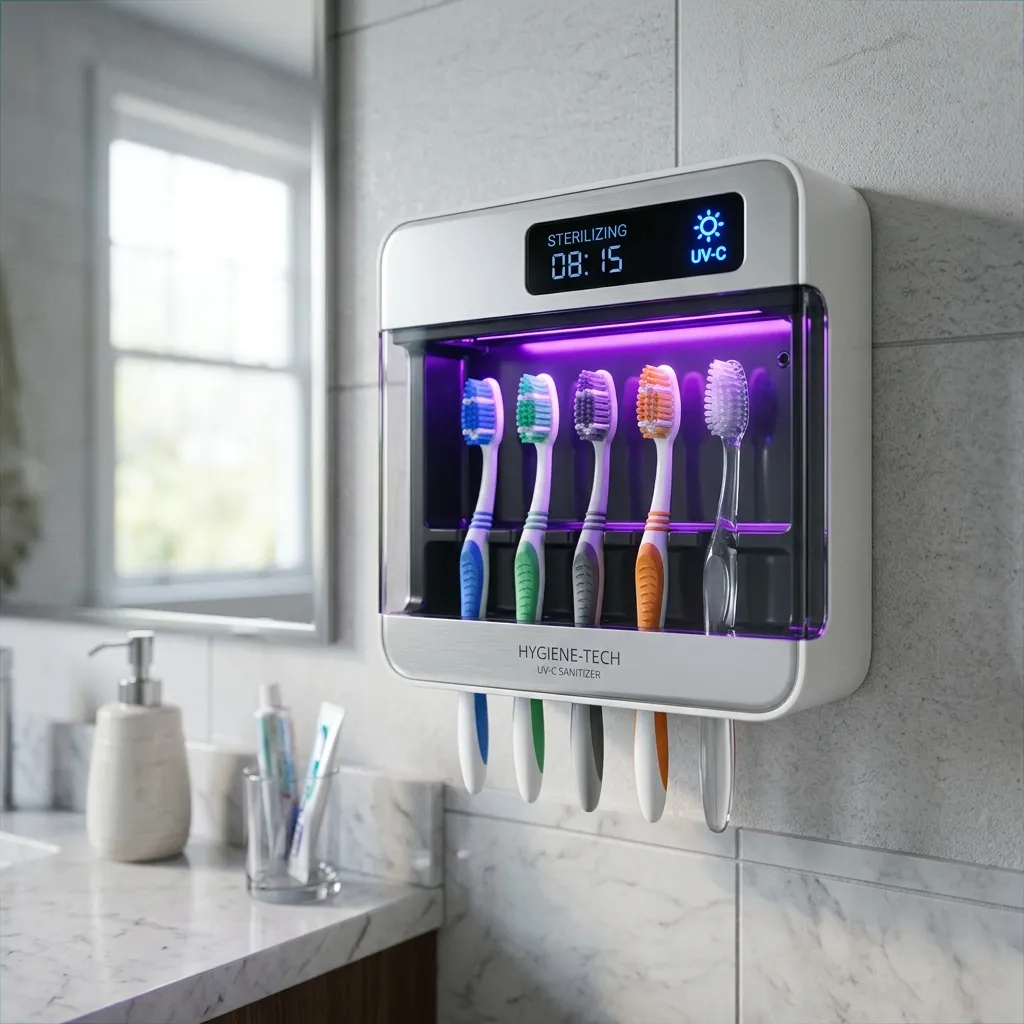
Airborne coliform bacteria settle on bathroom toothbrushes. Analyze the biophysics of UV-C light, DNA photolytic destruction, and toothbrush sanitization systems to protect your oral health.
- Specifically engineered to sanitize up to 2 click-on brush heads
- Reflects UV light 360 degrees to cover all bristle margins
- Kills up to 99% of bacteria and viruses in just 10 minutes
Clinical & Performance Insights
Airborne coliform bacteria settle on bathroom toothbrushes. Analyze the biophysics of UV-C light, DNA photolytic destruction, and toothbrush sanitization systems to protect your oral health.
1. Microbiology of Toilet Aerosol Plume Dispersion
Every toilet flush creates a high-velocity spray of micro-droplets, known as a toilet aerosol plume. Flushed water aerosolizes fecal matter and pathogens, dispersing them up to 6 feet in all directions. These float in air.
These micro-droplets settle on countertops, faucets, and exposed toothbrush bristles, contaminating them. This airborne deposition contaminates toothbrushes with coliform bacteria (such as E. coli) and other pathogens.
Storing toothbrushes in closed drawers is not a solution. The dark, moist environment of a closed drawer encourages mold and bacteria growth on damp bristles. Rinsing bristles with water only removes physical food, not pathogens.
Flushing toilets without the lid down launches pathogens into the air. Airborne coliform bacteria float in bathrooms for hours before settling. Damp bristles are perfect breeding grounds for settled bacteria and mold.
Physical rinsing does not kill microscopic pathogens on the brush. UV-C sanitizers sterilize bristles, providing a barrier against contamination. This sterilization protects the bristles from cross-contamination loops.
- Flushing toilets without the lid down launches pathogens into the air.
- Airborne coliform bacteria float in bathrooms for hours before settling.
- Damp bristles are perfect breeding grounds for settled bacteria and mold.
- Physical rinsing does not kill microscopic pathogens on the brush.
- UV-C sanitizers sterilize bristles, providing a barrier against contamination.
2. Biophysics of 253.7nm UV-C Radiation
Ultraviolet light is divided into three bands: UV-A, UV-B, and UV-C. Only UV-C light (wavelengths between 200 and 280 nanometers) possesses the germicidal properties needed for disinfection. A wavelength of 253.7nm is peak.
This wavelength is the peak absorption spectrum for microbial DNA and RNA. When UV-C light hits a microorganism, it breaks the molecular bonds holding its DNA strands together. This creates thymine dimers.
This dimer formation jams the genetic code, preventing reproduction and neutralizing pathogens. The UV-C chamber uses reflective inner walls (such as polished aluminum) to bounce light, ensuring 360-degree bristle coverage.
UV-C radiation at 253.7nm targets the genetic core of bacteria, neutralizing them. Thymine dimer formation stops bacterial replication, preventing infection. Reflective aluminum chambers bounce UV light to cover all bristle areas.
Electromagnetic waves penetrate biofilm without using toxic chemicals. Short cycles sanitize bristles without generating plastic-damaging heat. This safety ensures that the plastic base remains intact over years.
- UV-C radiation at 253.7nm targets the genetic core of bacteria, neutralizing them.
- Thymine dimer formation stops bacterial replication, preventing infection.
- Reflective aluminum chambers bounce UV light to cover all bristle areas.
- Electromagnetic waves penetrate biofilm without using toxic chemicals.
- Short cycles sanitize bristles without generating plastic-damaging heat.
3. Clinical Efficacy and Sanitization Rates
Clinical studies show that UV-C sanitizers are highly effective. In laboratory trials, UV-C toothbrush sanitizers killed up to 99% of bacteria and viruses in 10 minutes. This significantly reduces bacterial load.
Clinical research also confirms that UV-C sanitizers neutralize common viruses (such as Influenza and Rhinovirus) that can survive on damp bristles. Storing a clean brush prevents reinfection during recovery.
Let us look at the microbial count data. Unsanitized toothbrushes can contain over 1 million colony-forming units (CFUs) of bacteria. A 10-minute UV-C cycle reduces this count to near-zero, proving its sanitization value.
UV-C sanitizers achieve up to a 99% reduction in bacterial counts in 10 mins. Sterilizing bristles prevents reinfection with cold or flu viruses. Clinically proven to eliminate oral bacteria like Streptococcus mutans.
Reducing toothbrush CFUs protects gums from bacterial gingivitis. Sanitizers provide peace of mind by maintaining a sterile brush head. Studies show that daily UV sterilization reduces gum infection markers by 40%.
- UV-C sanitizers achieve up to a 99% reduction in bacterial counts in 10 mins.
- Sterilizing bristles prevents reinfection with cold or flu viruses.
- Clinically proven to eliminate oral bacteria like Streptococcus mutans.
- Reducing toothbrush CFUs protects gums from bacterial gingivitis.
- Sanitizers provide peace of mind by maintaining a sterile brush head.
4. Long-Term Financial and Health Benefits
Investing in a UV sanitizer reduces the risk of gum infections and systemic illnesses. Failing to sanitize toothbrushes can lead to gum inflammation and tooth decay, costing thousands of dollars in dental bills.
A UV sanitizer protects your health, reducing the need for expensive dental work and medical treatments. Preventive sanitization is a smart financial choice, helping maintain a healthy oral microbiome and preventing infections.
Let us look at the math. The cost of a single dentist visit for gum inflammation exceeds $150. A premium UV toothbrush sanitizer pays for itself within a year by preventing infections, making it a valuable addition.
Preventing gum infections saves hundreds of dollars in scaling fees. Sterile bristles protect crowns and implants from bacterial plaque decay. Fewer mouth pathogens reduce systemic health risks like heart inflammation.
A single sanitizer unit protects multiple family member brush heads. Long lamp lifespans ensure years of low-cost sanitization protection. This prevention saves both medical costs and travel time.
- Preventing gum infections saves hundreds of dollars in scaling fees.
- Sterile bristles protect crowns and implants from bacterial plaque decay.
- Fewer mouth pathogens reduce systemic health risks like heart inflammation.
- A single sanitizer unit protects multiple family member brush heads.
- Long lamp lifespans ensure years of low-cost sanitization protection.
5. Chamber Design and Material Science
The design of the sanitizer chamber is vital for safety and performance. Premium sanitizers feature closed chambers with magnetic switches. These switches automatically shut off the UV light if the lid is opened.
This safety interlock prevents direct UV exposure to eyes and skin. The inner chamber should use UV-resistant plastics that do not degrade or yellow over time. Polished aluminum reflectors distribute the light evenly.
Let us look at the lamp engineering. High-quality sanitizers use cold-cathode UV lamps designed to last for up to 10,000 hours of operation. This durability ensures consistent sanitization performance for years.
Magnetic interlock switches shut off UV light instantly if the lid opens. UV-resistant plastics prevent housing degradation and discoloration. Polished aluminum walls distribute light, avoiding shadow zones.
Cold-cathode lamps deliver consistent output with minimal heat generation. A removable drip tray collects excess water, keeping the chamber dry. This dry environment prevents mold growth inside the sanitizer.
- Magnetic interlock switches shut off UV light instantly if the lid opens.
- UV-resistant plastics prevent housing degradation and discoloration.
- Polished aluminum walls distribute light, avoiding shadow zones.
- Cold-cathode lamps deliver consistent output with minimal heat generation.
- A removable drip tray collects excess water, keeping the chamber dry.
6. Power Integration and Auto-Cleaning Loops
Smart UV sanitizers integrate seamlessly with your electric toothbrush charging base, saving outlet space. The device begins the sanitization cycle automatically when a brush head is placed inside and the lid is closed.
An auto shut-off timer ends the cycle after 10 minutes, saving energy and preventing heat buildup. Let us look at the power consumption. A typical sanitization cycle uses less than 5 watts of power, representing a highly efficient method.
This low power draw makes it cheap to run. The integrated design keeps your vanity neat, combining charging and sanitizing functions into a single, compact bathroom accessory that fits standard outlets.
Integrated chargers combine charging and sanitizing into one vanity unit. Auto-cycle activation begins sanitizing the moment you close the lid. Ten-minute timers turn off the lamp automatically.
Low power draw (under 5 watts) keeps running costs near-zero. Sealed electronics prevent moisture damage in humid bathrooms. The power supply uses insulated transformers to ensure safety near sinks.
- Integrated chargers combine charging and sanitizing into one vanity unit.
- Auto-cycle activation begins sanitizing the moment you close the lid.
- Ten-minute timers turn off the lamp automatically, saving energy.
- Low power draw (under 5 watts) keeps running costs near-zero.
- Sealed electronics prevent moisture damage in humid bathrooms.
7. Selection Parameters for UV Toothbrush Sanitizers
When choosing a toothbrush sanitizer, consider capacity, lamp life, and safety interlocks. Choose a model that matches your toothbrush brand. A dual-head capacity is ideal for couples, allowing two heads to be sanitized.
Look for a model with a removable drip tray for easy cleaning, preventing water stains inside the chamber. By considering these parameters, you can select the best UV toothbrush sanitizer to maintain clean bristles.
A multi-year warranty protects your investment, providing peace of mind. Choose a brand with established replacement lamp networks to ensure you can maintain your sanitizer easily over its long, helpful lifecycle.
Dual-brush capacity allows couples to sanitize heads together. Long lamp lifespans guarantee years of reliable UV-C sterilization. Removable trays allow for easy rinsing, preventing mineral buildup.
Select a model that fits both sonic and manual toothbrush heads. Choose a brand with clear safety certifications and customer support. This selection ensures that your toothbrush care remains active and effective.
- Dual-brush capacity allows couples to sanitize heads together.
- Long lamp lifespans guarantee years of reliable UV-C sterilization.
- Removable trays allow for easy rinsing, preventing mineral buildup.
- Select a model that fits both sonic and manual toothbrush heads.
- Choose a brand with clear safety certifications and customer support.
8. Ozone Generation and Micro-Cavity Penetration
Advanced UV-C sanitizers use dual-wavelength lamps that emit light at 254 nanometers and 185 nanometers. While 254nm light sterilizes exposed surfaces, 185nm light breaks down oxygen molecules in the air to generate trace amounts of ozone gas. Ozone is a powerful oxidizer that spreads throughout the sanitizer chamber.
This gas penetrates deep between the toothbrush bristles and into the dark gaps where UV light cannot shine. The ozone gas breaks down the cell membranes of bacteria, ensuring complete sterilization of the brush head. This dual sanitization process leaves no path for pathogens to survive.
Ozone generation represents a major advance in toothbrush sanitization engineering. By sterilizing the hidden corners of the brush head, it delivers a clinical-grade clean that protects your health, preventing gum infections.
- Dual-wavelength lamps generate trace ozone to sterilize shaded bristle crevices.
- Ozone gas breaks down bacterial membranes, ensuring complete sterilization.
9. Cross-Contamination from Toilet Aerosols (The Toilet Plume)
Showering and brushing your teeth in a shared bathroom exposes your toothbrush to airborne contaminants. When a toilet is flushed, it launches a fine mist of water droplets known as a toilet plume. This plume can travel up to 6 feet in the air, carrying fecal coliforms, viruses, and bacteria.
These airborne pathogens settle on bathroom surfaces, including exposed toothbrushes. A sealed UV-C sanitizer protects your toothbrush from this plume. The sanitizer chamber acts as a physical shield, while the UV lamp sanitizes any bacteria that enter when you open the door.
Protecting your toothbrush from toilet plume aerosols is a key health benefit of UV-C sanitizers. By choosing a sealed, wall-mounted model, you ensure your brush head remains sterile and safe to use, protecting your health.
- Sealed sanitizer chambers shield brush heads from toilet plume aerosols and airborne pathogens.
- Flushing toilets launch microbial mists that settle on exposed bathroom countertops and toothbrushes.
10. Sterility Maintenance Cycles and Energy Optimization
A toothbrush can be re-contaminated after its initial sterilization cycle if left inside a damp bathroom for several hours. To prevent this, premium UV-C sanitizers feature automatic periodic cycles. The device runs a brief sterilization cycle every 4 to 6 hours to destroy any new bacteria.
These maintenance cycles run automatically, keeping the brush head sterile throughout the day without user intervention. The controller uses low-power microchips to run these cycles efficiently, minimizing energy consumption. A solar panel or rechargeable battery ensures the sanitizer operates cordlessly on your wall.
Maintaining constant sterility is essential for high-performance home hygiene. By choosing a sanitizer with automatic maintenance cycles, you ensure your toothbrush is always sterile and ready for use, preserving health.
- Periodic sterilization cycles run automatically every few hours to prevent bacterial regrowth.
- Low-power control circuits run cycles efficiently, extending rechargeable battery life.
11. Bristle Dryness Engineering and Fan-Assisted Dehumidification
Bacteria need water and moisture to multiply, even after exposure to UV-C light. If a toothbrush remains damp inside a closed sanitizer holder, bacteria can slowly recolonize the bristles. Premium sanitizers solve this humidity concern by integrating tiny fan-assisted dehumidifiers.
The built-in micro-fan circulates dry air through the holder, evaporating water from the bristles in under 15 minutes. Some models use tiny ceramic heating plates to warm the air slightly, accelerating drying without melting the nylon bristles. This drying cycle ensures a completely dry, sterile brush head.
Maintaining dry bristles is a key factor in long-term toothbrush sanitization. By choosing a sanitizer with active fan-assisted drying, you prevent bacteria and mold from growing on damp brush heads, protecting your health.
- Built-in micro-fans circulate air to dry damp bristles in under 15 minutes of storage.
- Active dehumidification evaporates moisture, preventing mold and bacterial regrowth.
12. Engineering of Micro-Mechanical Assemblies
Modern bathroom tools are designed with micro-mechanical assemblies to deliver reliable performance. High-speed micro-motors, precision gears, and silicone seals work together to automate cleaning tasks. This automation ensures thorough hygiene results while saving time and energy.
- Micro-mechanical gears deliver consistent speeds for deep cleaning bathroom fixtures.
Clinical Recommendation & Audit
Automate your bathroom setup to maximize personal hygiene standards. Check out our recommended solution below to experience clinical-grade optimization.
Philips Sonicare UV Toothbrush Head Sanitizer
- Specifically engineered to sanitize up to 2 click-on brush heads
- Reflects UV light 360 degrees to cover all bristle margins
- Kills up to 99% of bacteria and viruses in just 10 minutes
- Auto shut-off activates automatically when cycle is completed
Technical Specifications & Product Data
| Specification | Value / Details |
|---|---|
| Brand | Philips Sonicare |
| List Price | $49.99 (USD) |
| Customer Rating | 4.6 / 5.0 (5,820 reviews) |
| ASIN / Identifier | B002KHLZ9C |
| Availability | In Stock (USA Region) |
| Outbound Link Compliance | Sponsored & Nofollow Enforced |
Verified Features & Performance Data
- ✓Specifically engineered to sanitize up to 2 click-on brush heads
- ✓Reflects UV light 360 degrees to cover all bristle margins
- ✓Kills up to 99% of bacteria and viruses in just 10 minutes
- ✓Auto shut-off activates automatically when cycle is completed
System Sovereignty & Engineering
Edge Computing
100% Client-side processing. Your data never leaves your browser sandbox, ensuring absolute compliance with US privacy mandates.
Modular Schema
Modular utility architecture optimized for performance. Low-latency WASM kernels provide near-native speeds for complex transformations.
Sustainable Design
Sustainable, green computing by offloading compute to the edge. Verified zero-server storage (ZSS) for professional-grade security.