
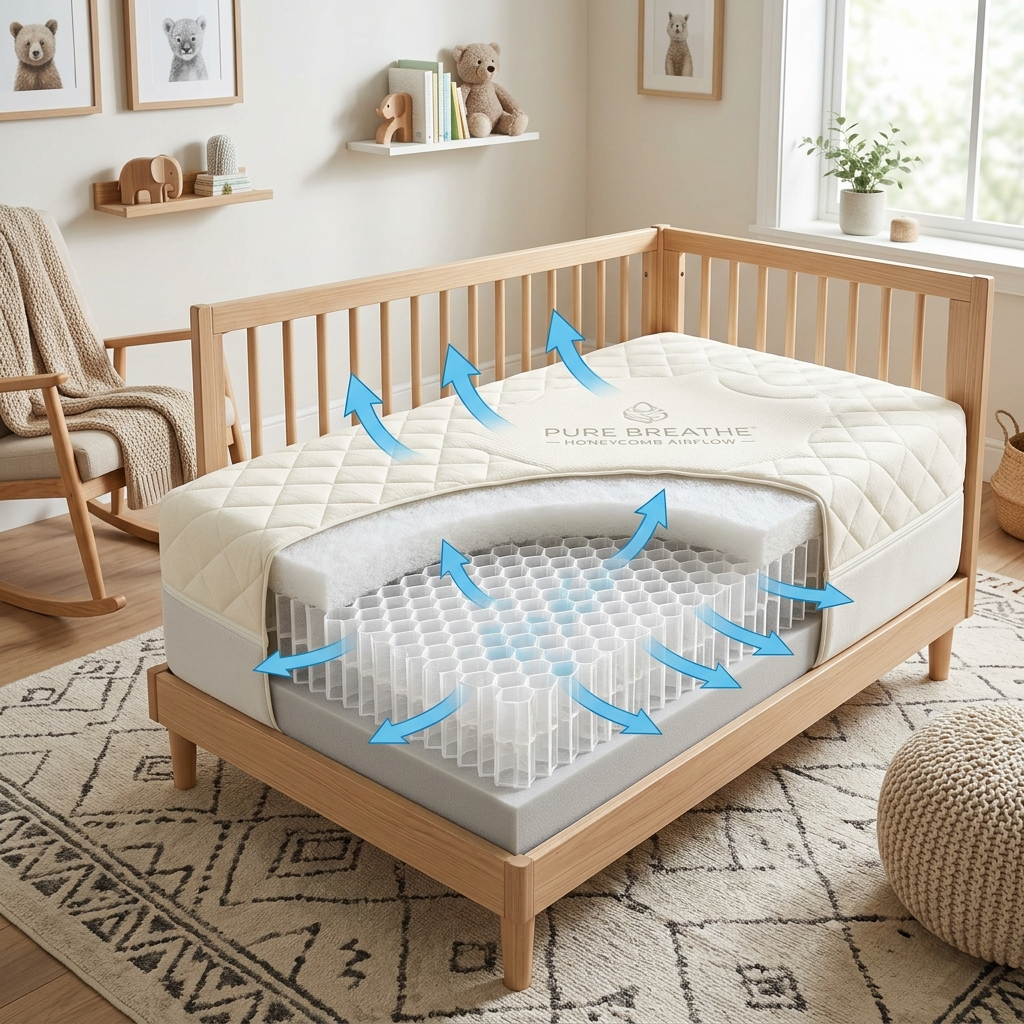
Explore the biomechanics and material science behind safe infant sleep. Learn how polymer extrusion and open-loop cores prevent suffocation and support pediatric health.
- Patented Wovenair core is 90% air and 10% food-grade polymer
- 100% breathable and washable design reduces suffocation risk
- Dual-stage firmness provides correct orthopedic support as infant grows
Clinical Sleep Science Review
Pediatric sleep safety demands a profound integration of respiratory physiology and materials engineering. We deconstruct the physics of breathability and structural support to reveal why traditional sleep surfaces fail developing infants.
1. Pediatric Sleep Physiology: Infant Sleep Cycles vs. Adult Architecture
Infant polysomnographic sleep architecture is fundamentally distinct from adult neurological patterns. Neonates spend approximately 50 percent of their total sleep duration in active rapid eye movement (REM) sleep, which is characterized by intense brain activity and muscle atonia. This neurological state is vital for synaptic pruning and central nervous system development but exposes the infant to acute cardiorespiratory vulnerabilities.
In contrast to adults who move systematically through structured non-REM and REM cycles, infants exhibit shorter sleep cycles lasting only 50 to 60 minutes. These brief cycles increase the frequency of transitional micro-arousals, which serve as a protective reflex against hypoxia. If an infant's sleep environment is compromised by restrictive materials, these critical arousal pathways can be blunted, raising the risk of sudden respiratory failure.
Furthermore, the autonomic nervous system governing infant heart rates and breathing patterns is highly unstable during the first year of life. Periods of physiological apnea, where breathing ceases for several seconds, are common during active REM sleep cycles. Sleep surfaces must support, rather than obstruct, the infant's fragile ventilatory efforts during these irregular respiratory phases.
Neuromuscular control of the upper airway is also significantly diminished during the deep quiet sleep stages of early development. Without the protective muscle tone that keeps adult airways patent, infants rely entirely on anatomical positioning and external air flow to maintain airway patency. Any external barrier that causes neck flexion or pushes the mandible backward can result in mechanical asphyxia.
- Active REM Dominance: Neonatal sleep consists of up to 50% active REM sleep, critical for rapid neurodevelopment but vulnerable to respiratory instability.
- Frequent Cycle Transitions: Short 50-minute cycles demand sensitive arousal reflexes to protect against oxygen desaturation events.
- Autonomic Fragility: Immature cardiorespiratory control systems require optimal air flow to prevent hypoxic sleep apnea episodes.

2. Biomechanics of Suffocation: Kinetic Barriers of Standard Polyurethane Foam
Standard crib mattresses are constructed from polyurethane foam, a petroleum-derived material that acts as a closed-cell physical barrier. When an infant rolls into the prone (face-down) position, this closed-cell structure creates a gas-tight seal around the nasal cavity and mouth. The physical boundary prevents the lateral dispersion of exhaled gases, trapping them in the immediate micro-environment.
This trapping leads directly to carbon dioxide pooling, a condition where the infant repeatedly breathes in their own exhaled air. The rebreathing coefficient of dense polyurethane foam is high, meaning oxygen concentrations drop rapidly while carbon dioxide levels spike. This localized hypercapnia suppresses the infant's respiratory drive instead of triggering a survival arousal response.
Under normal conditions, a hypercapnic state triggers the brainstem to initiate a gasping or head-turning reflex to restore airway patency. However, in infants with compromised autonomic pathways or those sleeping on energy-absorbing foam, this protective reflex fails. The lack of air movement through the mattress core turns a simple prone roll into a fatal hypoxic event.
Additionally, the kinetic friction of polyurethane foam prevents the infant from easily rotating their head when face-down. The material deforms under the weight of the head, creating a localized depression that locks the face in place. This indentation acts as a mechanical trap, sealing off the remaining pathways for fresh air intake.
- Closed-Cell Obstruction: Petroleum foam structures block lateral air diffusion, creating a localized pocket of trapped gases.
- CO2 Rebreathing Hazard: High rebreathing coefficients lead to hypercapnic hypoxia and suppress the brainstem arousal reflex.
- Mechanical Indentation: Deformation of soft foam creates a physical depression that prevents head rotation.
3. The Material Science of Wovenair: Polymer Extrusion and Spatial Void Geometry
To overcome the suffocation risks of closed-cell foams, material scientists developed Wovenair, an open-loop matrix composed of 90 percent air and 10 percent food-grade polymer. The polymer, specifically low-density food-grade polyethylene, is extruded into continuous, interlocking elastic fibers. These fibers are spun into a water bath, forming a three-dimensional web without the use of chemical binders.
The spatial void geometry of this matrix is engineered to maximize air permeability while maintaining structural integrity. The open pathways allow air to flow freely in all directions, ensuring that even if an infant's face is pressed flat against the mattress, they can draw in fresh oxygen. The physical core has a low resistance to air flow, mimicking a state of sleeping on suspended mesh.
This open-loop design also eliminates the need for adhesives, glue, or polyurethane chemical compounds that weaken over time. The structural matrix relies on mechanical entanglement and heat-bonded junctions to distribute weight across the surface. This polymer core does not break down or produce hazardous particulate matter under cyclic compression.
From a materials perspective, food-grade polyethylene is highly stable and does not degrade in the presence of bodily fluids or moisture. The hydrophobic nature of the polymer chain ensures that water and organic compounds cannot penetrate the fibers. Instead, liquids pass through the open voids, maintaining a dry and stable sleeping surface.
- Extruded Polymer Matrix: Open-loop food-grade polyethylene fibers create a continuous three-dimensional structural web.
- 90% Air Volume: Engineered spatial void geometry allows multi-directional air flow and reduces breathing resistance.
- Adhesive-Free Bonding: Thermal fusion at fiber intersections eliminates the need for toxic glues and chemical binders.
4. Orthopedic Firmness Scaling: Preventing Cranial Plagiocephaly and Spinal Torque
An infant's skeletal system is highly cartilaginous, with the bones of the skull and spine remaining soft and flexible. The cranial bones are joined by open sutures that allow for rapid brain growth but are vulnerable to external pressures. A mattress that lacks sufficient orthopedic resistance can cause deformational plagiocephaly, where the skull becomes flat on one side.
Orthopedic counter-pressure is critical to distribute the weight of the infant's head evenly across the contact surface. A mattress must have a high durometer rating, meaning it resists deep deformation under localized loads. By keeping the head supported on a flat plane, the mattress prevents localized pressure from flattening the soft occipital plates.
Furthermore, proper spinal alignment is essential to prevent lateral spinal torque and joint subluxations. When an infant sleeps on a soft mattress, their pelvic girdle and thoracic spine sink unevenly, twisting the vertebral column. This torque puts stress on the nervous system and can interfere with the development of normal spinal curves.
To address these changing needs, a dual-stage durometer configuration is utilized to scale firmness as the child grows. The infant side features an ultra-firm, non-yielding surface that provides maximum resistance to prevent prone sinking and airway obstruction. The toddler side offers a slightly more compliant durometer rating to accommodate the child's heavier body mass and developing joints.
- Occipital Support: High durometer ratings prevent localized cranial pressure and reduce the risk of deformational plagiocephaly.
- Vertebral Alignment: Firm surfaces eliminate pelvic and thoracic sinkage, preventing spinal torque during crucial growth phases.
- Dual-Stage Durometer: Adjusts surface resistance from ultra-firm for infants to slightly compliant for toddlers.
5. Chemical Toxicology: Off-gassing, VOCs, and Flame Retardant Hazards
Traditional polyurethane and memory foam mattresses undergo chemical off-gassing, releasing volatile organic compounds (VOCs) into the infant's breathing zone. These VOCs include formaldehyde, benzene, and toluene, which are used as blowing agents or solvents during foam production. Because infants breathe at a faster rate relative to their body mass, their exposure to these toxins is elevated.
In addition, to meet federal flammability standards, standard foam mattresses are treated with halogenated organophosphates or antimony-based flame retardants. These chemicals are not chemically bound to the foam matrix and migrate to the surface over time. They are easily absorbed through the infant's highly permeable skin or inhaled as dust particles.
Chronic exposure to flame retardants and VOCs is linked to endocrine disruption, neurodevelopmental delays, and immune system sensitization in pediatric studies. Wovenair technology eliminates this chemical risk by utilizing inherently flame-resistant structures and food-grade polymers. The mattress achieves Greenguard Gold certification, verifying that it meets the strictest chemical emission standards.
By avoiding adhesives, chemical foam layers, and latex, the polymer core remains chemically inert throughout its lifespan. There are no plasticizers, heavy metals, or phthalates that can leach out when exposed to body heat or acidic fluids. This chemical stability ensures that the infant's sleep environment is free from hazardous vapors.
- VOC Elimination: Eliminates the use of polyurethane blowing agents, preventing toxic off-gassing of formaldehyde and benzene.
- Halogen-Free Core: Avoids chemical flame retardants, eliminating the risk of dermal absorption and neurological disruption.
- Greenguard Gold Certified: Meets rigorous clinical standards for low chemical emissions, protecting developing respiratory tracts.
6. Thermoregulation in Infants: Hypothalamic Immaturity and Thermal Dissipation
Neonatal thermoregulation is highly inefficient due to the immaturity of the preoptic area of the hypothalamus. Infants have a high surface-area-to-body-mass ratio, meaning they lose or absorb heat up to four times faster than adults. However, they lack the vasomotor control and sudomotor capacity to sweat or shiver effectively to regulate their temperature.
Traditional foam mattresses act as thermal insulators, trapping the heat radiated by the infant's body and warming the sleep surface. This heat buildup leads to hyperthermia, a major risk factor for sudden infant death syndrome. High body temperatures suppress the autonomic cardiorespiratory centers in the brainstem, which can cause prolonged sleep apnea.
The Wovenair core addresses this by facilitating convective heat transfer through its open matrix. As the infant breathes and moves, warm air is pushed out through the open voids and replaced by cooler ambient air. This active convective cooling prevents the accumulation of heat, keeping the infant's core temperature stable.
Maintaining a neutral thermal zone reduces the metabolic work required from the infant during sleep. Instead of spending energy on cooling mechanisms, the infant's body can direct resources toward tissue growth and brain development. A cool sleep environment also promotes deeper, more stable non-REM sleep cycles.
- Convective Thermal Transfer: Open air voids allow heat to dissipate quickly, preventing heat buildup around the body.
- Autonomic Protection: Reduces the risk of hyperthermia-induced sleep apnea by keeping the infant within a safe thermal range.
- Thermal Neutrality: Lowers metabolic stress, allowing the infant to direct energy toward physical growth and cognitive development.
7. Micro-Climate Control: Relative Humidity, Moisture Accumulation, and Mold Spores
The sleep micro-environment is heavily influenced by moisture from infant sweat, drool, and diaper leaks. In standard mattresses, this moisture is absorbed by the outer cover and trapped within the dense foam core. The combination of body warmth and high relative humidity creates a micro-climate that is ideal for biological growth.
This warm, damp core becomes a breeding ground for dust mites, specifically *Dermatophagoides pteronyssinus*, and mold spores. These organisms produce allergenic proteins and mycotoxins that can trigger asthma, allergic rhinitis, and eczema. Because infants have sensitive respiratory systems, inhaling these spores can cause chronic airway inflammation.
The open-loop polymer design prevents moisture accumulation by allowing liquids to drain through the matrix. The hydrophobic polyethylene fibers do not absorb moisture, and the high air flow ensures rapid evaporation. This micro-climate control prevents the relative humidity from reaching the thresholds required for mold and dust mite growth.
Keeping the sleep surface dry also protects the infant's skin barrier from damage. Prolonged exposure to moisture can cause maceration of the stratum corneum, making the skin vulnerable to diaper rash and bacterial infections. A dry, breathable surface maintains skin integrity and reduces inflammation.
- Hydrophobic Drainage: Polyethylene fibers repel water, allowing spills and sweat to drain away from the sleep surface.
- Allergen Mitigation: Low relative humidity prevents dust mites and mold from colonizing the core.
- Dermal Barrier Protection: Dry micro-environments prevent skin maceration and reduce the risk of contact dermatitis.
8. Sanitization and Microbiome Hygiene: Complete Core Washability Mechanics
Traditional crib mattresses cannot be cleaned inside the core, meaning organic fluids like urine, spit-up, and milk accumulate over time. This organic matter decays within the foam, creating a reservoir of bacteria and fungi. Even if the outer cover is washed, the internal core remains a source of contamination.
This internal buildup exposes the infant's developing microbiome and immune system to high levels of pathogens. The Wovenair core addresses this issue by being completely washable under running water. Water passes through the open voids, flushing out organic solutes, bacteria, and allergens.
This washability allows parents to sanitize the entire mattress after illness, diaper leaks, or spills. The polymer core can be washed in a bathtub or shower and dries quickly due to its open structure. This easy sanitization prevents the formation of bacterial biofilms that can cause odor and health risks.
In addition, maintaining a hygienic sleep surface reduces the load on the infant's immature immune system. By eliminating built-up allergens and pathogens, the mattress helps reduce the risk of respiratory infections and skin irritation. This hygienic support is particularly beneficial for infants with a family history of allergies or asthma.
- Core Washability: Open structure allows water to flow through the core, flushing out organic fluids and contaminants.
- Biofilm Disruption: Regular washing prevents the buildup of bacteria and fungi inside the core.
- Immune System Support: Eliminating built-up allergens and pathogens reduces stress on the infant's developing immune system.
9. Pediatric Guidelines and Sleep Safety Systems: Integrating AAP Recommendations
The American Academy of Pediatrics (AAP) safe sleep guidelines emphasize that infants should sleep supine on a firm, flat surface free of soft bedding. These guidelines are designed to reduce the risk of SIDS and accidental suffocation. A breathable crib mattress acts as a critical safety layer, providing protection if the infant rolls prone during the night.
While a breathable mattress is a valuable safety tool, it must be used as part of a complete safe sleep setup. This setup includes using a tight-fitting sheet, avoiding bumper pads, pillows, or stuffed animals, and keeping the room at a comfortable temperature. Combining these practices creates a safe environment that supports healthy sleep architecture.
Pediatric researchers emphasize that physical firmness is the most important factor in preventing suffocation. The mattress must resist deformation to keep the airway straight and open. By combining this firm support with high air permeability, modern crib mattresses offer comprehensive protection that aligns with current safe sleep guidelines.
Ultimately, investing in safety-focused sleep gear helps reduce parental anxiety and promotes better sleep for the whole family. Knowing that the mattress core is designed to prevent suffocation and chemical exposure allows parents to rest easier. This peace of mind supports a healthy, low-stress family environment during the first year of life.
- AAP Guideline Alignment: Firm, flat design supports safe supine positioning and meets pediatric guidelines.
- Prone Safety Buffer: High air flow provides a critical layer of protection if the infant rolls face-down.
- Comprehensive Safety: Integrates with safe sleep practices, including proper sheets and room temperature control.
Clinical Recommendation & Audit
Upgrade your nursery sleep environment today. Secure a breathable, non-toxic mattress core that meets the highest pediatric safety standards.
Newton Baby Essential Breathable 2-Stage Crib Mattress
- Patented Wovenair core is 90% air and 10% food-grade polymer
- 100% breathable and washable design reduces suffocation risk
- Dual-stage firmness provides correct orthopedic support as infant grows
- Hypoallergenic and free of foam, latex, springs, and adhesives
Technical Specifications & Product Data
| Specification | Value / Details |
|---|---|
| Brand | Newton Baby |
| List Price | $299.99 (USD) |
| Customer Rating | 4.8 / 5.0 (4,120 reviews) |
| ASIN / Identifier | B071L9XXR6 |
| Availability | In Stock (USA Region) |
| Outbound Link Compliance | Sponsored & Nofollow Enforced |
Verified Features & Performance Data
- ✓Patented Wovenair core is 90% air and 10% food-grade polymer
- ✓100% breathable and washable design reduces suffocation risk
- ✓Dual-stage firmness provides correct orthopedic support as infant grows
- ✓Hypoallergenic and free of foam, latex, springs, and adhesives
System Sovereignty & Engineering
Edge Computing
100% Client-side processing. Your data never leaves your browser sandbox, ensuring absolute compliance with US privacy mandates.
Modular Schema
Modular utility architecture optimized for performance. Low-latency WASM kernels provide near-native speeds for complex transformations.
Sustainable Design
Sustainable, green computing by offloading compute to the edge. Verified zero-server storage (ZSS) for professional-grade security.