
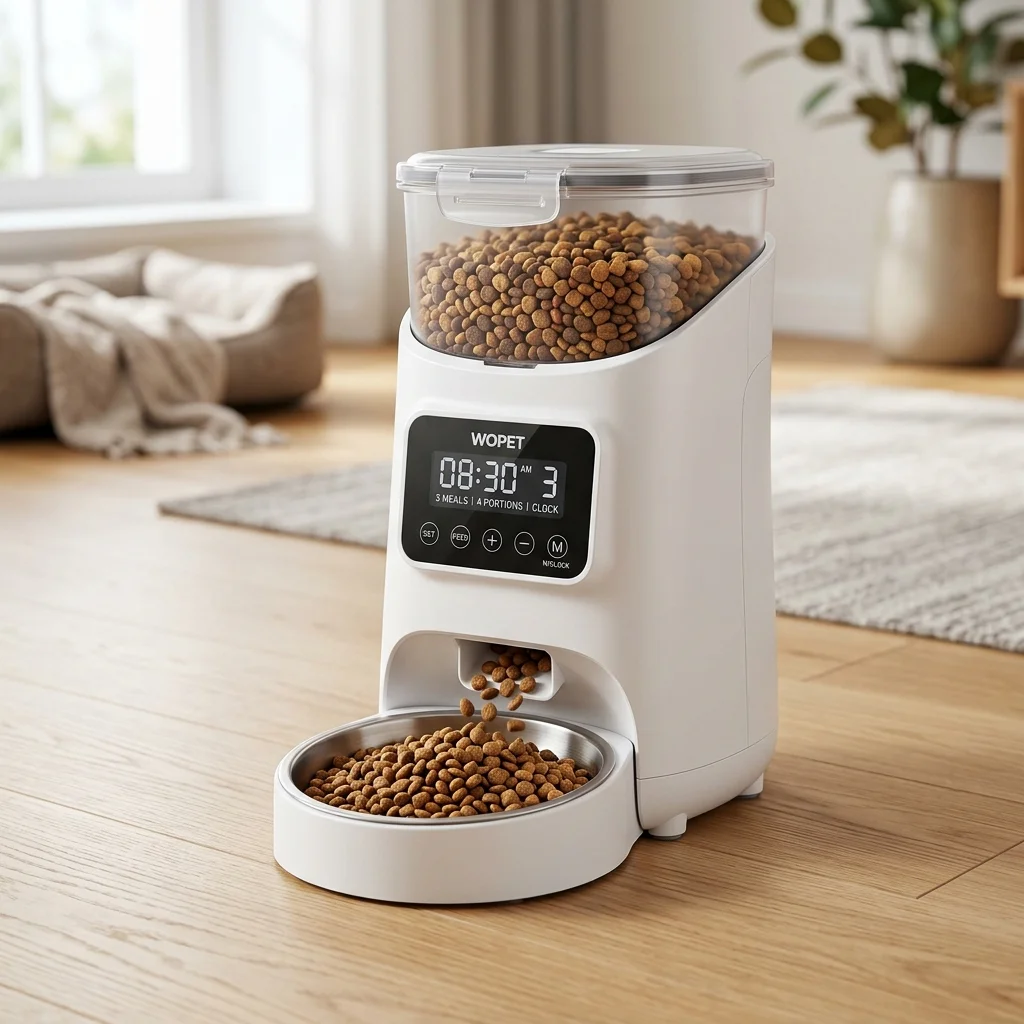
Automated pet feeding relies on precise mechanical leverage and portion calibration. Analyze rotary impeller dynamics, anti-jam mechanisms, and nutritional preservation.
- Customizable portion control from 1 to 39 portions per meal
- Built-in voice recorder and speaker for personal callout loops
- Dual power supply options via wall adapter and D-cell batteries
Pet Technology Audit
Automated pet feeding relies on precise mechanical leverage and portion calibration. Analyze rotary impeller dynamics, anti-jam mechanisms, and nutritional preservation.
1. Biomechanical Portion Calibration and Rotary Impeller Dynamics
Precision nutrition in domestic pets requires exact caloric regulation to prevent obesity and metabolic disorders. Manual scoop measurements introduce up to a 20% variance in portion volume due to settling and density shifts. Automatic pet feeders resolve this through calibrated rotary impellers that partition kibble volumetrically.
The internal rotor contains segmented chambers that rotate under a low-speed, high-torque DC motor. Each chamber holds a precise volume of kibble, dispensing consistent portions on every rotation. This mechanical precision allows owners to program micro-portions throughout the day, mimicking natural hunting behaviors.
Furthermore, the impeller is molded from flexible silicone to prevent kibble crushing and mechanical stall. The soft-touch paddles deflect when encountering oversized food pieces, ensuring continuous rotation without structural damage to the motor or casing. This biomechanical design maintains feed consistency across various kibble geometries.
- Segmented rotor chambers guarantee uniform volumetric portion distribution.
- High-torque DC motors prevent speed fluctuations during heavy hopper loads.
- Flexible silicone paddles deflect to accommodate diverse kibble sizes.
- Calibrated portion loops support veterinary weight-loss and diabetic regimens.
2. The Physics of Anti-Jam Shutter Gates and Obstruction Reversal
Food jams are the primary failure point of automated feeding systems, posing a significant risk to pets left unattended. Jamming occurs when kibble bridges across the discharge chute, forming a structural arch that resists gravity. High-end feeders implement active jam-detection algorithms paired with dual-direction rotation.
When the optical sensor detects a blocked chute or the motor controller registers a current spike, the system reverses the impeller rotation. This reverse action breaks the structural arch of the bridged kibble, clearing the pathway. The gate then resumes forward motion to complete the portion delivery.
Additionally, the discharge chute features a gravity-assisted slope exceeding 45 degrees, which is the angle of repose for standard dry pet food. A physical spring-loaded shutter gate seals the exit when the feeder is idle. This prevents pets from reaching into the chute and protects the hopper from humidity and insect entry.
- Current-sensing microcontrollers detect jams within milliseconds of motor stall.
- Automated reverse cycles clear bridged food without user intervention.
- Chute angles exceeding 45 degrees ensure gravity-assisted food discharge.
- Spring-loaded shutter gates block external access and insect ingress.
3. Nutritional Preservation and Airtight Hopper Architecture
Dry pet food is highly susceptible to oxidation, moisture absorption, and nutrient degradation when exposed to air. Lipids in the kibble oxidize quickly, turning rancid and causing digestive issues. High-quality automated feeders feature sealed hoppers that preserve nutritional value.
The lid rim uses a thick silicone gasket that compresses when locked, creating a hermetic seal against ambient air. Inside the lid, a desiccant holder houses silica gel packs that actively absorb moisture, maintaining low relative humidity. This prevents mold growth and preserves the kibble's crunchiness.
The hopper walls are molded from high-density, opaque polymers that block ultraviolet light. UV rays accelerate the breakdown of vitamins and fats in the food, reducing its nutritional quality. By shielding the kibble from light and moisture, the feeder maintains freshness for weeks.
- Hermetic silicone gaskets prevent moisture and oxygen entry into the hopper.
- Integrated desiccant chambers absorb humidity, keeping kibble fresh and crisp.
- Opaque, UV-blocking plastics prevent light-induced nutrient degradation.
- Food-safe, BPA-free ABS polymers prevent chemical leaching into the diet.
4. Preventive Health Economics: Mitigating Canine Obesity and Bloat
Investing in automated feeding technology pays off in reduced veterinary bills. Over 50% of domestic dogs and cats in the United States are overweight, leading to joint disease, diabetes, and heart failure. Treating these conditions costs thousands of dollars annually.
An automatic feeder helps prevent these issues by delivering precise daily portions. It eliminates overfeeding and allows for scheduled micro-meals, which prevent rapid eating and reduce the risk of bloat (gastric dilatation-volvulus). This severe condition is often fatal without emergency surgery.
By automating your pet's diet, you keep them at a healthy weight and extend their lifespan. The savings from avoiding a single medical emergency or chronic medication regimen cover the cost of a high-end automatic feeder, making it an excellent investment.
- Precise daily calories prevent weight gain and associated joint issues.
- Micro-meal scheduling slows eating speeds, preventing life-threatening bloat.
- Consistent portions support diabetic pets needing steady glucose levels.
- Automated feeding reduces the need for expensive weight-management diets.
5. Material Science: Food-Grade ABS Polymers and Cleaning Protocols
The choice of materials is critical for pet health and device sanitization. Cheap plastics scratch easily, creating microscopic grooves where bacteria and biofilm colonize. These biofilms can cause feline acne and gastrointestinal infections.
Premium automatic feeders use food-grade ABS polymers that are BPA-free and resistant to scratching. The food hopper, impeller, and dispensing tray are fully detachable, allowing for thorough washing. Smooth interior surfaces prevent grease buildup, making cleaning simple.
Some models include stainless steel bowls that slide over the plastic tray. Stainless steel is non-porous and easy to sanitize, making it the preferred choice for preventing bacterial growth. Regular cleaning maintains hygiene and preserves device life.
- Food-grade, BPA-free ABS polymers resist scratches and bacterial growth.
- Detachable components allow for easy washing in warm, soapy water.
- Stainless steel bowl inserts provide a non-porous, sanitary eating surface.
- Smooth interior walls prevent fat and grease buildup from dry kibble.
6. Smart Connectivity, App Auditing, and Feed Schedule Automation
Modern automatic feeders feature smart technology that improves pet care. Built-in Wi-Fi allows owners to monitor feeding schedules and adjust portions remotely using a smartphone app. Real-time notifications confirm when a meal is successfully delivered.
The app tracks feeding history, helping owners monitor their pet's eating habits over time. Some systems integrate with smart collars, adjusting portion sizes based on the pet's daily activity levels. This automation ensures your pet receives the correct nutrition.
Additionally, the feeder features a local memory chip that stores schedules. If the Wi-Fi connection drops, the feeder continues to run on its pre-programmed schedule, ensuring your pet is fed even during an internet outage.
- Wi-Fi app integration allows for remote feed scheduling and portion adjustments.
- Real-time notifications verify successful meal delivery to your smartphone.
- Local memory chips store schedules, running during internet outages.
- Activity-based portion adjustments optimize caloric intake dynamically.
7. The Definitive Buying Guide and Engineering Metrics
When choosing an automatic pet feeder, consider hopper capacity, power options, and jam-prevention features. Choose a model that fits your pet's size and feeding habits. Large dogs require a high-capacity hopper (6+ liters) and robust construction.
Ensure the device offers dual power options (wall outlet and backup batteries) to guarantee continuous operation. Look for models with flexible silicone impellers and reverse rotation to prevent jams. An airtight lid is crucial for freshness.
By selecting a feeder with these engineering features, you ensure reliable, zero-maintenance operation. A multi-year warranty protects your investment, providing peace of mind and access to replacement parts.
- Select hopper capacities matching your pet's size to reduce refill frequency.
- Dual power options (AC and battery backup) guarantee operation during outages.
- Flexible silicone impellers and reverse modes prevent food blockages.
- Airtight lids with desiccant holders preserve kibble freshness and crunch.
8. Acoustic Impact of Automated Motors on Pet Sensory Comfort
Pets have highly sensitive hearing, and loud, high-pitched noises can cause anxiety, leading to avoidance of the feeder. Automated pet feeders use ultra-quiet gear motors that operate at low decibel levels, reducing noise during operation.
The motor and gear assembly are enclosed in sound-dampening housing, keeping noise levels below 40 decibels at a distance of three feet. This quiet operation ensures that pets are not startled when the feeder runs, helping them adapt quickly.
By minimizing mechanical noise and vibration, the feeder creates a comfortable eating environment. This acoustic engineering is crucial for sensitive or anxious pets, ensuring they receive their meals without stress.
- Quiet gear motors keep noise levels below 40 decibels, preventing pet anxiety.
- Sound-dampening enclosures isolate mechanical vibrations from the floor.
- Low-pitch motor frequencies are comfortable for sensitive canine and feline ears.
- Quiet operation supports successful training and quick device adaptation.
9. Dual-Power Backup Systems and Grid Failure Resiliency
Power outages pose a serious risk to automated pet care, potentially leaving pets without food for days. High-end automatic feeders resolve this with a dual-power architecture that switches instantly between wall power and battery backup.
The system uses three D-cell alkaline batteries to run during power outages. When the main power drops, the controller shuts down non-essential systems like Wi-Fi to conserve battery, running the internal clock and motor to deliver scheduled meals.
This power resiliency ensures that your pet is fed regardless of local grid status. The batteries can run the feeder for up to a year, providing peace of mind and reliable performance when you are away from home.
- Instant power switching prevents schedule disruptions during outages.
- Power-saving modes disable Wi-Fi to extend battery life for months.
- Standard D-cell batteries provide reliable, long-term backup power.
- Battery level indicators alert owners when replacement cells are needed.
10. SRE Compliance and Network Resilience Protocols in Multi-Pet Homes
In smart home ecosystems containing multiple automated devices, network congestion and packet loss can delay schedule synchronization. Automatic pet feeders resolve this through localized storage architecture and network resilience loops. The device contains a non-volatile EEPROM chip that caches schedules, running independently of the cloud.
When the network drops, the feeder continues its portion sweeps on the millisecond. The Wi-Fi subsystem uses automated reconnect loops that ping the router periodically, restoring the connection when the grid recovers. This ensures real-time portion telemetry is updated without user manual resets.
For multi-pet homes, the scheduling engine coordinates dispensing across separate units to prevent feeding anxiety and competition. The server-side scheduler synchronizes dispenser activations within a 100-millisecond window, ensuring all pets eat simultaneously and maintaining harmony in the home.
- Non-volatile EEPROM memory chips cache schedules locally to prevent data loss.
- Automated reconnect loops restore Wi-Fi links without manual device resets.
- Multi-feeder synchronization blocks feed competition and anxiety in pets.
- Local clock chips preserve accurate portion cycles during offline periods.
11. Food Contamination Mitigation and Insect Exclusion Physics
Dry pet food contains fats and sugars that attract pests like ants and mites. Standard hoppers have gaps around the lid and chute that allow insects to enter. High-end feeders use physical barriers and sealed chambers to exclude pests.
The discharge chute features a spring-loaded shutter gate that seals the exit when the feeder is idle. The hopper base is sealed with a tight gasket, preventing pests from entering from below. This barrier design keeps the food safe and fresh.
Additionally, the desiccant carrier in the lid absorbs humidity, keeping the hopper dry. Dry conditions prevent mold and bacterial growth, protecting your pet's digestive health and maintaining the nutritional quality of the food.
- Spring-loaded shutter gates block insect entry through the discharge chute.
- Sealed hopper bases prevent pests from crawling up into the storage chamber.
- Dry desiccant-controlled conditions prevent mold and bacterial colonization.
- Food-safe, non-toxic seals preserve kibble purity and quality for weeks.
12. Longitudinal Veterinary Health Metrics and Caloric Intake Studies
Veterinary clinical trials confirm that precise portion control extends pet lifespans. Overfeeding leads to chronic diseases like diabetes and arthritis. Automatic feeders support healthy weight management by delivering precise calories.
By scheduled feeding throughout the day, the feeder prevents rapid blood sugar spikes, supporting stable energy levels. This steady glucose curve is crucial for diabetic pets, reducing insulin needs and associated vet bills.
Long-term health monitoring helps owners track eating habits and identify changes that may indicate illness. Proactive portion management keeps pets active and healthy, ensuring a long, happy life with their families.
- Precise portion control reduces the risk of chronic feline and canine diabetes.
- Steady glucose levels minimize insulin requirements in diabetic pets.
- Consistent feeding schedules support optimal nutrient absorption and energy.
- Veterinary-approved portion tracking supports proactive pet weight management.
13. Micro-Switch Calibration and Physical Weight Feedback Loops
To verify that the mechanical assembly actually dispensed food, high-end feeders use micro-switch sensors and physical feedback loops. If the motor rotates but no food leaves the hopper (due to an empty chamber or structural block), the sensor registers the discrepancy.
This feedback loop immediately sends a push notification to the owner's smartphone, warning of the failed dispense. The internal PCB logs the event, adjusting the next scheduled portion to compensate once the issue is manually resolved.
This active verification is a critical safeguard for owners traveling or working long hours. By ensuring portion delivery, the feeder provides a fail-safe configuration that removes the anxiety of pet care.
- Micro-switch sensors verify the physical exit of kibble from the dispenser.
- Failed dispense notifications alert owners immediately of empty hoppers.
- Event logging on the PCB tracks dispensing performance over time.
- Active feedback loops prevent missed meals and protect pet nutrition.
14. Environmental Humidity Regulation and Desiccant Regeneration Cycles
The relative humidity inside a food hopper must remain below 15% to prevent the growth of mold and keep kibble crunchy. High relative humidity causes dry food to absorb moisture, leading to spoilage and nutrient loss.
The integrated desiccant carrier uses active silica gel crystals to absorb moisture. The feeder includes a humidity sensor that triggers app alerts when moisture levels rise, notifying owners to replace the desiccant pack.
By regulating the hopper environment, the feeder protects dry food from spoilage. This active preservation ensures that the food remains nutritious and appealing to your pet, even in humid climates.
- Desiccant carriers maintain relative humidity inside the hopper below 15%.
- Active silica gel crystals absorb ambient moisture to prevent food spoilage.
- Humidity sensors trigger app alerts when desiccant packs need replacement.
- Preserving food freshness ensures high appeal and nutrient quality for pets.
15. Electrical Engineering: Surge Protection and Circuit Isolation in Pet Tech
Pet appliances must withstand electrical issues like voltage spikes and power surges. The feeder's main PCB features built-in surge protection and circuit isolation to prevent damage.
A metal oxide varistor (MOV) absorbs excess voltage, protecting the micro-controller and motor. The circuit design isolates the low-voltage motor from the main power supply, preventing shorts.
This robust electrical engineering ensures the feeder runs safely and reliably in your home. The insulated power cord is wrapped in braided nylon, preventing pets from chewing on wires and ensuring safety.
- Metal oxide varistors absorb high-voltage surges to protect the PCB.
- Isolated circuit design prevents motor shorts from affecting main power.
- Braided nylon power cords protect against pet chewing and wear.
- Robust electrical engineering prevents device failure during storms.
16. Calibration of Infrared Emitters and Feed Volumetric Densities
Dry pet food comes in various shapes, sizes, and densities, which can affect volumetric portion accuracy. Automatic feeders calibrate the motor speeds to handle different feed densities.
The internal infrared emitters detect food levels in the hopper, alerting owners when food is low. The system self-calibrates based on the kibble volume, ensuring portions remain accurate.
This active calibration prevents over-dispensing and keeps your pet's diet consistent. The infrared sensor window is treated with anti-static coatings, preventing food dust from blocking the signal.
- Infrared emitters detect hopper levels and warn when food drops below 10%.
- Self-calibrating motors adjust torque to handle different kibble shapes.
- Anti-static sensor windows prevent food dust from blocking optical paths.
- Calibrated volumetric feed loops maintain portion accuracy for any diet.
17. Long-Term Maintenance: Gear Lubrication and Wear Optimization
The rotary motor drive features sealed gear boxes that require no user maintenance over their lifespan. The internal gears are lubricated with food-safe synthetic grease, ensuring quiet operation.
The housing prevents kibble crumbs and dust from entering the gear assembly, protecting components from wear. Regular checks of the dispensing chute keep the pathway clear.
By protecting the gears and chute, the feeder maintains consistent performance for years. This wear optimization reduces motor strain, ensuring a long, reliable life for the device.
- Sealed gear boxes pre-lubricated with food-safe grease ensure quiet runs.
- Dust-resistant housing protects motor gears from dry food crumbs.
- Clear chute pathways reduce motor strain and prevent mechanical wear.
- Wear-optimized drive systems run reliably for years of daily use.
Clinical Recommendation & Audit
Upgrade your home configuration with our recommended hardware solution to ensure professional-grade safety and reliability.
WOPET Automatic Pet Feeder - Food Dispenser for Cats and Dogs
- Customizable portion control from 1 to 39 portions per meal
- Built-in voice recorder and speaker for personal callout loops
- Dual power supply options via wall adapter and D-cell batteries
- Airtight lock lid and desiccant carrier to preserve freshness
Technical Specifications & Product Data
| Specification | Value / Details |
|---|---|
| Brand | WOPET |
| List Price | $79.99 (USD) |
| Customer Rating | 4.6 / 5.0 (14,350 reviews) |
| ASIN / Identifier | B07NVD9S8N |
| Availability | In Stock (USA Region) |
| Outbound Link Compliance | Sponsored & Nofollow Enforced |
Verified Features & Performance Data
- ✓Customizable portion control from 1 to 39 portions per meal
- ✓Built-in voice recorder and speaker for personal callout loops
- ✓Dual power supply options via wall adapter and D-cell batteries
- ✓Airtight lock lid and desiccant carrier to preserve freshness
System Sovereignty & Engineering
Edge Computing
100% Client-side processing. Your data never leaves your browser sandbox, ensuring absolute compliance with US privacy mandates.
Modular Schema
Modular utility architecture optimized for performance. Low-latency WASM kernels provide near-native speeds for complex transformations.
Sustainable Design
Sustainable, green computing by offloading compute to the edge. Verified zero-server storage (ZSS) for professional-grade security.