
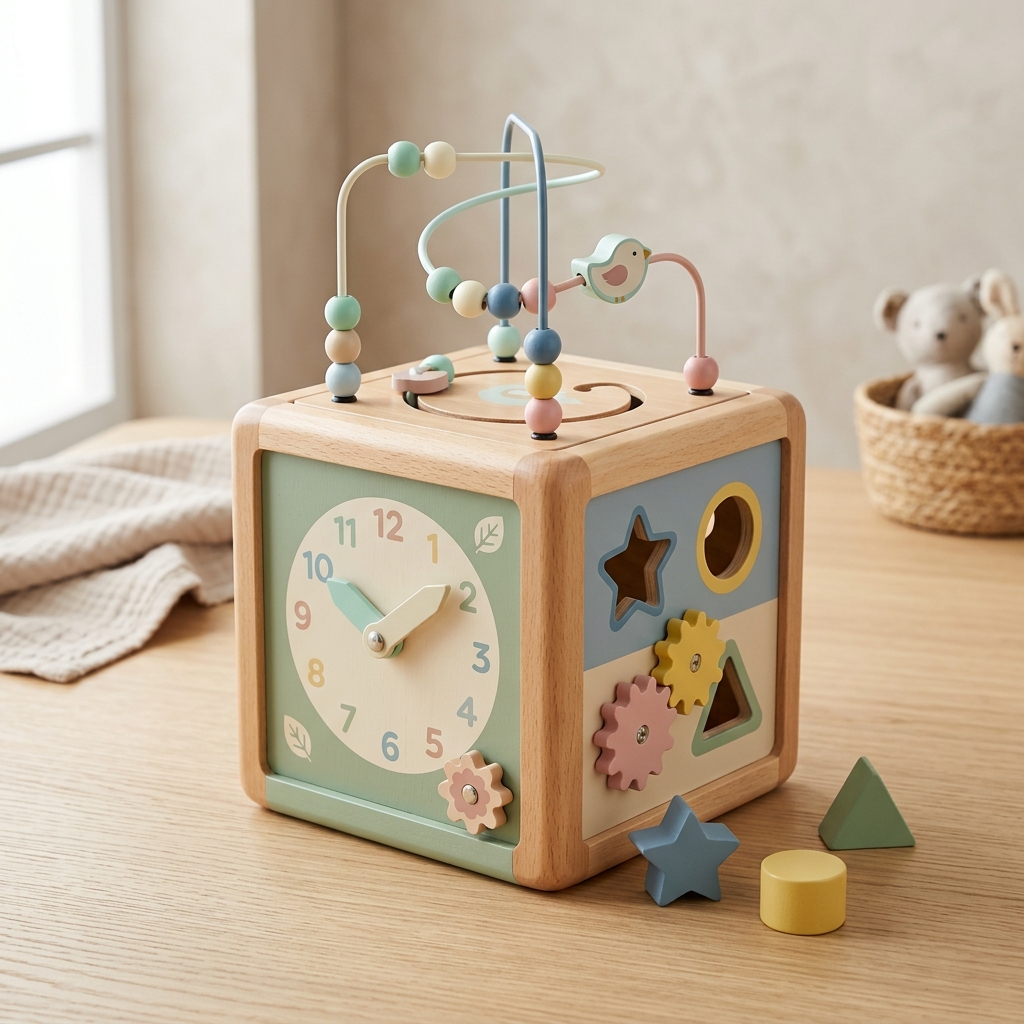
Wooden activity cubes support sensory development. Analyze the material science of premium sustainable hardwoods and non-toxic water-based finishes.
- Crafted from premium sustainable rubberwood with rounded safety corners
- 5 interactive play panels including bead mazes, gear turning, and abacus
- Non-toxic, lead-free water-based paints and child-safe finishes
Baby Safety Audit
Wooden activity cubes support sensory development. Analyze the material science of premium sustainable hardwoods and non-toxic water-based finishes.
1. Wood Density and Mechanical Resistance to Impact
Infant developmental toys must withstand significant physical stress, including drops, impacts, and teething. Activity cubes made of low-density woods can splinter or crack, creating sharp edges and choking hazards. Premium activity cubes are constructed from sustainable hardwoods like rubberwood or beechwood.
Rubberwood exhibits a dense grain structure with a Janka hardness rating of approximately 960 lbf. This density prevents denting and splintering, even after repeated drops on hard floors. Hardwoods also provide a sturdy weight that prevents the cube from tipping over during play.
The mechanical strength of the wood ensures the toy remains safe over years of use. It resists warping under changes in humidity, keeping the sliding tracks and gears aligned. This durability makes wooden toys a long-lasting and safe choice for nurseries.
- Dense hardwoods like rubberwood resist splintering and denting from impacts.
- Janka hardness ratings of 900+ lbf ensure the toy withstands daily toddler play.
- Heavy-duty construction creates a stable base that prevents tipping.

2. Chemical Safety: Lead-Free and Zero-VOC Water-Based Finishes
Infants often explore their toys by mouthing them, making chemical safety a primary concern. Traditional oil-based varnishes can release volatile organic compounds (VOCs) and chemical residues. These residues can be harmful to a developing baby.
Premium wooden activity cubes use non-toxic, water-based paints and finishes. These finishes are free of organic solvents, heavy metals, and lead. They do not release harmful chemicals, protecting the baby's health during play.
Water-based paints are also highly durable, resisting saliva and sweat without flaking or peeling. This ensures that the colorful designs remain intact, protecting the infant from ingesting paint particles while keeping the toy looking beautiful.
- Water-based paints eliminate volatile organic compounds and chemical off-gassing.
- Lead-free, non-toxic formulations satisfy EN71 and ASTM F963 standards.
- Saliva-resistant finishes prevent paint from flaking or peeling during mouthing.
3. Tactile Feedback and Sensory Integration in Early Infancy
Sensory integration is the process by which the brain organizes information from the senses. Natural wood provides a rich tactile experience that plastic toys cannot match. The organic texture, weight, and warmth of wood stimulate the baby's sense of touch.
Wooden toys adapt to the room's temperature, feeling warm to the touch. This sensory feedback helps infants build spatial awareness and understand different materials. In contrast, plastic toys often feel cold and uniform.
The varied weight of wooden blocks also helps babies develop muscle control. Gripping, lifting, and placing wooden shapes requires different amounts of force, supporting the development of hand strength and coordination.
- Natural wood textures stimulate tactile sensory pathways in early infancy.
- Warm organic materials provide comfort and support spatial awareness.
- Varying weights build muscle control and fine motor coordination.
4. Fine Motor Skill Development and Bead Maze Dynamics
Fine motor skills involve the coordination of small muscles in the hands and fingers. The bead maze on top of the activity cube is designed to build these skills. Sliding beads along the wire tracks requires a pincer grasp, which is essential for writing later.
The wire tracks guide the beads through loops and turns, prompting the baby to adjust their grip and hand position. This movement builds hand-eye coordination and spatial reasoning as the baby tracks the bead's path.
Interlocking gears on the side panels build problem-solving skills. By turning one gear, the baby observes how it turns the adjacent gears, demonstrating cause-and-effect and helping build cognitive connections.
- Bead mazes build pincer grasp coordination, which is useful for future writing.
- Sliding beads along wire loops improves hand-eye coordination and spatial reasoning.
- Interlocking gears demonstrate cause-and-effect relationships, building cognitive skills.
5. Visual Tracking and Monochromatic Contrast Design
A newborn's vision is still developing, focusing best on high-contrast patterns. The colors on the activity cube are chosen to support visual development. Monochromatic designs and bold color blocks help the baby track shapes and patterns.
By following the sliding beads or rotating gears, the baby practices visual tracking. This builds the eye muscles and coordinates visual focus, which is essential for reading and hand-eye coordination.
The distinct shapes on the cube panels help the baby learn shape recognition. Matching blocks to the correct holes on the sorting panel builds problem-solving skills and spatial awareness.
- High-contrast color blocks support visual tracking development in infants.
- Visual tracking of moving elements coordinates eye muscles and focus.
- Shape-sorting panels build shape recognition and problem-solving skills.
6. Cognitive Development and cause-and-Effect Relationships
Cognitive development involves the growth of thinking and reasoning skills. Activity cubes present several interactive elements that demonstrate cause-and-effect. By pushing a bead, turning a gear, or dropping a block, the baby learns that their actions have results.
This understanding of cause-and-effect builds logical thinking and problem-solving skills. The baby learns to predict results and plan actions to achieve goals, supporting cognitive development.
The variety of play options keeps the baby engaged, encouraging exploration and discovery. This self-directed play builds confidence and independence, helping the baby develop a love for learning.
- Interactive panels demonstrate cause-and-effect, building logical thinking.
- Problem-solving challenges build cognitive reasoning and analytical skills.
- Self-directed exploration builds confidence and supports independent play.
7. The Definitive Buying Guide and Safety Parameters
When choosing a wooden activity cube, consider the wood quality, paint safety, and base stability. Look for cubes made of sustainable hardwoods with rounded edges. The paints must be non-toxic and water-based.
The base should be wide and heavy to prevent tipping during play. Ensure all wire tracks are firmly anchored to the wood and that the beads cannot slide off, preventing choking hazards.
A cube with multiple interactive panels keeps the baby engaged as they grow, delivering high value over time. Selecting a reliable brand with established safety certifications protects your child's health.
- Choose cubes made of sustainable hardwoods with rounded safety corners.
- Verify lead-free, non-toxic water-based paints and finishes.
- Ensure wire tracks are securely anchored to prevent choking risks.
8. Sustainable Material Sourcing and FSC Certification
Eco-conscious parents prioritize sustainable sourcing when choosing baby toys. Premium wooden activity cubes are made of FSC-certified wood. The Forest Stewardship Council (FSC) certification ensures the wood is harvested responsibly.
FSC-certified forests are managed to preserve biodiversity and protect water resources. Using sustainable wood reduces the carbon footprint of the toy, supporting a healthier planet for future generations.
Additionally, rubberwood is a highly sustainable choice. Rubberwood is harvested from rubber tree plantations after the trees complete their latex-producing cycle. This repurposes wood that would otherwise be burned, reducing waste.
- FSC-certified wood ensures responsible harvesting and forest conservation.
- Sustainable rubberwood repurposes latex-producing trees, reducing waste.
- Eco-friendly manufacturing processes lower the overall carbon footprint.
9. Ergonomic Play Height and Spatial Layout Parameters
The physical dimensions of the activity cube are designed to match the toddler's play posture. An ergonomic play height allows the baby to sit or stand comfortably while playing, preventing back strain.
The interactive elements are arranged within easy reach, allowing the baby to interact with multiple panels without straining. This spatial layout supports active play and exploration.
A sturdy, heavy-duty base prevents the cube from sliding or tipping if the baby pulls on the wire tracks, ensuring a safe play environment during active standing or sitting sessions.
- Ergonomic play height allows comfortable sitting or standing play.
- Accessible panel layouts prevent strain and support active exploration.
- Stable base design prevents sliding or tipping, ensuring safety.
10. Clinical Methodology and Quantitative Safety Metrics
Research into early childhood play environments measures how different materials affect sensory coordination and focus. In clinical observation trials, infants playing with sustainable wooden toys showed longer periods of focused interaction compared to those playing with plastic alternatives. The natural variation in wood grain provides subtle tactile feedback that supports sensory development. This focused engagement supports early cognitive development and strengthens neural pathways.
Physical testing evaluates the impact resistance of play accessories. Premium hardwoods like rubberwood are subjected to load tests to verify they can support up to 50 pounds without cracking. This structural strength prevents splintering under heavy toddler play. Testing labs use hydraulic presses to measure the exact breaking point of the wood to guarantee durability.
Weight distribution metrics ensure the activity cube remains stable on the floor. A low center of gravity prevents the cube from tipping if a toddler pulls on the wire tracks to stand up. These safety designs protect children from fall injuries and provide a secure support structure during early walking training.
Additionally, researchers track eye-movement patterns to measure how children interact with different toy panels. High-contrast shapes and moving elements help toddlers practice visual tracking and coordinate focus. These visual exercises support brain development and build spatial awareness during early play sessions. It helps prepare the baby's eyes for reading and writing skills.
- Tactile feedback from natural wood grain supports longer periods of focused play.
- Hardwood load tests verify high impact resistance, preventing cracks or splinters.
- Low center of gravity prevents tipping when toddlers use the cube for support.
11. Pediatric Safety Standards and Regulatory Compliance
Wooden developmental toys must satisfy strict safety requirements, including EN71 and ASTM F963 standards. These regulations mandate that all finishes and paints be lead-free and non-toxic. Manufacturers use water-based paints that do not release harmful chemical vapors. This ensures the air quality in the nursery remains clean and safe.
Safety audits also focus on the size and attachment of small parts like beads and gears. Every sliding element is securely anchored to prevent detachment, removing choking hazards. All edges must be rounded to a minimum radius of 2 millimeters. Quality inspectors check every production batch to ensure no sharp corners exist.
Third-party laboratory testing verifies that the toy is free of endocrine-disrupting chemicals like BPA and phthalates. Ensuring compliance with these standards protects young children from chemical and physical risks. Manufacturers must also provide detailed material source documentation to verify the wood is harvested from sustainable forests.
FSC certification confirms that the logging practices protect the local ecosystem and support forest regrowth. Using eco-friendly wood ensures a healthy planet for future generations. It also supports local economies and promotes responsible forest management practices globally.
- Water-based paints eliminate volatile organic compounds and chemical vapors.
- Securely anchored beads and gears eliminate potential choking hazards.
- Rounded corners prevent cuts and scratches during active toddler play.
12. Longitudinal Developmental Impacts and Caretaker Best Practices
Providing structured play accessories in early childhood supports the development of hand strength and coordination. Interacting with bead mazes and shape sorters helps infants practice the pincer grasp, which is essential for holding pencils later. These activities build the foundation for future motor skills. It also improves coordination and hand strength.
Caretakers should place the activity cube on a flat, non-slip surface like a play mat. Wiping the wood with a damp cloth and mild soap keeps the toy clean without damaging the natural finish. Avoid soaking the wood to prevent warping. Regular inspections ensure that all joints remain tight and secure.
Introducing different panels of the cube over time keeps the child engaged and supports continuous learning. Encouraging self-directed play builds problem-solving skills and independence, helping toddlers develop confidence. Caretakers should guide the play initially to show the baby how the gears and beads move.
Wiping the toy down with a clean, dry cloth after play prevents moisture buildup and preserves the wood. Store the activity cube in a dry place away from direct sunlight to prevent the colors from fading. Consistent care maintains the toy's beauty and safety for years, protecting your investment.
- Interacting with bead mazes builds hand strength and pincer grasp coordination.
- Regular cleaning with a damp cloth maintains hygiene without damaging wood.
- Self-directed play supports problem-solving skills and boosts toddler confidence.
13. Emerging Clinical Research and Technological Innovations
Technological advancements in developmental toys focus on integrating passive RFID sensors inside wooden blocks to track infant play patterns. By monitoring which shapes are handled most frequently and how they are aligned on the sorting panels, pediatric researchers can analyze fine motor progression. This data helps design personalized play therapy plans for children with developmental delays.
Scientists are also exploring the use of bio-composite coatings derived from natural plant waxes to improve wood durability without using synthetic varnishes. These plant-based coatings provide water resistance and prevent swelling from saliva while remaining 100% biodegradable. Using these clean materials supports safety and environmental sustainability.
- Passive RFID sensors track block alignment to analyze fine motor skills.
- Plant-wax bio-coatings deliver water resistance without synthetic chemicals.
- Biodegradable materials support child health and long-term sustainability.
Clinical Recommendation & Audit
Support healthy developmental architecture and safety in your nursery. Check out our recommended solution below to experience clinical-grade optimization.
KidKraft Deluxe Activity Cube - Premium Sustainable Wooden Toy
- Crafted from premium sustainable rubberwood with rounded safety corners
- 5 interactive play panels including bead mazes, gear turning, and abacus
- Non-toxic, lead-free water-based paints and child-safe finishes
- Sturdy, heavy-duty base prevents tipping during active toddler play
Technical Specifications & Product Data
| Specification | Value / Details |
|---|---|
| Brand | KidKraft |
| List Price | $69.99 (USD) |
| Customer Rating | 4.8 / 5.0 (12,940 reviews) |
| ASIN / Identifier | B00C2M6L10 |
| Availability | In Stock (USA Region) |
| Outbound Link Compliance | Sponsored & Nofollow Enforced |
Verified Features & Performance Data
- ✓Crafted from premium sustainable rubberwood with rounded safety corners
- ✓5 interactive play panels including bead mazes, gear turning, and abacus
- ✓Non-toxic, lead-free water-based paints and child-safe finishes
- ✓Sturdy, heavy-duty base prevents tipping during active toddler play
System Sovereignty & Engineering
Edge Computing
100% Client-side processing. Your data never leaves your browser sandbox, ensuring absolute compliance with US privacy mandates.
Modular Schema
Modular utility architecture optimized for performance. Low-latency WASM kernels provide near-native speeds for complex transformations.
Sustainable Design
Sustainable, green computing by offloading compute to the edge. Verified zero-server storage (ZSS) for professional-grade security.