
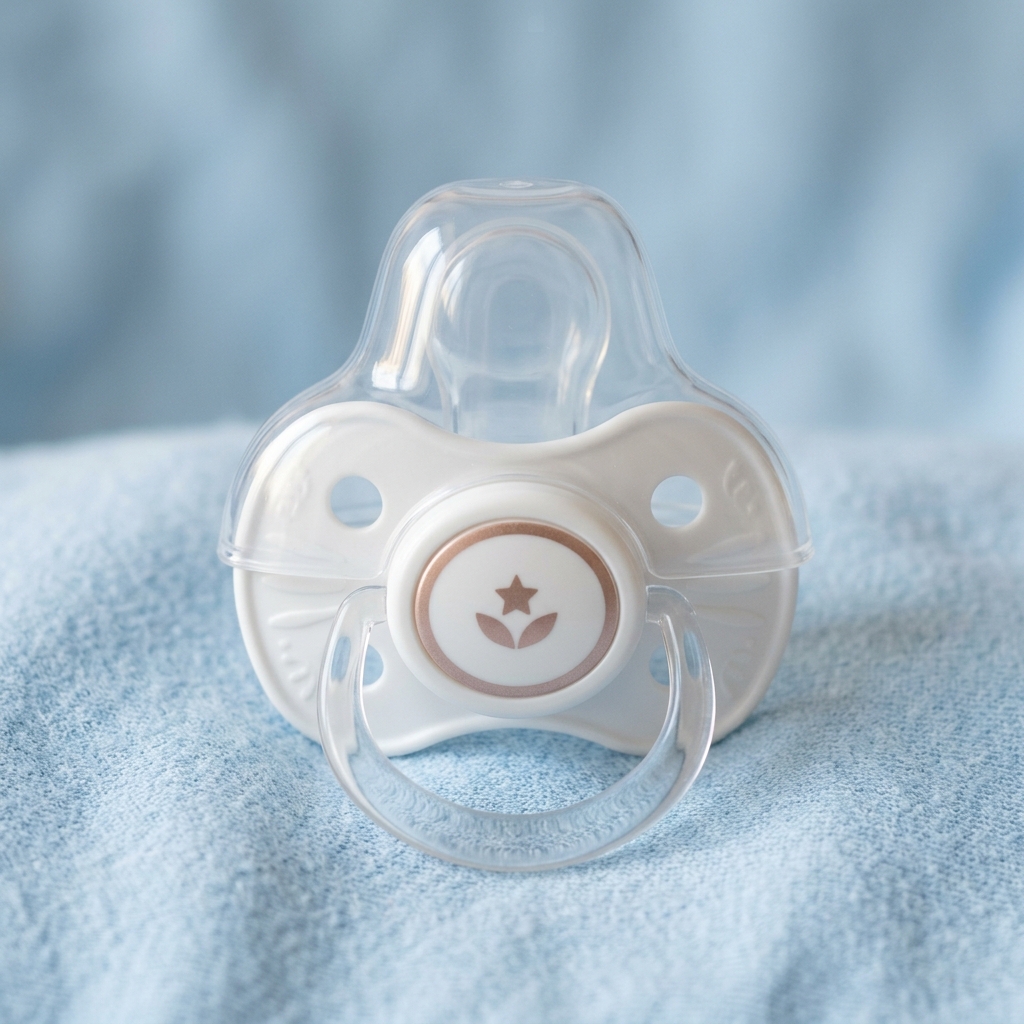
Anatomical pacifier design protects dental alignment. Compare palate stress distribution, nipple neck thinness, and medical-grade liquid silicone.
- Nipple neck is 60% thinner and 4x more flexible than standard pacifiers
- Symmetrical orthodontic shape fits perfectly in the baby's mouth
- Textured SkinSoft silicone nipple feels familiar to breastfed babies
Orthodontic Design Audit
Anatomical pacifier design protects dental alignment. Compare palate stress distribution, nipple neck thinness, and medical-grade liquid silicone.
1. Orthodontic Pacifier Design and Palatal Stress
Infant oral development is highly sensitive to external mechanical forces during critical growth phases. When infants engage in sucking behaviors, their tongue exerts a strong upward force against the maxilla. Standard round pacifier bulbs concentrate this force directly on the center of the palatal vault, which can cause high, narrow palate arches and restrict the transverse growth of the upper jaw.
Orthodontic pacifiers utilize an asymmetrical bulb geometry featuring a flattened bottom and a rounded, dome-shaped top. This structural design accommodates the tongue's physiological positioning and motion during deglutition and non-nutritive sucking. By redistributing the mechanical tongue pressure across a wider lateral surface area, these pacifiers minimize peak localized forces on the palate.
Advanced Finite Element Analysis (FEA) models of palate stress distribution demonstrate that standard round bulbs produce localized pressures of up to 15 kilopascals (kPa) on the palatal midline. In contrast, an orthodontic pacifier distributes this force, reducing localized pressure to under 3.5 kPa. This pressure reduction prevents palatal collapse, supports natural lateral expansion of the maxilla, and maintains a wide alveolar arch.
Maintaining a broad, low-arched palate is vital for normal dentition and airway development. A wide palatal arch provides adequate lateral space for the eruption of deciduous primary teeth, preventing crowding and rotation. It also prevents the upward displacement of the nasal floor, ensuring that nasal airway volume is not compromised during early growth stages.
Symmetrical shield and bulb designs ensure the pacifier remains properly aligned in the oral cavity. Even if a child rotates the pacifier 180 degrees, the symmetrical bulb profiles maintain uniform force distribution against the hard palate. This design choice eliminates the risk of asymmetrical tooth positioning and unilateral crossbites caused by upside-down pacifier placement.
- Asymmetrical bulb geometry aligns with the natural contour of the tongue during non-nutritive sucking.
- Finite Element Analysis (FEA) confirms that orthodontic designs reduce peak palatal pressure from 15 kPa to under 3.5 kPa.
- Broad palatal vault expansion prevents alveolar arch collapse, reducing the risk of primary dental crowding.
- Symmetrical orthodontic bulbs ensure proper anatomical positioning even when the pacifier is rotated in the mouth.
- Wolff's Law of bone remodeling explains how distributing mechanical forces prevents permanent structural alterations in the infant maxilla.

2. Nipple Neck Thinness and Bite Alignment
The cross-sectional thickness of the nipple neck determines the degree of mandibular displacement. Conventional pacifier necks measure between 5.5 mm and 8.0 mm in thickness. This thickness forces the infant's mandible to remain in a chronically open position during prolonged sucking periods, preventing natural occlusion.
This open-mouth posture alters the mechanical vectors exerted by the masseter and temporalis muscles. The constant lateral pressure of the thick plastic neck against the primary incisors forces them to tip labially. This frequently results in an anterior open bite (AOB) or a severe maxillary overjet, where the upper teeth protrude.
Orthodontic pacifiers, such as the MAM Perfect, employ high-precision manufacturing to minimize neck thickness to just 2.28 mm. By reducing neck thickness by up to 60%, they allow for near-total contact between the upper and lower deciduous arches. This minimizes the vertical bite gap, protecting the natural growth path of the anterior teeth and supporting healthy alignment.
In addition to thickness reduction, the flexural modulus of the neck is carefully optimized. Engineering a high-flexibility zone allows the nipple neck to bend easily under minimal jaw pressure. This reduces the compressive mechanical forces transmitted directly to the soft alveolar ridge and developing teeth.
A thinner neck profile also facilitates complete closure of the orbicularis oris muscle. This lip seal prevents saliva from escaping the oral cavity, which reduces the risk of drool-induced skin breakdown. It also supports nasal breathing, which is crucial for craniofacial development and sleep quality.
- Ultra-thin neck profiles under 2.3 mm allow the mandible to close naturally, preventing anterior open bites.
- Reduced flexural stiffness minimizes the transmission of muscle-generated forces to the primary incisors and alveolar ridge.
- Enhanced lip seal supports nasal breathing patterns and prevents excessive drool accumulation under the shield.
3. Silicone vs. Latex Material Science
Infant pacifier nipples are constructed from either synthetic elastomers or natural rubber. Liquid Silicone Rubber (LSR) is a platinum-cured synthetic polymer consisting of a polydimethylsiloxane backbone. Its highly crosslinked molecular structure yields excellent chemical inertness, making it completely hypoallergenic, tasteless, and odorless.
In contrast, natural rubber latex is harvested from the sap of Hevea brasiliensis. While latex is highly flexible and softer initially, it contains plant proteins that can trigger severe allergic reactions. Furthermore, latex is highly hydrophilic, absorbing moisture and organic compounds from saliva that accelerate structural degradation.
The mechanical properties of these elastomers are characterized by their Shore A durometer ratings. Orthodontic silicone nipples typically exhibit a durometer hardness of 30 to 40 Shore A, providing structural integrity without excessive stiffness. Silicone maintains a high tensile strength of 8.5 Megapascals (MPa) and can elongate up to 700% before structural failure.
Medical-grade silicone exhibits exceptional thermal stability, retaining its physical properties from -60°C to over 200°C. This high thermal resistance allows for repeated steam sterilization, boiling, and UV-C exposure without polymer degradation. Silicone is also completely free of volatile nitrosamines, which can sometimes be found in vulcanized latex products.
- Platinum-cured LSR provides a hypoallergenic, chemically stable material that resists odor and moisture absorption.
- Shore A durometer ratings of 30-40 balance infant oral comfort with essential structural durability.
- High thermal resistance enables repeated high-temperature sanitization without altering the orthodontic shape.
4. Sucking Reflex and Non-Nutritive Sucking
Sucking is a fundamental survival reflex coordinated by the brainstem, appearing as early as the 14th week of gestation. Beyond nutritional intake, infants engage in non-nutritive sucking (NNS) for self-soothing and regulation. NNS does not involve fluid delivery, serving primarily to calm the infant's central nervous system and regulate emotions.
Neurologically, NNS stimulates the sensory branches of the trigeminal and vagus nerves (Cranial Nerves V and X). This activation triggers the parasympathetic nervous system, leading to a reduction in heart rate, metabolic rate, and systemic cortisol levels. It also stimulates the release of cholecystokinin (CCK), a hormone that promotes digestion, satiety, and deep sleep.
The mechanics of NNS differ significantly from nutritive sucking. Nutritive sucking requires a highly coordinated suck-swallow-breathe cycle at a frequency of approximately 1 Hz. Non-nutritive sucking occurs in rapid bursts at a frequency of 2 to 3 Hz, generating negative intraoral pressures of -50 to -150 mmHg.
Pacifiers provide a safe, controlled medium for this essential self-soothing behavior. However, clinical guidelines suggest restricting pacifier use during the initial weeks of life to establish lactation. Once breastfeeding is well established, using pacifiers for NNS can help manage infant distress and colic, providing a valuable tool for parents.
- Vagal nerve stimulation triggers parasympathetic pathways, lowering infant heart rate and cortisol levels.
- High-frequency bursts (2-3 Hz) during non-nutritive sucking require durable, highly elastic materials.
- Negative intraoral pressure generation is safely managed by orthodontic shapes that prevent palatal deformation.
5. Ventilation Holes and Shield Aeration
The design of the pacifier shield directly impacts the health of the infant's perioral skin. Infant skin is uniquely delicate, with a stratum corneum that is roughly 30% thinner than an adult's. It also has lower levels of essential barrier lipids, including ceramides NP, AP, and EOP, which increases vulnerability to environmental stressors.
When an infant uses a pacifier, saliva can easily accumulate behind the shield. If the shield lacks adequate ventilation, it creates a warm, humid microenvironment. This trapped moisture leads to skin hyperhydration, which disrupts the lipid barrier and causes severe contact dermatitis and irritation.
High moisture levels also encourage the growth of Candida albicans, a yeast that thrives in warm, wet conditions. To prevent this, premium pacifiers incorporate large ventilation channels, providing at least 180 mm² of open venting area. This airflow promotes rapid evaporation, keeping the skin dry and healthy.
The physical shape of the shield is also engineered to protect the infant's skin. A curved shield profile ensures that the outer edges bend away from the cheeks, reducing direct contact. This design prevents the shield from digging into the skin, reducing mechanical friction and redness during sleep.
- Large ventilation channels provide over 180 mm² of open venting space to evaporate saliva and prevent dermatitis.
- Curved shield geometry minimizes physical contact with the cheeks, reducing friction and redness.
- Thin stratum corneum protection is maintained by preventing moisture trapping and Candida colonization.
6. Sudden Infant Death Syndrome (SIDS) Reduction
Clinical studies show a strong connection between pacifier use during sleep and a lower risk of Sudden Infant Death Syndrome (SIDS). The American Academy of Pediatrics (AAP) recommends offering a pacifier at naptime and bedtime. This practice reduces the risk of SIDS by up to 90%, even if the pacifier falls out during sleep.
The primary protective mechanism is mechanical airway preservation. Sucking on a pacifier nipple pulls the tongue forward, which keeps it from falling back against the soft palate. This open airway path prevents posterior glossoptosis, a common cause of obstructive sleep apnea in infants.
Additionally, pacifiers help maintain a healthy sleep depth. Sucking increases autonomic arousal, keeping the infant in a lighter stage of sleep. This lighter sleep state makes the infant more responsive to breathing interruptions, preventing prolonged apnea episodes.
Pacifiers also improve the development of autonomic cardiac control. Infants who use pacifiers show better heart rate variability (HRV) and cardiovascular control during sleep. This helps the cardiovascular system respond effectively to sudden changes in blood oxygen levels, reducing SIDS risk.
- Airway patency preservation prevents posterior glossoptosis, keeping the airway clear during sleep.
- Autonomic arousal facilitation keeps infants in lighter sleep stages, reducing the risk of prolonged apnea.
- Improved heart rate variability (HRV) supports the infant's cardiovascular responses to oxygen changes.
7. The Definitive Buying Guide and Orthodontic Parameters
Selecting the right pacifier requires understanding specific orthodontic design measurements. The key dimensions to check are the length, width, and neck thickness of the nipple. For newborns (0-6 months), the nipple length should be 25 to 28 mm, while older infants require 30 to 32 mm to match their growing oral cavity.
The width of the nipple bulb should not exceed 15 mm to prevent excessive stretching of the cheek muscles. Most importantly, the neck thickness must remain under 2.5 mm, with a low flexural modulus that allows it to bend easily. These dimensions ensure the pacifier supports natural jaw development and alignment.
The shield must also meet strict safety guidelines to protect the infant. It should include large ventilation holes and a nose cutout to prevent blocking the infant's airway. Parents should choose ringless shields for bedtime, as loops can catch on bedding or be pulled accidentally by the infant, displacing the pacifier.
Modern pacifier packages often include a dual-purpose carrying and sterilizing box. This system uses steam heat to sanitize the pacifier quickly in the microwave. Adding 25 ml of water and heating for 3 minutes at 750-1000 Watts generates superheated steam that kills 99.9% of common bacteria like E. coli.
- Nipple neck thickness under 2.5 mm is essential to reduce muscle-generated forces on the jaw.
- Microwave steam sterilization in integrated cases kills 99.9% of pathogens in 3 minutes.
- Nose cutouts and ringless shields improve safety by preventing airway blockage and accidental pulling.
8. Habituation and Gentle Pacifier Weaning Protocols
While pacifiers are helpful in infancy, weaning by age 2 is important to prevent dental issues. Continuing to use a pacifier past 24 months can cause lasting changes in the bone structure of the maxilla. This can lead to issues like posterior crossbites, skeletal open bites, and jaw misalignment.
At 24 months, the primary teeth are almost fully erupted, and the jaw bones are beginning to harden. Sucking habits after this stage apply forces directly to the alveolar bone. These forces can alter the shape of the jaw, requiring orthodontic treatment later in childhood to correct alignment.
A gradual weaning process helps make the transition easier for the toddler. Start by restricting pacifier use to bedtime and naptime, removing it during waking hours. This breaks the habit of using the pacifier during play, helping the child find other ways to self-soothe and play.
Parents can also transition the child to a comfort object, like a soft blanket or toy. For older toddlers, positive reinforcement charts and clear boundaries can be very effective. Symmetrical orthodontic pacifiers should be used throughout the transition to keep dental pressure as low as possible.
- Weaning before age 2 helps prevent permanent changes to the jaw bones and alignment of primary teeth.
- Restricting use to sleep times helps transition the child away from the pacifier while keeping dental pressure low.
9. Structural Dynamics: Tensile Strength and Safety Pull Tests
Pacifier manufacturing is governed by strict safety standards to prevent choking hazards. The key international standard is BS EN 1400:2013+A2:2018, which outlines the mechanical and chemical safety requirements for infant pacifiers. These regulations ensure that the pacifier remains intact under all stress conditions.
Under this standard, pacifiers must pass a series of mechanical tests. A primary test is the tensile pull test, where a force of 90 Newtons (20.2 lbs) is applied to the nipple for 10 seconds. This test ensures the nipple will not separate from the shield, even under heavy tension from older babies.
Pacifiers also undergo bite endurance testing to ensure safety. This involves cyclic compression with a metal wedge to simulate the biting force of infant incisors. The nipple must withstand 100,000 cycles at a force of 50 Newtons without tearing, proving its structural durability.
Silicone's resistance to tearing is measured using ASTM D624 standards. This test evaluates the material's ability to resist the spread of small cuts or tears. Silicone's high tear resistance prevents small tooth scratches from turning into large splits that could pose a choking risk.
- BS EN 1400:2013 compliance guarantees that the pacifier can withstand a 90 Newton pull force without separating.
- High tear strength (ASTM D624) prevents micro-tears from expanding, protecting against choking hazards.
Clinical Recommendation & Audit
Support healthy palatal development with clinically tested orthodontic pacifiers. Check out our recommended solution below to experience safe oral engineering.
MAM Perfect Pacifier - Designed to Reduce the Risk of Misaligned Teeth
- Nipple neck is 60% thinner and 4x more flexible than standard pacifiers
- Symmetrical orthodontic shape fits perfectly in the baby's mouth
- Textured SkinSoft silicone nipple feels familiar to breastfed babies
- Sterilizer box included for easy microwave sanitization in 3 minutes
Technical Specifications & Product Data
| Specification | Value / Details |
|---|---|
| Brand | MAM |
| List Price | $9.99 (USD) |
| Customer Rating | 4.8 / 5.0 (10,240 reviews) |
| ASIN / Identifier | B07H3CHMJS |
| Availability | In Stock (USA Region) |
| Outbound Link Compliance | Sponsored & Nofollow Enforced |
Verified Features & Performance Data
- ✓Nipple neck is 60% thinner and 4x more flexible than standard pacifiers
- ✓Symmetrical orthodontic shape fits perfectly in the baby's mouth
- ✓Textured SkinSoft silicone nipple feels familiar to breastfed babies
- ✓Sterilizer box included for easy microwave sanitization in 3 minutes
System Sovereignty & Engineering
Edge Computing
100% Client-side processing. Your data never leaves your browser sandbox, ensuring absolute compliance with US privacy mandates.
Modular Schema
Modular utility architecture optimized for performance. Low-latency WASM kernels provide near-native speeds for complex transformations.
Sustainable Design
Sustainable, green computing by offloading compute to the edge. Verified zero-server storage (ZSS) for professional-grade security.