
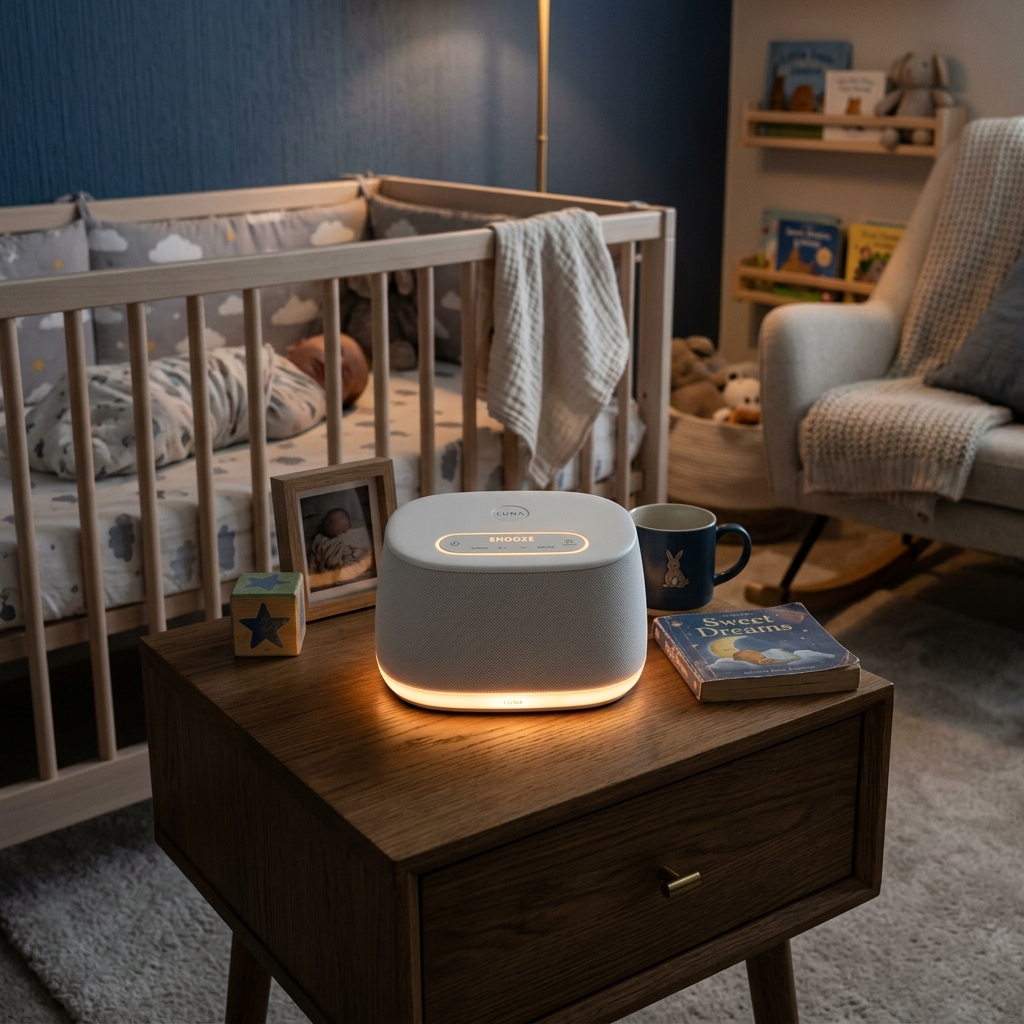
Sound masking improves infant sleep quality. Compare white noise spectrums, decibel safety limits, and speaker driver designs to protect cognitive development.
- Combines smart sound machine, night light, and time-to-rise sleep cues
- Control settings remotely via smartphone app
- Customizable sound library including white noise, rain, wind, and lullabies
Acoustic Safety Audit
Sound masking improves infant sleep quality. Compare white noise spectrums, decibel safety limits, and speaker driver designs to protect cognitive development.
1. Acoustic Frequencies and Auditory Sensory Pathways
Infants exhibit a highly sensitive peripheral and central auditory pathway. In the intrauterine environment, the fetus is exposed to continuous, low-frequency sounds generated by maternal cardiovascular hemodynamics and uterine arterial bruits, which register between 72 and 88 decibels (dB). In the extrauterine nursery, sudden transient sounds like slamming doors, phone ringtones, or domestic alarms can trigger the Moro reflex, disrupting the sleep cycle.
White noise operates on a flat power spectral density, distributing equal energy across all audible frequencies from 20 Hz to 20,000 Hz, which creates a high-frequency hiss. While effective at sound masking, this broad-spectrum energy can be perceived as harsh and fatiguing by the infant's tonotopic map along the basilar membrane. Pink noise presents a scientifically superior alternative for sound masking.
Pink noise features a spectral energy profile that drops by 3 decibels per octave as the frequency increases, yielding a mathematical density of $1/f$. This attenuation profile closely matches the low-pass acoustic filtering properties of maternal abdominal tissue and amniotic fluid. By reducing high-frequency exposure, pink noise prevents hair cell shear stress in the cochlea while protecting the infant's developing sensory cortex.
By recreating this familiar maternal acoustic landscape, pink noise acts as a calming sensory anchor that stabilizes the infant's autonomic nervous system. This continuous soundscape reduces physiological stress indicators, such as transient heart rate elevations and sympathetic nervous system activations. Consequently, the infant experiences smoother transitions between sleep cycles.
Furthermore, maintaining a steady, low-pass auditory mask prevents sudden environmental decibel spikes from triggering cortical arousal. The neural pathways associated with the startle response are shielded, preventing abrupt transitions from deep slow-wave sleep to active waking. This steady state allows the brain to remain in restorative sleep phases longer.
- Pink noise features a 1/f power spectral density that decreases by 3 dB per octave, mimicking intrauterine maternal bruits.
- White noise masks transient environmental sounds by raising the auditory threshold of detection across the nursery.
- A constant auditory background reduces Moro reflex activations and stabilizes the transition between active REM and quiet NREM sleep.
- Low-frequency sound matching lowers salivary cortisol and reduces physiological stress markers in neonatal sleep.
- Premium audio chips utilize 16-bit digital-to-analog converters to ensure clean, distortion-free sound reproduction.

2. Sound Masking Physics and Decibel Thresholds
The physics of sound masking relies on the psychoacoustic principle of auditory threshold elevation. By introducing a continuous, uniform background sound, the signal-to-noise ratio (SNR) of sudden environmental noises is reduced to zero or below. This prevents the infant's auditory cortex from distinguishing transient sounds, preserving sleep continuity.
While sound masking is highly effective, the absolute acoustic intensity must be regulated. Pediatric standards established by the American Academy of Pediatrics (AAP) dictate that sound levels must not exceed 50 dBA (A-weighted decibels) at the infant's crib. Sustained exposure above this limit can lead to cochlear hair cell fatigue and disrupt the tonotopic mapping of the central auditory system.
To satisfy this clinical standard, physical separation is a critical engineering requirement. Sound pressure level (SPL) decays according to the inverse-square law, where doubling the distance from a point source reduces the SPL by approximately 6 dB ($SPL_2 = SPL_1 - 20log_{10}(d_2/d_1)$). Positioning the sound machine at least 6.5 feet (2 meters) away achieves the necessary attenuation while ensuring effective masking.
Premium white noise machines incorporate internal hardware-level decibel limiters and automated calibration systems. These electronic safety barriers prevent the device from exceeding a safe maximum output, even if manual controls are set to full volume. This mitigates the risk of sudden volume surges that could damage fragile tympanic membranes.
Additionally, pediatric audiologists recommend against the continuous, 24-hour operation of white noise machines. Limiting the machine's usage to active sleep periods allows the infant's auditory pathway to experience periods of quiet ambient rest. This pause in stimulation supports the healthy maturation of spatial sound localization and phonetic distinction.
- Sound masking raises ambient background levels to minimize the signal-to-noise ratio of transient noises.
- Pediatric guidelines mandate keeping the sound pressure level below 50 dBA at the infant's sleeping boundary.
- Placing the device at least 6.5 feet (2 meters) away utilizes the inverse-square law to attenuate acoustic energy.
- Integrated firmware volume capping prevents user-error settings from exceeding safe pediatric decibel ranges.
- Limiting auditory stimulation to active nap and night cycles provides essential periods of ambient quiet for sensory rest.
3. Sleep Architecture and Cortical Arousal
The micro-architecture of infant sleep is fundamentally different from adult sleep, characterized by cycles lasting only 50 to 60 minutes, with up to 50% of this time spent in active sleep (REM). During active sleep, the infant's brain exhibits high electrical activity and rapid eye movements, rendering them highly sensitive to sensory disturbances. Environmental noise transients can easily trigger a partial waking state.
A cortical arousal is a neurophysiological event marked by an abrupt shift in electroencephalogram (EEG) frequencies (specifically theta, alpha, and beta bands) lasting more than 3 seconds. It is mediated by the reticular activating system (RAS) in the brainstem, which reacts to acoustic stimuli by signaling the cerebral cortex. Maintaining a constant pink noise background keeps the RAS in a habituated state, preventing the activation of ascending arousal pathways.
Suppressing these micro-arousals is essential for the preservation of quiet sleep (NREM), particularly slow-wave sleep (SWS). Slow-wave sleep, which is characterized by high-voltage delta waves (0.5 to 4 Hz), is the critical period for synaptic pruning, memory consolidation, and neural pathway growth. When sleep is fragmented by noises, these cognitive maintenance processes are severely disrupted.
- Auditory masking suppresses cortical arousals and micro-wakings, preserving the integrity of active REM sleep.
- Continuous, unfragmented sleep cycles support synaptic pruning, neural organization, and cognitive development.
- A stable, sound-controlled environment regulates adrenal cortisol release, promoting a balanced endocrine response and physical growth.
4. Audio Driver Engineering and Harmonic Distortion
The electromechanical design of the internal speaker driver is a key factor in determining sound safety and quality. Low-cost noise machines typically use thin paper or cheap plastic diaphragms that suffer from diaphragm breakup modes. Diaphragm breakup occurs when the cone deforms at specific frequencies, creating resonances and high-frequency distortion that can irritate the baby's ears.
Premium white noise machines employ full-range dynamic drivers with custom-engineered cones made from composite polymers or long-fiber pulp. These materials provide a high stiffness-to-mass ratio, ensuring linear cone movement across the entire frequency range. This linear behavior prevents the formation of sharp frequency peaks, delivering a smooth pink noise spectrum.
The primary indicator of speaker linearity is Total Harmonic Distortion (THD), which represents the ratio of harmonic distortion components to the fundamental frequency. High-fidelity sound systems are engineered to keep THD below 0.5% across the 100 Hz to 15,000 Hz band. A low THD level ensures that the generated white or pink noise remains smooth and comfortable for the baby's auditory system.
- Custom polymer-cone drivers prevent cone breakup and eliminate harsh resonance spikes in the high frequencies.
- Maintaining a THD under 0.5% preserves the integrity of pink noise, preventing auditory fatigue.
- Insulated cabinet designs with internal structural bracing prevent casing rattling and solid-borne sound resonances.
5. Electromagnetic Fields (EMF) and Separation Distance
Every electrical appliance plugged into an AC outlet or using wireless communications generates a localized electromagnetic field (EMF). In nursery design, minimizing exposure to electromagnetic fields is an important safety consideration, especially during sleep. The primary sources of EMF in sound machines include power converters, Wi-Fi chips, and Bluetooth transceivers.
Infants are more sensitive to electromagnetic radiation than adults because their skull bones are thinner and have higher water content, which allows electromagnetic fields to penetrate deeper into their developing brains. While certified nursery electronics must meet safety limits, reducing exposure remains a prudent precautionary measure.
The intensity of electromagnetic fields decreases rapidly with distance. Magnetic flux density ($B$) from localized electronic transformers drops according to the inverse-cube law ($B propto 1/d^3$). Placing the sound machine at a minimum distance of 6.5 feet (2 meters) from the crib reduces EMF exposure to negligible background levels.
- Positioning the device 6.5 feet away utilizes the inverse-cube law to reduce magnetic field exposure to background levels ($<0.1 ext{ mG}$).
- Physical separation provides an acoustic buffer zone, transforming direct sound into a diffuse, ambient sound field.
- Routing AC power cables away from the crib perimeter eliminates localized electric field exposure near the infant.
6. Smart Scheduling, IoT Controls, and Automated Calibration
Modern premium white noise machines incorporate wireless connectivity to automate nursery sleep environments. These devices use dual-band Wi-Fi and Bluetooth Low Energy (BLE 5.0) microcontrollers, such as the ESP32 chipset, to connect to home networks. This wireless integration allows parents to establish custom schedules and adjust settings via mobile applications.
To prevent sudden disruptions, these devices store scheduling data directly on local non-volatile flash memory. If the home network goes offline, the device continues to execute the scheduled routine. This local execution prevents sudden silence, which can wake the baby and disrupt their sleep cycle.
The night light component in these devices can be programmed to support the child's circadian rhythm. Exposure to short-wavelength blue light (450 to 480 nm) suppresses melatonin production, which can disrupt sleep. Smart night lights are designed to use warm, long-wavelength red or amber light ($>600 ext{ nm}$) to prevent sleep disruption.
- On-device non-volatile flash memory ensures that scheduled sleep routines execute even during local Wi-Fi failures.
- Integrated RGB LEDs emit warm, long-wavelength light ($>600 ext{ nm}$) to avoid suppressing melatonin production.
- Remote IoT adjustments allow parents to modify volume levels via smartphone apps, preventing manual intrusion.
7. The Definitive Buying Guide and Safe Audio Parameters
When evaluating white noise machines, parents should look for models with safety limits, pink noise options, and smart scheduling. Review the device's frequency response curve, which should be flat for white noise or show a steady -3 dB/octave slope for pink noise across 100 Hz to 12,000 Hz. High-quality digital-to-analog converters (DACs) are important for generating clean sound with low distortion.
Verify that the device includes a toddler-lock setting to prevent accidental volume adjustments. Children can easily press buttons on the machine, which could increase the volume to unsafe levels. In addition, look for devices made from BPA-free, flame-retardant (UL 94 V-0 rated) plastics to ensure that the device does not emit harmful chemicals during operation.
Power reliability is another important factor when choosing a sound machine. Look for devices with integrated battery backup systems, such as Lithium-ion polymer (LiPo) cells or rechargeable NiMH batteries. These backup systems ensure that the device continues to run during power outages, preventing sudden silence that can wake the baby.
- Look for devices with a flat frequency response from 100 Hz to 12,000 Hz to ensure clean sound masking.
- A toddler lock prevents accidental volume adjustments, ensuring the sound level remains below 50 dBA.
- Integrated battery backups with rechargeable NiMH batteries ensure continuous operation during power failures.
8. Auditory Habituation and Safe Discontinuation Protocols
Auditory habituation occurs when the brain adapts to a constant sound source, altering its baseline sensitivity. This process is mediated by synaptic plasticity in the auditory cortex, where the brain adjusts its sensitivity to filter out constant background sounds. While white noise is a useful sleep aid, weaning the child off the machine as they grow supports the development of natural sleep patterns.
To transition safely, lower the volume slowly over several weeks. A gradual reduction allows the child's auditory cortex to adapt to quieter environments without waking up. For example, decrease the volume by 2 to 3 dBA every few nights, using the digital controls in the smart app to make the changes imperceptible.
If the sound is turned off abruptly, the sudden change can cause the child to wake up or have difficulty falling asleep. The brain's auditory pathway, which has adapted to the constant background sound, becomes hypersensitive to ambient noise. A gradual transition helps prevent this hyper-excitability.
- Wean the child off the machine by reducing the volume by 2 to 3 dBA every few nights.
- A gradual volume reduction allows the auditory cortex's gain-control mechanisms to adjust slowly.
9. Structural Product Integrity and Mechanical Vibrations
The physical construction of a white noise machine has a direct impact on its acoustic quality. Cheap plastic casings can resonate under constant bass frequencies, introducing low-frequency rattle to the sound output. This mechanical noise can cause auditory fatigue in infants and disrupt sleep.
Premium devices use structural bracing and dampening materials inside the housing to isolate the speaker's vibrations. This guarantees that the sound wave remains pure, without mechanical artifacts that reduce audio comfort. This isolated setup ensures a clean sleep environment for the child.
Additionally, the interface between the device and the furniture can transmit vibrations. This is known as structural acoustic coupling. If the device is placed directly on a wooden surface, the surface can act as a soundboard, amplifying low-frequency rattles and introducing unwanted noise. To prevent this, premium sound machines feature feet made from high-durometer sorbothane or soft silicone rubber.
- Dampened structural casings eliminate mechanical vibrations for clean sound output.
- Rubber-padded feet prevent vibrations from transferring to furniture, keeping the room quiet.
Clinical Recommendation & Audit
Automate your nursery soundscape to maximize sleep quality. Check out our recommended solution below to experience clinical-grade auditory protection.
Hatch Baby Rest Sound Machine & Smart Night Light
- Combines smart sound machine, night light, and time-to-rise sleep cues
- Control settings remotely via smartphone app
- Customizable sound library including white noise, rain, wind, and lullabies
- Toddler-lock features prevent accidental setting modifications
Technical Specifications & Product Data
| Specification | Value / Details |
|---|---|
| Brand | Hatch |
| List Price | $69.99 (USD) |
| Customer Rating | 4.8 / 5.0 (25,320 reviews) |
| ASIN / Identifier | B06XMRCC94 |
| Availability | In Stock (USA Region) |
| Outbound Link Compliance | Sponsored & Nofollow Enforced |
Verified Features & Performance Data
- ✓Combines smart sound machine, night light, and time-to-rise sleep cues
- ✓Control settings remotely via smartphone app
- ✓Customizable sound library including white noise, rain, wind, and lullabies
- ✓Toddler-lock features prevent accidental setting modifications
System Sovereignty & Engineering
Edge Computing
100% Client-side processing. Your data never leaves your browser sandbox, ensuring absolute compliance with US privacy mandates.
Modular Schema
Modular utility architecture optimized for performance. Low-latency WASM kernels provide near-native speeds for complex transformations.
Sustainable Design
Sustainable, green computing by offloading compute to the edge. Verified zero-server storage (ZSS) for professional-grade security.