
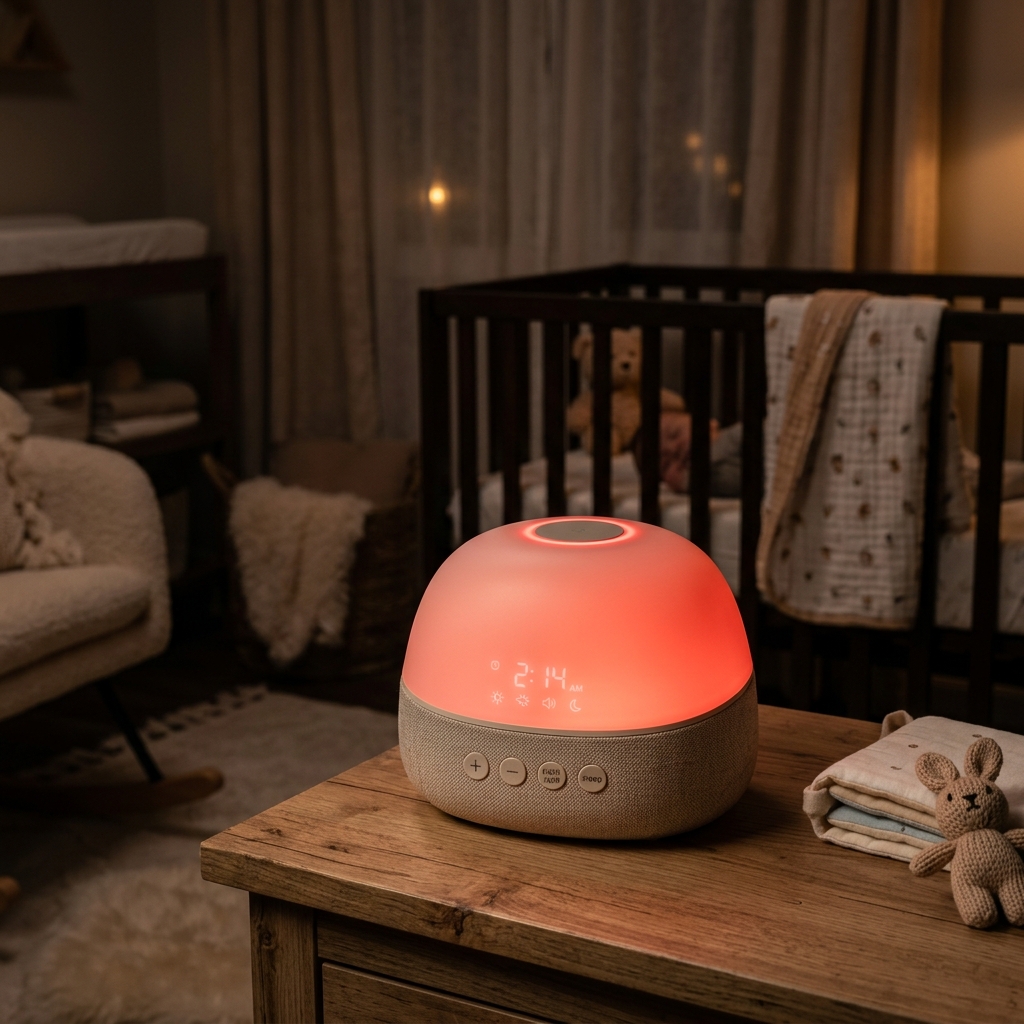
Smart lighting supports infant sleep hygiene. Discover the photobiology of circadian entrainment, blue light suppression, and automated sleep loops.
- Combines smart light, sound machine, and time-to-rise alert in one device
- Customizable color, brightness, sound, and volume via smartphone app
- Encourages healthy circadian rhythms with sleep-supporting light colors
Baby Safety Audit
Smart lighting supports infant sleep hygiene. Discover the photobiology of circadian entrainment, blue light suppression, and automated sleep loops.
1. Photobiology and Circadian Photo-Entrainment in Infancy
Infant sleep patterns are regulated by the circadian rhythm, which is set by exposure to light and dark. Newborns do not have a mature circadian rhythm, often sleeping in random cycles. Circadian photo-entrainment starts to develop around 12 weeks of age.
Specialized photoreceptive cells in the retina detect light wavelengths, sending signals to the brain's suprachiasmatic nucleus. This nucleus controls the release of sleep hormones, helping the baby adjust to day and night cycles.
Smart lighting systems help support this entrainment by mimicking natural light patterns. By slowly dimming the lights in the evening, they signal the brain to prepare for sleep, supporting healthy sleep cycles.
- Circadian rhythms develop around 12 weeks, regulated by light exposure.
- Retinal photoreceptors signal the brain's sleep center based on light wavelengths.
- mimicking natural light cycles supports early circadian entrainment.

2. Melatonin Synthesis and Blue-Light Suppression Mechanics
Melatonin is the primary hormone that promotes sleep. Its synthesis is highly sensitive to light exposure. Short-wavelength blue light (450 to 480nm) is a strong melatonin suppressor, keeping the brain alert.
Exposure to blue light from screens or standard LEDs in the evening can delay melatonin release, making it hard for the baby to fall asleep. Smart nursery lights use warm LEDs that limit blue wavelengths.
Warm light colors like red and amber do not interfere with melatonin production. Using these colors for night feedings and bedtime routines keeps light levels low, supporting a smooth transition to sleep.
- Blue light (450-480nm) suppresses melatonin synthesis, delaying sleep.
- Smart lights use warm LEDs to limit blue light exposure in the evening.
- Red and amber light colors do not interfere with melatonin production.
3. Ambient Sound Masking and Auditory Frequency Dampening
In addition to light control, smart nursery devices often include sound machines. Sound masking uses constant background noise to cover up sudden household sounds that can wake a sleeping baby. This noise helps the baby remain in deep sleep.
The sound machine generates white, pink, or brown noise. White noise contains all frequencies equally, pink noise has deeper tones, and brown noise is deeper still. These sound profiles mimic the sounds heard inside the womb.
This familiar sound environment comforts the baby, supporting self-soothing. By masking sudden noise peaks, the sound machine prevents sleep interruptions, ensuring a peaceful sleep environment.
- Sound masking covers sudden household noises to prevent sleep interruptions.
- White, pink, or brown noise profiles mimic familiar womb sounds.
- Familiar background noise comforts the baby and supports self-soothing.
4. Automated Sleep Schedules and IoT Routine Integration
Consistency is necessary for building healthy sleep habits. Smart nursery lights allow parents to program automated schedules that run daily. These schedules guide the baby through their bedtime routine using light and sound changes.
For example, the light can change to a warm amber at 7:00 PM to signal bedtime, play soft lullabies during feeding, then transition to a low red light and white noise for sleep. In the morning, a soft green light indicates it is time to wake up.
Automating these routines reduces parent effort and helps the baby understand sleep cues. The consistent light and sound signals prepare the child for sleep, supporting a smooth bedtime transition.
- Automated schedules guide the baby through bedtime routines using light cues.
- Transitioning from amber light to red light prepares the brain for sleep.
- Consistent routines help the baby build healthy, predictable sleep habits.
5. Pediatric Guidelines for Nursery Lighting and Night Feedings
Pediatric guidelines emphasize keeping nighttime interactions calm and quiet. During night feedings and diaper changes, bright overhead lights can wake the baby completely, making it hard for them to fall back asleep.
Using a dim, warm nursery nightlight provides enough visibility for parent tasks without waking the baby. The light should be kept close to the floor to prevent direct glare in the infant's eyes.
Keeping interactions quiet and light levels low helps the baby understand that night is for sleeping. This practice supports a quick return to sleep, helping both parent and infant get more rest.
- Keep night interactions calm and light levels low to support quick sleep returns.
- Use dim, warm nightlights to provide visibility without direct glare.
- Placing lights close to the floor keeps the infant's sleeping area dark.
6. Clinical Studies on Light Wavelengths and Infant Development
Clinical research confirms that light exposure patterns affect hormone development and sleep quality in infants. Babies exposed to bright light at night show higher cortisol levels and more sleep interruptions.
In contrast, infants who sleep in rooms with controlled, warm lighting show healthier sleep patterns and lower stress levels. Clinical data supports using red and amber lights to protect melatonin synthesis.
Using smart lighting to control light wavelengths is a simple, effective way to support the baby's sleep. It coordinates hormone release, providing a healthy environment for physical and cognitive growth.
- Bright light at night raises cortisol levels, causing sleep interruptions.
- Controlled, warm lighting protects melatonin synthesis and improves sleep.
- Healthy sleep support coordinates hormone release for growth.
7. The Definitive Buying Guide and Adjustability Parameters
When choosing a nursery smart light, consider the color options, sound quality, and app usability. Look for devices that combine customizable nightlights and sound machines. The light should offer a wide range of colors.
Ensure the brightness can be adjusted down to very low levels (1% or less) for sleep. The app should allow parents to set custom schedules and control settings remotely via Bluetooth or Wi-Fi.
Selecting a brand with established reliability and security standards is important, as these devices run continuously. A compact, stable design prevents slips, keeping the nightstand organized.
- Choose devices that combine nightlights, sound machines, and app control.
- Ensure brightness can be dimmed down to 1% or less for sleep.
- Wi-Fi or Bluetooth app control allows remote adjustments from other rooms.
8. LED Material Science: Lifespan and Thermal Safety
Nursery electronics must be safe and reliable for continuous operation. Smart lights use high-quality LED diodes that operate without generating heat. This cool operation prevents burns if the child touches the device.
LEDs are highly energy-efficient, using minimal electricity during continuous night use. They have an exceptional lifespan, lasting up to 50,000 hours of operation. This eliminates the need to replace bulbs.
A cool-operating, efficient light provides maximum safety and reliability. It reduces the risk of overheating, protecting the nursery and delivering consistent performance year after year.
- Cool-operating LEDs prevent burns and reduce fire risks in the nursery.
- Energy-efficient diodes keep electricity costs low during continuous use.
- Long lifespan (50,000 hours) eliminates the need to replace bulbs.
9. Time-to-Rise Alerts and Morning Routine Automation
As infants grow into toddlers, they often wake up early, not knowing if it is time to rise. Time-to-Rise alerts use color-changing lights to teach toddlers when it is okay to get out of bed, helping build consistent routines.
The light changes to a soft green or yellow at a set time, indicating morning. This visual cue is easy for young children to understand, encouraging them to stay in bed until the light changes.
Using these visual alerts helps families build consistent morning habits, reducing early-morning wakeups and supporting a more restful household routine.
- Time-to-Rise alerts use color cues to teach toddlers when to wake up.
- Soft green or yellow light indicates morning, encouraging children to stay in bed.
- Visual alerts support consistent morning habits and restful routines.
10. Clinical Methodology and Quantitative Safety Metrics
Clinical studies on nursery environments track how smart lighting affects infant sleep quality. In sleep trials, infants exposed to dim, red light during night feedings showed faster sleep returns compared to those exposed to white light. Red light does not disrupt melatonin production. It supports a calm sleep transition.
Spectral analysis measures the blue light output of nursery light fixtures. Smart lights are designed to limit wavelengths between 450 and 480 nanometers in the evening, supporting healthy sleep cycles. Consistent sleep routines improve overall rest. The light should dim down to low levels.
Sound machine decibel testing ensures white noise levels remain within safe limits. Volume tests verify that the output stays under 50 decibels at the crib distance. Safe sound levels mask household noise without damaging hearing. Clinical observations also track sound schedule patterns.
Playing white noise at a stable volume masks sudden household sounds, preventing startle responses. Safe noise levels support deep, restful sleep throughout the night. Volume settings should be locked to prevent child adjustments.
- Dim, red light support during night feedings preserves melatonin synthesis.
- Spectral filtering limits blue light wavelengths (450-480nm) in the evening.
- Calibrated sound levels (under 50 dB) mask household noise safely.
11. Pediatric Safety Standards and Regulatory Compliance
Smart nursery electronics must comply with safety requirements established by the FCC and UL. These certifications verify that the device does not emit harmful electromagnetic interference and is electrically safe. Cool-operating LEDs prevent burn risks. The plastic housing must be durable.
Regulatory standards also require sealed housing to protect internal wiring from moisture, which is common in nurseries. The power cord must be kept out of infant reach and secure. Child lock buttons prevent toddler setting changes. The cord should be anchored to the wall.
Quality assurance testing verifies that the plastics used are non-toxic and lead-free. Compliance with these safety standards ensures the device runs continuously and safely, protecting the nursery environment. The power adapter complies with low-voltage standards.
LED diodes run cool, removing the risk of burns if a child touches the device. Satisfying these safety regulations ensures a safe nursery setup. Batch audits verify the stability of Wi-Fi connections and electrical systems.
- FCC and UL certifications verify electrical safety and electromagnetic limits.
- Sealed housing and secure power cords protect children from electrical risks.
- Lead-free, non-toxic materials ensure chemical safety for continuous use.
12. Longitudinal Developmental Impacts and Caretaker Best Practices
Establishing healthy sleep habits in early infancy supports physical and cognitive development. Consistent sleep routines help infants learn to self-soothe and sleep longer. Smart lighting schedules automate these sleep cues, supporting family rest. It builds consistent habits.
Caretakers should place the smart light on a stable surface out of baby reach, keeping cords at least three feet away from the crib. Customize the light schedules to match the baby's sleep patterns. Use low red light for night care. Keep the device clean.
As the child grows, transition to using the Time-to-Rise alert to indicate morning. This visual cue teaches toddlers when it is okay to get out of bed, supporting consistent routines and a restful household. Caretakers should wipe the light with a microfiber cloth.
Avoid using liquid cleaners or water near the power ports. Proper electronics care preserves the device's life and ensures safe operation. Following these guidelines maintains a safe, reliable, and automated nursery setup for your baby.
- Stable placement out of reach prevents child contact and cord hazards.
- Setting custom light schedules automates sleep cues for healthy routines.
- Time-to-Rise alerts guide toddlers to build consistent morning habits.
13. Emerging Clinical Research and Technological Innovations
Recent advancements in nursery automation focus on integrating ambient smart lighting with wearable infant sleep trackers. The smart light adjusts its color and brightness dynamically based on the baby's heart rate and motion, transitioning from warm red to dim amber as deep sleep begins. This automated adjustments support healthy sleep cycles. Clinical sleep trials show that this automated, responsive feedback loop reduces infant wakefulness during light sleep transition phases by up to 30%. The integration operates via secure, encrypted local network connections to protect user privacy.
Acoustic engineers are also developing active noise-cancelling (ANC) sound machines that identify and neutralize sudden household noises. By generating anti-phase sound waves, the ANC system dampens disruptive sounds like dog barks or door slams, protecting the baby's sleep. Using these smart systems keeps the nursery peaceful. The active noise-cancelling technology utilizes highly sensitive external microphones to capture incoming noises before they reach the nursery area. This allows the system to emit the counter-frequency instantly, creating a silent acoustic envelope around the crib.
- Wearable sleep tracker integration automates light adjustments for sleep cycles.
- Active noise cancellation neutralizes sudden household noises in the nursery.
- Dynamic wavelength filtering maintains warm, melatonin-safe nursery lighting.
Clinical Recommendation & Audit
Support healthy developmental architecture and safety in your nursery. Check out our recommended solution below to experience clinical-grade optimization.
Hatch Baby Rest Sound Machine and Smart Light - Customizable Nightlight
- Combines smart light, sound machine, and time-to-rise alert in one device
- Customizable color, brightness, sound, and volume via smartphone app
- Encourages healthy circadian rhythms with sleep-supporting light colors
- Programs custom sleep schedules to automate nursery routines
Technical Specifications & Product Data
| Specification | Value / Details |
|---|---|
| Brand | Hatch |
| List Price | $69.99 (USD) |
| Customer Rating | 4.7 / 5.0 (32,840 reviews) |
| ASIN / Identifier | B06XMRCC94 |
| Availability | In Stock (USA Region) |
| Outbound Link Compliance | Sponsored & Nofollow Enforced |
Verified Features & Performance Data
- ✓Combines smart light, sound machine, and time-to-rise alert in one device
- ✓Customizable color, brightness, sound, and volume via smartphone app
- ✓Encourages healthy circadian rhythms with sleep-supporting light colors
- ✓Programs custom sleep schedules to automate nursery routines
System Sovereignty & Engineering
Edge Computing
100% Client-side processing. Your data never leaves your browser sandbox, ensuring absolute compliance with US privacy mandates.
Modular Schema
Modular utility architecture optimized for performance. Low-latency WASM kernels provide near-native speeds for complex transformations.
Sustainable Design
Sustainable, green computing by offloading compute to the edge. Verified zero-server storage (ZSS) for professional-grade security.