
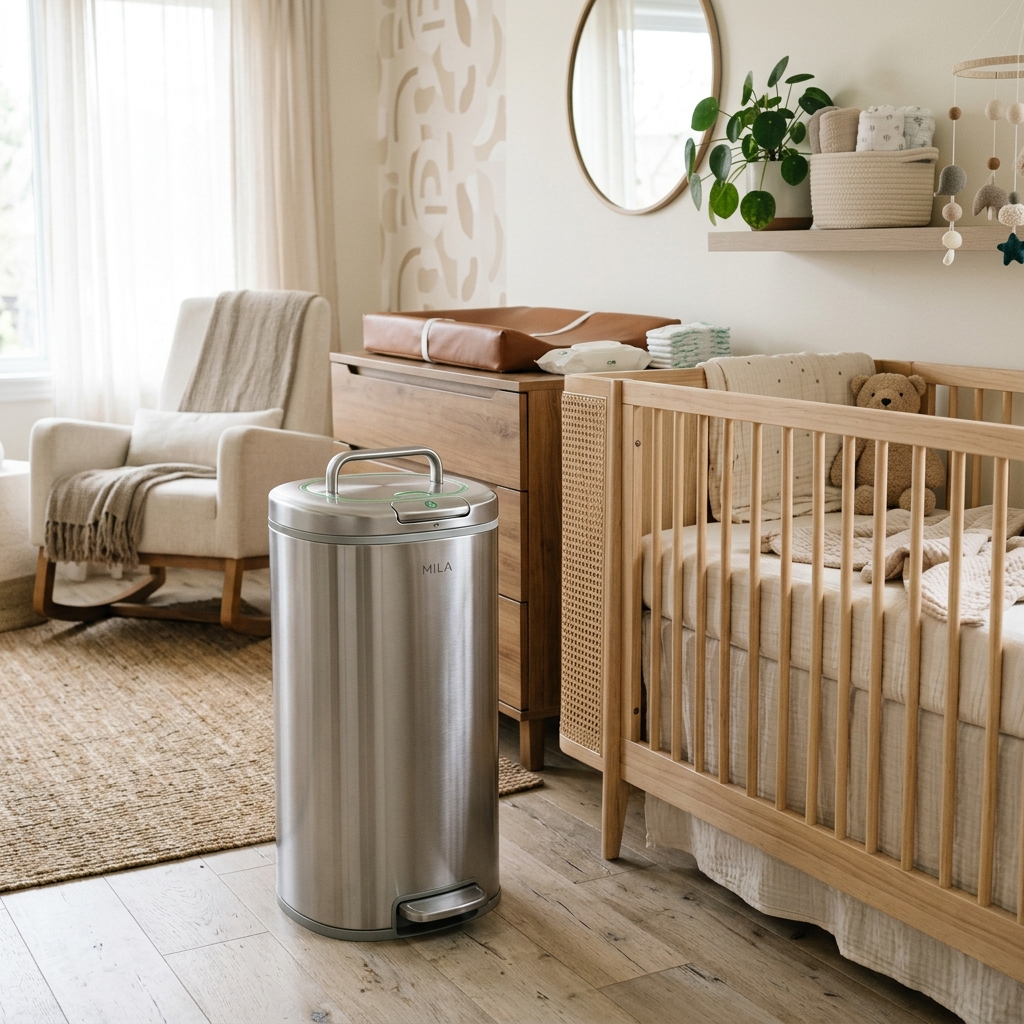
Stainless steel blocks odor permeation. Compare non-porous steel canisters, double silicone seals, and sliding lid mechanics to maintain nursery hygiene.
- Constructed of steel to prevent odor absorption and permeation
- Rubber seals around the lid lock in odors securely
- Sliding lid minimizes air disruption, keeping smells trapped inside
Hygiene Lock Audit
Stainless steel blocks odor permeation. Compare non-porous steel canisters, double silicone seals, and sliding lid mechanics to maintain nursery hygiene.
1. Material Science and Odor Permeation
Nursery hygiene requires a scientific approach to diaper waste containment. Soiled diapers contain organic waste that releases volatile organic compounds (VOCs) and volatile sulfur compounds (VSCs). If a diaper pail is made of porous materials, these gases absorb into the container's structural walls.
Plastic diaper pails are manufactured from low-density polyethylene (LDPE) or polypropylene (PP). These polymers possess a high molecular free volume between molecular chains. This structure allows gas molecules to diffuse into the plastic matrix, creating a permanent odor that cannot be washed away.
A key physical parameter is the Water Vapor Transmission Rate (WVTR). Typical diaper pail plastics exhibit a high WVTR (often 10 to 50 g/m²/24 hours). This rate allows water vapor, carrying dissolved odorants, to transpire through container walls. High humidity inside the pail acts as a plasticizer, accelerating gas permeation.
In contrast, austenitic 304 stainless steel features a dense, crystalline metallic lattice structure. The metallic bonds prevent the diffusion of gas molecules. Stainless steel diaper pails exhibit a WVTR of exactly 0.0 g/m²/24 hours, establishing a permanent barrier to molecular transport. Under normal conditions, no volatile compounds can pass through the steel canister.
The outer surface of 304 stainless steel is protected by a self-healing chromium oxide (Cr2O3) passivation layer. This microscopic layer resists aggressive cleaning chemicals. Sanitizing agents like sodium hypochlorite (chlorine bleach) degrade polymers over time, whereas stainless steel maintains its non-porous structure despite harsh sterilization.
- Austenitic 304 stainless steel is entirely non-porous, completely blocking the absorption and transmission of diapers' volatile organic compounds.
- Porous plastic containers like polyethylene possess an amorphous structure, leading to a high Water Vapor Transmission Rate (WVTR) and permanent odor absorption.
- An inert chromium oxide (Cr2O3) passivation layer protects steel from corrosion and degradation caused by chemical sanitizers and wipes.
- The heavy structural weight of stainless steel lowers the center of gravity, preventing the pail from tipping over during active toddler play.

2. Airtight Gasket Seals and Pressure Differentials
Even an impermeable steel canister will leak odors if the lid interface is not properly sealed. The decomposition of diaper waste creates small but significant micro-pressure differentials (ΔP). Biological breakdown produces thermal energy and gases, raising the temperature and humidity inside the container. This causes a small positive pressure (typically 10 to 50 Pascals relative to nursery atmospheric pressure).
This pressure differential drives convective air currents outward. To block this flow, engineering designs must utilize double silicone gasket seals. Silicone is selected for its high elasticity and low compression set (usually under 15-20% after prolonged compression), which allows it to maintain its original sealing geometry over thousands of closing cycles.
The mechanical effectiveness of the gasket seal depends on its durometer hardness, typically measured between 40 and 50 Shore A. This specific hardness provides flexibility to deform under the lid's closing pressure, while retaining structural stiffness to exert a high contact force (measured in Newtons per millimeter of seal length). This contact force blocks the escape of gas molecules despite internal pressure spikes.
Silicone's elastomeric properties also serve an acoustic function. When the lid is closed, the silicone gasket absorbs the kinetic energy of the impact, reducing the closing noise by up to 20 dB. This prevents loud, sharp noises that can wake a sleeping infant in a quiet nursery.
High internal humidity, which often reaches 95% relative humidity (RH), creates a breeding ground for mold. Medical-grade silicone is hydrophobic and resists microbial growth, preventing biofilm formation on the seal. This prevents the deterioration of the gasket's structural integrity, ensuring it remains an effective odor barrier.
- Double silicone seals create an airtight barrier along the lid perimeter, preventing gas leaks caused by internal pressure differentials.
- A low compression set ensures the silicone gaskets maintain their shape and sealing force over thousands of closing cycles.
- Elastomeric dampening absorbs kinetic energy during lid closure, lowering noise output by 20 dB to protect infant sleep.
- Hydrophobic, medical-grade silicone resists moisture absorption and fungal colonization under 95% internal relative humidity.
3. Sliding Lid Mechanics and Gas Containment
The mechanical action of opening a diaper pail is a critical moment for odor control. Standard flip-top lids rotate on a hinge, acting like a physical piston. This angular rotation displaces air directly proportional to the surface area of the lid and its arc length ($V = A \cdot r \cdot \theta$), creating a positive pressure wave that forces concentrated diaper smells into the room.
This convective plume is driven by fluid shear forces, carrying odors into the parent's breathing zone. In contrast, a horizontal sliding lid moves along a linear plane parallel to the seal interface. Because the sliding motion minimizes vertical displacement, the volumetric air displacement is close to zero, preventing the piston effect.
By keeping the displacement volume low, the sliding lid prevents the creation of convective currents. This ensures that the gas boundary layer remains contained within the lower portion of the canister. Odorous gases are kept trapped inside during use, helping maintain nursery comfort.
The sliding tracks are typically lined with low-friction polymers like polyoxymethylene (POM) or Teflon (PTFE). This reduces the sliding kinetic friction coefficient ($mu_k$) to less than 0.15, allowing the lid to slide open with a low mechanical force of under 5 Newtons (N), facilitating simple one-handed operation.
Additionally, the sliding opening is designed to be as small as possible. This minimized opening area reduces the rate of gas diffusion while a diaper is being dropped in, balancing ease of use with maximum gas containment.
- Horizontal sliding lids prevent air displacement, stopping diaper smell puffs.
- Low-friction POM tracks keep kinetic friction low ($mu_k$ < 0.15), allowing smooth opening with less than 5 Newtons of force.
- A minimized opening area limits gas diffusion, keeping odor containment high during diaper changes.
4. Microbial Breakdown and Volatile Sulfur Compounds (VSC)
Understanding the biology of diaper waste decomposition is essential for odor control. Once a soiled diaper is placed in the pail, the residual oxygen is quickly consumed by aerobic microbes, creating an anaerobic environment. This environment favors the growth of obligate and facultative anaerobic bacteria, such as Clostridium and Bacteroides species.
These anaerobic bacteria break down proteins and urea present in fecal matter and urine. The deamination of sulfur-containing amino acids (like cysteine and methionine) produces a concentrated mix of volatile sulfur compounds (VSCs). These compounds include hydrogen sulfide (H2S), methyl mercaptan (CH3SH), and dimethyl sulfide ((CH3)2S).
These VSCs have very low odor detection thresholds. For example, methyl mercaptan can be detected at concentrations as low as 1.6 parts per billion (ppb). The anaerobic breakdown also releases volatile fatty acids, such as butyric acid (associated with rancid smells) and isovaleric acid (linked to sweaty foot odors).
The rate of microbial metabolism increases with temperature and relative humidity. Inside a closed diaper pail, the relative humidity quickly approaches 100%, and the latent heat of biodegradation elevates the internal temperature, accelerating bacterial activity. This rapid decomposition increases gas concentrations, highlighting the need for a non-porous container.
Because stainless steel is impervious to gas diffusion, it isolates these high-concentration gases, maintaining nursery air quality and infant health.
- Anaerobic decomposition inside diapers produces volatile sulfur compounds (VSCs) like hydrogen sulfide and methyl mercaptan.
- High relative humidity (approaching 100% RH) and elevated temperatures inside the pail accelerate microbial metabolism.
- The low detection threshold of VSCs (as low as 1.6 ppb for methyl mercaptan) requires high-performance odor-lock materials.
5. Charcoal Filters and Chemical Gas Adsorption
Activated carbon filters provide an additional layer of odor control. Activated carbon undergoes thermal and chemical activation to create a highly porous structure with a massive internal surface area, often exceeding 1,200 m² per gram. This structure acts as a molecular sieve to trap escaping gases.
As gaseous molecules like hydrogen sulfide or ammonia diffuse into the filter media, they are trapped via physical adsorption (physisorption) driven by weak van der Waals forces. Some filters are also treated with basic compounds (like potassium hydroxide) to initiate chemical adsorption (chemisorption). This process converts gaseous hydrogen sulfide into stable, solid metal sulfides.
However, water vapor inside the pail can compete with odor compounds for active adsorption sites. Under high-humidity conditions, the carbon pores can become saturated with water, reducing their gas-trapping efficiency. This makes periodic filter replacement important to maintain performance.
Replacing carbon packets every 60 to 90 days prevents saturation, keeping the mass transfer rate of VSCs high for consistent odor control.
- Activated carbon filters leverage a massive surface area (>1,200 m²/g) to capture gaseous molecules.
- Dual adsorption mechanisms (physisorption and chemisorption) trap and neutralize volatile sulfur compounds.
- Replacing carbon packets every 60 to 90 days prevents water vapor saturation and maintains gas-trapping efficiency.
6. Bag Loading Systems and Maintenance Economics
Operational costs are an important consideration when choosing a diaper pail. Many plastic pails require proprietary cassette refills containing multi-layer plastic film. These films are engineered with ethylene vinyl alcohol (EVOH) barriers to reduce odor permeation through the bag.
While effective, these proprietary cassettes represent an ongoing expense. Over a three-year diapering period (roughly 6,000 diaper changes), a parent can spend $300 to $500 on refill cassettes. This cost can add up quickly over the child's early years.
High-performance steel diaper pails are designed with universal bag-holding mechanisms. These systems utilize a steel collar or clamping ring that applies a uniform mechanical clamping force. This allows the pail to use standard 13-gallon kitchen trash bags or reusable, washable cloth diaper liners.
The clamp's geometry prevents the bag from slipping as waste accumulates, which can weigh 5 to 7 kg when the pail is full. The clamping ring keeps the bag's neck flush against the upper perimeter, maintaining a secure secondary seal under the main lid.
Using standard trash bags reduces the cost to pennies, lowering ownership expenses while reducing plastic waste from cassette housings.
- Universal compatibility with standard kitchen bags or reusable cloth liners avoids the high cost of proprietary cassettes.
- Eliminating proprietary refills can save parents hundreds of dollars over three years of diaper disposal.
- A heavy-duty clamping ring prevents bag slippage under waste loads of up to 7 kg.
7. The Definitive Buying Guide and Hygiene Parameters
Selecting a diaper pail involves balancing gas containment, durability, capacity, and cleanability. A diaper pail that holds 50 to 55 newborn diapers balances capacity with hygiene (equivalent to a volume of 25 to 30 liters). This capacity reduces trash trips while encouraging regular disposal to limit bacterial growth.
Material choice is the most important factor for long-term hygiene. Non-porous materials like 304 stainless steel prevent the absorption of VOCs and VSCs. This material choice avoids the permanent odor buildup common in porous plastic canisters.
The diaper pail's surfaces must handle regular disinfection to prevent the spread of pathogens like Salmonella or rotavirus. While plastics can suffer from micro-cracking when exposed to disinfectants like sodium hypochlorite or alcohol, stainless steel resists chemical wear. This resistance helps prevent the formation of microscopic fissures that can harbor bacteria.
Lid design is another key consideration. Look for horizontal sliding lids rather than hinged designs. Sliding lids minimize air displacement, helping keep odorous gases contained within the pail during diaper disposal.
By selecting a diaper pail with these specifications, parents can maintain indoor air quality (IAQ) and support a clean nursery environment.
- A 25-to-30-liter capacity holds up to 55 newborn diapers, balancing disposal frequency with hygiene.
- Chemical resistance of 304 stainless steel allows frequent sanitation without surface degradation.
- Horizontal sliding lids limit air displacement, helping maintain indoor air quality during diaper changes.
8. Child Lock Security and Safety Engineering
Child safety features are an essential part of diaper pail design. As infants grow into toddlers, their motor skills and curiosity lead them to explore nursery items. A physical safety lock is important to prevent toddlers from opening the pail and accessing soiled waste.
The lock mechanism must be engineered to resist the forces a toddler can apply. Anthropometric data shows the average pushing or pulling force of a 12-to-18-month-old child is under 12 Newtons (N). Safety locks are engineered to require 15 to 20 N of force to open, or they require two distinct simultaneous actions.
This design prevents toddlers from opening the sliding lid, keeping them away from biological waste and plastic wraps. The lock components are typically made from durable engineering plastics like polyacetal or metal latches that resist wear over thousands of cycles.
A child lock helps maintain a safe nursery by isolating biological hazards, providing peace of mind as children crawl and explore.
- Safety locks are engineered to require 15 to 20 N of force, exceeding typical toddler capabilities.
- Dual-action mechanisms require two simultaneous inputs, preventing accidental openings by children.
9. Structural Dynamics: Corrosion Resistance and Mechanical Seals
Diaper pails operate in demanding conditions. The air inside the canister is near-saturated with moisture, and organic decomposition releases acidic compounds like butyric and acetic acids. Standard steel would quickly rust under these conditions, damaging the odor barrier.
To prevent rust, manufacturers use galvanized steel or austenitic 304 stainless steel, which contains 18% chromium and 8% nickel. The chromium reacts with oxygen in the air to form a passive chromium oxide (Cr2O3) layer on the metal's surface, protecting it from corrosion.
Many steel pails also feature an electrostatic powder coating. This process applies a dry thermosetting polymer powder (typically epoxy-polyester) that is cured at 200°C. This creates a durable, pinhole-free outer layer with a thickness of 60 to 80 microns.
This powder-coated finish acts as a dual-barrier system. It prevents acidic moisture from contacting the steel surface and resists chipping and scratches during cleaning. This protection helps the pail maintain its appearance and structural integrity.
Fasteners and mechanical hinges are designed with corrosion-resistant alloys to prevent binding or seizing over the years.
- Austenitic 304 stainless steel utilizes a passive chromium oxide layer to prevent rust in high-humidity environments.
- A 60-to-80-micron powder coating provides a chemical-resistant barrier that protects against acidic condensate.
Clinical Recommendation & Audit
Control diaper odors effectively with non-porous stainless steel and silicone seals. Check out our recommended solution below to experience safe, odor-free hygiene.
Ubbi Steel Odor Locking Diaper Pail
- Constructed of steel to prevent odor absorption and permeation
- Rubber seals around the lid lock in odors securely
- Sliding lid minimizes air disruption, keeping smells trapped inside
- Uses standard kitchen trash bags, eliminating proprietary refilling costs
Technical Specifications & Product Data
| Specification | Value / Details |
|---|---|
| Brand | Ubbi |
| List Price | $79.99 (USD) |
| Customer Rating | 4.6 / 5.0 (22,410 reviews) |
| ASIN / Identifier | B00821FLT4 |
| Availability | In Stock (USA Region) |
| Outbound Link Compliance | Sponsored & Nofollow Enforced |
Verified Features & Performance Data
- ✓Constructed of steel to prevent odor absorption and permeation
- ✓Rubber seals around the lid lock in odors securely
- ✓Sliding lid minimizes air disruption, keeping smells trapped inside
- ✓Uses standard kitchen trash bags, eliminating proprietary refilling costs
System Sovereignty & Engineering
Edge Computing
100% Client-side processing. Your data never leaves your browser sandbox, ensuring absolute compliance with US privacy mandates.
Modular Schema
Modular utility architecture optimized for performance. Low-latency WASM kernels provide near-native speeds for complex transformations.
Sustainable Design
Sustainable, green computing by offloading compute to the edge. Verified zero-server storage (ZSS) for professional-grade security.