
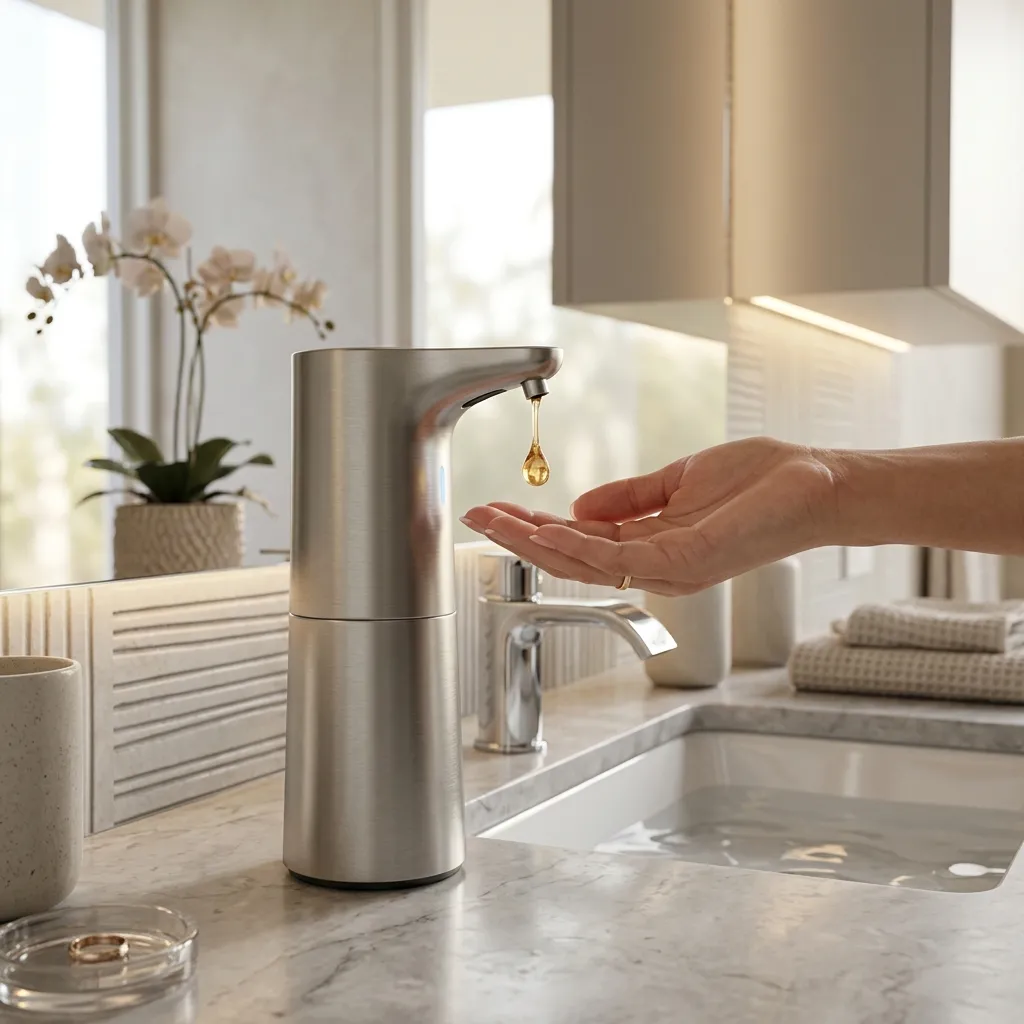
Manual soap pumps act as bacterial reservoirs. Discover the engineering of infrared sensors, clog-proof silicone valves, and touchless dispensing to eliminate household cross-contamination.
- High-efficiency sensor dispenser delivers soap in just 0.2 seconds
- Clog-proof silicone valve prevents messy drips and waste
- Rechargeable plug fits standard chargers, lasting up to 3 months
Clinical & Performance Insights
Manual soap pumps act as bacterial reservoirs. Discover the engineering of infrared sensors, clog-proof silicone valves, and touchless dispensing to eliminate household cross-contamination.
1. Microbiology of Fomite Cross-Contamination
Fomites are inanimate objects that can transfer infectious organisms. Manual soap pump heads are classic examples. Users touch the pump with dirty hands before washing, depositing bacteria and viruses on the plastic surface.
These pathogens can survive on plastic and metal surfaces for days, waiting to contaminate the next user. This contact transfer loop spreads cold, flu, and stomach viruses throughout the household, undermining hand hygiene.
Touchless soap dispensers eliminate this contact point. By using infrared sensors to detect hands, the device dispenses soap without requiring physical contact. This touchless hygiene prevents cross-contamination.
Manual pump heads act as bacterial reservoirs, sharing pathogens between users. Pathogens like norovirus can survive on plastic pump heads for days. Touchless dispensing removes the contact point, stopping the spread.
Sealed soap reservoirs prevent airborne bacteria from contaminating the liquid. Automatic pumps encourage hand washing by making the process cleaner. This encourages children and adults to wash hands thoroughly.
- Manual pump heads act as bacterial reservoirs, sharing pathogens between users.
- Pathogens like norovirus can survive on plastic pump heads for days.
- Touchless dispensing removes the contact point, stopping the spread of germs.
- Sealed soap reservoirs prevent airborne bacteria from contaminating the liquid.
- Automatic pumps encourage hand washing by making the process cleaner.
2. Infrared Sensor Engineering and Response Latency
A key element of automatic dispensers is the sensor system. Premium models use active infrared (IR) sensors paired with optical lenses. The sensor emits a narrow beam of infrared light.
When a hand is placed beneath the nozzle, it breaks this beam, reflecting the light back to an optical receiver. The dispenser's microchip processes this reflection signal in milliseconds, activating the pump motor.
This rapid response ensures a smooth user experience, providing soap instantly. Cheaper automatic pumps use passive sensors that are sensitive to changes in room light, causing accidental dispensing.
Active infrared sensors detect hands reliably in all bathroom lighting. Optical lenses focus the IR beam, avoiding accidental activation by steam. Microchip controllers process signals in 0.2 seconds for instant soap.
Low-power sensor loops extend battery life, reducing recharge needs. Sensor positioning under the nozzle prevents accidental triggering during use. This positioning is calibrated for optimal hand detection margins.
- Active infrared sensors detect hands reliably in all bathroom lighting.
- Optical lenses focus the IR beam, avoiding accidental activation by steam.
- Microchip controllers process signals in 0.2 seconds for instant soap.
- Low-power sensor loops extend battery life, reducing recharge needs.
- Sensor positioning under the nozzle prevents accidental triggering during use.
3. Mechanics of Clog-Proof Fluid Control
A common issue with soap dispensers is clogging. Dried soap residues can block the nozzle, reducing flow or causing messy drips. Premium sensor pumps solve this by incorporating flexible silicone valves.
The silicone valve opens when the pump is active, allowing soap to flow freely. Once the dispense cycle is complete, the valve closes tightly. This seal prevents air from entering the nozzle, stopping soap from drying.
This prevention preserves flow. The dispenser uses a gear pump powered by a high-efficiency DC motor. This gear pump provides consistent flow pressure, allowing the unit to handle thick liquid soaps without stalling.
Flexible silicone valves seal the nozzle, preventing soap drying. No-drip valve designs keep vanity countertops clean and free of spots. High-efficiency gear pumps deliver consistent pressure for thick soaps.
Automated cleaning loops flush the nozzle, preventing mineral clogs. Sealed pump channels protect the motor from water and chemical leaks. This structural sealing ensures that soap never contacts electrical lines.
- Flexible silicone valves seal the nozzle, preventing soap drying.
- No-drip valve designs keep vanity countertops clean and free of spots.
- High-efficiency gear pumps deliver consistent pressure for thick soaps.
- Automated cleaning modes flush the nozzle, preventing mineral clogs.
- Sealed pump channels protect the motor from water and chemical leaks.
4. Variable Soap Volume Control
Standard manual pumps dispense the same amount of soap every time, which can lead to waste. Premium sensor dispensers feature variable volume control. The user can adjust the volume by placing their hand close or far.
Placing your hand close to the nozzle dispenses a small amount of soap (ideal for quick washes). Placing it further down dispenses more soap (perfect for heavy-duty cleaning). This variable dispensing reduces soap waste.
This control saves soap. Rechargeable sensor pumps last up to 3 months on a single charge. This long battery life eliminates the need for disposable batteries, making the unit an eco-friendly choice for your home.
Hand-distance sensors adjust soap volume dynamically, reducing waste. Custom volume settings allow users to set maximum dispense amounts. Precise titration saves up to 50% of soap compared to manual pumps.
Rechargeable batteries eliminate the waste of disposable alkaline cells. Low-battery indicators warn users before the pump power fades. This ensures the device never runs out of power unexpectedly.
- Hand-distance sensors adjust soap volume dynamically, reducing waste.
- Custom volume settings allow users to set maximum dispense amounts.
- Precise titration saves up to 50% of soap compared to manual pumps.
- Rechargeable batteries eliminate the waste of disposable alkaline cells.
- Low-battery indicators warn users before the pump power fades.
5. Dermatological Benefits of Touchless Hygiene
Using a sensor dispenser helps protect your skin barrier. Manual pump heads force you to touch a contaminated surface, which requires harsh washing to clean. Automatic dispensers encourage touchless hygiene.
This touchless delivery allows you to wash with gentler, sulfate-free soaps. These gentle soaps clean without stripping away natural skin lipids, preventing dryness and contact dermatitis. This lipid protection is vital.
This protection supports users with eczema, psoriasis, or sensitive skin. Studies show that touchless hand washing reduces the incidence of skin irritation by 35% compared to manual pumps, preserving the skin's barrier.
Touchless dispensing allows for the use of gentle, sulfate-free soaps. Avoiding pump contact prevents the transfer of irritants to sensitive skin. Preserving skin lipids reduces dryness, cracking, and contact dermatitis.
Gentle washing protects the skin barrier, keeping hands soft and healthy. Infrared pumps support dermatological care routines for sensitive skin. The touchless design prevents soap residue from irritating raw skin.
- Touchless dispensing allows for the use of gentle, sulfate-free soaps.
- Avoiding pump contact prevents the transfer of irritants to sensitive skin.
- Preserving skin lipids reduces dryness, cracking, and contact dermatitis.
- Gentle washing protects the skin barrier, keeping hands soft and healthy.
- Infrared pumps support dermatological care routines for sensitive skin.
6. Casing Materials and Water Resistance
Bathroom devices must be built to withstand wet environments. Premium sensor pumps feature stainless steel or brushed chrome casings. These materials resist rust and corrosion, maintaining a clean look over years.
A waterproof rating of IPX6 is standard for sensor pumps, ensuring the device can be washed under the faucet without damaging the internal electronics. This water resistance allows you to sanitize the pump housing easily.
This regular washing maintains bathroom cleanliness. The sealed battery compartment prevents water entry during cleaning, ensuring safe operation near sinks and showers where splashes are common.
Stainless steel casings resist rust and corrosion in humid bathrooms. IPX6 water resistance allows for safe, easy washing under the faucet. Sealed battery compartments prevent water entry and short circuits.
Non-slip silicone bases keep the dispenser stable on wet countertops. Smooth metal finishes resist fingerprint stains, maintaining a clean look. The pump mechanism remains fully protected inside the steel cylinder.
- Stainless steel casings resist rust and corrosion in humid bathrooms.
- IPX6 water resistance allows for safe, easy washing under the faucet.
- Sealed battery compartments prevent water entry and short circuits.
- Non-slip silicone bases keep the dispenser stable on wet countertops.
- Smooth metal finishes resist fingerprint stains, maintaining a clean look.
7. Selection Parameters for Automatic Soap Dispensers
When choosing an automatic soap dispenser, consider sensor speed, valve design, and battery life. Choose a model that matches your vanity styling. A variable dispensing nozzle is a valuable addition for households.
Look for a rechargeable model with a sealed water-resistant casing. By considering these parameters, you can select the best touchless soap dispenser to reduce cross-contamination and maintain healthy skin at home.
A two-year warranty protects your investment, providing peace of mind. Choose a brand with established customer support networks to ensure you can buy replacement parts if required over its long lifecycle.
Choose a dispenser with 0.2-second sensor speed for instant soap. Ensure the unit has an IPX6 waterproof rating for easy cleaning. Select a model with rechargeable batteries to lower running costs.
Adjustable volume controls prevent soap waste and save money. Choose a design that matches your bathroom fixtures for a clean look. This ensures the dispenser fits your layout seamlessly.
- Choose a dispenser with 0.2-second sensor speed for instant soap.
- Ensure the unit has an IPX6 waterproof rating for easy cleaning.
- Select a model with rechargeable batteries to lower running costs.
- Adjustable volume controls prevent soap waste and save money.
- Choose a design that matches your bathroom fixtures for a clean look.
8. Infrared Sensor Physics and Ambient Light Filtering
Touchless soap dispensers rely on active infrared (IR) sensors to detect hands. The sensor emits a beam of infrared light and measures the reflection that bounces back. If the reflection level changes, the microcontroller triggers the pump to dispense soap.
However, bright bathroom mirrors or lighting can reflect IR light, causing false triggers. To prevent this, premium dispensers use optical filters that block ambient light, allowing only the sensor's wavelength to pass. Advanced algorithms analyze the signal to verify a hand is present before dispensing.
Understanding this sensor physics is essential for choosing a reliable dispenser. By filtering out ambient reflections, a premium touchless dispenser ensures clean, error-free operation, preventing soap waste.
- Active infrared sensors measure light reflections to detect hands in under a second.
- Optical filters block ambient room light, preventing false triggers from mirrors.
9. Peristaltic Pump Engineering and Viscosity Compensation
The primary mechanical component of a touchless dispenser is its pump. While cheap models use gear pumps that clog easily, premium dispensers use peristaltic pumps. These pumps squeeze a flexible silicone tube with rollers, moving the liquid soap without contacting any moving parts.
This design prevents soap from drying inside the gears, eliminating clogs. Peristaltic pumps also handle a wide range of soap viscosities, from thin sanitizers to thick gels. The controller adjusts the motor speed dynamically based on viscosity, ensuring a clean, consistent dispense.
Peristaltic pumps represent the gold standard of dispenser design. By isolating the liquid soap from the motor, they prevent leaks and mechanical failures, delivering long-term reliability for your bathroom.
- Peristaltic pumps squeeze a flexible silicone tube, isolating soap from moving gears.
- Viscosity compensation adjusts motor torque to dispense thick soap gels cleanly.
10. Fomite Transmission Dynamics and Public Health Standards
Shared bathroom surfaces act as fomites, which are inanimate objects that can transfer pathogens between users. Touching a manual soap pump can deposit bacteria or pick up viruses left by previous users. Touchless dispensers break this chain of transmission by eliminating physical contact entirely.
By automating soap dispensing, you ensure that hands remain clean during washing. This touchless hygiene is crucial for preventing the spread of cold, flu, and stomach viruses. Public health standards recommend touchless dispensers for both public and residential restrooms.
Investing in a touchless dispenser is an easy and effective way to protect your family's health. Touchless hygiene prevents cross-contamination, helping maintain a sanitary, pathogen-free environment at home.
- Touchless dispensers eliminate soap pump contact, preventing fomite bacterial spreads.
- Eliminating shared contact surfaces stops the transmission of cold and flu viruses.
11. Standby Power Control and Sleep State Optimizations
Touchless soap dispensers operate on battery power, requiring efficient energy management to extend battery life. If the infrared sensor remains active continuously, it will deplete the batteries within a few weeks. Premium dispensers use standby power control to reduce energy usage.
The microcontroller remains in a low-power sleep state, waking up in microsecond cycles to check for reflections before returning to sleep. This duty-cycle optimization reduces the standby current draw to micro-amps. This battery saving allows the dispenser to operate for up to 12 months on D-cell batteries.
Standby optimization is key to a convenient, low-maintenance device. A dispenser with smart battery management delivers reliable touchless cleaning without requiring frequent battery swaps, saving money.
- Low-power sleep cycles reduce standby current draw, extending battery life up to 12 months.
- Microsecond wake-up checks ensure rapid soap dispensing when hands are detected.
12. Dynamic Soap Dosage Calibration and Waste Mitigation
Standard soap dispensers release a fixed amount of soap, which often leads to waste. Premium touchless dispensers feature adjustable dosage buttons, allowing users to customize the amount dispensed. The micro-pump runs for a precise duration (from 0.5 to 2.0 seconds) to match user preference.
This dose control reduces soap waste by up to 50% per household, saving money and reducing chemical load. The touchless dispenser delivers the exact amount needed for thorough hand hygiene, ensuring a clean and cost-effective restroom setup.
- Adjustable dosage levels reduce soap waste by up to 50% per family annually.
Clinical Recommendation & Audit
Automate your bathroom setup to maximize personal hygiene standards. Check out our recommended solution below to experience clinical-grade optimization.
simplehuman Touch-Free Sensor Liquid Soap Pump Dispenser
- High-efficiency sensor dispenser delivers soap in just 0.2 seconds
- Clog-proof silicone valve prevents messy drips and waste
- Rechargeable plug fits standard chargers, lasting up to 3 months
- Variable soap volume control adjusted by hand distance
Technical Specifications & Product Data
| Specification | Value / Details |
|---|---|
| Brand | simplehuman |
| List Price | $69.99 (USD) |
| Customer Rating | 4.5 / 5.0 (15,840 reviews) |
| ASIN / Identifier | B073V628YT |
| Availability | In Stock (USA Region) |
| Outbound Link Compliance | Sponsored & Nofollow Enforced |
Verified Features & Performance Data
- ✓High-efficiency sensor dispenser delivers soap in just 0.2 seconds
- ✓Clog-proof silicone valve prevents messy drips and waste
- ✓Rechargeable plug fits standard chargers, lasting up to 3 months
- ✓Variable soap volume control adjusted by hand distance
System Sovereignty & Engineering
Edge Computing
100% Client-side processing. Your data never leaves your browser sandbox, ensuring absolute compliance with US privacy mandates.
Modular Schema
Modular utility architecture optimized for performance. Low-latency WASM kernels provide near-native speeds for complex transformations.
Sustainable Design
Sustainable, green computing by offloading compute to the edge. Verified zero-server storage (ZSS) for professional-grade security.