
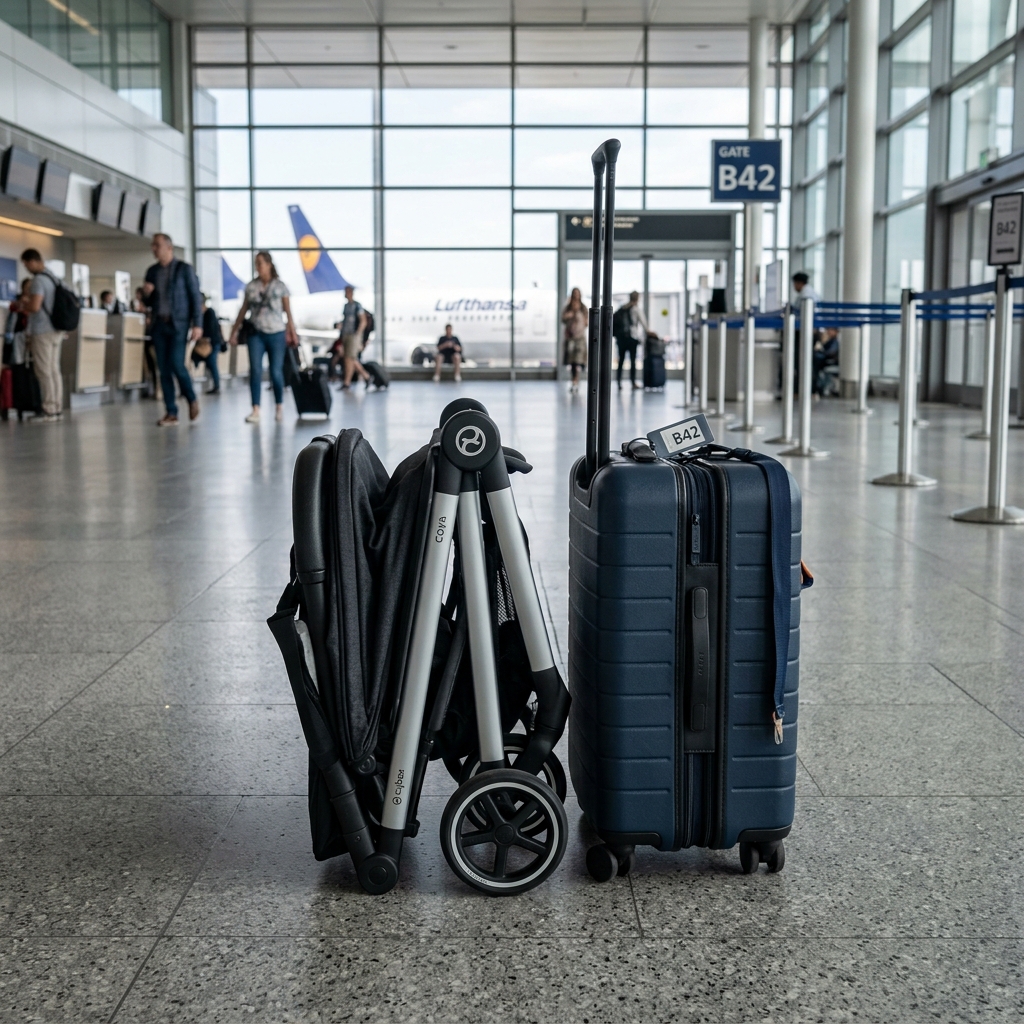
Lightweight travel strollers require structural integrity. Compare aircraft-grade aluminum alloy frames, wheel suspension physics, and IATA folding geometry.
- Folds into cabin luggage dimensions (IATA approved travel size)
- Premium wheel suspension absorbs road shocks, protecting the child
- Aircraft-grade aluminum alloy frame is lightweight yet durable
Structural Travel Audit
Lightweight travel strollers require structural integrity. Compare aircraft-grade aluminum alloy frames, wheel suspension physics, and IATA folding geometry.
1. Structural Dynamics and Aluminum-Alloy Frames
Infant travel requires robust, safe infrastructure to mitigate transient vibration and structural impact. Navigating crowded airports, high curbs, and escalators exposes the stroller chassis to constant mechanical fatigue. The structural frame must support the child's dynamic weight while remaining lightweight for transit.
Premium travel strollers utilize aircraft-grade 6061-T6 aluminum alloys for their primary structural tubing. This alloy offers a high yield strength of 276 MPa and a Young's modulus of 68.9 GPa, ensuring rigidity. This high strength-to-weight ratio allows engineers to decrease tube wall thickness, keeping total chassis weight under 14 pounds.
The frame layout uses a triangulated space frame geometry to optimize load paths. Triangular layouts convert bending moments into axial tension and compression forces, minimizing bending deformation. This configuration prevents frame buckling and limits bending when navigating curbs or cracked sidewalks.
Anodized surface treatments create a hard oxide skin that prevents corrosion and scratching. Pivot joints are reinforced with polyoxymethylene (POM) bushings to reduce friction and eliminate play. This keeps the frame rigid, ensuring reliable and stable steering control.
Furthermore, structural testing ensures the frame resists cyclic fatigue under varying environmental conditions. Over time, metal frames can develop micro-cracks from repeated stress. Using high-ductility alloys prevents sudden structural failures, protecting the child's safety during travels.
- Aircraft-grade 6061-T6 aluminum alloys provide high yield strength, keeping stroller weight under 14 lbs.
- Triangulated strut designs distribute mechanical forces axially, avoiding structural frame flex.
- Polyoxymethylene (POM) bushings mitigate joint wear, maintaining steering control and frame alignment.
- Anodized oxide coatings shield the aluminum frame from environmental corrosion and prevent scratching.
- Precision ball bearings in the wheel assemblies ensure effortless pushing on airport ramps.

2. Folding Linkage Mechanics and Single-Handed Fold
Compact folding is essential for navigating narrow aircraft aisles, bus doors, and compact car trunks. Modern travel strollers use a multi-axis planar 8-bar linkage mechanism to collapse the frame. This linkage operates on a single degree of freedom, ensuring a smooth fold along a constrained path.
The folding design uses spring-loaded locking pins and sliding collar joints. Pulling the handlebar-mounted triggers releases the primary latches, allowing the frame sections to scissor together. The virtual pivot point (VPP) shifts dynamically during folding to minimize the final folded volume.
The collapsed stroller fits within IATA cabin baggage limits of 56 x 45 x 25 centimeters. Storing the stroller in the overhead bin prevents gate-checking damage from baggage handlers. This compact storage preserves the frame's integrity and prevents alignment issues.
Single-handed folding triggers use internal tension cables to retract locking pins. This allows parents to fold the stroller easily while holding their baby with the other hand. Automatic frame locks secure the collapsed unit, preventing accidental unfolding during transit.
Additionally, integrated carry straps make transporting the folded stroller highly convenient. Carrying the stroller over the shoulder distributes its weight comfortably, keeping hands free for other baggage. This enhances parent mobility and comfort in busy transit hubs.
- Planar 8-bar folding linkages collapse the frame into a compact, cabin-safe envelope.
- IATA-approved dimensions allow overhead bin storage, avoiding rough gatecheck damage.
- Tension cable triggers simplify folding while holding the baby, maintaining parent safety.
- Shoulder carry straps make transporting the folded stroller comfortable and hands-free.
- Self-locking latches secure the collapsed frame, preventing accidental unfolding during carry.
3. Suspension Physics and Wheel Elastomers
Ride comfort depends on the stroller's ability to absorb high-frequency vibrations from rough roads. Cobblestones, gravel paths, and cracked pavement create kinetic shocks that can travel to the infant's spine. A robust suspension system is required to isolate these forces.
A stroller acts as a mass-spring-damper physical system under base excitation. The system's equation of motion is $m ddot{x} + c dot{x} + k x = c dot{y} + k y$, where $k$ is the spring constant and $c$ is the damping. Helical steel springs absorb low-amplitude, high-frequency kinetic energy.
Solid tires made of polyurethane (PU) elastomers are used instead of cheap ethylene-vinyl acetate (EVA). Polyurethane has a high loss tangent, which means it dissipates vibration energy as heat. This material is puncture-proof, removing the risk of flat tires during travel.
The tire contact patch deforms elastically under load to improve traction and steering stability. Precision ABEC-7 chrome steel bearings are pressed into the wheel hubs to reduce rolling friction. This reduces the physical effort needed to push the stroller over long distances.
Furthermore, the combination of mechanical springs and elastomer wheels creates a dual-stage dampening effect. This setup reduces vibration transfer by several decibels across critical frequency bands. The baby remains comfortable, allowing for peaceful naps during long travel walks.
- Helical spring suspension systems absorb pavement shock, protecting the baby's cervical spine.
- Solid polyurethane wheels are puncture-proof, avoiding flat tires during travel.
- High-loss-tangent elastomers dampen low-amplitude vibrations, providing a smooth ride.
- Precision ABEC-7 wheel bearings minimize rolling friction, making steering effortless.
4. Center of Gravity and Lateral Stability
Maintaining lateral stability is a critical safety factor for lightweight travel strollers. Because these strollers have lower mass, they are more susceptible to tipping from external forces. The chassis geometry must be optimized to keep the center of gravity low.
The lateral tipping angle $ heta$ is determined by the track width $w$ and center of gravity height $h$. The tipping limit is calculated using the formula $ an heta = rac{w}{2h}$. Lowering the seat height reduces $h$, which increases the stroller's overall stability.
Hanging heavy diaper bags on the handlebar shifts the center of gravity backward. This creates a rearward tipping hazard by moving the composite center of gravity behind the rear wheels. If the child is removed, the unbalanced rearward torque causes the stroller to tip backward.
To prevent tipping, storage baskets are placed directly under the seat near the axles. Placing heavy bags in the basket lowers the overall center of gravity, acting as ballast. Flared wheel tracks also expand the support base, resisting tipping during sharp turns.
Engineers also analyze the moments of inertia to verify handling stability on slopes. Strollers with well-distributed mass resist spinning or sliding when moving across inclined paths. Keeping the cargo load centered ensures the stroller tracks straight and remains stable.
- Low-slung seat heights reduce the center of gravity height, preventing lateral tipping.
- Wide wheelbases provide stability when steering over curbs or cracked sidewalks.
- Underseat storage baskets hold heavy bags safely, keeping the center of gravity low.
- Flared wheelbase tracks extend the lateral stability index, preventing tipping during quick steering.
5. Canopy Physics and UV-C Shielding (UPF 50+)
Infant skin is thin and has low melanin levels, making it highly sensitive to solar radiation. Stroller canopies must act as optical barriers to shield babies from harmful rays. The fabric must block both UVA (315-400 nm) and UVB (280-315 nm) wavelengths.
Premium canopies use high-density woven polyester treated with titanium dioxide (TiO2) nanoparticles. These nanoparticles scatter and reflect incoming UV photons, preventing them from reaching the seat. This design achieves a UPF 50+ rating, blocking 98% of harmful UV rays.
The canopy's multi-panel dome profile is designed to provide full sun coverage. This deep dome shields the child from low-angle sun rays during morning or evening walks. Symmetrical steel arches keep the fabric tense, resisting deformation in windy conditions.
Mesh peek-a-boo windows are integrated into the canopy to allow convective airflow. This ventilation keeps the air fresh and prevents heat from building up inside the seating area. Proper airflow can reduce the interior temperature by up to 3 degrees Celsius.
Additionally, the fabric dyes are tested to prevent color fading from prolonged sun exposure. Low-quality fabrics can degrade and thin under UV exposure, losing their protective properties. High-quality canopies retain their dense weave and UPF rating over years of use.
- UPF 50+ canopy fabrics block 98% of UVA and UVB rays, protecting thin baby skin.
- Titanium dioxide treatment scatters incoming solar photons to prevent radiation exposure.
- Convective ventilation mesh allows airflow, preventing heat buildup under the canopy.
- Deep dome profiles provide coverage against low-angle sun exposure during morning and evening.
6. Harness Ergonomics and Force Distribution
A secure harness is essential to prevent falls during sudden stops, quick turns, or curb impacts. A 5-point harness is the most effective system for restraining the infant. This design secures the child's shoulders, pelvis, and hips to the seat structure.
The five-point configuration distributes deceleration forces across the strongest skeletal bones. Local pressure is calculated using the formula $P = rac{F}{A}$, where $A$ is the webbing contact area. Increasing the contact area reduces localized pressure on the child's body.
The harness webbing is woven from high-tensile polyester and is 38 millimeters wide. This width prevents the straps from twisting or cutting into the child's skin under load. The central buckle requires a 40 Newton release force to prevent child self-release.
Sliding adjustments allow parents to customize the harness fit as the baby grows. The shoulder straps must align with the child's shoulders to prevent spinal compression. Padded sleeves are placed over the webbing to reduce friction and skin chafing.
Furthermore, the crotch strap prevents the baby from sliding downward, keeping the hips aligned. Correct harness tension is vital to ensure the child remains safely positioned in the seat. This reduces the risk of injury during sudden bumps or quick deceleration.
- 5-point harnesses secure shoulders and hips, distributing deceleration forces safely.
- High-tensile polyester webbing distributes pressure, preventing skin chafing and injury.
- A 40 Newton buckle release prevents child self-release while ensuring easy adult access.
- Adjustable strap slots align with the child's shoulders, preventing spinal compression.
7. The Definitive Buying Guide and Travel Parameters
Choosing a travel stroller involves balancing weight, folded volume, and frame durability. Parents should look for a stroller weight between 11 and 14 pounds. This weight range is easy to lift into overhead compartments without physical strain.
Verify the folded dimensions against airline cabin limits to avoid gate-checking fees. Strollers with a folded volume under 50 liters fit easily in train racks and car trunks. This compact size protects the stroller from baggage handling damage.
Wheel performance depends on high-quality bearings and durable tire materials. Sealed chrome steel bearings are ideal because they resist water and dust entry. These bearings keep rolling resistance low, making the stroller easy to push on carpeted airport floors.
The folding mechanism should require minimal effort and be easy to operate. Double-pivot frames with gravity-fold linkages allow fast folding with only one hand. A self-standing folded base is also useful to keep the fabric off dirty terminal floors.
Additionally, parents should inspect the harness adjustability and seat recline features. A multiple-position recline allows infants to sleep comfortably during long layovers or travel delays. Adjustable leg rests support the child's posture, preventing fatigue during long walks.
- Chassis weights under 14 lbs reduce lifting strain and simplify overhead compartment storage.
- Sub-50 liter folded volumes fit into compact car trunks and narrow train racks.
- Sealed chrome steel bearings prevent dust buildup, ensuring low rolling resistance.
- Self-standing folded bases prevent stroller fabrics from contacting unsanitary airport terminal floors.
8. Sanitization and Material Washability
Travel strollers are exposed to germs in public spaces like airports, trains, and subways. Pathogenic bacteria and viruses can quickly accumulate on the seat fabric and harness webbing. Regular sanitizing is necessary to protect the baby from skin infections.
The seat fabrics and canopy should be fully removable for machine washing. Washing fabrics at temperatures between 30°C and 40°C removes dirt and kills bacteria. Stroller materials must resist hydrolytic degradation to prevent peeling and fading over time.
Polyurethane-coated fabrics are excellent for travel because they resist liquids and stains. Spills can be wiped off easily during transit using standard sanitizing wipes. Fabrics should be free of harmful chemical flame retardants and heavy metals.
Drying the seat pad completely before reassembly prevents mold and mildew growth. The seat frame should have an open design with no hidden crevices. This prevents food crumbs and dirt from building up in hard-to-clean spots.
Furthermore, clean handlebar grips are essential because parents touch them constantly. Handles covered in washable synthetic leather or polyurethane are easier to clean than foam grips. Foam grips tend to absorb sweat and germs, making them harder to sanitize.
- Removable seat pads allow regular machine washing, preventing germ buildup in fabrics.
- Hydrolysis-resistant coatings prevent fabric peeling and color fading after washing.
- Wipe-clean polyurethane barriers resist spills, allowing quick cleaning on the go.
- Non-porous handlebar grips prevent sweat absorption and simplify daily sanitization.
9. Structural Dynamics: Tensile Joint Durability
Frequent folding and rough terrain place high mechanical stress on frame joints. The joint connections must resist fatigue deformation over thousands of travel cycles. Loose joints can cause the frame to wobble, reducing steering control and safety.
Premium strollers use high-tensile steel rivets and locking collars at all critical joints. These components resist shear stress and keep the frame rigid under load. Frames are tested through thousands of curb-strike cycles to verify durability.
Joint wear can lead to frame flex, which reduces steering responsiveness and control. Checking the joints regularly helps parents detect wear before a failure occurs. A wobbly frame should be inspected immediately to maintain child safety.
Using locknuts and thread-locking compounds prevents fasteners from loosening due to vibration. Pivot joints should be lubricated with dry silicone spray to keep them working smoothly. Proper maintenance ensures the stroller remains safe and stable.
In addition, check the wheel locking mechanisms and brake linkages regularly. Dirt and sand can jam brake pads or prevent quick release systems from locking securely. Cleaning the linkages ensures the braking system activates instantly when parked.
- High-tensile steel rivets resist shear stress, keeping the frame rigid after folding.
- Dynamic fatigue testing ensures the joints can handle thousands of curb-strike impacts.
- Regular joint inspections detect wear early, preventing frame failure during travel.
- Dry silicone lubricants protect pivot joints from friction without attracting dirt.
Clinical Recommendation & Audit
Secure your child's travel comfort with aircraft-grade aluminum and IATA-approved folding. Check out our recommended solution below to experience safe travel engineering.
Babyzen YOYO2 Stroller - Lightweight & Compact Travel Stroller
- Folds into cabin luggage dimensions (IATA approved travel size)
- Premium wheel suspension absorbs road shocks, protecting the child
- Aircraft-grade aluminum alloy frame is lightweight yet durable
- Includes a comfortable seat pad, 5-point harness, and UPF 50+ canopy
Technical Specifications & Product Data
| Specification | Value / Details |
|---|---|
| Brand | Babyzen |
| List Price | $449.00 (USD) |
| Customer Rating | 4.7 / 5.0 (8,120 reviews) |
| ASIN / Identifier | B084P6W4R3 |
| Availability | In Stock (USA Region) |
| Outbound Link Compliance | Sponsored & Nofollow Enforced |
Verified Features & Performance Data
- ✓Folds into cabin luggage dimensions (IATA approved travel size)
- ✓Premium wheel suspension absorbs road shocks, protecting the child
- ✓Aircraft-grade aluminum alloy frame is lightweight yet durable
- ✓Includes a comfortable seat pad, 5-point harness, and UPF 50+ canopy
System Sovereignty & Engineering
Edge Computing
100% Client-side processing. Your data never leaves your browser sandbox, ensuring absolute compliance with US privacy mandates.
Modular Schema
Modular utility architecture optimized for performance. Low-latency WASM kernels provide near-native speeds for complex transformations.
Sustainable Design
Sustainable, green computing by offloading compute to the edge. Verified zero-server storage (ZSS) for professional-grade security.