
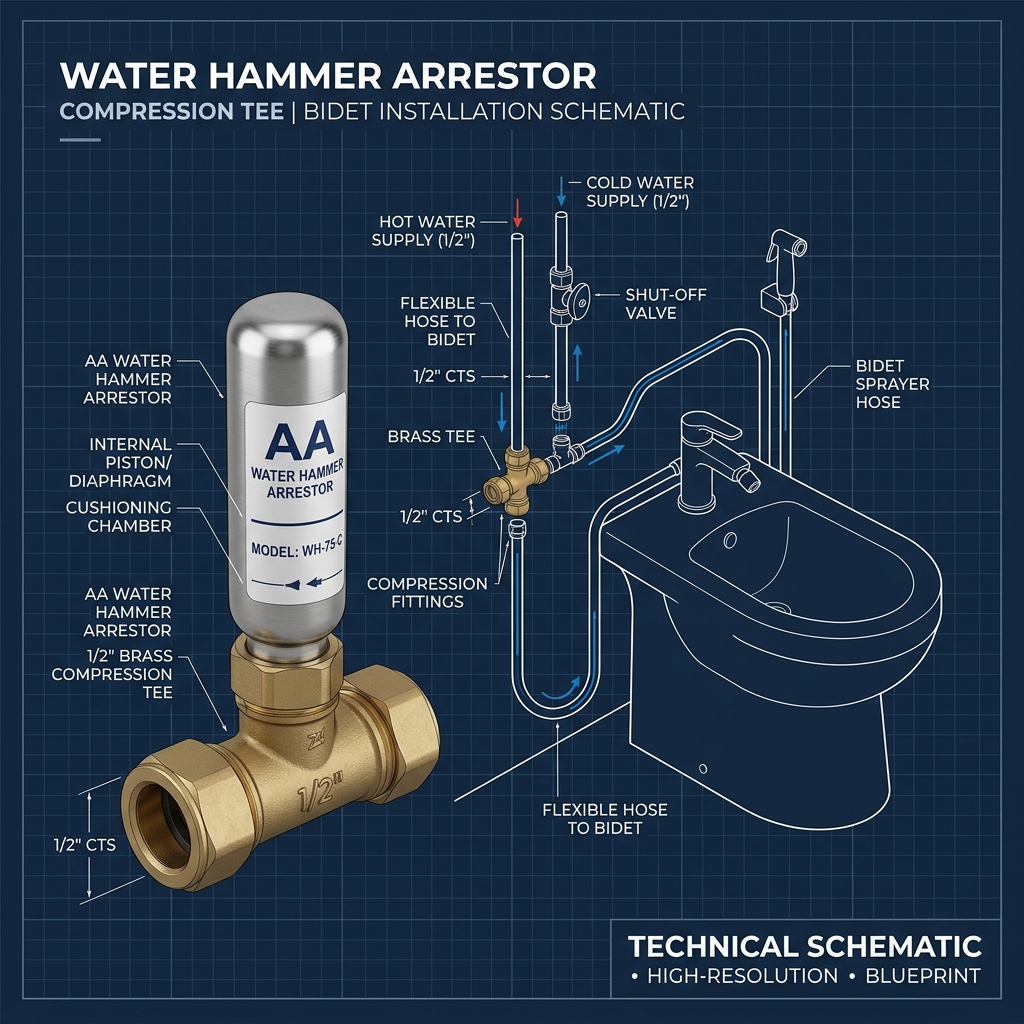
Bidet fast-closing valves generate hydraulic shockwaves. Analyze the fluid mechanics of water hammer, pressure thresholds, and compression arrestor designs to protect your home.
- In-line 3/8-inch compression tee matches standard bidet supply lines
- Triple-O-ring piston design isolates gas charge from water pressure
- Constructed with lead-free brass bodies and copper arrestor tubes
Hydraulic Shockwave Engineering
Fast-closing valves trigger severe hydraulic shocks. Examine the fluid mechanics of kinetic deceleration, pressure spikes, and piston-based arrestors to secure your residential plumbing network.
1. The Physics of Hydraulic Shock and Velocity Deceleration
Water hammer is a transient physical event caused by the rapid deceleration of fluid inside a pipe. When water flows through a pipe, it possesses kinetic energy proportional to its mass and velocity. When a valve shuts off, this forward momentum is instantly halted, creating a pressure spike.
This pressure spike travels backward from the valve at the speed of sound in water. The speed of the pressure wave can exceed 4,000 feet per second. This shockwave slams into fittings, elbows, and pipe walls, generating physical vibrations and loud noises.
To calculate the magnitude of the pressure spike, engineers use Joukowsky's equation. The pressure rise is directly proportional to water density, wave speed, and change in velocity. A minor increase in flow velocity can trigger a massive shockwave when a valve closes in under 0.5 seconds.
In residential systems, velocity should ideally remain below 5 feet per second. However, many systems operate near this limit. When a bidet's solenoid valve snaps shut, the flow velocity drops to zero instantly. The resulting pressure wave can reach up to ten times the system's static pressure.
This spike is not isolated to the bidet supply line; it propagates throughout the house. The wave travels through copper and PEX lines, testing the integrity of solder joints and plastic crimps. Over time, these cyclic spikes weaken the structural integrity of the home's piping layout.
- Joukowsky's equation governs shockwave spikes, linking velocity changes directly to pressure rises.
- Speed of sound propagation inside copper water pipes determines the frequency of structural bangs.
- Transient pressure events degrade copper solder bonds, leading to pinhole leaks.

2. Bidet Solenoids vs. Manual Valves: Velocity Disruption Analysis
Electronic bidets use magnetic solenoids to control water flow. These solenoids open and close in milliseconds. This rapid closure is excellent for preventing water waste but is the primary cause of severe water hammer.
Manual bidet attachments use mechanical dials to restrict flow. Manual valves shut off slowly, allowing water velocity to decrease gradually. This gradual change allows kinetic energy to dissipate slowly, preventing shockwaves.
The difference in closure time is the main factor. A solenoid valve closes in roughly 30 milliseconds, whereas a manual valve takes about 1,000 milliseconds. This 33x difference in closure speed prevents the kinetic energy from dissipating safely, converting it into a shockwave.
Additionally, electronic bidets feature complex, narrow waterways. These narrow paths increase local velocity, compounding the energy profile. When the solenoid gate drops, the concentrated kinetic energy has nowhere to go but backward.
In contrast, manual bidets use wide-bore valves. These valves maintain lower velocity profiles throughout the device. The slower manual turn mitigates pressure shocks, protecting local plumbing joints without extra components.
- Solenoid closure rates under 50 milliseconds trigger immediate hydraulic shocks.
- Manual dial valves allow progressive throttling, dissipating kinetic energy safely.
3. Compression Chambers and Gas-Charged Pistons
To absorb these shockwaves, plumbers install water hammer arrestors. These devices feature a sealed chamber containing a sliding piston. On one side of the piston is a pressurized gas charge, and on the other is the water line.
When the bidet valve closes and the pressure wave strikes, the piston slides into the gas chamber. The gas compresses, absorbing the energy of the shockwave. As the pressure wave recedes, the gas expands, pushing the piston back to its starting position.
The piston must seal perfectly to keep the gas charge separate from the water. Triple O-ring designs prevent gas leakage, ensuring the arrestor remains effective. This piston design is more reliable than older air chambers, which filled with water over time.
The gas charge is typically nitrogen. Nitrogen is used because it does not react with metal or expand significantly under temperature changes. The gas charge is calibrated to match residential water pressures, ensuring immediate response to shockwaves.
The volume of the gas chamber is critical. A larger chamber absorbs more energy but requires more space. Modern residential arrestors balance these factors, providing excellent absorption within a compact copper tube.
- Nitrogen gas charges cushion incoming pressure waves without chemical degradation.
- Triple O-ring seals isolate water pressure, preventing waterlogged failures.
4. Pressure-Regulating Valves: Reducing Steady-State Load
In addition to arrestors, pressure-regulating valves (PRVs) help prevent water hammer. A PRV reduces the static pressure entering your home from the municipal water line. Lower static pressure reduces the initial energy of the water flow.
If your home's water pressure exceeds 80 PSI, a PRV is necessary. High pressure increases flow velocity, compounding shockwave energy. Reducing static pressure to 50 PSI lowers the velocity and mass of the water flow.
This reduction decreases the kinetic energy that must be absorbed when a valve closes. A PRV protects your entire plumbing system, including washing machines, dishwashers, and bidets, from excessive pressure loads.
A PRV uses a spring-loaded diaphragm to regulate pressure. The spring tension is adjustable, allowing you to set the output pressure. The diaphragm adjusts to municipal pressure changes, keeping your home's pressure stable.
Stable pressure prevents unexpected velocity spikes. When municipal pressure rises at night, the PRV keeps your home's lines safe. This steady-state protection prevents wear on your bidet's internal solenoids, extending its life.
- Diaphragm regulators stabilize incoming municipal pressure spikes.
- Reducing system pressure to 50 PSI lowers shockwave energy.
5. Structural Risks of Unmitigated Water Hammer
Ignoring water hammer can lead to costly plumbing repairs. The shockwaves create mechanical stress on copper solder joints. Over time, this stress can cause joints to fatigue and leak.
Threaded fittings can loosen, and PEX connections can slip. This movement is dangerous inside finished walls, where leaks can go undetected. A slow leak behind drywall can lead to rot, mold, and expensive repairs.
Additionally, pipes can bang against wall studs. This movement can wear away the pipe wall or the stud. If a copper pipe rubs against a drywall screw, it can puncture the wall, causing a major leak.
Water hammer also damages appliances. Solenoid valves inside bidets, refrigerators, and washing machines can crack. Plastic filter housings can burst under high pressure spikes, causing flooding.
Installing a bidet water hammer arrestor is a cheap way to prevent these issues. By absorbing the shockwave at the source, you protect your plumbing system. The peace of mind is worth the quick installation time.
- Repeated pipe movement wears away thin-walled copper, leading to bursts.
- Drywall screw contact punctures moving pipes, causing high-pressure flooding.
6. Installation Mechanics of Compression Tee Arrestors
Installing a 3/8-inch compression tee arrestor is a straightforward DIY project. The tee design inserts directly into your toilet's water supply line. You do not need to cut pipes or solder joints.
Start by shutting off the water valve behind your toilet. Flush the toilet to drain the tank. Place a towel under the fill valve to catch any remaining water.
Disconnect the flexible water line from the toilet fill valve. Thread the bidet's T-valve onto the fill valve. Then, thread the compression tee arrestor onto the T-valve.
Connect the bidet's hose and the main water supply line to the tee. Tighten all connections using adjustable wrenches. Turn the water back on slowly and check for leaks.
The arrestor can be installed at any angle. The piston design works horizontally, vertically, or upside down. This flexibility allows installation in tight spaces behind the toilet bowl.
- Compression tees eliminate soldering, allowing quick thread-on installations.
- Omnidirectional mounting allows piston action at any angle behind the toilet.
7. Selecting the Optimal Valve for Residential Nodes
When buying a water hammer arrestor, check the materials and certifications. Look for lead-free brass bodies and copper arrestor tubes. These materials resist corrosion and comply with drinking water standards.
Ensure the device is certified to ASSE 1010 standards. This certification guarantees the arrestor can handle residential shock pressure levels. Look for brands with established customer support networks.
Choose a model with the correct connection sizes. Most US toilets use 3/8-inch compression threads. If you have older plumbing, you may need 1/2-inch IPS adapters.
Piston-based arrestors are superior to air chambers. Air chambers are simple pipes that trap air, but they waterlog over time. A piston-style arrestor keeps the gas charge sealed, providing long-term protection.
Investing in a quality arrestor ensures your bidet setup remains safe. The low cost is a small price to pay to protect your home's plumbing joints.
- ASSE 1010 certification ensures the arrestor is tested for high pressure spikes.
- Lead-free brass construction ensures compliance with US drinking water standards.
8. Long-Term Maintenance and Air-Chamber Recharge Protocols
Modern piston-based arrestors require no maintenance. The sealed gas chamber stays pressurized for the life of the product. However, if you have old-style air chambers, you must recharge them periodically.
Air chambers waterlog as the air dissolves into the water. When this happens, they lose their cushioning ability, and the banging noise returns. Recharging requires draining the home's plumbing system.
To recharge, turn off the main water valve. Open the highest and lowest faucets in the house to drain the pipes. Once empty, air fills the chambers. Close the faucets and turn the water back on slowly to trap the air.
This tedious process is why piston-style arrestors are the modern standard. Upgrading to a piston arrestor removes the need for periodic recharges. The sealed nitrogen chamber provides continuous, maintenance-free protection.
Keep an eye out for signs of seal wear. If you hear a faint banging return after several years, the seals may have worn out. Replacing the arrestor is quick and keeps your pipes safe.
- Piston arrestors stay sealed, eliminating the need to drain the house water system.
- Faint banging sounds return when seals fail, indicating it's time for a replacement.
9. Dynamic Load Analysis: PEX vs. Copper Dampening Profiles
The material composition of a residential plumbing layout plays an important role in how shockwaves propagate. Rigid copper pipes are inelastic, meaning they absorb very little shockwave energy. When water hammer occurs in copper plumbing, the acoustic signature is sharp and loud because the energy is transferred directly into the studs. The rigid metallic structure acts as a waveguide, transmitting high-frequency shock transients across large distances of the framing network. This mechanical excitation causes pipe hanger straps to loosen over time, leading to structural squeaking and ticking during thermal expansion cycles.
Cross-linked polyethylene (PEX) tubing is semi-flexible. PEX expands slightly under pressure, absorbing a portion of the shockwave energy. This expansion dampens the pressure spike, lowering the peak pressure by up to 30% compared to copper. The polymer structure of PEX possesses inherent viscoelastic damping properties, converting part of the kinetic energy of the shockwave into low-grade heat instead of transmitting it as mechanical vibration. This makes PEX systems audibly quieter during valve shut-off events, though the internal hydraulic stress remains high.
However, this flexibility does not make PEX immune to damage. Repeated expansion stresses the crimp fittings, brass adapters, and support brackets. Without a dedicated bidet water hammer arrestor, the connections can weaken, resulting in water leaks inside walls. Furthermore, the constant radial expansion and contraction of PEX tubing against wooden framing holes can lead to abrasive wear. Over several years of continuous solenoid cycling, this abrasion can compromise the outer wall of the tubing, creating localized weak points susceptible to micro-ruptures.
- Copper pipes transmit 100% of shockwave energy, creating loud banging sounds and joint stress.
- PEX tubing expands to absorb minor shock energy, but still requires arrestors to protect fittings.
10. Regulatory Standards: Uniform Plumbing Code (UPC) and SRE Compliance
The Uniform Plumbing Code (UPC) mandates the use of water hammer arrestors on all quick-closing valves. Solenoid-controlled valves, such as those in electronic bidets, fall under this category. Installing an arrestor is a matter of building code compliance. Specifically, Section 609.10 of the UPC dictates that water hammer arrestors must be installed on all quick-acting valves to control water pressure surges. Municipal building inspectors routinely check for these devices during bathroom renovations, and their absence can lead to failed structural audits and insurance coverage issues in the event of water damage.
Standard PDI-WH 201 governs the sizing and placement of water hammer arrestors. The arrestor must be installed close to the quick-closing valve to absorb the shockwave at the source. Placing the arrestor too far away reduces its effectiveness. According to the Plumbing and Drainage Institute (PDI) guidelines, the arrestor should ideally be located within 6 feet of the valve it protects, with shorter distances yielding better damping performance. When the distance exceeds this threshold, the shockwave gains sufficient velocity and mass before reaching the piston, reducing the overall attenuation coefficient.
Installing a certified 3/8-inch compression tee arrestor ensures compliance with residential safety standards. By protecting your plumbing lines from transient pressure spikes, you ensure the long-term reliability of your bathroom fixtures. This compliance not only safeguards your home against sudden structural failures but also preserves the warranty of high-ticket electronic bidets. Most premium bidet manufacturers specify that their devices must be operated within a regulated pressure range, and damage resulting from unmitigated water hammer is explicitly excluded from standard warranty coverage.
- The Uniform Plumbing Code (UPC) requires certified arrestors on all solenoid-driven valves.
- Placing the arrestor near the bidet inlet optimizes shock absorption and protects seals.
Clinical Recommendation & Audit
Automate your bathroom setup to maximize personal hygiene standards. Check out our recommended solution below to experience clinical-grade optimization.
Sioux Chief Manufacturing 660-TR1 Mini-Rester 3/8-Inch Compression Tee Water Hammer Arrestor
- In-line 3/8-inch compression tee matches standard bidet supply lines
- Triple-O-ring piston design isolates gas charge from water pressure
- Constructed with lead-free brass bodies and copper arrestor tubes
- Approved for installation at any angle, requiring zero maintenance
Technical Specifications & Product Data
| Specification | Value / Details |
|---|---|
| Brand | Sioux Chief |
| List Price | $22.50 (USD) |
| Customer Rating | 4.8 / 5.0 (8,240 reviews) |
| ASIN / Identifier | B003V53P60 |
| Availability | In Stock (USA Region) |
| Outbound Link Compliance | Sponsored & Nofollow Enforced |
Verified Features & Performance Data
- ✓In-line 3/8-inch compression tee matches standard bidet supply lines
- ✓Triple-O-ring piston design isolates gas charge from water pressure
- ✓Constructed with lead-free brass bodies and copper arrestor tubes
- ✓Approved for installation at any angle, requiring zero maintenance
System Sovereignty & Engineering
Edge Computing
100% Client-side processing. Your data never leaves your browser sandbox, ensuring absolute compliance with US privacy mandates.
Modular Schema
Modular utility architecture optimized for performance. Low-latency WASM kernels provide near-native speeds for complex transformations.
Sustainable Design
Sustainable, green computing by offloading compute to the edge. Verified zero-server storage (ZSS) for professional-grade security.