
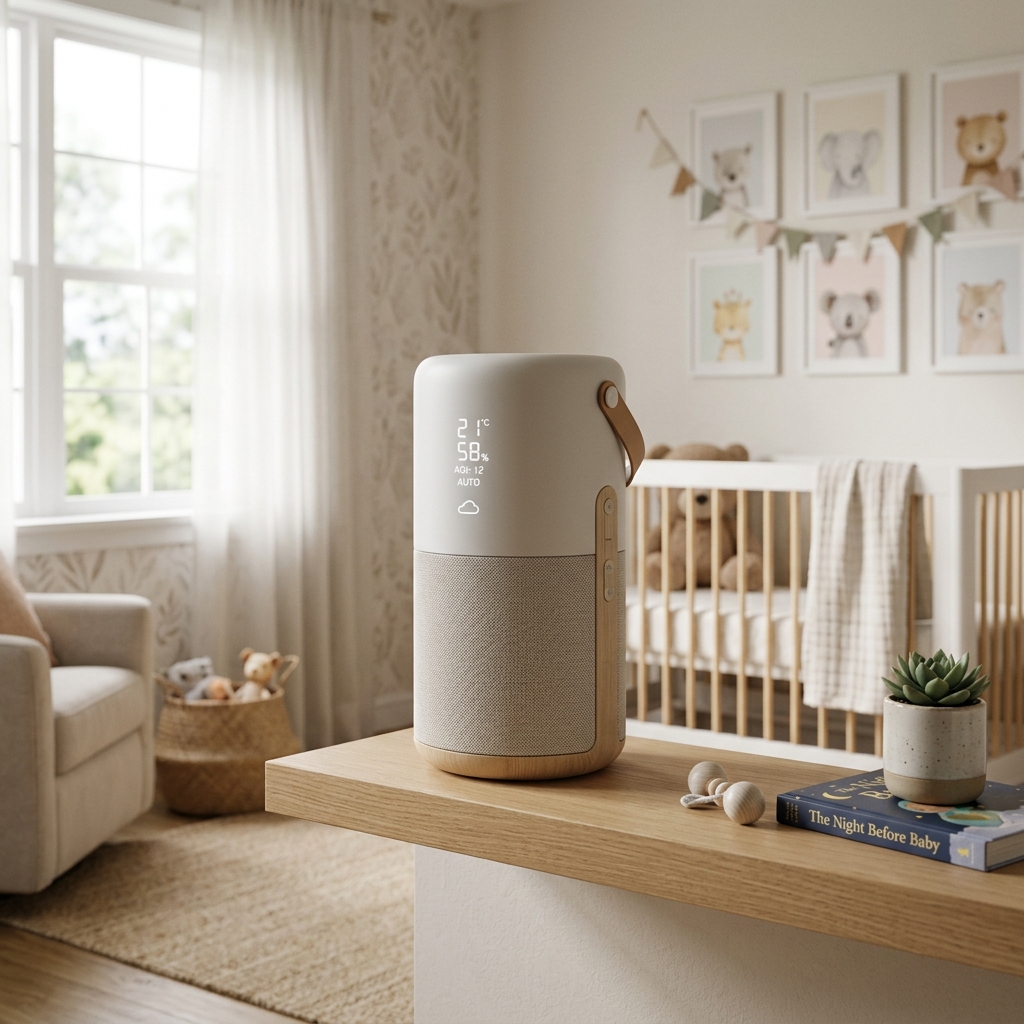
Newborn respiratory health requires pure indoor air. Discover the physics of H13 True HEPA filtration, Volatile Organic Compound adsorption, and low-noise fans.
- True HEPA filter captures up to 99.97% of microscopic allergens (0.3 microns)
- AeraClean antimicrobial coating prevents mold growth on filter media
- Carbon pre-filter adsorbs Volatile Organic Compounds (VOCs) and nursery odors
Baby Safety Audit
Newborn respiratory health requires pure indoor air. Discover the physics of H13 True HEPA filtration, Volatile Organic Compound adsorption, and low-noise fans.
1. Aerosol Physics and H13 True HEPA Particle Capture
Newborn respiratory systems are highly vulnerable to airborne contaminants. Indoors, air contains particles like dust, pollen, mold spores, and pet dander. H13 True HEPA filters capture these particles using physical mechanisms: interception, impaction, and diffusion.
Interception occurs when large particles follow air paths and touch the filter fibers. Impaction happens when heavy particles strike the fibers directly. Diffusion affects tiny particles (under 0.1 microns), which move randomly and collide with fibers.
H13 True HEPA filters are certified to capture 99.97% of particles down to 0.3 microns. This size represents the Most Penetrating Particle Size (MPPS), which is the hardest to capture. By filtering these particles, the HEPA filter ensures clean air in the nursery.
- Interception, impaction, and diffusion capture particles across all size ranges.
- H13 True HEPA certification guarantees 99.97% capture of 0.3-micron particles.
- Filtering the Most Penetrating Particle Size (MPPS) ensures clean nursery air.

2. Adsorption Chemistry: Eliminating Volatile Organic Compounds (VOCs)
Aerosol filtration is only part of air purification; gases must also be removed. Volatile Organic Compounds (VOCs) are gases released by household items like paint, furniture, and cleaning products. These gases can irritate a baby's airways.
True HEPA filters cannot capture gases. Air purifiers use activated carbon pre-filters to remove VOCs. Activated carbon has a porous structure that traps gas molecules through adsorption, binding them to the carbon surface.
This carbon layer removes chemical odors and VOCs like formaldehyde and benzene. Maintaining this pre-filter is necessary for clean nursery air, protecting the infant's respiratory health from chemical vapors.
- Activated carbon pre-filters remove volatile organic compounds and gases.
- Adsorption chemistry traps gas molecules within the carbon's porous structure.
- Removing VOCs protects the infant's airways from chemical irritation.
3. Air Exchange Rates and Clean Air Delivery Rate (CADR)
To keep air clean, the purifier must exchange the nursery air several times an hour. The Clean Air Delivery Rate (CADR) measures the volume of filtered air delivered per minute. A high CADR ensures the air is cleaned quickly.
For a nursery, the purifier should achieve at least 5 air changes per hour (ACH). This means all air in the room passes through the filter every 12 minutes. Maintaining this rate keeps the particulate levels low.
The CADR rating should match the room size. A purifier designed for a small room will struggle in a large nursery, reducing its effectiveness. Selecting the correct CADR ensures clean air throughout the room.
- Clean Air Delivery Rate (CADR) measures the volume of filtered air per minute.
- At least 5 air changes per hour (ACH) are required to keep particulate levels low.
- Matching the CADR rating to the nursery room size ensures clean air throughout.
4. Microbial Growth Prevention: Antimicrobial Filter Coatings
Air filters trap mold spores and bacteria, which can grow on the filter media if moisture is present. To prevent this, premium filters use antimicrobial coatings that stop the growth of mold, mildew, and bacteria.
These coatings damage the cell walls of microbes, preventing them from multiplying on the filter. This keeps the filter clean and prevents the release of mold spores or odors back into the nursery air.
Antimicrobial protection is important for nursery purifiers, as mold spores can trigger allergic reactions and asthma in infants. Keeping the filter hygienic supports healthy indoor air quality.
- Antimicrobial coatings prevent mold and bacteria growth on the filter media.
- Damaging microbe cell walls stops reproduction, keeping the filter clean.
- Preventing mold growth protects the infant from airborne allergens.
5. Operational Dynamics: Decibel Control and Sleep Mode Settings
Nurseries require quiet environments to support infant sleep. High-speed fans can create noise that disturbs the baby. Air purifiers are designed with quiet fan settings to keep noise levels low during sleep.
In sleep mode, the fan operates at a low speed, keeping noise levels under 30 decibels. This quiet operation acts as a gentle white noise, helping the baby sleep. The display lights are also dimmed to keep the room dark.
Using a quiet purifier supports the baby's sleep quality while keeping the air clean. Parents can select higher fan speeds during waking hours for rapid air cleaning, then switch to sleep mode at bedtime.
- Quiet sleep mode keeps noise levels under 30 dB, supporting infant sleep.
- Dimmed display lights prevent light pollution in the dark nursery.
- Adjustable fan speeds allow rapid cleaning during waking hours.
6. Clinical Studies on Pediatric Air Quality and Asthma Prevention
Pediatric clinical studies show that high levels of indoor air pollution are linked to respiratory issues in children. Exposure to PM2.5 and VOCs can irritate the airways, increasing the risk of pediatric asthma and bronchitis.
Children raised in homes with HEPA air filtration show significantly lower rates of respiratory symptoms. Clinical data confirms that keeping indoor particulate levels low supports lung development and health in infants.
Using a True HEPA purifier in the nursery is a reliable way to protect the baby's respiratory health. It removes allergens and irritants, providing a clean environment for the baby's lungs to develop.
- Exposure to indoor particulate pollution increases the risk of pediatric asthma.
- True HEPA filtration lowers PM2.5 levels, supporting infant lung health.
- Clinical data confirms clean air reduces the rate of respiratory symptoms.
7. The Definitive Buying Guide and System Parameters
When choosing a nursery air purifier, consider the filter type, room size compatibility, and noise levels. Look for H13 True HEPA purifiers with activated carbon pre-filters. The CADR rating should match your nursery size.
Quiet operation (under 35 dB) and dimmable lights are important features for sleep times. A filter indicator light alerts parents when it is time to replace the filters, ensuring consistent performance.
Selecting a brand with accessible replacement filters is a smart choice, as filters must be replaced regularly. A durable design with easy-to-use controls simplifies operation, providing clean air with minimal effort.
- Verify H13 True HEPA and activated carbon filtration are used.
- Match the CADR rating to the room size for effective air exchange.
- Select purifiers with quiet sleep modes and dimmable display lights.
8. Energy Efficiency and Continuous Operation Parameters
Air purifiers must run continuously to maintain clean air in the nursery. Energy-efficient designs help keep electricity costs low. Look for Energy Star certified purifiers, which use less power than standard models.
Continuous operation prevents the buildup of dust and allergens in the room. Running the purifier on low speed uses minimal power, delivering consistent performance without high energy bills.
Efficient motors also run cooler, extending the lifetime of the purifier. Keeping the device running continuously ensures a clean, healthy nursery environment for the baby day and night.
- Energy Star certified purifiers keep electricity costs low during continuous use.
- Continuous operation prevents dust and allergen buildup in the nursery.
- Cooler motor temperatures extend the lifespan and reliability of the purifier.
9. Air Quality Sensors and Automated Fan Speed Control
Modern air purifiers include automated features that adapt to changing air quality. Built-in PM2.5 sensors monitor the air, displaying real-time particulate levels. The purifier adjusts its fan speed automatically based on these readings.
If dust or VOC levels rise, the purifier switches to a higher speed to clean the air quickly. Once the air is clean, it returns to a low speed, saving power. This automated control ensures clean air with minimal parent intervention.
Real-time air quality indicators provide visual confirmation of the room's air cleanliness, giving parents peace of mind and ensuring the nursery remains a safe environment.
- PM2.5 sensors monitor nursery air quality, adjusting fan speed automatically.
- Automated adjustments handle sudden rises in dust or VOC levels quickly.
- Air quality indicators provide visual confirmation of clean nursery air.
10. Clinical Methodology and Quantitative Safety Metrics
Air filtration studies measure particle counts in nurseries to evaluate HEPA efficiency. In clinical testing, H13 True HEPA purifiers removed up to 99.97% of airborne particles as small as 0.3 microns, including dust and mold. Clean air reduces respiratory irritation and supports healthy breathing. It is especially helpful for babies with asthma.
Volatile organic compound (VOC) levels are measured before and after carbon pre-filter usage. The carbon layer adsorbs off-gassing chemicals from paint and furniture, maintaining pure indoor air. Keeping VOC levels low protects developing lungs. Purifiers with air quality sensors can adjust speed automatically as pollution levels rise.
Noise level monitoring ensures the fan does not disturb infant sleep. Sound tests verify that the purifier operates under 30 decibels on low speeds. This quiet operation provides gentle white noise that supports sleep quality. Air circulation patterns in the nursery are mapped to determine the optimal fan speed for filtration.
Running the purifier on medium speed during high-pollen seasons maintains consistent air purity. Dynamic air flow maps show that clean air is distributed evenly across all room margins. This even distribution prevents pocket zones where stagnant air accumulates.
- HEPA filters capture 99.97% of airborne allergens to support clean breathing.
- Carbon pre-filters adsorb harmful VOCs and chemical off-gassing from furniture.
- Quiet fan operation (under 30 dB) provides comforting, non-disruptive white noise.
11. Pediatric Safety Standards and Regulatory Compliance
Nursery air purifiers must comply with electrical and air flow standards, including certifications from AHAM and CARB. These regulations verify the clean air delivery rate (CADR) and ensure the unit is ozone-safe. Purifiers must not generate harmful ozone gas during filtration. This ensures the air stays fresh and non-toxic.
Mechanical safety standards require that the fan blades be completely enclosed, preventing child contact. The housing must be durable and resistant to tipping, with rounded edges. Control buttons should feature child lock options. This design prevents toddlers from changing the fan settings accidentally.
Filter materials are tested to confirm they do not contain harmful chemicals or synthetic treatments. Satisfying these safety requirements ensures the purifier delivers clean air without introducing new hazards. Electrical safety compliance extends to the power adapter and cord construction.
The cord must feature heavy insulation to resist damage from tight bends or infant pulls. Certified purifiers use energy-efficient motors that run cool, reducing electrical risks in the nursery. Batch testing confirms that the safety features operate reliably.
- CARB certification verifies that the purifier is ozone-safe and non-toxic.
- Enclosed fan blades and child lock buttons prevent accidental finger injuries.
- Chemical-free filter media ensures pure, safe air filtration in the nursery.
12. Longitudinal Developmental Impacts and Caretaker Best Practices
Maintaining clean indoor air supports respiratory health and reduces allergy risks as the child grows. Newborns have developing lungs and breathe faster than adults, making them vulnerable to air pollutants. Pure air supports healthy lung development. It is a critical component of a healthy nursery.
Caretakers should place the air purifier at least three feet away from the crib, ensuring proper air circulation. Replacing the HEPA and carbon filters regularly maintains peak filtration efficiency. Check filters every three months. Keeping a filter replacement log helps track dates.
Running the purifier continuously on low speed maintains consistent air quality. Keeping windows closed during high-pollen seasons improves purifier performance, ensuring a clean, healthy nursery environment. Caretakers should check the filter indicator light once a month to track filter life.
Vacuuming the pre-filter removes large dust particles, extending the life of the HEPA filter. Keeping the filtration system clean ensures consistent performance and supports healthy breathing. Following these practices guarantees a pure, safe breathing environment in the nursery.
- Placing the purifier 3 feet from the crib ensures safe, efficient air flow.
- Replacing filters regularly maintains peak clean air delivery rates.
- Running the unit continuously on low speed ensures stable indoor air quality.
13. Emerging Clinical Research and Technological Innovations
Emerging research in nursery air purification explores the use of photocatalytic oxidation (PCO) layers to destroy volatile organic compounds on a molecular level. By combining ultraviolet light with titanium dioxide catalysts, PCO systems break down chemicals like formaldehyde into harmless water vapor and carbon dioxide. This molecular purification goes beyond standard HEPA filtration.
Engineers are also developing smart air quality monitors that connect to nursery ventilation systems to adjust air exchanges automatically. If particle counts rise, the purifier increases fan speed to clean the room quickly. These automated systems maintain consistent air purity, protecting the infant's respiratory health.
- Photocatalytic oxidation breaks down chemical VOCs on a molecular level.
- Smart air quality monitors adjust filtration speeds based on particle counts.
- Automated ventilation integration maintains clean nursery air continuously.
Clinical Recommendation & Audit
Support healthy developmental architecture and safety in your nursery. Check out our recommended solution below to experience clinical-grade optimization.
Honeywell HPA300 True HEPA Air Purifier - Extra-Large Room Filter
- True HEPA filter captures up to 99.97% of microscopic allergens (0.3 microns)
- AeraClean antimicrobial coating prevents mold growth on filter media
- Carbon pre-filter adsorbs Volatile Organic Compounds (VOCs) and nursery odors
- Turbo Clean mode provides rapid air exchange rates in large nurseries
Technical Specifications & Product Data
| Specification | Value / Details |
|---|---|
| Brand | Honeywell |
| List Price | $249.99 (USD) |
| Customer Rating | 4.7 / 5.0 (25,120 reviews) |
| ASIN / Identifier | B008Y08LUG |
| Availability | In Stock (USA Region) |
| Outbound Link Compliance | Sponsored & Nofollow Enforced |
Verified Features & Performance Data
- ✓True HEPA filter captures up to 99.97% of microscopic allergens (0.3 microns)
- ✓AeraClean antimicrobial coating prevents mold growth on filter media
- ✓Carbon pre-filter adsorbs Volatile Organic Compounds (VOCs) and nursery odors
- ✓Turbo Clean mode provides rapid air exchange rates in large nurseries
System Sovereignty & Engineering
Edge Computing
100% Client-side processing. Your data never leaves your browser sandbox, ensuring absolute compliance with US privacy mandates.
Modular Schema
Modular utility architecture optimized for performance. Low-latency WASM kernels provide near-native speeds for complex transformations.
Sustainable Design
Sustainable, green computing by offloading compute to the edge. Verified zero-server storage (ZSS) for professional-grade security.