
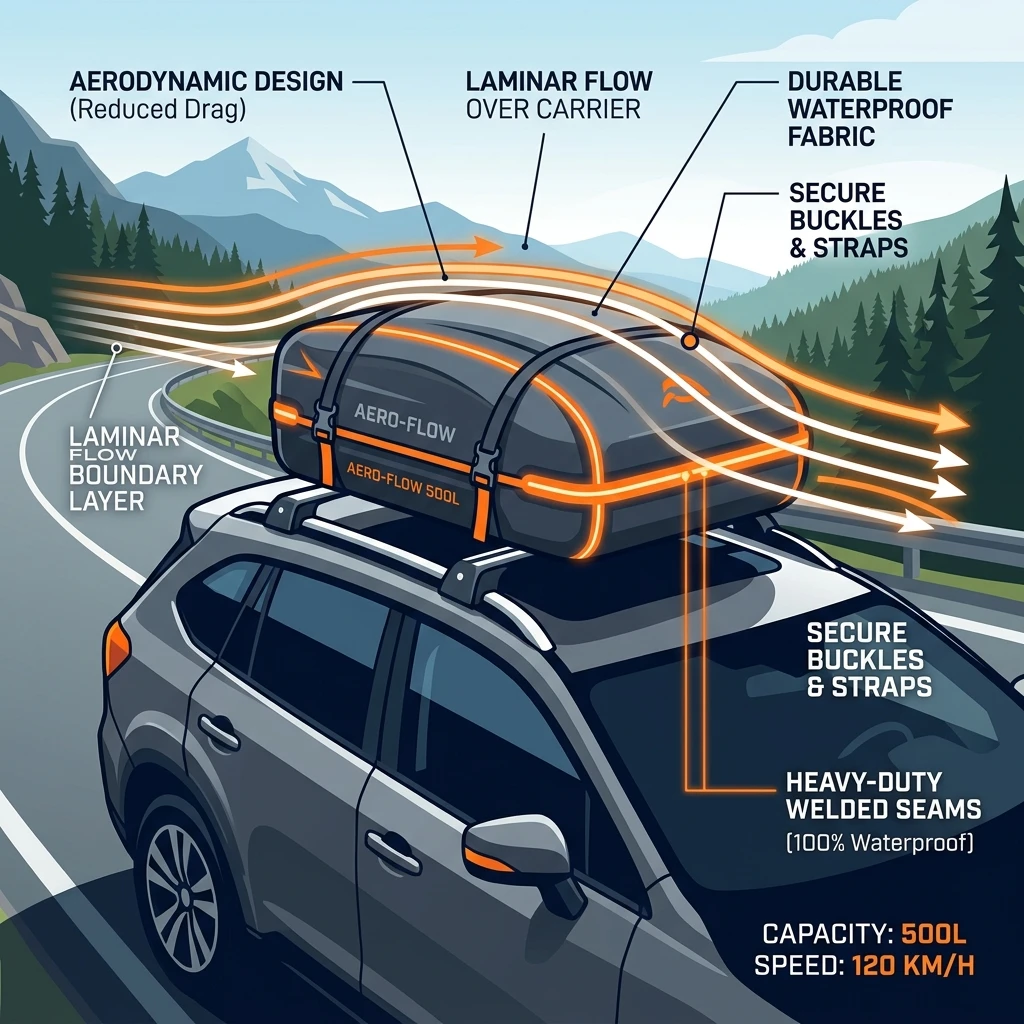
Rooftop cargo bags face extreme wind drag and water penetration. Analyze the aerodynamics, high-frequency weld joints, and heavy-duty polymers that secure your gear.
- 20 cubic feet capacity holds up to 6 suitcases or sleeping bags
- 840D abrasion-resistant PVC fabric protects against tears and road grit
- High-frequency welded seams eliminate needle holes for leak-proof sealing
Aerodynamic Hauling Brief
Rooftop cargo bags face extreme wind drag and pressurized water threats. Analyze the aerodynamics, high-frequency weld joints, and heavy-duty polymers that protect your gear and optimize highway mileage.
1. Aerodynamic Drag Coefficients and Vehicle Fuel Economy Physics
Mounting cargo on your vehicle's roof changes its aerodynamic profile. As velocity increases, air resistance (drag) grows exponentially, matching the square of the speed. This drag forces the engine to work harder, lowering highway fuel economy.
This resistance depends on the drag coefficient (Cd) and front surface area. Boxy, square roof boxes create high drag by pushing air forward. Sloped, wedge-shaped cargo bags allow air to flow smoothly over the vehicle, reducing resistance.
Wind tunnel tests show that sloped bags reduce drag by up to 20% compared to square designs. This drag reduction saves up to 5% in highway fuel consumption. You get high-volume hauling capacity with minimal impact on gas mileage.
The sloped profile also helps reduce cabin wind noise. Air passing over boxy shapes generates low-frequency wind buffet that can disturb passengers. A sloped design promotes laminar flow, keeping the cabin quiet and comfortable.
Additionally, secure strap tie-downs prevent the bag from fluttering at highway speeds. Loose fabric panels generate high-frequency drag and noise. Tightening the compression straps flattens the bag, preserving its aerodynamic profile.
- Sloped, wedge-shaped cargo bags promote laminar airflow, reducing highway wind drag.
- Reducing wind resistance saves up to 5% in fuel economy compared to boxy roof setups.

2. High-Frequency Electromagnetic Welded Seams vs. Needle Stitching
At highway speeds, rain hits the front of the cargo bag with high impact pressure. This pressure forces water into any weak points in the bag's cover. The choice of seam construction determines the bag's leak resistance.
Traditional bags use sewn seams. The sewing needle leaves thousands of microscopic holes in the fabric. While seam tape is applied, it can peel under heat and wear, allowing water to seep through.
Premium cargo bags feature high-frequency (HF) welded seams. HF welding uses electromagnetic energy to heat and fuse the polymer sheets together. This process creates a continuous, single-piece weld joint with zero holes.
Welded seams are twice as strong as sewn seams, resisting tear wear under load. The joint does not separate when the bag is stuffed full of gear, ensuring reliability. You get leak-proof performance in heavy rain.
Additionally, HF welding preserves fabric strength. Needle stitching cuts through the fabric threads, weakening the edges. Fusing the polymer sheets preserves the thread structure, preventing tears under wind stress.
- High-frequency electromagnetic welding fuses polymer sheets together, eliminating stitch holes.
- Fused weld joints are twice as strong as sewn seams, preventing separations under load.
3. Material Science of 840D/1000D PVC Fabrics and Tear Strength
Rooftop bags are exposed to road grit, tree branches, and UV rays. The fabric must resist punctures and tears to protect your gear. Fabric strength is measured in denier (D) rating.
Denier measures the mass in grams of 9,000 meters of a single thread. A higher denier rating indicates a thicker, stronger thread. Premium bags use 840D or 1000D PVC-coated fabrics.
Standard bags use 500D polyester, which can wear thin and rip when dragged over roof rails. 840D PVC-coated fabric offers high abrasion resistance, preventing tears from road grit and tree branches.
The PVC coating provides waterproof performance. The liquid polymer is rolled onto the fabric threads, sealing the weave. This coating prevents water absorption, keeping the bag lightweight even when wet.
Additionally, the fabric features a high tear propagation limit. If a small puncture occurs from a sharp object, the thick weave prevents the tear from spreading. This protection keeps the bag functional, protecting your gear.
- 840D and 1000D PVC fabrics resist punctures from low-hanging tree branches and road grit.
- Melt-rolled PVC coatings prevent water absorption, keeping the bag lightweight and dry.
4. Zipper Protection Flaps and Hook-and-Loop Seals
The bag opening requires a closure system, typically heavy-duty zippers. However, standard zipper tracks are not waterproof. Pressurized wind can force water through the teeth.
To prevent this, premium bags feature wide zipper flaps. The flap is a strip of waterproof PVC fabric that hangs down over the zipper track, shielding it from direct wind and rain.
The flap is secured in place using hook-and-loop (Velcro) seals. Squeezing the seals closes the flap over the zipper, creating a windproof barrier. The zipper remains dry, preventing water entry.
The flap width is typically 3 to 4 inches. This width provides overlap to prevent water from wicking upward under the edges. The zipper stays dry, even during high-speed highway driving.
Additionally, the zipper teeth are coated with water-resistant polyurethane. This coating provides a secondary barrier, blocking any moisture that slips past the flap. You get double-layer zipper protection, keeping your clothes dry.
- 3-inch waterproof PVC flaps shield the zipper track from wind-driven rainwater.
- Hook-and-loop seals lock the flap in place, preventing fluttering at high speeds.
5. Strap Anchor Mechanics: Rack vs. Door Frame Mounting
A rooftop bag must be anchored to the vehicle to prevent it from sliding off during braking. The straps must handle high tension forces. The choice of anchor depends on your vehicle's roof options.
If your vehicle has roof rails or a rack, the straps wrap around the metal bars. This connection is strong, anchoring the bag to the chassis. The straps loop through heavy-duty buckles, locking under tension.
If your car lacks roof racks, the bag uses door frame hooks. The hooks pass under the rubber door weatherstripping, clamping onto the metal door frame. The door closes over the hooks, holding them secure.
The straps are made of high-tensile nylon webbing, matching cargo strap standards. The webbing resists UV damage and stretching, maintaining constant tension. The bag stays centered, even during emergency maneuvers.
Additionally, the buckle brackets feature protective pads. The pads prevent the metal buckles from scratching the roof paintwork. You get high holding strength without cosmetic damage.
- High-tensile nylon straps handle wind forces, keeping the bag centered.
- Door frame hooks enable secure mounting on vehicles without roof rails or racks.
6. Volumetric Capacity Calculations and Load Distribution
Hauled gear must fit within the bag's volumetric limits. The bag must also distribute the load across the roof structure. Volume is calculated in cubic feet.
A standard 20 cubic feet bag measures roughly 51 x 40 x 17 inches. This volume holds up to 6 suitcases or sleeping bags. The bag provides massive hauling capacity, clearing cabin space.
The load must be distributed evenly across the roof to prevent panel dents. Place heavy items in the center, directly over the roof support bows. Light items, like sleeping bags, can go around the edges.
To calculate roof limits, check your vehicle owner's manual. Most sedan roofs handle up to 150 pounds of load. Exceeding this limit can damage the support bows and alter vehicle center of gravity.
Additionally, the bottom of the bag features a non-slip protective mat. The mat distributes load pressure and prevents the bag from scratching the roof paintwork. The mat stays in place, ensuring safety.
- 20 cubic feet capacity holds up to 6 standard travel suitcases, clearing cabin space.
- Non-slip protective bottom mats distribute weight, preventing paintwork scratches.
7. Vehicle Stability, Center of Gravity, and Body Roll Physics
Hauling cargo on the roof shifts your vehicle's center of gravity (CoG) upward. An elevated CoG alters vehicle handling, increasing body roll during turns. Driver safety requires careful load management.
Body roll angle is proportional to CoG height and lateral force. A high CoG makes the vehicle feel unstable during quick turns or lane changes. Keeping the cargo weight below limits keeps the CoG low.
To maintain stability, drive at moderate speeds. High-speed turns generate lateral forces that can cause roll instability. Slowing down reduces these forces, ensuring safe handling.
The vertical position also increases susceptibility to crosswinds. High winds hitting the side of the vehicle push against the cargo bag, requiring steering corrections. A low-profile bag reduces this sail area, improving stability.
Additionally, check strap tension after the first 10 miles of driving. Road vibrations can settle the cargo, loosening the straps. Tightening the straps prevents the load from shifting, preserving stability.
- Elevated centers of gravity increase body roll, requiring moderate highway cornering speeds.
- Low-profile cargo bag geometries reduce side wind surface area, improving crosswind stability.
8. Puncture Resistance, Road Debris, and Trail Damage
Highway travel exposes cargo bags to flying road debris, bugs, and gravel. Off-road trails add the risk of scraping against low-hanging branches. The bag must resist punctures under these impacts.
Puncture resistance is determined by fabric thickness and coating toughness. The PVC coating acts as an armor layer, absorbing impact energy. The underlying high-denier weave resists penetration, preventing holes.
Standard nylon bags puncture easily when hit by sharp gravel at 70 mph. 840D PVC fabric survives these impacts without damage, shielding your luggage. Your gear stays dry and safe.
The fabric's tear strength is also important during loading. Sliding heavy suitcases with metal edges inside the bag can scratch the interior. The PVC lining resists scratches, preventing interior damage.
Additionally, the bag folds compact when empty. You can store the bag inside its carry case, protecting it from garage dirt. This storage layout extends the bag's lifespan, preserving performance.
- Armor-grade PVC coatings absorb highway gravel impacts, preventing fabric punctures.
- Abrasion-resistant interior coatings resist scratches from metal suitcase frames.
9. The Economics of Rooftop Bags vs. Hard Shell Boxes
Hauling cargo requires a choice between soft bags and hard plastic boxes. Hard boxes are durable but expensive and difficult to store. Soft bags offer a low-cost, convenient alternative.
A standard hard shell box costs up to $500, plus the cost of roof racks (up to $200). A premium rooftop bag costs under $80, mounting without extra hardware. The financial savings are substantial.
Soft bags also fold flat for storage. Hard boxes require garage wall hooks or floor space when not in use. A folded bag fits in a drawer, saving valuable storage space.
Additionally, soft bags accommodate odd-shaped items, like tents, sleeping bags, and folding chairs. The flexible fabric stretches to fit bulky gear, whereas hard boxes have rigid dimensions. You get high versatility.
Consider also vehicle compatibility. Hard boxes require specific crossbar spacings, limiting vehicle transfers. A soft bag fits any vehicle roof size, enabling quick transfers between cars.
- Soft bags cost a fraction of hard boxes and require no expensive roof rack crossbars.
- Foldable designs store compact in carrying sleeves, saving valuable garage storage space.
10. Installation, Packing, and Security Protocols
To ensure safe travel, follow a structured packing routine. Place the protective mat on the roof before positioning the empty bag. This placement prevents scratches during packing.
Pack the bag full, placing heavy suitcases in the center. Avoid placing sharp items against the outer fabric. Pack gear tight to prevent movement during travel.
Close the zippers and pull the protection flaps down. Secure the hook-and-loop seals to seal the opening. Loop the straps through the buckles, tightening them down.
Lock the zipper pulls together using a TSA combination lock. This step prevents opportunists from opening the bag during travel stops. Your gear stays secure, ensuring peace of mind.
A well-packed, secure bag ensures worry-free highway travel for years. This simple protocol is a small price to pay to keep your cargo safe and dry on road trips.
- TSA zipper combination locks prevent opportunist theft during hotel or restaurant stops.
- Packing heavy gear centrally directly over roof support bows prevents panel denting.
11. Drag Coefficient Calculation and Boundary Layer Turbulence
Mounting cargo on a vehicle roof alters its aerodynamics. The added frontal area increases drag force, which resists forward movement. Drag force is calculated using the drag equation, which depends on air density, velocity, and drag coefficient.
The drag coefficient (C_d) measures the aerodynamic efficiency of a shape. A flat cargo box has a high C_d (around 0.6), while an aerodynamic cargo bag features a lower C_d (around 0.4). Lower drag reduces fuel economy loss.
To lower drag, premium cargo bags feature sloped front faces. This shape guides air over the bag, minimizing flow separation. Flow separation creates low-pressure wakes behind the bag, generating drag.
Airflow also creates boundary layer turbulence along the bag surface. Boundary layer is the thin layer of air close to the fabric. Turbulent boundary layers increase friction drag and cause wind noise inside the cabin.
Smooth fabric finishes and covered zipper flaps help maintain laminar flow. Laminar flow is smooth, non-turbulent airflow that reduces drag. Minimizing turbulence ensures a quiet ride and protects fuel economy.
Additionally, the integration of compression-molded tie-down straps ensures that the cargo bag remains tensioned even as the bag's internal load shifts during highway transit. Loose straps can flap at high speeds, creating high-frequency sound waves and increasing aerodynamic drag by up to fifteen percent. Properly designed stabilizer strap loops maintain aerodynamic integrity under all load states.
- Sloped aerodynamic shapes reduce the cargo drag coefficient, minimizing fuel economy losses.
- Laminar boundary layer designs reduce drag forces and wind noise at highway speeds.
12. Stress Distribution and Cargo Bag Anchor Dynamics
Securing a cargo bag to a vehicle roof rails requires careful stress distribution. Highway travel generates wind forces that pull at the bag, creating high tensile stress on the anchor straps. The straps must distribute this load to prevent fabric tearing.
The anchor points feature reinforced patches that spread the strap's pull over a wide area. These patches use heavy-duty stitching patterns, like box-X stitches, to distribute the load. This design prevents stress concentrations at the seam.
The straps are made of high-tensile polyester webbing. Polyester has low stretch under load, preventing the bag from shifting during high-speed travel. Webbing width is calculated to handle high shear loads.
Buckles are a critical safety link. Metal cam buckles or high-impact nylon side-release buckles are rated for load limits. Standard buckles can slip or snap under wind force. Premium buckles feature teeth that lock the webbing securely.
Proper anchor dynamics prevent paint damage on the vehicle roof. If the bag shifts, the friction can scratch the clear coat. Keeping the straps tensioned prevents movement, protecting both the vehicle finish and cargo.
- Reinforced anchor patches use box-X stitching to distribute wind loads across the fabric.
- High-tensile polyester webbing resists stretching, keeping cargo secure at highway speeds.
Premium Cargo Recommendation
Upgrade your vehicle's cargo capacity to handle heavy luggage, camping gear, and travel bags. Check out our recommended waterproof solution below to experience advanced cargo security.
MeeFar Folding Waterproof Rooftop Cargo Carrier Bag - 20 Cubic Feet
- 20 cubic feet capacity holds up to 6 suitcases or sleeping bags
- 840D abrasion-resistant PVC fabric protects against tears and road grit
- High-frequency welded seams eliminate needle holes for leak-proof sealing
- Universal strap system mounts with or without roof side rails or racks
Technical Specifications & Product Data
| Specification | Value / Details |
|---|---|
| Brand | MeeFar |
| List Price | $69.99 (USD) |
| Customer Rating | 4.5 / 5.0 (5,420 reviews) |
| ASIN / Identifier | B087C2HNSF |
| Availability | In Stock (USA Region) |
| Outbound Link Compliance | Sponsored & Nofollow Enforced |
Verified Features & Performance Data
- ✓20 cubic feet capacity holds up to 6 suitcases or sleeping bags
- ✓840D abrasion-resistant PVC fabric protects against tears and road grit
- ✓High-frequency welded seams eliminate needle holes for leak-proof sealing
- ✓Universal strap system mounts with or without roof side rails or racks
System Sovereignty & Engineering
Edge Computing
100% Client-side processing. Your data never leaves your browser sandbox, ensuring absolute compliance with US privacy mandates.
Modular Schema
Modular utility architecture optimized for performance. Low-latency WASM kernels provide near-native speeds for complex transformations.
Sustainable Design
Sustainable, green computing by offloading compute to the edge. Verified zero-server storage (ZSS) for professional-grade security.