
Standard rubber wiper blades degrade rapidly under heat and friction. Learn the silicone polymer chemistry, hydrophobic transfer physics, and beam blade aerodynamics that preserve visibility.
- Rain-X water-repelling formula transfers to the windshield during wiping cycles
- Beam blade design contours to curved glass for uniform pressure distribution
- Synthetic blend rubber squeegee resists cracking and drying in summer heat
Streak-Free Vision Brief
Standard rubber wiper blades degrade rapidly under heat, UV light, and friction. Learn the silicone polymer chemistry, hydrophobic shearing physics, and beam blade aerodynamics that preserve windshield visibility.
1. Silicone Polymer Chemistry and Hydrophobic Shearing Physics
Clear windshield visibility is critical for road safety. Standard rubber blades degrade under UV light, leaving streaks that distort vision. Silicone wiper blades solve this wear issue using advanced polymer chemistry.
Silicone polymers feature a stable siloxane (Si-O-Si) backbone. This inorganic chemical structure is stronger than the carbon-carbon bonds in natural rubber, resisting heat and UV damage. The squeegee stays soft and flexible, ensuring reliable performance.
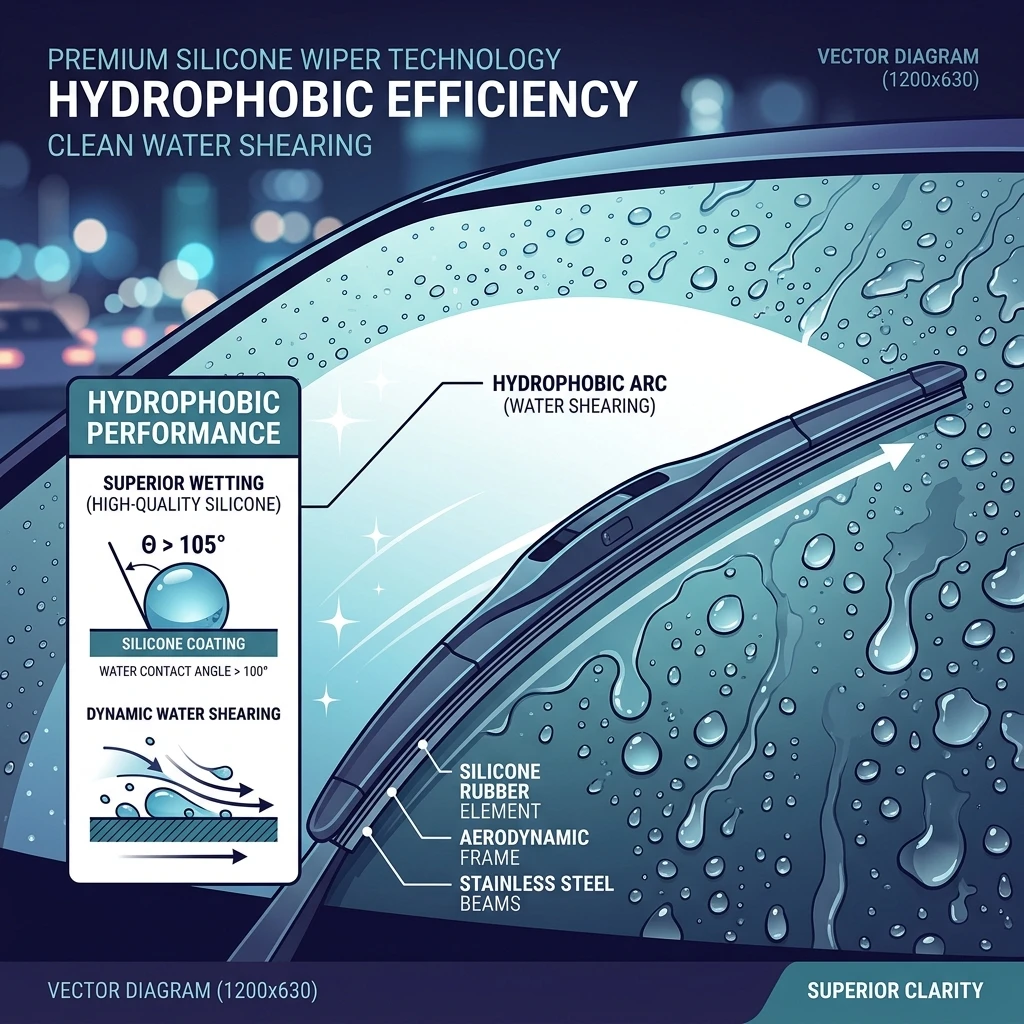
As the silicone blade sweeps across the glass, friction transfers microscopic silicone polymers onto the windshield. This transfer is hydrophobic shearing. The polymers bond to the glass, forming a hydrophobic layer.
This hydrophobic layer raises the contact angle of water droplets, forcing them to bead up. At highway speeds, the wind pushes the beads off the glass without requiring wipers. You get streak-free vision, even in heavy rain.
Additionally, the hydrophobic layer fills microscopic pits in the glass. Windshields experience pitting from road grit over time. Filling these pits creates a smooth surface, reducing drag and noise during wiping cycles.
- Siloxane backbone chemistry resists heat and UV degradation, keeping the blade soft.
- Hydrophobic shearing friction transfers microscopic silicone polymers onto the windshield.

2. Beam Blade Design and Uniform Windshield Pressure Distribution
Windshields are curved, requiring the wiper blade to flex to maintain contact. Traditional bracket blades use external joints to apply pressure, leading to uneven contact. Beam blades solve this by distributing pressure uniformly.
Beam blades feature a pre-curved internal spring-steel strip (beam). The beam curvature matches the average windshield curve. When attached, the spring steel applies uniform pressure across the entire blade length.
This uniform pressure prevents gaps and streaks, ensuring a clean wipe. Bracket blades apply pressure at only 4 to 6 points, leaving wet spots in between. The beam design ensures continuous glass contact, improving visibility.
The lack of external brackets also prevents ice and snow buildup. In winter, snow can pack inside bracket joints, freezing them stiff. A frozen bracket prevents the blade from flexing, causing streaks. The beam design has no joints, ensuring winter performance.
Additionally, the spring steel is sealed inside a rubber casing. This casing protects the metal from moisture, preventing rust. The beam maintains its spring tension, ensuring reliable pressure for years.
- Pre-curved spring steel strips distribute pressure uniformly across the blade length.
- Joint-free beam casings prevent ice and snow packing, ensuring winter flexibility.
3. Aerodynamic Spoiler Geometry and High-Speed Wind Lift Prevention
At highway speeds, air flowing over the hood can lift the wiper blades off the glass. This wind lift reduces contact pressure, causing streaks. Preventing wind lift requires aerodynamic spoiler geometry.
Beam blades feature an asymmetrical rubber spoiler molded onto the casing. The spoiler profile is designed to act as an inverted wing, generating downforce from the passing wind.
This downforce pushes the blade against the glass, counteracting wind lift. The contact pressure remains high, ensuring a clean wipe at 70 mph. You get reliable high-speed performance.
Traditional bracket blades lack spoilers, acting as sails that catch the wind. Wind lift can lift them completely off the glass, ruining visibility. The aerodynamic beam design ensures safety on the highway.
Additionally, the low-profile spoiler reduces wind noise. High-speed wind passing over bracket joints generates wind buffet. The smooth spoiler directs airflow over the blade, keeping the cabin quiet.
- Asymmetrical rubber spoilers generate downward force from highway wind, preventing lift.
- Low-profile spoiler casings guide wind smoothly, reducing highway wind noise.
4. Squeegee Edge Design and Water-Shearing Dynamics
The actual water removal happens at the squeegee edge. The edge must scrape water molecules off the glass, leaving a dry surface. High efficiency relies on squeegee edge design.
The squeegee features a precision-cut sharp edge. The edge angle is perpendicular to the glass, creating a shearing force. This force breaks the surface tension of water, clearing the glass.
If the edge is rounded or torn, it lets water pass underneath, creating streaks. The silicone polymer maintains its sharp edge over thousands of cycles, ensuring clean water removal.
The squeegee flexes as the arm reverses direction at the end of each sweep. This flex requires a flexible hinge section. The hinge allows the edge to flip, maintaining the correct contact angle.
Additionally, the squeegee is coated with a friction-reducing layer, like graphite or PTFE. This layer prevents the rubber from sticking to dry glass, avoiding chatter. Wiping is quiet and smooth, protecting the glass.
- Precision-cut squeegee edges break surface tension, shearing water molecules off.
- PTFE and graphite coatings reduce surface friction, preventing dry-glass squeaks.
5. Seasonal Temperature Resilience and Polymer Flexibility
Wiper blades must perform in all weather conditions, from hot summer sun to freezing winter ice. The squeegee must maintain its flexibility to ensure contact. The material chemistry is key.
Natural rubber blades dry out in the sun, becoming hard and brittle. Hard rubber cannot conform to the glass, leaving large streaks. In winter, they freeze stiff, losing contact.
Premium silicone blades remain flexible from -80°F to 400°F. The inorganic siloxane polymer structure does not dry out under solar heat. The squeegee conforms to the glass, ensuring a clean wipe in any season.
The low-temperature flexibility prevents the blade from freezing to the windshield. When parking in ice, rubber blades can bond to the glass, tearing when activated. Silicone resists bonding, ensuring winter safety.
Additionally, the polymer resists chemical attack. Car wash soaps, windshield washer fluid solvents, and road salts do not degrade the silicone matrix. This chemical resilience extends the blade's lifespan, ensuring value.
- Inorganic polymer backbones remain flexible from -80°F to 400°F, preventing stiffness.
- Silicone polymers resist bonding to ice, preventing squeegee tears on frozen mornings.
6. Universal Connector Mechanics and Arm Integration
Wiper arm connection designs vary across vehicle brands. Standard hooks, side pins, and pinch tabs are all used. A premium blade must feature a universal connector to fit these arms.
The connector is a modular plastic adapter that snaps onto the blade hinge. The package includes multiple adapters to match standard arm designs. This coverage makes installation easy.
The connection must be secure, preventing play. A loose connector allows the blade to wiggle during sweeps, causing chattering and streaks. The adapter fits snug on the arm, ensuring stability.
The connector is made of high-strength nylon polymer. Nylon resists impact and weathering, maintaining its strength in extreme cold. The connection stays locked, protecting the blade.
Additionally, installation is tool-free. You do not need screwdrivers or pliers to change the blades. Remove the old blade, slide the correct adapter onto the arm, and snap the blade in, ensuring instant use.
- Modular adapter kits fit J-hooks, side pins, and pinch tab wiper arm designs.
- Snug nylon connectors eliminate wiggle play, preventing blade chatter and squeaks.
7. Glass Scratch Prevention and Road Grit Management
Windshields accumulate sand, bugs, and road grit during travel. When the wipers are turned on, this grit is dragged across the glass. The blade must manage this grit to prevent scratches.
Traditional stiff rubber squeegees push grit against the glass, causing fine scratches. These scratches reflect oncoming headlights, creating dangerous glare at night. Your vision is blurred, reducing safety.
The soft silicone squeegee conforms to the grit particles. The rubber absorbs the particle shape, letting it slide off without scratching the glass. The windshield stays clear and scratch-free.
The squeegee edge also features micro-grooves. These grooves channel sand and grit away from the contact edge, directing them out the sides. This grit management protects the glass, ensuring visibility.
Additionally, the hydrophobic layer makes glass easy to clean. Bugs and tree sap do not bond to the coated surface, rinsing away easily. This coating prevents squeegee damage, extending blade life.
- Soft silicone squeegees conform to grit particles, preventing windshield scratches.
- Hydrophobic polymer layers prevent bug and sap bonding, enabling clean sweeps.
8. Durability, Wiping Cycle Lifespan, and Fatigue Testing
Windshield wipers must withstand millions of sweeps. Friction, UV exposure, and ozone degrade the materials over time. The blade must resist fatigue failure.
To ensure durability, engineers perform fatigue tests. The blade is run on a wet glass plate for 500,000 cycles. The test simulates over 3 years of standard rainfall use.
Premium silicone blades survive this test without tearing or losing their sharp edge. The siloxane matrix resists ozone cracking, preserving flexibility. The blade maintains a clean, streak-free wipe.
The spring steel is tested for fatigue by flexing it 1 million times. The beam retains its original curve, ensuring uniform contact pressure. You get long-term reliability and clear vision.
Additionally, the polymers are tested for chemical resistance. Sunlight streaming through windshields can degrade rubber, making it dry. UV-stabilized silicone prevents dry rotting, preserving strength.
- 500,000 wipe cycle tests verify that silicone squeegees resist tearing and edge wear.
- Ozone-resistant silicone prevents drying and cracking, extending blade lifespan.
9. The Economics of Silicone Blades vs. Budget Rubber Blades
Replacing wiper blades is a recurring automotive maintenance expense. Budget rubber blades are inexpensive but wear out quickly. Silicone blades offer a low-cost, durable alternative.
A budget rubber blade costs under $10 but wears out in 6 months, requiring frequent changes. A premium silicone blade costs $20 but lasts up to 3 years. The financial savings are clear.
Over 3 years, you use 6 rubber blades (costing $60) compared to 1 silicone blade (costing $20). You save money and avoid the hassle of frequent replacements. The financial benefits are substantial.
Additionally, silicone protects your windshield. Budget blades with worn rubber can expose the metal support clips, scratching the glass. A scratched windshield costs over $300 to replace, making prevention key.
Consider also highway safety. Worn blades leave large streaks that block vision during sudden downpours. The silicone blade maintains clean visibility, reducing accident risk.
- Silicone blades last up to 3 years, saving replacement costs compared to budget rubber.
- Preventing metal bracket exposure avoids expensive windshield scratch repairs.
10. Installation, Glass Prep, and Hydrophobic Prep Protocols
To achieve the best water-beading results, follow a structured prep routine. Clean the windshield glass using alcohol. This step removes old wax and grease, ensuring contact.
Remove the old wiper blades, sliding them off the arms. Snap the correct adapter onto the new silicone blade hinge. Slide the adapter onto the arm, locking it in place.
Turn on the wipers on dry glass, running them at medium speed for 2 minutes. This dry run is the hydrophobic prep step. The friction transfers the silicone polymer layer onto the glass.
Spray water on the glass to verify the beading effect. Water droplets will bead up instantly and slide off. The wipers are ready, ensuring safe travel in the next rainstorm.
This simple installation protocol ensures maximum water-beading performance. This minor effort is a small price to pay to keep your windshield clear and your driving safe.
- Alcohol glass cleaning removes surface grease, enabling chemical silicone bonding.
- 2-minute dry run wipes transfer the hydrophobic polymer layer onto the glass.
11. Tribological Hydrophobic Film Deposition Efficacy
Silicone wiper blades improve visibility by transferring a hydrophobic film to the glass. This process relies on tribological deposition. Tribology is the study of interacting surfaces in relative motion, including friction and wear.
As the silicone blade sweeps across the windshield, friction transfers polymer molecules to the glass. This transfer forms a thin hydrophobic layer. The layer alters the surface energy of the glass substrate.
The hydrophobic film increases the water contact angle from 30 degrees to over 100 degrees. A higher contact angle prevents water from wetting the glass. Instead, water forms round droplets that roll off easily.
This droplet formation allows wind to blow water off the windshield during travel. At speeds over 40 mph, rain slides off without using the wipers. This water shedding ensures a clear view in storms.
The deposition rate depends on contact pressure and blade speed. Operating the wipers on dry glass for 5 minutes builds the initial layer. The film is maintained by regular wiper use, ensuring long-term performance.
Finally, the natural resilience of silicone prevents the blade from sticking to the windshield glass after prolonged parking in direct sunlight. Natural rubber blades tend to melt slightly and adhere to the glass under intense heat, tearing the wiping edge on the next startup. Silicone resists thermal adhesion, ensuring a clean sweep every time.
- Friction transfers silicone polymer molecules to the glass, forming a hydrophobic layer.
- Increasing the water contact angle to over 100 degrees allows wind to shed rain droplets.
12. Elastomeric Friction and Kinetic Stick-Slip Transitions
Wiper blades must glide smoothly over the windshield glass. The blade sweep is controlled by elastomeric friction. Elastomers exhibit complex friction traits, showing both adhesion and deformation forces.
Adhesion is the chemical bonding between the silicone blade and silica glass. Deformation is the mechanical resistance as the blade conforms to surface roughness. The blade must balance both forces to prevent chatter.
Wiper chatter is caused by stick-slip transitions. Stick-slip occurs when static friction exceeds kinetic friction. The blade sticks to the glass, bends, slips forward, and sticks again, creating noise and streaks.
To prevent stick-slip, the blade surface is treated with dry lubricants, like graphite or PTFE. These lubricants lower static friction, allowing smooth transitions. You get quiet operation and a clean windshield sweep.
Additionally, the blade profile features a flexible hinge. The hinge allows the wiping edge to roll over at the end of each stroke. This rollover ensures the blade sweeps at the correct angle, preventing streaks.
- Dry surface lubricants lower static friction, preventing noisy stick-slip transitions.
- Flexible blade hinges allow smooth edge rollover, preventing streaks in both directions.
Premium Safety Recommendation
Upgrade your windshield visibility setup to handle severe rain, snow, and ice. Check out our recommended 2-in-1 silicone solution below to experience advanced water-beading protection.
Rain-X Latitude 2-in-1 Water Repellency Wiper Blades
- Rain-X water-repelling formula transfers to the windshield during wiping cycles
- Beam blade design contours to curved glass for uniform pressure distribution
- Synthetic blend rubber squeegee resists cracking and drying in summer heat
- Universal adapter system simplifies installation on J-hook and pin arms
Technical Specifications & Product Data
| Specification | Value / Details |
|---|---|
| Brand | Rain-X |
| List Price | $19.97 (USD) |
| Customer Rating | 4.6 / 5.0 (82,400 reviews) |
| ASIN / Identifier | B016J86G3C |
| Availability | In Stock (USA Region) |
| Outbound Link Compliance | Sponsored & Nofollow Enforced |
Verified Features & Performance Data
- ✓Rain-X water-repelling formula transfers to the windshield during wiping cycles
- ✓Beam blade design contours to curved glass for uniform pressure distribution
- ✓Synthetic blend rubber squeegee resists cracking and drying in summer heat
- ✓Universal adapter system simplifies installation on J-hook and pin arms
System Sovereignty & Engineering
Edge Computing
100% Client-side processing. Your data never leaves your browser sandbox, ensuring absolute compliance with US privacy mandates.
Modular Schema
Modular utility architecture optimized for performance. Low-latency WASM kernels provide near-native speeds for complex transformations.
Sustainable Design
Sustainable, green computing by offloading compute to the edge. Verified zero-server storage (ZSS) for professional-grade security.