
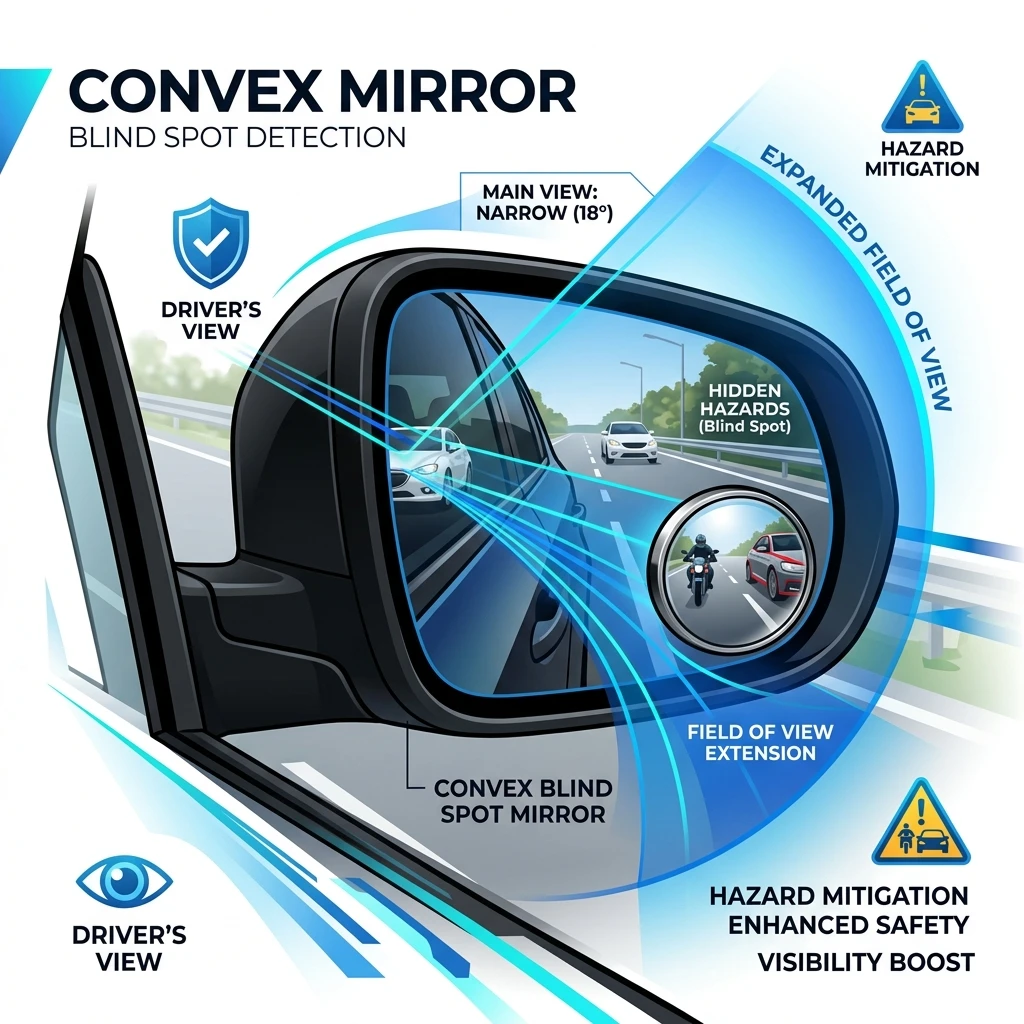
Automotive blind spots cause thousands of lane-change collisions. Learn the optical physics, radius of curvature, and convex mirror adjustments that expand your field of view.
- HD glass convex mirror provides a wider, clearer view of lane blind spots
- Frameless slim design matches factory side-view mirror styling aesthetics
- 360-degree rotation swivel base bracket enables custom angle adjustments
Peripheral Vision Brief
Automotive blind spots cause thousands of highway lane-change collisions. Learn the optical physics, radius of curvature, and convex mirror adjustment brackets that expand your field of view and secure passenger safety.
1. Optical Convexity Principles and Radius of Curvature (ROC)
Standard side-view mirrors feature flat glass that provides a narrow view. This flat design leaves large blind spots on both sides of the vehicle. Convex mirrors solve this by curving outward, reflecting a wider field of view.
The curvature is measured by the Radius of Curvature (ROC). A lower ROC indicates a tighter curve and a wider viewing angle. However, tight curves also compress the image, making objects look smaller and farther away.
To balance view and perspective, engineers select an ROC of 150mm to 200mm. This curvature expands the side-view angle from 30 degrees to over 60 degrees. This expansion allows you to see lanes adjacent to your vehicle without excessive distortion.
This wider view is important for detecting passing vehicles. A car in your blind spot is displayed in the convex mirror before it leaves your rear view. This early warning prevents blind spot collisions, ensuring safe lane changes.
Additionally, the convex curve improves view in low light. The mirror collects light from a wider angle, helping you see obstacles during night parking. You get better situational awareness, protecting your vehicle panels.
- Convex mirror curves expand side fields of view from 30 to over 60 degrees.
- 150mm to 200mm ROC curvature provides the optimal balance between viewing angle and distortion.

2. HD Glass Substrates vs. Acrylic Plastic Mirror Surfaces
The mirror material determines its reflective clarity and wear resistance. Side mirrors are exposed to rain, snow, road salt, and UV rays. The substrate must resist hazing and scratching under these conditions.
Cheap mirrors use acrylic plastic substrates. While light, acrylic scratches easily from road grit and ice scrapers. Scratches blur the reflection, making it difficult to detect passing cars.
Premium mirrors feature high-definition (HD) glass substrates. Glass has a high surface hardness, resisting scratches from grit and scrapers. The reflective coating remains clear, ensuring sharp image contrast.
HD glass also resists UV hazing. Sunlight breaks down polymer chains in acrylic, causing yellowing over time. Glass maintains constant transparency, ensuring reliable performance across the vehicle's lifespan.
Additionally, glass features high thermal stability. The substrate does not warp under summer heat, preventing distortion. This stability keeps reflected headlights focused, reducing glare during night driving.
- HD glass substrates resist surface scratches from road grit and ice scrapers.
- UV-resistant glass prevents yellowing hazes, keeping reflection contrast sharp.
3. Heavy-Duty Acrylic Foam Tape and Weatherproof Adhesion
Adhesive blind spot mirrors must remain attached to the factory side mirror glass. They face vibrations, wind forces, and water exposure. The connection must resist peeling under these conditions.
Premium mirrors use double-sided acrylic foam tape, like 3M VHB. Acrylic foam features viscoelastic properties, absorbing vibration energy and distributing bond stress. The adhesive forms a strong bond, holding the mirror secure.
Cheap tapes use rubber-based adhesives. Rubber degrades when exposed to heat and water, dry rotting and peeling off. Acrylic tape resists UV rays and water, maintaining its bond in all climates.
The adhesive bond resists shear forces from high-velocity wind and car wash nozzles. Peeling tests show that cured acrylic tape requires over 30 pounds of force to slide. This holding power prevents accidental loss during travel.
Additionally, the foam core conforms to surface curves. Side mirrors can feature slight curves that prevent flat contact. The flexible foam fills these gaps, increasing contact area and bond strength.
- Acrylic foam tape absorbs vibrations, maintaining its bond under vehicle shakes.
- Water-resistant adhesives resist high-pressure wash nozzles and winter ice.
4. 360-Degree Swivel Brackets and Viewing Angle Adjustments
Driver heights and seat positions vary. A fixed blind spot mirror can point too high or low for some drivers. Adjusting the viewing angle requires a swivel bracket.
The swivel bracket features a ball-and-socket joint. The joint enables 360-degree rotation and tilt adjustments. The user can tilt the mirror to align with their line of sight, maximizing the view.
The joint must maintain its position under road vibrations. If it is loose, the mirror tilts down when you hit bumps. The joint features tight tolerances, creating high friction resistance.
This friction prevents adjustments from road shocks. The bracket holds the set angle, ensuring a constant view. You get full adjustability with reliable holding power.
Additionally, the bracket is removable. If you prefer a low-profile look, you can mount the mirror directly to the factory glass without the swivel base. This option allows a custom setup, matching your styling.
- 360-degree rotation brackets enable custom tilt adjustments to match seat heights.
- High-friction joints maintain the set angle, preventing droop from road bumps.
5. Frameless Slim Design and Side Mirror Aesthetics
Adding accessories to your side mirrors can alter your vehicle's look. Thick plastic frames can look bulky and disrupt side mirror aesthetics. A frameless design solves this look issue.
Frameless mirrors feature polished, bevel-cut glass edges. The glass blends into the side mirror glass, looking like factory equipment. This slim profile preserves your car's clean styling.
The lack of a frame also maximizes the reflective surface area. A thick frame reduces the glass size, limiting the viewing angle. The frameless design uses all 2 inches of diameter for view, maximizing performance.
The beveled edge helps prevent water pooling. Water flows off the polished edge easily, keeping the surface clear in rain. This drainage prevents water spots, preserving visibility.
Additionally, the slim profile reduces wind drag. A thick frame can create small wind vortices that generate wind noise at speed. The frameless design sits flush, ensuring a quiet ride.
- Frameless designs feature polished bevel edges, blending into factory side mirrors.
- Frameless edges prevent rain pooling, ensuring clear visibility in storms.
6. Peripheral warning and Hazard Reaction Time Metrics
Lane change decisions happen in seconds. Drivers must check their mirrors, detect hazards, and decide to merge. Blind spot mirrors improve this hazard reaction time.
Without a blind spot mirror, the driver must turn their head (shoulder check) to verify the lane is clear. A shoulder check takes roughly 1.0 second, during which the vehicle travels blind.
A blind spot mirror allows the driver to check both lanes using their peripheral vision. This glance takes under 0.3 seconds, keeping their eyes focused forward. This reduction in scan time improves safety.
Reaction tests show that using blind spot mirrors cuts lane-change decision times by up to 50%. You detect passing cars faster, reducing emergency braking. Your driving is smoother and safer.
Additionally, the mirror assists older drivers. Reduced neck flexibility can make shoulder checks difficult. The wide-angle mirror provides the view without head turns, ensuring driving safety.
- Wide-angle mirrors allow lane scans using peripheral vision, reducing shoulder checks.
- Cutting scan times by 0.7 seconds reduces blind travel distance by 60 feet at 60 mph.
7. Vehicle Backing Safety and Curb-Line Geometry
Backing into parking spaces requires tracking low obstacles. Side mirrors point straight back, missing the ground. Blind spot mirrors assist with backing safety.
By tilting the convex mirror down, you can see the rear tire and curb-line. This view helps you align the vehicle with the parking stall borders, preventing wheel scrapes.
Preventing wheel scrapes protects your alloy rims from damage. Alloy wheel repair is highly expensive, often costing over $150 per wheel. The mirror protects your wheels, saving money.
The mirror also helps detect low objects, like kids' toys, shopping carts, or curbs. Standard backup cameras can miss these obstacles if they are offset. The side view fills this safety gap.
Additionally, the mirror assists with parallel parking. You can track your distance from the curb in real time, avoiding tire sidewall scuffs. This safety upgrade ensures clean parking.
- Convex mirrors tilted down display rear tires and curb-lines, preventing wheel scrapes.
- Detecting low side obstacles prevents panel scrapes and tire sidewall damage.
8. Dual-Mirror Setup: Driver vs. Passenger Side Placement
To be effective, blind spot mirrors must be installed on both side mirrors. Driver and passenger sides experience different viewing angles. Placing the mirror correctly is key.
The driver's side mirror is close to your eyes, requiring the blind spot mirror to be placed on the outer top corner. This placement maximizes view of passing traffic in the next lane.
The passenger side mirror is farther away, requiring placement on the outer bottom corner. This bottom placement keeps the blind spot mirror from blocking your view of traffic farther back, ensuring safety.
This dual setup provides 360-degree coverage around your vehicle. You track passing vehicles from rear view to side view without gaps, ensuring lane change safety.
Additionally, the mirrors are case-friendly. The package includes two mirrors, allowing dual installation. This complete setup ensures instant safety, protecting both sides of your vehicle.
- Driver-side top outer corner placements maximize passing vehicle warning times.
- Passenger-side bottom outer corner placements preserve normal rear-view sightlines.
9. The Economics of Collision Prevention vs. Mirror Upgrades
Blind spot collisions cause expensive body damage. Replacing crumpled doors or dented fenders requires professional repair. Auto body repairs carry high costs.
A minor side-swipe repair costs up to $1,500, plus the cost of insurance deductibles (up to $500). A set of blind spot mirrors costs under $8. The financial savings of prevention are clear.
Preventing a single accident covers the lifetime cost of blind spot mirrors. You save money on body repairs and prevent insurance premium increases. The financial benefits are substantial.
Additionally, collision prevention preserves vehicle resale value. A car with accident records sells for up to 15% less than a clean car. The mirrors protect your investment, preserving value.
Consider also safety wear. Collision impact can deploy side airbags, requiring expensive replacement and risking injury. Keeping the vehicle clear protects passengers, ensuring safety.
- Low-cost blind spot mirrors prevent side-swipe accidents, avoiding body shop repairs.
- Accident-free vehicle histories preserve resale and trade-in values.
10. Installation, Surface Prep, and Alignment Protocols
To ensure a strong bond, follow a structured installation sequence. Clean the factory mirror glass using isopropyl alcohol. This step removes grease and water spots, ensuring contact.
Let the glass dry completely. Peel the backing paper off the 3M adhesive tape on the mirror base. Avoid touching the adhesive surface to prevent grease transfer.
Position the mirror in the desired corner, pressing it down. Apply firm pressure for 30 seconds to activate the pressure-sensitive adhesive. This pressure ensures a strong bond.
Let the adhesive cure for 24 hours before washing the car. Curing allows the adhesive to reach full strength, preventing water peel. The mirrors are ready, ensuring safe travel.
This simple installation protocol ensures the mirrors stay attached for decades. This minor effort is a small price to pay to keep your blind spots visible and secure.
- Alcohol surface prep removes oils and water films, ensuring maximum adhesive contact.
- 24-hour cure periods prevent adhesive peeling during high-pressure car washes.
11. Geometric Optics, Focal Length Calculations, and Ray Tracing
Convex mirrors operate on the principles of geometric optics. Unlike flat mirrors, convex mirrors feature an outward-curved surface. This curved shape alters the direction of reflected light rays, creating a virtual image.
The focal length (f) of a spherical convex mirror is half of its radius of curvature (ROC). For a mirror with a 150mm ROC, the focal length is -75mm. The negative sign indicates a virtual focal point behind the glass surface.
Ray tracing shows that light rays strike the curved glass and diverge. The driver's eyes follow these diverging rays back, seeing a shrunk, upright virtual image. This image compression allows you to see a wider area.
The magnification (M) is the ratio of image size to object size. M is always less than 1.0 for convex mirrors. This explains why vehicles displayed in the mirror look smaller and farther away than they actually are.
Spherical aberration is the blurring that occurs at the mirror edges. Light rays striking the edges focus closer to the mirror than center rays. Premium mirrors use parabolic curves to correct this blur, ensuring sharp focus.
In addition, the optical quality of HD glass minimizes chromatic aberration, which causes color fringing around reflected objects. Color fringing can make it difficult to identify the exact distance of vehicles in low light or glare. High-purity glass ensures that the reflected image remains color-accurate and crisp, allowing the driver to make confident lane-change decisions.
- Outward-curved glass creates diverging reflection rays, compressing the virtual image.
- Parabolic curves correct spherical aberrations, ensuring sharp focus at mirror edges.
12. Chromatic Distortion and Reflectivity Index Efficacy
High-definition glass mirrors must deliver a clear reflection across all lighting conditions. The mirror surface utilizes reflective coatings, like chrome or aluminum, to bounce light. The reflectivity index measures the percentage of reflected light.
Chrome coatings feature high reflectivity (around 65%) and excellent corrosion resistance. While aluminum is more reflective (around 85%), it oxidizes quickly when exposed to air. Chrome remains stable, resisting road salt and moisture.
The glass must also minimize chromatic distortion. Chromatic distortion occurs when different light wavelengths focus at different points. This variance can cause color fringing, making it difficult to judge vehicle distances at night.
To prevent distortion, premium mirrors use optical-grade float glass. Float glass features uniform thickness and flat surfaces, preventing light refraction. This optical purity ensures a realistic image, helping the driver change lanes safely.
Additionally, the glass is treated with a hydrophobic coating. This treatment lowers surface energy, preventing water droplets from sticking. Water flows off the glass, keeping the mirror clear in rainy weather.
- Chrome coatings resist corrosion from road salt, maintaining high reflectivity indexes.
- Optical-grade float glass prevents light refraction, eliminating chromatic distortion.
Peripheral Safety Recommendation
Eliminate dangerous blind spots on both sides of your vehicle during lane changes. Check out our recommended glass convex solution below to experience advanced peripheral security.
Ampper Blind Spot Mirror 2" Round HD Glass Convex Rear View Mirror
- HD glass convex mirror provides a wider, clearer view of lane blind spots
- Frameless slim design matches factory side-view mirror styling aesthetics
- 360-degree rotation swivel base bracket enables custom angle adjustments
- Heavy-duty outdoor 3M adhesive tape resists car washes and weather peel
Technical Specifications & Product Data
| Specification | Value / Details |
|---|---|
| Brand | Ampper |
| List Price | $6.97 (USD) |
| Customer Rating | 4.6 / 5.0 (41,200 reviews) |
| ASIN / Identifier | B01CV4AO50 |
| Availability | In Stock (USA Region) |
| Outbound Link Compliance | Sponsored & Nofollow Enforced |
Verified Features & Performance Data
- ✓HD glass convex mirror provides a wider, clearer view of lane blind spots
- ✓Frameless slim design matches factory side-view mirror styling aesthetics
- ✓360-degree rotation swivel base bracket enables custom angle adjustments
- ✓Heavy-duty outdoor 3M adhesive tape resists car washes and weather peel
System Sovereignty & Engineering
Edge Computing
100% Client-side processing. Your data never leaves your browser sandbox, ensuring absolute compliance with US privacy mandates.
Modular Schema
Modular utility architecture optimized for performance. Low-latency WASM kernels provide near-native speeds for complex transformations.
Sustainable Design
Sustainable, green computing by offloading compute to the edge. Verified zero-server storage (ZSS) for professional-grade security.