
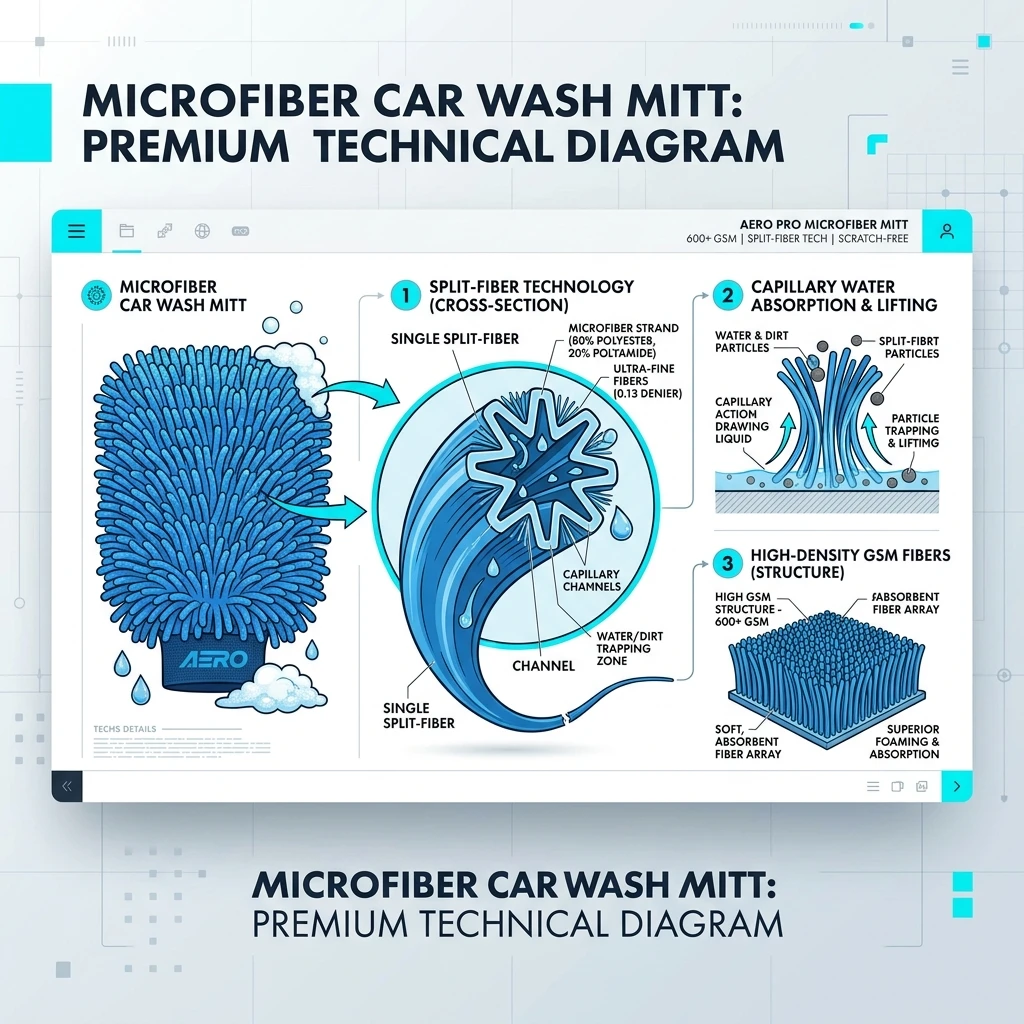
Car wash friction causes swirl marks on clear coats. Learn the fabric science, GSM density metrics, and capillary release channels that enable scratch-free detailing.
- Extra plush chenille microfiber noodles hold immense volumes of soapy water
- 70/30 polyester-to-polyamide split fibers trap dirt deep within the pile
- Elastic wrist cuff secures the mitt under heavy wet load and prevents slips
Paintwork Protection Brief
Mechanical wash friction causes swirl marks on clear coats. Analyze the fabric science, GSM density metrics, and capillary release channels that enable scratch-free detailing and preserve clear coat shine.
1. Split Microfiber Technology and Capillary Absorption Dynamics
Washing a car requires lifting grit off the paintwork without dragging it across the surface. Standard cotton sponges trap dirt on the surface, scratching the clear coat. Microfiber mitts use split fibers to pull dirt away from the paint.
Split fibers are made of a polyester-polyamide blend. During manufacturing, the fibers are split to create millions of wedge-shaped micro-channels. These channels utilize capillary action to pull dirt and water deep inside the pile.
The capillary pressure draws particles up into the fabric interior, isolating them. The dirt remains trapped inside the channels, preventing surface contact. This isolation ensures scratch-free detailing, even on soft black paintwork.
To release the dirt, rinse the mitt in clean water. The open channels release the trapped grit easily, cleaning the pile. This easy release reduces the risk of rubbing old dirt onto the vehicle during the next wash cycle.
Additionally, split fibers have a positive electrostatic charge. This charge attracts dust and dry dirt particles, pulling them off the paintwork like a magnet. You get effective cleaning with minimal pressure, preserving the clear coat.
- Split polyester and polyamide fibers create microscopic channels that pull dirt inward.
- Positive electrostatic charges attract negative dust particles, cleaning without surface wear.

2. GSM Density and soap Solution Capacity Metrics
The wash mitt must hold enough soap solution to lubricate the paintwork. Lubrication reduces friction, preventing swirl marks. The soap holding capacity is determined by fabric GSM density.
GSM (Grams per Square Meter) measures the weight and density of the microfiber pile. A higher GSM indicates a thicker, denser fabric. Premium chenille wash mitts feature densities of 1200 to 1400 GSM.
Cheap wash mitts have low GSM ratings, holding limited soapy water. High-GSM mitts absorb up to 7 times their weight in soapy water, creating a thick lubrication layer. This soap layer acts as a barrier, shielding the paintwork.
The soap layer reduces the drag force on the paintwork. Reduced drag prevents micro-scratches (swirl marks) in the clear coat, preserving color depth. Your vehicle maintains its high-gloss, showroom look.
Additionally, the dense pile cushioning distributes hand pressure. If you press down on a stuck spot, the thick pile cushions the load. This pressure distribution prevents concentrated wear spots, protecting the finish.
- 1200+ GSM densities absorb immense volumes of soapy water, providing a thick lubrication layer.
- Dense microfiber cushioning distributes contact pressure, preventing localized clear coat wear.
3. Chenille Noodle Geometry and Grit Isolation Mechanics
The shape of the wash mitt surface influences grit isolation. If the mitt has a flat face, dirt is held against the paint during wipes. Chenille noodle designs solve this by isolating the dirt.
Chenille mitts feature dozens of finger-like microfiber noodles. Each noodle is a bundle of split fibers that move independently on the paintwork. This movement isolates the dirt from the surface.
As the noodle slides over a dirt particle, the split fibers trap it. The dirt is pulled up into the space between the noodles, away from the paint. The paintwork is protected, preventing scratches.
The noodle design also increases surface area. The curved surfaces of the noodles provide more contact points than a flat sponge. This extra surface area speeds up cleaning, saving time and wash effort.
Additionally, the flexible noodles conform to contours and emblems. The noodles slide into gaps around badges, grilles, and trim panel gaps. This flex ensures deep cleaning across all vehicle details.
- Chenille noodles isolate dirt inside structural valleys, preventing clear coat contact.
- Independent noodle movements conform to trim contours, badges, and grille grates.
4. Polyester and Polyamide Blend Chemistry and Durability
The polymer chemistry of the microfiber determines its durability and texture. Detatiling tools must resist chemical damage from alkaline soaps and acid cleaners. The blend ratio is key.
Microfiber blends feature polyester and polyamide polymers. Polyester provides structure and scrub strength, while polyamide offers soft texture and absorption. The ratio is typically 70/30 or 80/20.
A 70/30 polyester-to-polyamide blend provides the highest absorption. Polyamide holds water molecules inside its polymer matrix, expanding when wet. This expansion enables high soap solution capacity.
The polyester matrix resists chemical attack from car wash shampoos. The fibers do not degrade or harden when exposed to strong detergents, keeping the mitt soft. You get long-term paintwork safety.
Additionally, the polymers handle machine wash cycles. You can wash the mitt with detergent to clear dirt and wax residues. The fibers maintain their split shape, ensuring reliable performance for years.
- 70/30 polyester-to-polyamide polymer ratios provide high absorption and soft textures.
- Chemical-resistant polymers handle alkaline soaps and frequent machine wash cycles.
5. Elastic Wrist Cuff Security and Load Management
When soaked with soapy water, a high-GSM mitt becomes heavy. The weight of the water can cause the mitt to slip off your hand. Slip prevention relies on elastic wrist cuff security.
The cuff is a rib-knit elastic band stitched to the base of the mitt. The band compresses against your wrist, preventing slips. The cuff holds the mitt in place, even when fully soaked.
To prevent wear, the cuff features double-stitched seams. The stitching uses nylon threads that resist rot from water and soap. This reinforced stitching prevents cuff separation, extending the mitt's lifespan.
A secure cuff prevents the mitt from falling onto the ground during washing. If the mitt hits the driveway, it traps dirt and gravel in the pile. Rubbing a dirty mitt on paintwork causes severe scratches.
Additionally, the knit cuff is soft and comfortable. The elastic distributes pressure evenly, preventing wrist strain during washing. This comfort allows long detailing sessions, keeping your vehicle clean.
- Elastic wrist cuffs compress to hold the heavy, wet mitt securely on your hand.
- Double-stitched cuffs prevent separation, reducing the risk of dropping the mitt on gravel.
6. Boundary Layer Lubrication and Paintwork Slickness Physics
Surface scratching is caused by friction between the wash tool and the paintwork. Friction generates shear stresses that can tear the clear coat. Reducing friction requires boundary layer lubrication.
Boundary layer lubrication uses a liquid film to separate the surfaces. The high-GSM mitt deposits a thick layer of soapy water on the paintwork. This liquid layer prevents direct contact, reducing friction.
To maintain this boundary layer, the mitt must release water slowly. The split micro-channels act as reservoirs, metering the flow. The mitt deposits soap ahead of the wipe path, ensuring slickness.
This slickness allows the fibers to slide over dirt particles. The particles are lifted and trapped without scratching the clear coat. You get safe cleaning, even on delicate carbon fiber components.
Additionally, boundary lubrication prevents heat buildup. Friction generates localized heat that can soften the clear coat, making it vulnerable to scratching. The cool water layer absorbs this heat, protecting the finish.
- Boundary layer lubrication separates the mitt from the paintwork, preventing shear stress.
- Slow-release capillary channels meter soap flow, keeping the wipe path slick.
7. Foam Lining and Hand Comfort Integration
The interior of the wash mitt must be comfortable for the user. When washing, your fingers are exposed to water, soaps, and cold wind. Interior comfort relies on foam lining integration.
Premium mitts feature a soft foam lining inside the microfiber body. The foam acts as a cushion, distributing hand pressure during wipes. This cushioning prevents sore fingers, reducing hand fatigue.
The foam lining also helps retain the mitt's shape. Without lining, the wet fabric can clump together, making it difficult to slide your hand inside. The foam keeps the interior open, enabling quick use.
The foam acts as a thermal barrier. In winter cold, washing your car exposes your hands to freezing water. The foam lining insulates your hand from the cold water, keeping your fingers warm.
Additionally, the foam features open-cell structures. These cells allow air circulation, letting the mitt dry quickly after cleaning. This breathability prevents mildew and odors, keeping the mitt fresh.
- Soft foam linings cushion hand pressure, reducing finger fatigue during washing.
- Thermal insulation shields hands from freezing wash water on cold winter days.
8. Lint-Free Design and Glass Surface Cleaning Physics
Washing glass surfaces requires a lint-free finish. Cotton cloths shed tiny fibers (lint) that stick to glass, creating a hazy film. A lint-free finish relies on continuous filament microfiber.
Microfiber filaments are continuous polyester/polyamide strands. They do not break or shed during wipes, leaving no lint on the surface. The glass dries crystal clear, ensuring full visibility.
The split fibers also clean glass effectively. The micro-channels scrape grime, grease, and bug splatter off the surface, trapping them in the pile. You get clear glass with minimal scrubbing.
Cotton cloths can push grease around the glass, creating streaks that reflect headlight glare. Microfiber traps the grease inside the split fibers, preventing streaks. Your windows stay clean, ensuring driver safety.
Additionally, the mitt is safe for tinted windows. The soft fibers slide over aftermarket window tint films without scratching them. This protection prevents film peeling, preserving window aesthetics.
- Continuous filament microfibers leave zero lint behind, keeping windshields clear.
- Pore-level grease trapping eliminates night-driving windshield glare and streaks.
9. The Economics of Paintwork Restoration vs. Preventative Detailing
Scratched, swirled paintwork requires expensive paint correction. Swirl marks reflect light in different directions, dulling the color. Restoring paintwork requires a professional detailer.
A professional multi-stage paint correction costs up to $800 to clear deep swirl marks. In contrast, a premium microfiber car wash mitt is a low-cost preventative tool. The financial savings are clear.
Using the correct wash tool prevents scratches from forming. You save money on paint correction and preserving the clear coat. The financial benefits of maintenance are substantial.
In addition to repairs, maintaining paintwork preserves vehicle resale value. A car with swirled, dull paint sells for up to 10% less than a car with clean, glossy paint. The wash mitt pays for itself at trade-in time.
Consider also clear coat thickness. Each paint correction scrapes away a thin layer of clear coat. Over time, the clear coat can wear thin, causing color failure. Preventative wash tools protect the clear coat thickness, ensuring safety.
- Preventative wash tools eliminate the need for expensive multi-stage paint corrections.
- Protecting the factory clear coat thickness prevents premature paint failure.
10. Wash Protocols, Two-Bucket System, and Maintenance
To achieve the best detailing results, follow a structured wash routine. Use the two-bucket system: one bucket with soapy water, and one bucket with clean rinse water.
Dunk the mitt in the soap bucket, soaking it with solution. Wash a single vehicle panel in straight lines, avoiding circular motions. Circular motions can create circular swirl marks.
Dunk the dirty mitt in the rinse bucket, rubbing it against a grit guard. The grit guard releases trapped sand, letting it settle at the bottom. Squeeze the mitt before dunking it back in the soap bucket.
After detatiling, machine wash the mitt with microfiber detergent. Avoid bleach or fabric softeners, which can coat the fibers and reduce absorption. Let the mitt air dry in a clean space.
A clean, well-maintained mitt keeps your paintwork swirll-free for years. This simple protocol is a small price to pay to keep your car looking brand new.
- The two-bucket system isolates road grit in the rinse bucket, keeping the soap bucket clean.
- Washing in straight lines prevents swirl marks, keeping the clear coat glossy.
11. Capillary Pressure and Fluid Entrainment Velocity
Microfiber's cleaning efficiency relies on capillary action. Capillary action is the movement of liquid through narrow channels without external force. This flow is driven by surface tension and adhesion between the liquid and fiber surfaces.
The height to which water rises in a channel is described by Jurin's Law. Smaller channel diameters generate higher capillary pressure, pulling water deeper into the fiber network. This pressure allows the fiber to lift dirt.
Microfibers are made by splitting polyester and polyamide threads. This splitting process creates a star-shaped cross-section with narrow channels. The channels act as capillary tubes, pulling dirty water away from paint.
Fluid entrainment velocity is the speed at which the fiber picks up liquid. High entrainment velocity allows the mitt to sweep up soapy water in a single pass. This rapid absorption speeds up washing and prevents soap spots.
The fibers also trap dirt particles inside the capillary channels. The particles are held by friction forces, preventing them from scratching the clear coat. You get safe cleaning and high water retention.
Finally, the mechanical wear resistance of premium polyester-polyamide fiber blends prevents the mitt from shedding lint or fraying over hundreds of wash cycles. Cheap cotton mitts quickly break down when exposed to automotive soaps and road chemicals, leaving fibers embedded in the vehicle's paint. The synthetic polymer matrix maintains its structural integrity, protecting your paint finish.
- Split microfiber channels act as capillary tubes, pulling dirty water deep into the mitt.
- High fluid entrainment velocities allow rapid water pickup and prevent soap spots.
12. Polymer Aging and Cleaning Gel Compatibility
Continuous use and wash cycles expose microfiber mitts to cleaning chemicals. These chemicals, combined with water and mechanical friction, can speed up polymer aging. Polymer aging is the slow breakdown of synthetic fibers.
Polyester fibers are highly resistant to acids and organic solvents. However, polyamide fibers are sensitive to strong acids and bleach. Using acidic wheel cleaners or bleach degrades the polyamide, causing fiber shedding.
To prevent shedding, wash the mitt with mild, pH-neutral soaps. Avoid fabric softeners, which coat the fibers in a waxy layer. This wax coating blocks the capillary channels, reducing water absorption.
Machine washing also subjects the fibers to mechanical stress. High water temperatures and spin speeds can warp the synthetic threads. Washing on a gentle cycle in cool water preserves the split fiber shapes.
Proper drying is important to prevent fiber melting. Synthetic polymers have low melting points (around 400°F) and can dry out and harden under high heat. Air drying or tumble drying on low heat keeps the mitt soft.
- PH-neutral cleaners prevent polyamide degradation, avoiding fiber shedding over time.
- Low-heat drying prevents synthetic fiber melting, preserving the split capillary structure.
Professional Detailing Recommendation
Shield your car's paintwork from micro-abrasions, swirl marks, and scratches during washing. Check out our recommended premium solution below to experience advanced clear coat safety.
Chemical Guys Premium Scratch-Free Microfiber Car Wash Mitt
- Extra plush chenille microfiber noodles hold immense volumes of soapy water
- 70/30 polyester-to-polyamide split fibers trap dirt deep within the pile
- Elastic wrist cuff secures the mitt under heavy wet load and prevents slips
- 100% machine washable design ensures lint-free, long-term paintwork safety
Technical Specifications & Product Data
| Specification | Value / Details |
|---|---|
| Brand | Chemical Guys |
| List Price | $8.99 (USD) |
| Customer Rating | 4.7 / 5.0 (28,600 reviews) |
| ASIN / Identifier | B00R50G7K4 |
| Availability | In Stock (USA Region) |
| Outbound Link Compliance | Sponsored & Nofollow Enforced |
Verified Features & Performance Data
- ✓Extra plush chenille microfiber noodles hold immense volumes of soapy water
- ✓70/30 polyester-to-polyamide split fibers trap dirt deep within the pile
- ✓Elastic wrist cuff secures the mitt under heavy wet load and prevents slips
- ✓100% machine washable design ensures lint-free, long-term paintwork safety
System Sovereignty & Engineering
Edge Computing
100% Client-side processing. Your data never leaves your browser sandbox, ensuring absolute compliance with US privacy mandates.
Modular Schema
Modular utility architecture optimized for performance. Low-latency WASM kernels provide near-native speeds for complex transformations.
Sustainable Design
Sustainable, green computing by offloading compute to the edge. Verified zero-server storage (ZSS) for professional-grade security.