
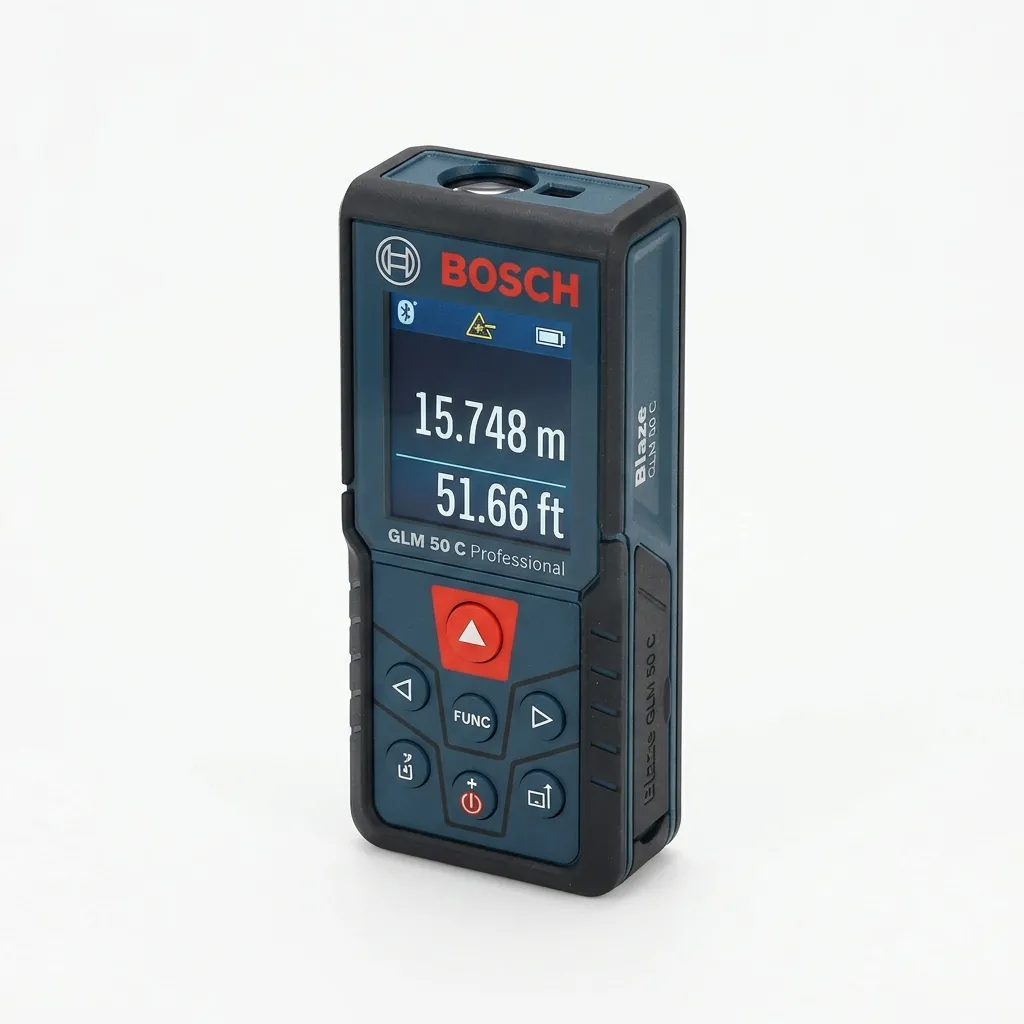
Laser distance measurement outpaces manual tape measuring. Analyze optical phase shift dynamics, ambient light filtering, and Bluetooth data synchronization to optimize volumetric estimation.
- Bluetooth connectivity for wireless transfer of measurements to app
- Color display with backlighting for high visibility in dark environments
- Extremely precise measuring within 1/16 inch accuracy up to 165 feet
Electro-Optical Precision
Digital layout requires electro-optical accuracy. Learn how phase shift comparison and bandpass filtering prevent measurement drift and enable rapid volumetric estimation.
1. The Science of Optical Phase Shift and Distance Calculation
Digital laser measures determine distance using one of two methods: time-of-flight or phase shift. Time-of-flight measures the time a single light pulse takes to travel to a target and back. Optical phase shift technology, however, modulates the laser beam's intensity and compares the phase offset of the reflected wave.
By comparing the emitted and reflected wavelengths, the tool calculates the distance based on the shift in the wave's phase. This phase comparison provides extreme precision, allowing measurements accurate to within 1/16 of an inch over 165 feet. This accuracy is essential for interior fit-outs.
The modulated laser light is captured by a highly sensitive photodiode. The onboard microchip analyzes the phase differences across multiple modulation frequencies. This multi-frequency analysis ensures reliable readings, even when measuring different surfaces and textures.
- Phase-shift technology delivers sub-millimeter precision, exceeding tape measure accuracy.
- Multi-frequency analysis prevents distance errors caused by changing surface textures.

2. Ambient Light Interference and Optical Filtering
A major challenge for digital laser measures is ambient light, especially bright sunlight. The sun emits light across the entire visual spectrum, including the red or green wavelengths used by laser measures. This ambient light can overwhelm the tool's receiver photodiode, masking the weak reflected laser pulse.
To counter this interference, premium laser measures feature built-in bandpass optical filters. These filters allow only the exact wavelength of the laser light to reach the photodiode, screening out ambient light. This filtering ensures reliable measurements in brightly lit environments.
Additionally, advanced digital signal processing algorithms help isolate the modulated signal from background noise. When the signal-to-noise ratio is low, the tool takes multiple readings and averages them to ensure accuracy. This ensures reliability under challenging lighting conditions.
- Bandpass optical filters block out ambient light, maintaining outdoor measuring capability.
- Digital signal averaging filters out background noise, ensuring accurate readings.
3. Volumetric and Area Calculation Software Logic
Beyond measuring single distances, modern laser measures feature built-in calculation functions. Onboard software allows users to compute area and volume with a few button presses. By taking length, width, and height measurements, the tool automatically calculates total volume.
This automated calculation is valuable for material estimation. For example, drywall contractors can quickly calculate total square footage to estimate sheet counts. HVAC technicians use volume calculations to size heating and cooling systems correctly.
High-end tools also support indirect measurements using the Pythagorean theorem. By measuring the hypotenuse and base, the tool calculates the vertical height of a wall. This allows for safe, convenient measuring of hard-to-reach points.
- Built-in calculators compute area and volume instantly, eliminating manual math errors.
- Indirect measuring modes calculate heights using simple geometric principles.
4. Bluetooth Integration and Digital Blueprint Syncing
Writing down measurements on scrap paper often leads to errors and lost data. Modern laser measures feature Bluetooth connectivity to sync data with smartphones or tablets. Measurements can be sent directly to digital floor plan apps in real time.
This digital workflow streamlines layout creation. Users can draw a room outline on their screen, then apply measurements directly from the tool. This eliminates manual transcription errors and speeds up the estimation process.
High-end software allows users to overlay measurements onto photos. This visual record is helpful for documenting worksite conditions and sharing updates with clients. Cloud backup ensures that project data is secure and accessible from any device.
- Bluetooth data syncs measurements directly to digital plans, reducing input errors.
- Photo overlay software documents layout measurements for easy client sharing.
5. Incline Sensors and Angle measurement Mechanics
Many advanced laser measures feature built-in tilt sensors. These sensors act as electronic levels, measuring the tilt angle of the tool. The incline value is used to calculate true horizontal distances, even when measuring over obstacles.
If a piece of furniture blocks a direct measurement along the floor, you can measure diagonally over it. Onboard software uses the tilt angle to compute the horizontal distance automatically. This feature is a major benefit for cluttered residential sites.
Tilt sensors also support indirect height measurements. By measuring the angle to the top and bottom of a wall, the tool calculates the vertical height. This indirect method is safe and fast, avoiding the need for ladders.
- Integrated tilt sensors calculate true horizontal distances over physical obstacles.
- Angle-based height calculations permit safe vertical measuring from the floor.
6. Display backlighting and Visibility in Low Light
Dark basements and unlit framing spaces make reading standard displays difficult. Modern laser measures feature backlit color displays to ensure readability in low light. Automatic light sensors adjust screen brightness to match ambient conditions.
Color displays improve usability by color-coding different data points. For example, active measurements are highlighted in blue, while history logs appear in gray. This visual separation makes reading data fast and clear.
High-contrast screens are also readable in bright sunlight, preventing glare. Protective glass covers shield screens from scratches and impact. Durable housings protect tools from drop damage on site.
- Backlit color screens ensure legibility in dark framing zones.
- Color-coded data layouts prevent reading mistakes on complex layout sites.
7. The Definitive Buying Guide and Parameters
When choosing a laser distance measure, evaluate range, accuracy, connectivity, and IP rating. For residential tasks, a range of 165 feet is sufficient. Look for tools with an IP54 or higher rating to ensure dust and splash protection.
Bluetooth connectivity is a must-have for modern digital workflows. Opt for models that integrate with popular blueprint software to maximize utility. Sturdy belt clips keep tools secure and accessible on site.
Check the battery requirements. Some models use standard AAA batteries, while others feature built-in lithium-ion packs. A comprehensive manufacturer warranty protects your investment, providing peace of mind.
- IP54 dust-and-splash ratings protect tools on demanding residential construction sites.
- Long range (165 ft) and high accuracy (1/16 in) cover all residential layout needs.
8. Targeting Reference points and Laser dot Visibility
To get an accurate measurement, the laser dot must be visible on the target surface. Highly reflective surfaces or dark, light-absorbing textures can affect readings. Using target plates can help improve visibility and accuracy in challenging conditions.
Green laser diodes are up to 4 times more visible than red lasers to the human eye. If you work in bright sunlight, a green laser model is recommended. Laser glasses can also help enhance dot visibility on site.
Always ensure the laser path is clear of dust and debris. Dust blocking the lens can scatter the beam, introducing measurement errors. Regular cleaning of optical elements is essential to maintain performance.
- Target plates improve dot reflection on dark or highly textured substrates.
- Green laser diodes provide superior visibility over long distances in bright spaces.
9. The Physics of Surface Reflection and Material Absorption
Optical measurement accuracy depends on how target materials reflect laser light. Smooth, light-colored surfaces provide clean reflections, returning a strong signal to the sensor. Conversely, dark, porous materials like insulation absorb light, weakening the returned signal.
To handle low reflections, the receiver photodiode must be highly sensitive. Onboard processors analyze the return wave, filtering out noise to calculate distances. This processing ensures reliable readings, even on complex surfaces.
Avoid measuring to transparent surfaces like glass, as the laser will pass through them. In these cases, placing a target card over the surface is necessary to ensure accuracy. Proper targeting is essential for reliable results.
- High-reflectivity target surfaces return clean signals, improving measurement speed.
- Sensitive photodiode circuits pick up weak reflections from dark, porous substrates.
10. Photodiode Receiver Calibration and Noise Filtering in High-Lux Environments
The performance of digital laser measures depends heavily on the photodiode receiver's calibration. In bright outdoor environments, high-lux solar radiation acts as ambient noise, potentially saturating the sensor. To prevent measurement errors, developers implement advanced optical bandpass filters that only allow the specific laser wavelength to pass.
Behind the optical filter, a phase-locked loop (PLL) circuit decodes the incoming modulated laser signal. The PLL synchronizes its internal frequency with the return laser, separating the weak measurement signal from background noise. This signal processing is critical for achieving accuracy over long distances.
Additionally, temperature fluctuations can affect the photodiode's response time, leading to calculation drift. Internal thermal sensors monitor ambient temperatures and dynamically adjust the calibration values in real time. This automated compensation ensures reliable measurements from freezing worksites to hot summer rooftops.
- Optical bandpass filters screen out solar noise, preventing sensor saturation outdoors.
- Real-time thermal sensors adjust calibration to prevent drift in extreme temperatures.
11. Field Case Study: Multi-Room Commercial Estimating and Measurement Drift
Consider an estimating audit for a large, multi-room commercial building. The estimator must capture precise room dimensions to calculate flooring and drywall requirements. Using a traditional tape measure would require two operators and take hours, but a digital laser measure completes the task in minutes.
However, the building contains large glass windows and polished metal panels. Laser beams reflect off these surfaces, potentially causing optical interference and signal loss. To avoid measurement errors, the estimator uses target cards to provide a flat, non-reflective surface for the laser to bounce off.
The measured data is synced via Bluetooth to a tablet running CAD software. This digital workflow eliminates manual data-entry errors, ensuring the estimates are accurate. By replacing manual paperwork with a connected digital tool, the estimating team saves time and reduces project overhead.
- Bluetooth data sync connects the laser measure to design software for rapid planning.
- Reflective target cards prevent measurement errors on glass or polished metal surfaces.
12. Optical Care and Calibration Check Routines for Laser Measures
To maintain the accuracy of a digital laser measure, proper optical care is essential. The laser emitter and photodiode receiver lenses must be kept clean of dust, fingerprints, and smudges. Cleaning them with a soft, dry microfiber cloth prevents beam scattering and signal distortion during measurement.
Contractors should also perform baseline calibration audits periodically. By comparing laser measurements against a verified steel tape measure over a set distance, they can confirm the tool is operating within tolerances. Any drift should be calibrated out using the tool's system settings.
Additionally, battery maintenance is crucial for preventing damage to internal electronics. Alkaline batteries can leak over time, causing terminal corrosion and board damage. If the laser measure is stored for long periods, removing the batteries ensures the circuitry remains protected.
Wiping down the rubberized casing with a damp cloth prevents building site grime from getting into the keypad. A clean housing makes the buttons easier to press and protects the display from scratches. Protecting your optical equipment secures its high-precision capabilities.
For high-accuracy mapping, avoid storing the device in direct contact with metal hand tools in your toolbox. The magnetic fields from steel tools can influence the electronic compass or gyroscope sensor, requiring recalibration of the angle measurement modes. Keep the device in its custom protective pouch and perform baseline checks every thirty days to ensure accuracy.
- Microfiber lens cleaning prevents beam scattering, maintaining optical signal strength.
- Removing cells during long storage protects internal terminals from acid leaks.
13. Signal Attenuation and Atmospheric Dispersion Analysis
In open construction zones, dust, fog, and paint overspray scatter the laser beam, reducing the signal strength returning to the receiver. This signal attenuation can affect the sensor's response time, causing measurement errors. Understanding how atmospheric dispersion influences laser accuracy allows contractors to plan reliable measurements.
To minimize laser beam dispersion over long distances, high-end measures use high-focus lenses to keep the beam narrow. The concentrated light beam travels cleanly through airborne particles, ensuring a strong return signal. Proper lens alignment preserves calibration parameters, providing reliable records on the worksite.
- Narrow laser beam footprints resist dust dispersion, ensuring accurate long-range returns.
- Advanced optical receivers isolate signal return lines to screen out scattering noise.
Professional Recommendation & Audit
Streamline your layout workflow with our top-rated laser measurement solution. Check out the Bosch Blaze GLM 50 C below for high-precision area and volume calculations.
Bosch Blaze GLM 50 C Bluetooth 165 ft Laser Distance Measure
- Bluetooth connectivity for wireless transfer of measurements to app
- Color display with backlighting for high visibility in dark environments
- Extremely precise measuring within 1/16 inch accuracy up to 165 feet
- Includes real-time measurement mode for continuous adjustment
Technical Specifications & Product Data
| Specification | Value / Details |
|---|---|
| Brand | Bosch |
| List Price | $119.00 (USD) |
| Customer Rating | 4.7 / 5.0 (6,120 reviews) |
| ASIN / Identifier | B01B1EFAF2 |
| Availability | In Stock (USA Region) |
| Outbound Link Compliance | Sponsored & Nofollow Enforced |
Verified Features & Performance Data
- ✓Bluetooth connectivity for wireless transfer of measurements to app
- ✓Color display with backlighting for high visibility in dark environments
- ✓Extremely precise measuring within 1/16 inch accuracy up to 165 feet
- ✓Includes real-time measurement mode for continuous adjustment
System Sovereignty & Engineering
Edge Computing
100% Client-side processing. Your data never leaves your browser sandbox, ensuring absolute compliance with US privacy mandates.
Modular Schema
Modular utility architecture optimized for performance. Low-latency WASM kernels provide near-native speeds for complex transformations.
Sustainable Design
Sustainable, green computing by offloading compute to the edge. Verified zero-server storage (ZSS) for professional-grade security.