
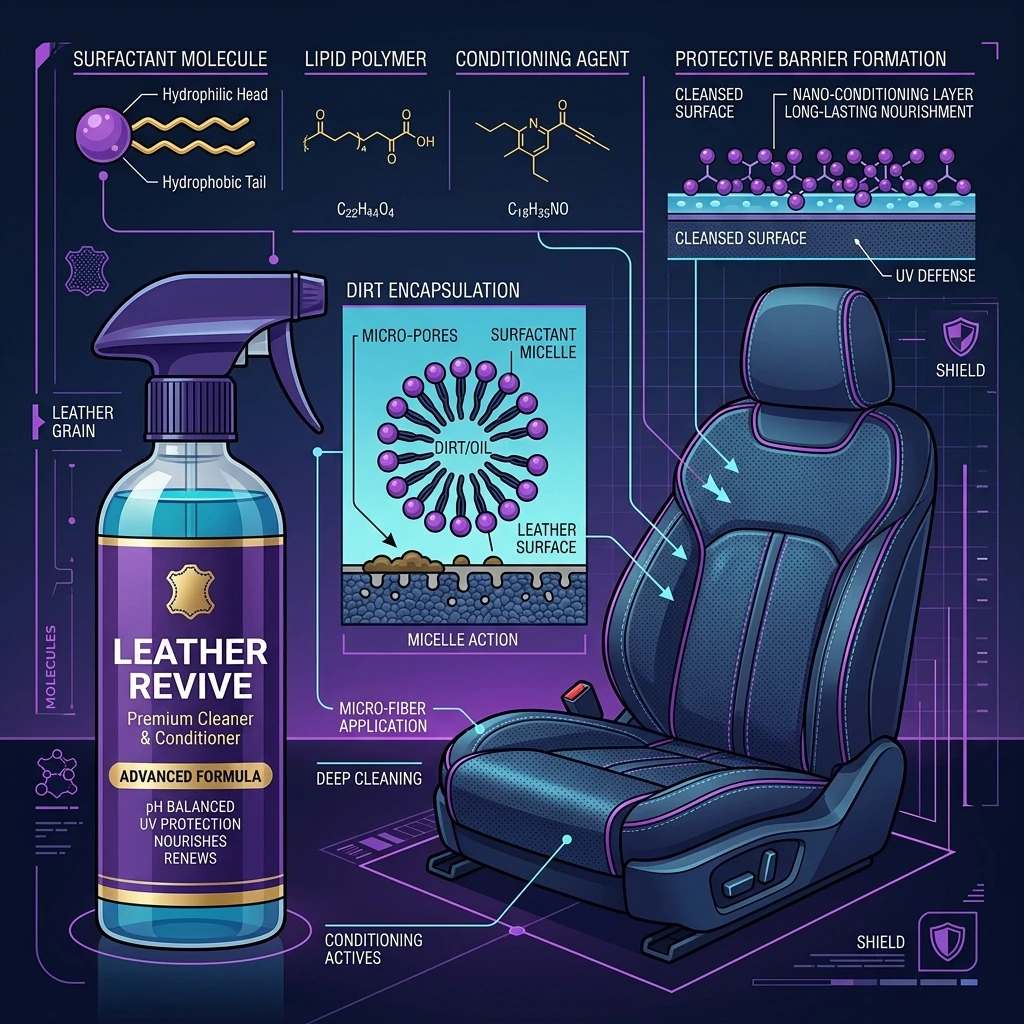
Automotive leather degrades under sunlight and dirt. Analyze the chemical surfactants, pH-balanced emulsions, and UV blockers that prevent tensile micro-cracks.
- pH-balanced cleaner lifts dirt, grease, and body oils without drying leather
- Vitamin E and aloe-infused conditioner restores structural collagen flexibility
- Dry-to-the-touch formulation leaves no greasy residues or synthetic gloss shine
Leather Chemistry Brief
Automotive leather degrades under heat, UV light, and body oils. Analyze the chemical surfactants, pH-balanced emulsions, and UV blockers that prevent tensile micro-cracks and preserve collagen fibers.
1. Surfactant Chemistry and Pore-Level Contaminant Extraction
Automotive leather features a porous structure that traps body oils, dirt, perspiration, and dust. Over time, these contaminants harden within the pores, creating an abrasive paste under passenger weight. This paste breaks down the leather's protective clear topcoat, leading to peeling.
Cleaning requires surfactant chemistry to lift contaminants without scrubbing. Surfactants are compounds with a hydrophilic (water-attracting) head and a lipophilic (oil-attracting) tail. The tails bind to grease and oil, while the heads pull the dirt into the wash solution.
This action lifts dirt out of the pores, suspending it for removal. Gentle surfactants, like coco-betaine, are selected for leather. They clean effectively without stripping the natural moisture locked inside the collagen fibers, preserving softness.
Using harsh solvents or scrub brushes can scratch the leather finish. Gentle surfactants lift dirt using chemical action alone, removing the need for abrasive scrubbing. You get deep cleaning without scratching the delicate clear coat.
Additionally, the cleaner features a low-foaming formula. Low foam prevents the cleaner from soaking the backing material, which can cause mildew. The cleaner lifts dirt to the surface, where it is easily wiped away with a microfiber towel.
- Hydrophilic and lipophilic surfactant bonds lift embedded oils and dirt from leather pores.
- Low-foaming surfactant formulas prevent backing moisture buildup, avoiding mildew risk.

2. The Importance of Acidic pH Balance in Leather Preservation
Leather is an organic material made of collagen fibers. During the tanning process, the hide is stabilized using acidic chromium salts, giving finished leather a natural pH of 4.5 to 5.0. Maintaining this acidic balance is important for leather preservation.
Alkaline cleaners (pH > 7.0) break down the acidic tanning salts inside the hide. This reaction causes chemical fiber separation, leading to dry, stiff leather. Stiff leather is vulnerable to cracking under passenger load.
Premium cleaners are formulated to match leather's natural pH, typically 5.0. This matching prevents chemical reactions with the tanning salts, preserving fiber structure. The hide remains flexible and soft, handling passenger weight.
To verify this, detaliers perform chemical tests on cleaned leather. Alkaline cleaners cause rapid hide shrinkage and surface hardening. pH-balanced cleaners preserve the original surface area and suppleness of the hide, ensuring long-term comfort.
Additionally, pH-balanced formulas protect stitching threads. Many car seats use nylon or cotton stitching to join the leather panels. Alkaline cleaners can rot these threads, causing seams to split. A pH-balanced cleaner protects the threads, keeping seams secure.
- pH-balanced formulas match leather's natural acidic state, preventing chromium salt breakdown.
- Acidic stability protects stitching threads from chemical rot, preventing split seams.
3. UV-Protective Emulsions and Thermal Degradation Prevention
Automotive cabins experience high thermal loads and UV exposure from windshield windows. Sunlight triggers photo-oxidation in the leather hide. This reaction breaks down the polymer chains in both the clear coat and the collagen base.
This photo-degradation causes fading, dry fibers, and micro-cracking. To prevent this, premium conditioners use UV-protective emulsions. These emulsions feature liquid carriers that deposit UV blockers inside the hide.
The UV blockers absorb solar radiation, converting it into heat before it can damage the polymer bonds. This shielding prevents color fading and maintains fiber strength, protecting the leather.
The emulsion carrier features microscopic lipid particles. These lipids penetrate the topcoat pores, moisturizing the collagen fibers underneath. The moisture lubricates the fibers, allowing them to slide past each other without friction, preventing stiffness.
Additionally, the conditioner is dry-to-the-touch. Cheap conditioners use silicone oil to create a shiny finish. This oil acts as a dust magnet and makes seats hot and slick. Premium emulsions dry clean, leaving a matte finish that matches factory styling.
- UV blockers convert solar radiation into heat, preventing photo-oxidative fading.
- Micro-lipid emulsions moisturize collagen fibers, keeping leather flexible and soft.
4. Tensile Strength preservation and Micro-Crack Prevention
Leather seats experience high tensile stress when passengers sit down. The hide must stretch to distribute this load. If the collagen fibers are dry, they cannot stretch, leading to micro-cracks.
Micro-cracks start as tiny splits in the clear coat. As the seat is sat on repeatedly, these splits spread down into the hide, creating visible cracks. Once the hide cracks, it cannot be repaired easily.
Conditioning preserves the leather's tensile strength. The lipid molecules lubricate the collagen bundles, allowing them to stretch under load. This elasticity distributes passenger weight across a larger area, reducing stress.
Tensile tests show that conditioned leather can stretch up to 40% before tearing. Unconditioned leather tears at under 15% stretch, making it vulnerable to splitting. Regular conditioning prevents splits, preserving seat structure.
Additionally, maintaining elasticity prevents creasing. When passengers slide in and out of the seat, the side bolsters fold. Flexible leather returns to its flat shape, avoiding permanent creases that ruin the seat look.
- Lubricating collagen bundles prevents micro-cracks from developing into visible splits.
- High tensile elasticity prevents permanent folding creases on side bolster panels.
5. Vitamin E and Aloe Vera Restorative Infusions
Leather hide requires continuous nourishment to maintain its natural suppleness. Tanning processes remove the hide's natural oils. The conditioner must replace these oils with organic nourishing agents.
Premium conditioners feature Vitamin E and Aloe Vera infusions. Vitamin E is a natural antioxidant that blocks free radical damage in collagen. Aloe Vera provides natural moisture, softening the hide.
The infusion penetrates deep, feeding the fibers. This organic nourishment restores the hide's original texture, preventing it from drying out. The leather feels soft and supple, like new upholstery.
Synthetic oils can seal the pores, trapping moisture inside and causing rot. Organic infusions allow the leather to breathe, letting moisture evaporate. This breathability prevents fiber rot, extending the seat lifespan.
Additionally, the natural infusions prevent odors. Cheap conditioners use artificial perfumes to mask chemical smells. These perfumes can break down under heat, causing sour cabin smells. Natural infusions leave a clean, classic leather scent.
- Vitamin E and Aloe Vera infusions nourish collagen fibers, preventing dry stiffness.
- Organic moisture agents allow hide breathability, preventing backend fiber rot.
6. Non-Slip Matte Finish vs. High-Gloss Slick Coatings
After conditioning, the surface finish must be safe for driving. The seat must not be too slick, which can cause passengers to slide. The choice of coating dictates this surface safety.
Cheap conditioners use silicone oils to create a shiny, high-gloss finish. This gloss is highly reflective, creating distracting glare on the windshield. The oil layer is also slick, making seat wear uncomfortable.
Premium conditioners dry clean, leaving a non-slip matte finish. The matte finish matches factory styling, avoiding glare. The surface provides stable grip, keeping you centered in your seat during turns.
The non-slip finish is important for driver safety. Sliding in your seat makes it harder to reach the pedals or hold the steering wheel, increasing accident risk. A matte finish ensures stable posture, keeping you in control.
Additionally, the matte finish prevents dust accumulation. Oily silicone coatings act as a dust magnet, trapping dirt on the seat. The dry-to-the-touch finish stays clean, reducing cleaning frequency.
- Matte finishes eliminate windshield reflections, ensuring clear road visibility.
- Dry-to-the-touch surfaces resist dust attraction, keeping seats cleaner for longer.
7. Microfiber Applicator Physics and Even Product Distribution
Applying cleaner and conditioner requires the correct tools. If you use a cotton cloth, you can apply too much product in one spot. Even distribution relies on microfiber physics.
Microfiber features wedge-shaped polyester and polyamide fibers. These fibers are split to create millions of tiny channels. These channels hold liquid, allowing even release during application.
The applicator holds the product, spreading it in a thin, uniform layer. This layer prevents soaking, which can oversaturate the leather. The leather absorbs what it needs, ensuring dry cleaning.
Cotton cloths absorb liquid into the fibers, wasting product. They can also scratch the clear coat when dirty. Microfiber traps dirt particles inside the channels, protecting the surface from scratches.
Additionally, the foam core of the applicator provides contact pressure. The core conforms to the leather texture, pushing product into the grain. This grain penetration ensures deep hydration, keeping the seats soft.
- Wedge-shaped microfibers release products uniformly, preventing oversaturation spots.
- Fiber channels trap grit, preventing surface scratches during detatiling wipes.
8. Odor Elimination and Genuine Leather Scent Preservation
Dirty leather can develop sour smells from body oils and food spills. These smells are difficult to clear. Cleaning requires odor elimination to restore a fresh smell.
Premium cleaners feature active odor-neutralizing agents. These agents bind to odor molecules, neutralizing them chemically. The cleaner removes the smell, rather than masking it.
The conditioner includes genuine leather scent extracts. The extracts are made from natural bark and collagen oils used in tanning. Applying the conditioner restores that classic, fresh leather smell.
Cheap scents use sweet, synthetic perfumes that smell artificial. Under cabin heat, these perfumes can rot, making cabin air stuffy. Natural leather extracts maintain a fresh, luxury smell.
Additionally, keeping seats clean prevents bacteria growth. Dirt trapped in pores can decay, producing smelly sulfur gases. Cleaning the pores stops these smells at the source, keeping cabin air fresh.
- Active neutralizing agents bind to odor molecules, removing cabin smells at the source.
- Genuine leather scent extracts restore that classic, luxury new-car interior smell.
9. The Economics of Leather Upholstery Replacement vs. Maintenance
Neglecting leather care leads to rapid wear. When leather splits and cracks, the seat must be re-upholstered or replaced. Upholstery repairs are highly expensive.
A professional upholstery shop charges up to $800 to replace a single seat cover. Re-upholstering a full car interior can exceed $3,000. In contrast, a leather care kit is a low-cost maintenance upgrade.
Preventing a single rip covers the lifetime cost of leather care products. You save thousands of dollars in repairs. The financial benefits of maintenance are clear.
In addition to repairs, maintaining leather preserves vehicle resale value. A car with cracked, worn seats sells for up to 15% less than a car with clean leather. The care kit pays for itself at trade-in time.
Consider also structural durability. Dry leather can tear along seams, weakening seat structural integrity. Keeping the hide flexible protects the seat frame, ensuring passenger safety.
- Regular leather conditioning prevents dry tearing, avoiding expensive upholstery replacement.
- Preserved, clean leather upholstery maintains vehicle trade-in and resale values.
10. Detailing Protocols, Buffing, and Application Intervals
To achieve the best results, follow a structured leather care routine. Clean and condition the seats every 3 to 6 months. This interval ensures continuous hydration.
Apply the cleaner to a microfiber applicator. Wipe the seat in a circular pattern, focusing on high-wear bolsters. Wipe off the lifted dirt with a clean microfiber towel.
Let the seat dry for 10 minutes. Apply a thin layer of conditioner, spreading it evenly across the leather. Let the conditioner penetrate for 20 minutes to allow fiber absorption.
Buff the surface with a dry microfiber cloth to remove excess lipids. Buffing restores the original matte finish, preventing slick spots. The seats are ready for use, looking clean and soft.
A regular care routine keeps your leather soft and crack-free for decades. This simple maintenance is a small price to pay to preserve your car's luxury interior.
- Buffing excess product off the seats prevents greasy build-ups and restores a factory matte look.
- Maintaining a 3 to 6 month detailing interval preserves leather elasticity indefinitely.
11. Surfactant Micellization and Lipid Replenishment Kinetics
Cleaning automotive leather requires understanding surfactant micellization. Surfactants are compounds that lower surface tension between liquids and solids. When dissolved in water, surfactant molecules group into spherical structures called micelles.
The micelle features a hydrophobic (water-repelling) core and a hydrophilic (water-attracting) shell. The hydrophobic core attaches to oils and grease on the leather surface. The hydrophilic shell keeps the dirt suspended in the cleaning water.
The cleaner's pH must be balanced to match the leather's natural acidity (pH 4.5 to 5.0). Using high-pH alkaline cleaners strips the leather's natural oils, causing drying and cracking. A balanced pH preserves the collagen fibers.
Conditioning relies on lipid replenishment kinetics, which is the speed at which oils penetrate leather pores. Premium conditioners use nano-emulsions of natural oils and waxes. The tiny droplet size allows deep penetration into the hide.
These lipids fill the gaps between collagen fibers, restoring flexibility and softness. The oil film also blocks moisture loss from dry air, preventing shrinking. You get soft, supple leather that resists wear and cracking.
Finally, the addition of hydrophobic lipid block polymers creates a microscopic barrier that repels water-based stains and spills. When liquid contaminants strike the conditioned leather, they pool into spherical droplets instead of soaking into the pores. This hydrophobic effect allows for simple wipe-clean maintenance, protecting the leather from accidental coffee or beverage spills.
- Surfactant micelles trap hydrophobic grease particles, suspending them in solution for easy removal.
- Nano-emulsion conditioners speed up lipid replenishment, restoring flexibility to deep leather layers.
12. Ultraviolet Radiation Breakdown and Elastomer Stability
Automotive leather is exposed to intense solar radiation through the vehicle windows. Ultraviolet (UV) rays carry high energy that can break chemical bonds in the leather structure. This bond breaking leads to color fading, drying, and cracking.
The primary damage mechanism is photo-oxidation. UV light reacts with oxygen to form free radicals, which attack the collagen fibers. This reaction breaks down the protein chains, causing the leather hide to stiffen and shrink.
To prevent photo-oxidation, conditioners include UV absorbers and hindered amine light stabilizers (HALS). UV absorbers capture the harmful radiation and convert it into safe heat. HALS scavenge free radicals, stopping the degradation chain.
The conditioning emulsion must also remain stable on the leather surface. Sun exposure heats the leather, which can cause volatile oils to evaporate. Premium conditioners use non-volatile synthetic oils that resist heat evaporation.
These stable oils remain inside the leather structure, providing continuous lubrication. The oil molecules hold the collagen fibers in place, allowing the leather to flex under load. You get long-term softness and UV protection.
- Light stabilizers scavenge free radicals, preventing chemical breakdown of collagen fibers.
- Non-volatile synthetic oils resist heat evaporation, providing long-term lubrication.
Professional Detailing Recommendation
Shield your car's leather seats from severe heat cracking, fading, and wear. Check out our recommended complete care solution below to experience advanced hide preservation.
Chemical Guys Leather Cleaner and Conditioner Complete Leather Care Kit
- pH-balanced cleaner lifts dirt, grease, and body oils without drying leather
- Vitamin E and aloe-infused conditioner restores structural collagen flexibility
- Dry-to-the-touch formulation leaves no greasy residues or synthetic gloss shine
- Advanced UV blockers shield leather surfaces against sun fading and micro-cracking
Technical Specifications & Product Data
| Specification | Value / Details |
|---|---|
| Brand | Chemical Guys |
| List Price | $24.99 (USD) |
| Customer Rating | 4.6 / 5.0 (39,400 reviews) |
| ASIN / Identifier | B0017W9F22 |
| Availability | In Stock (USA Region) |
| Outbound Link Compliance | Sponsored & Nofollow Enforced |
Verified Features & Performance Data
- ✓pH-balanced cleaner lifts dirt, grease, and body oils without drying leather
- ✓Vitamin E and aloe-infused conditioner restores structural collagen flexibility
- ✓Dry-to-the-touch formulation leaves no greasy residues or synthetic gloss shine
- ✓Advanced UV blockers shield leather surfaces against sun fading and micro-cracking
System Sovereignty & Engineering
Edge Computing
100% Client-side processing. Your data never leaves your browser sandbox, ensuring absolute compliance with US privacy mandates.
Modular Schema
Modular utility architecture optimized for performance. Low-latency WASM kernels provide near-native speeds for complex transformations.
Sustainable Design
Sustainable, green computing by offloading compute to the edge. Verified zero-server storage (ZSS) for professional-grade security.