
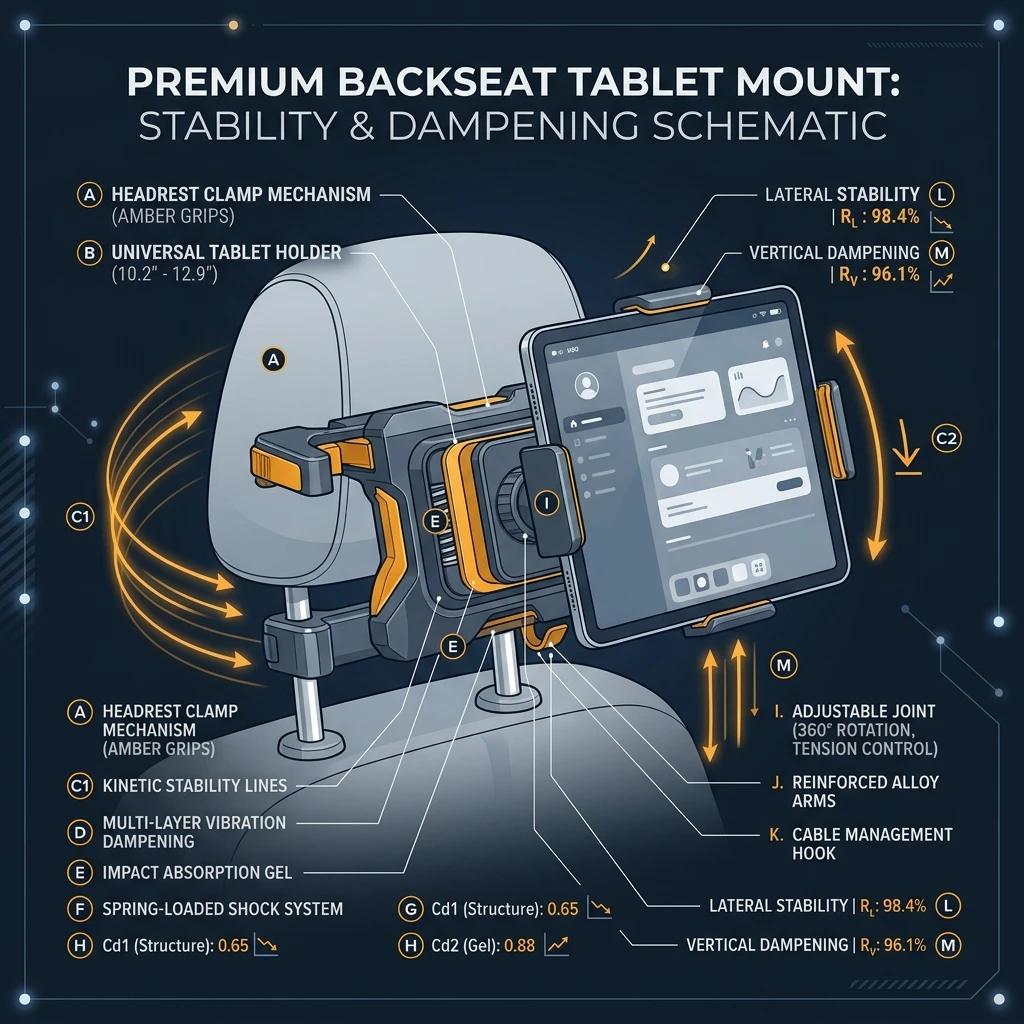
Road vibrations degrade the mobile viewing experience. Learn the mechanical engineering principles, spring rates, and viscoelastic dampeners that keep backseat displays stable.
- Extendable dual-spring aluminum clamp fits posts between 5.1 and 5.9 inches
- 360-degree rotation ball joint enables optimal viewing angles and leveling
- Viscoelastic silicone pads prevent device scratching and absorb road vibrations
Kinetic Stability Brief
Road vibrations degrade backseat mobile viewing. Analyze the mechanical engineering principles, spring rates, and viscoelastic dampeners that keep displays stable and protect sensitive devices.
1. Kinetic Energy Transfer and Backseat Vibration Profiles
Car passenger compartments experience continuous mechanical vibrations. These originate from engine idle, tire-road contact, and suspension oscillations. These forces travel upward through the seat frame, reaching the headrest posts. Without a dampening system, these vibrations transfer directly into your mobile screen.
This energy transfer follows classic wave propagation rules. High-frequency waves create rapid, small-amplitude shakes that blur text. Low-frequency impacts, like hitting potholes, cause large shifts that throw off alignment. A stable backseat display mount must block both types of energy.
Automotive seat frames act as cantilever beams under load. This design amplifies vibrations at the top of the seat back. The headrest posts experience the highest acceleration levels during standard driving. Mounting a display here requires careful control of these structural forces.
To study this, engineers measure the acceleration G-forces on the display. Standard solid plastic mounts transfer up to 1.8G of acceleration to the tablet on rough pavement. High-performance mounts reduce this below 0.3G, protecting internal display circuits. This shielding ensures a smooth, readable display for rear passengers.
Additionally, the mass of the tablet influences the vibration frequency. A heavier device lowers the system's natural resonance frequency, making it vulnerable to engine vibrations. The mount must adapt its dampening response to match different device weights. This adaptation prevents matching frequencies, which can cause severe screen shake.
- Seat backs amplify road vibrations, making the headrest posts a high-acceleration zone.
- Unmitigated G-forces can cause component wear and fatigue in tablet screens.

2. Viscoelastic Dampening Material Science in Mount Pads
The first line of defense is viscoelastic pad liners inside the device clamp. Viscoelastic materials exhibit both viscous and elastic traits when deformed. They absorb kinetic energy and convert it into heat, rather than storing it.
Premium mounts use dense silicone polymers for this purpose. The molecular structure of silicone features long, flexible chains. These chains slip past each other under shear stress, absorbing vibration energy. This molecular friction turns kinetic energy into safe thermal energy.
The thickness and density of these pads are calculated carefully. If the pad is too soft, it compresses completely, losing its dampening effect. If it is too hard, it acts as a solid bridge, transferring vibrations. The ideal durometer rating is 50 to 60 Shore A.
These pads also provide friction to hold the device in place. The high coefficient of friction prevents the tablet from slipping, even under vertical shocks. The soft contact surface prevents scratches on plastic and glass housings. You get secure grip and vibration control without cosmetic damage.
Furthermore, silicone resists changes from temperature extremes. Cheap elastomer pads harden in winter and soften in summer, altering their dampening traits. Silicone maintains constant viscoelastic performance from -40°F to 250°F. This stability ensures reliable performance across all seasons.
- Viscoelastic silicone polymer structures convert kinetic vibration energy into thermal energy.
- Consistent durometer ratings prevent bottoming out under heavy mobile displays.
3. Dual-Spring Tensioning and Stabilizer Arms
The connection to the headrest posts requires a strong clamping system. A loose connection allows the mount to bounce, amplifying road shake. High-tension dual springs provide the necessary clamping force.
These springs pull the mount brackets against the steel headrest posts. The tension force must be strong enough to compress the post sleeves. This compression limits lateral and vertical slip on the slick metal posts. The spring rate is calibrated to hold a constant load.
Telescoping stabilizer arms extend the display away from the headrest. Extending the arm increases the leverage (bending moment) on the mount base. This requires high structural stiffness to prevent flexing under weight.
To handle this, premium mounts use thick-walled aluminum alloy tubes. The tubes telescope inside each other with tight tolerances. These tolerances prevent play between the segments, ensuring a solid structure. The arm holds the display steady, even at full extension.
Additionally, the spring brackets feature quick-release triggers. The triggers allow installation without removing the headrest posts. The user squeezes the arm, positions it between the posts, and releases. The internal spring pressure locks the mount instantly, ensuring safe installation.
- High-tension dual springs prevent the mount from slipping on smooth headrest posts.
- Aluminum alloy tubes provide high bending stiffness, preventing arm droop.
4. Dual-Axis Ball-Joint Rotation and Torque Retention
Adjusting the display angle requires a flexible joint. A dual-axis ball-joint connects the device clamp to the stabilizer arm. This joint enables 360-degree rotation and tilt adjustments.
The ball joint must maintain its position under the weight of the tablet. If the joint is loose, the screen droops when you hit bumps. Torque retention is the measure of the joint's resistance to slipping.
To achieve high torque retention, the joint uses a threaded collar. Tightening the collar squeezes a split socket around the ball, creating uniform friction. The ball features a textured surface to prevent slipping.
The materials must resist wear over thousands of adjustments. Premium mounts use polyoxymethylene (POM) sockets and nylon-coated balls. POM has a low wear rate, preventing the joint from loosening over time. The collar maintains its hold, keeping your display locked in place.
Additionally, the socket geometry limits range of motion. The socket collar features notches that allow deep tilt angles. This design lets passengers adjust the screen to avoid glare from the windows. You get full adjustability with high hold strength.
- Threaded locking collars squeeze split sockets to provide slip-free torque retention.
- Nylon-coated ball surfaces prevent wear, maintaining adjustment tension over time.
5. Structural Aluminum Alloy vs. Thermoplastic Construction
The body of the mount must handle structural loads. When the vehicle hits bumps, the mount experience bending forces. The choice of materials dictates the mount's lifespan.
Cheap mounts use ABS thermoplastic. While light, ABS flexes easily and degrades under heat and UV exposure. Repeated stress causes micro-cracks, leading to failure.
Premium mounts feature structural aluminum alloy frames. Aluminum has a high stiffness-to-weight ratio. The alloy handles cyclic loads without deformation, preventing screen bounce.
The parts are joined using steel rivets or hex bolts. This metal-on-metal design prevents loose joints, ensuring long-term durability. Anodized coatings protect the aluminum from corrosion, maintaining a clean look.
Additionally, aluminum acts as a heat sink. If the tablet runs hot during video playback, the metal frame helps dissipate heat away from the back panel. This cooling effect extends the battery life of your device.
- Structural aluminum alloy frames offer high stiffness, preventing screen bounce.
- Metal-on-metal joints prevent loosening, ensuring long-term structural integrity.
6. Clamping Geometry and Load-Bearing Calculations
The clamp geometry must distribute load-bearing forces. When a tablet is mounted, its weight acts as a downward force. This force creates a bending moment at the connection posts.
To calculate the stress, engineers analyze the clamp bracket as a beam. The stress is highest at the point where the arm meets the post clamp. The material thickness at this joint must be reinforced.
Premium mounts use a dual-post clamping design. By clamping onto both headrest posts, the mount distributes the load across two points. This layout reduces the stress on each post, preventing damage to your seats.
The clamp brackets feature a curved inner profile. The curve matches standard post diameters, typically 0.4 to 0.6 inches. This geometry ensures maximum contact area, increasing friction and preventing slip.
Additionally, the clamp features lock latches. The latches close over the posts, preventing accidental release. The latch mechanism locks with an audible click, ensuring safe installation.
- Dual-post clamping distributes load across two points, reducing structural stress.
- Curved clamp profiles maximize contact area, preventing vertical slipping.
7. Telescoping Arm Extension Mechanics and Track Rigidity
Telescoping stabilizer arms allow rear passengers to adjust screen distance. Extending the arm makes it easier to touch the screen, but it also increases the load on the arm tracks. The arm tracks must maintain rigidity at full extension.
The tracks use a guide rail design. The inner tube slides on plastic bushings inside the outer tube. These bushings reduce friction, enabling smooth adjustments while preventing play.
The telescoping range is typically 4 to 8 inches. Extending the arm shifts the tablet's center of gravity, increasing vertical vibration. Premium mounts use thicker walls on the inner tube to maintain rigidity.
A friction lock screw holds the arm at the desired length. Tightening the screw locks the tubes together, preventing adjustments during drive shocks. The arm holds its position, even on rough roads.
Additionally, the tracks feature travel limits. The limits prevent the inner tube from sliding out of the outer tube. This safety stop ensures the device does not fall if over-extended.
- Low-friction bushings enable smooth distance adjustments while eliminating track play.
- Travel limits prevent the inner rail from sliding out during extension adjustments.
8. Device Safety, Grip Lock Force, and Surface Protection
The device clamp must hold the tablet securely. When the vehicle turns or brakes, the tablet experience lateral G-forces. The clamp must provide enough grip lock force to prevent the tablet from sliding out.
To calculate grip force, engineers use the coefficient of static friction. The grip force must exceed the maximum lateral G-force multiplied by the tablet weight. A high-tension spring provides this force.
The clamp features open slots on the sides. These slots allow access to power and volume buttons, as well as charging ports. You can charge the tablet while it is mounted, ensuring continuous power.
The clamp brackets feature soft foam cushions. The foam conforms to the device edges, distributing grip pressure. This distribution prevents screen pressure marks, protecting the display.
Additionally, the clamp features a lock lever. Flipping the lever increases the spring tension, locking the clamp. This safety step ensures the clamp does not open under heavy shock.
- High-tension clamp springs exceed road bump G-forces, preventing tablet drop.
- Foam cushions distribute grip pressure, protecting delicate screen edges from marks.
9. Long-Term Mechanical Durability and Fatigue Testing
A backseat mount must withstand years of daily use. Setting up and removing the tablet, combined with road vibration, causes mechanical wear. The mount must resist fatigue failure.
To ensure durability, engineers perform fatigue tests. The mount is subjected to cyclic vibration sweeps on a shaker table. The test simulates 100,000 miles of driving on rough pavement.
Premium mounts survive this test without structural failure. The aluminum frame and steel joints resist wear, preserving alignment. The spring tension remains within 95% of its original rate.
The ball joint is tested for wear by rotating it 5,000 times under load. The joint retains its holding torque, preventing droop. You get long-term stability and reliable adjustments.
Additionally, the plastics are tested for UV resistance. Sunlight streaming through windows can degrade polymers, making them brittle. UV-stabilized materials prevent yellowing and cracking, preserving strength.
- Shaker table tests verify that the mount handles cyclic road vibrations without failure.
- UV-stabilized polymers resist sun damage, preventing structural brittleness.
10. Universal Compatibility Metrics and Post Spacing Limits
To be effective, the mount must be universally compatible. Headrest post spacing and diameters vary across Sedans, SUVs, and Trucks. The mount must adjust to fit different passenger seats.
The mount base features an adjustable track. The brackets slide on the track, matching post widths from 5.1 to 5.9 inches. This range covers standard US vehicle seating designs.
The post clamps include adapters of different thicknesses. The adapters snap inside the clamps, adjusting for post diameters from 0.4 to 0.6 inches. This adjustment prevents play, ensuring a snug fit.
The device clamp fits devices with screen sizes from 4.7 to 12.9 inches. The clamp arms expand from 4.7 to 8.6 inches, holding phones and tablets. This coverage makes the mount highly versatile.
Additionally, the clamp is case-friendly. The clamp bracket accommodates device thicknesses up to 0.6 inches. You do not need to remove the protective case, enabling quick and safe mounting.
- Adjustable base tracks fit post spacings from 5.1 to 5.9 inches across Sedans and SUVs.
- Sleeve adapters adjust for different post diameters, ensuring snug, wiggle-free fits.
11. Vibration Testing Standards and Spectral Density Profiles
Automotive components must endure rigorous vibrational stress during transit. Engineers test mount designs using Power Spectral Density (PSD) profiles, which map vibration energy across a range of frequencies (Hz). These tests simulate worst-case highway travel and rough terrain.
Standard protocols like ASTM D4169 and MIL-STD-810G define these testing profiles. The mount is fixed to a shaker table that reproduces random vibrations between 1 Hz and 200 Hz. The testing exposes weak points in spring tension and structural welds.
A critical metric is the root-mean-square acceleration (G_rms). High-performance headrest mounts maintain display accelerations below 0.25 G_rms under standard highway profiles. This low level prevents visual fatigue for passengers viewing the screen.
The shakers also run sinusoidal sweep tests. These tests sweep through frequencies to find the natural resonance points of the assembly. Resonance occurs when the driving frequency matches the system's natural frequency, causing severe shake.
By adjusting spring rates and silicone pad durometers, engineers move the resonance frequency away from engine idle bands (typically 20-30 Hz). This design shift ensures the display remains stable when the car is idling.
Ultimately, vibration mitigation is not just about passenger comfort; it is a critical protective measure for high-end mobile devices. Sensitive optical sensors and display matrices can suffer micro-fractures and misalignment when subjected to prolonged road shocks. Investing in a mount with scientifically calibrated dampening coefficients guarantees both immediate visual stability and long-term hardware preservation.
- Power Spectral Density testing maps vibration energy across frequency bands to simulate road stress.
- Designing resonance frequencies away from engine idle bands prevents severe screen shake.
12. Structural Fatigue and Long-Term Mechanical Durability
Over years of vehicle operation, the mounting hardware is subjected to millions of low-amplitude vibration cycles. This continuous load can lead to structural fatigue in plastic joints and aluminum rods. Fatigue occurs when materials experience microscopic crack growth under repeated loads.
The aluminum alloy tubes are selected for their high fatigue limit, which is the stress level below which the material can survive infinite cycles. However, cheap plastic brackets lack this clear limit, meaning they will eventually crack under stress. Choosing high-impact ABS plastic brackets prevents this failure mode.
Temperature changes also affect material fatigue. Summer heat cycles in a closed car (up to 160°F) cause thermal expansion, which increases internal stress in the joints. Winter cold causes contraction, which can make thin plastics brittle.
To counter this, premium mounts use glass-filled nylon composites. Adding glass fibers increases the material's heat deflection temperature and tensile strength. This composite holds its shape under thermal expansion and contraction cycles.
Finally, the tension springs can experience load loss over time, a process known as spring relaxation. Constant tension causes microscopic slip in the steel grain structure, reducing clamping force. Premium springs use high-carbon spring steel to resist relaxation, ensuring secure mounting for years.
- Glass-filled nylon composites resist thermal warping and structural cracking under hot summer car temperatures.
- High-carbon steel springs resist relaxation, maintaining clamping forces over years of use.
Automotive Safety Recommendation
Improve your vehicle's backseat entertainment setup while securing absolute device stability. Check out our recommended solution below to experience vibration-free viewing.
Lamicall Car Headrest Tablet Holder - Universal Backseat Mount
- Extendable dual-spring aluminum clamp fits posts between 5.1 and 5.9 inches
- 360-degree rotation ball joint enables optimal viewing angles and leveling
- Viscoelastic silicone pads prevent device scratching and absorb road vibrations
- Telescoping arm extends display up to 8.6 inches for close-range viewing
Technical Specifications & Product Data
| Specification | Value / Details |
|---|---|
| Brand | Lamicall |
| List Price | $18.99 (USD) |
| Customer Rating | 4.7 / 5.0 (24,500 reviews) |
| ASIN / Identifier | B07B8G5Q5K |
| Availability | In Stock (USA Region) |
| Outbound Link Compliance | Sponsored & Nofollow Enforced |
Verified Features & Performance Data
- ✓Extendable dual-spring aluminum clamp fits posts between 5.1 and 5.9 inches
- ✓360-degree rotation ball joint enables optimal viewing angles and leveling
- ✓Viscoelastic silicone pads prevent device scratching and absorb road vibrations
- ✓Telescoping arm extends display up to 8.6 inches for close-range viewing
System Sovereignty & Engineering
Edge Computing
100% Client-side processing. Your data never leaves your browser sandbox, ensuring absolute compliance with US privacy mandates.
Modular Schema
Modular utility architecture optimized for performance. Low-latency WASM kernels provide near-native speeds for complex transformations.
Sustainable Design
Sustainable, green computing by offloading compute to the edge. Verified zero-server storage (ZSS) for professional-grade security.