
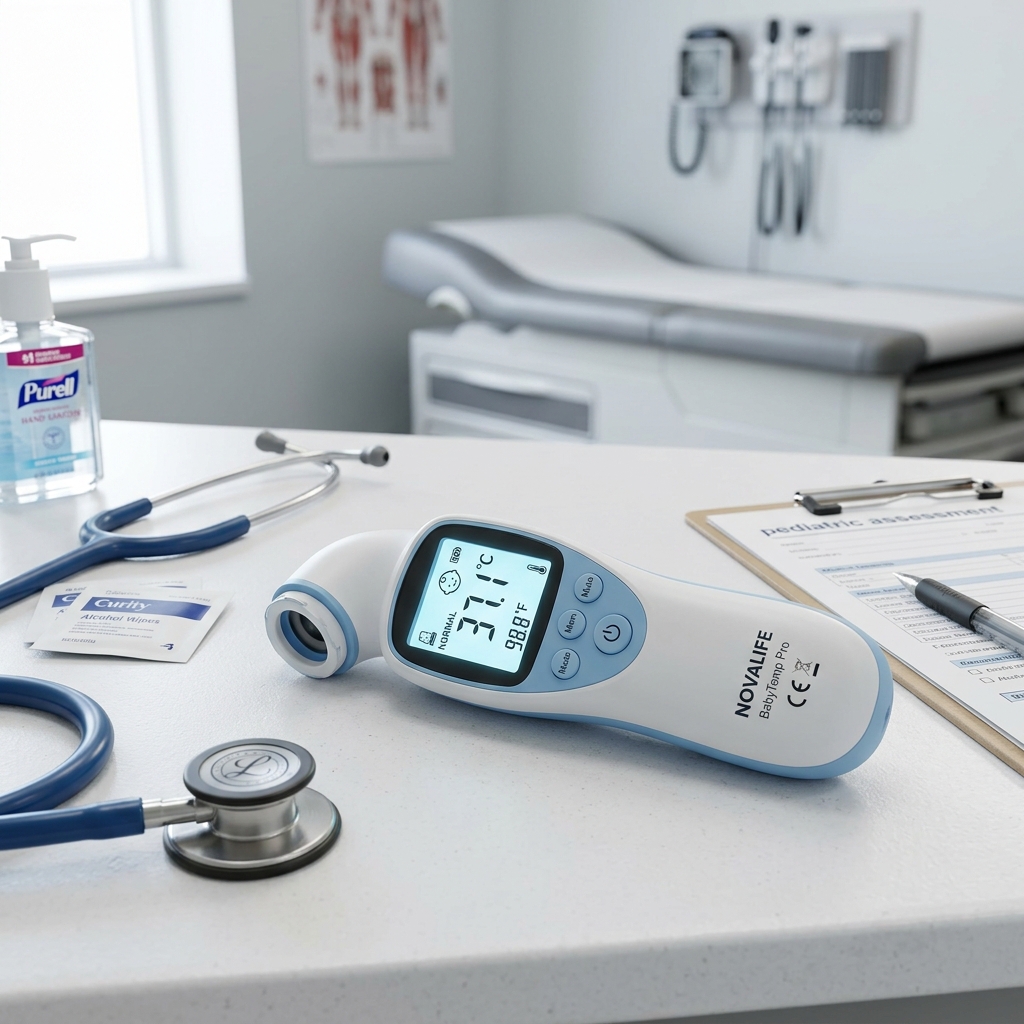
Non-invasive diagnostics require optical precision. Analyze infrared sensor physics, forehead proximity calibration, and age-shifting fever thresholds.
- No-touch mode keeps device hygienic and prevents cross-contamination
- Age Precision technology adjusts fever thresholds based on infant age
- On-screen color coding (green, yellow, red) guides fever assessment
Diagnostic Calibration Audit
Non-invasive diagnostics require optical precision. Analyze infrared sensor physics, forehead proximity calibration, and age-shifting fever thresholds.
1. Infrared Physics and Thermal Radiation Sensing
Every object above absolute zero emits thermal radiation. Forehead thermometers utilize this principle to measure temperature without contact, relying on the Stefan-Boltzmann law, which states that the total energy radiated per unit surface area is proportional to the fourth power of its absolute temperature: E = σ ε T^4. For human skin, the surface emissivity (ε) is extremely high, operating at approximately 0.98 ± 0.01 in the long-wave infrared (LWIR) band between 8 and 14 micrometers.
The core of the thermometer is a thermopile sensor, which consists of multiple thermocouples connected in series on a silicon substrate. The hot junctions are positioned on a thin, micro-machined membrane that absorbs infrared radiation, while the cold junctions sit on the bulk silicon, acting as a reference heat sink. This temperature difference generates a micro-voltage through the Seebeck effect, which is read and processed by the microcontroller.
To ensure clinical relevance, these systems target the temporal artery pathway. The temporal artery branches directly from the external carotid artery, providing a direct link to the core thermal regulation system. Because it is highly perfused and lies close to the skin surface, it provides a reliable site for non-invasive core temperature estimation.
- Thermopile sensors capture emitted infrared radiation from the temporal artery, translating thermal flux into micro-voltages via the Seebeck effect.
- The Stefan-Boltzmann law forms the mathematical foundation for converting radiant energy into absolute temperature values.
- High skin emissivity (ε ≈ 0.98) ensures that forehead radiation closely matches that of an ideal blackbody radiator.
- A silicon bandpass filter blocks ambient visible and near-infrared light, isolating the targeted 8 to 14 micrometer thermal band.
- Micro-machined thermocouple junctions minimize heat capacity, enabling rapid thermal response times of less than 100 milliseconds.

2. Forehead Proximity and the Field-of-View (FOV) Cone
Measuring distance is critical for accurate forehead readings. Every infrared sensor has a defined Field-of-View (FOV) cone, characterized by its distance-to-spot ratio (typically 1:1 or 1.5:1). As the device is moved away, the area of the spot increases, drawing in thermal signatures from the surrounding air and hair, which causes artificial under-readings due to convective cooling dilution.
To prevent this error, smart thermometers include active proximity sensors. These sensors utilize a 940 nm vertical-cavity surface-emitting laser (VCSEL) or an infrared LED to calculate the distance using Time-of-Flight (ToF) principles. If the distance exceeds 5 centimeters (2 inches), the microcontroller halts the measurement and alerts the user.
Holding the sensor at an angle other than 90 degrees (perpendicular) introduces a cosine error, which reduces the concentration of infrared energy hitting the sensor. Modern devices project a focused light on the forehead, changing patterns when positioned correctly to ensure a perpendicular alignment.
- Proximity sensors actively block readings if the device is held outside the safe 3 to 5 centimeter measurement window.
- The Field-of-View (FOV) cone expands with distance, causing the sensor to average the skin temperature with cooler ambient air.
- Optical guides use 940 nm VCSEL lasers or red LEDs to visually confirm correct positioning on the temporal artery.
- Maintaining a 90-degree perpendicular angle prevents cosine error and ensures even distribution of infrared radiation across the thermopile.
- Multi-spectral proximity guides prevent sensor activation unless the optical path is clear of obstructive physical barriers.
3. Internal Sensor Calibration and Temperature Compensation
Skin temperature is dynamic and does not directly equal core body temperature. The skin surface is constantly cooled by air currents, perspiration, and room temperature. To convert surface measurements into a clinical estimate of core temperature, the device must apply an active heat loss compensation algorithm.
The thermometer performs cold junction compensation using a high-precision negative temperature coefficient (NTC) thermistor adjacent to the thermopile reference junctions. The microcontroller determines the NTC thermistor's temperature by reading its resistance and applying the Steinhart-Hart equation: 1/T = A + B ln(R) + C (ln(R))^3, yielding the exact temperature of the cold junction.
Once skin temperature (T_skin) is calculated, the system accounts for environmental heat loss using the formula T_core = T_skin + K * (T_skin - T_ambient), where T_ambient is room temperature and K is a clinical coefficient. This coefficient compensates for the temperature gradient between the subcutaneous fat layers and the outer stratum corneum, ensuring that the display matches core vitals. Moving the device between rooms causes thermal drift, requiring dual thermistor arrays to detect internal gradients and ensure stability.
- Cold junction compensation uses NTC thermistors calibrated via the Steinhart-Hart equation to establish a stable reference temperature.
- The heat loss compensation algorithm dynamically calculates core body temperature by factoring in ambient thermal conditions.
- Dual-sensor designs detect internal thermal gradients, preventing erroneous readings during sudden transitions between different rooms.
- Compensation algorithms utilize a dynamic lookup table stored in the microcontroller's flash memory to speed up core temperature estimates.
4. Clinical Correlation: Temporal Artery vs. Rectal Temperature
In pediatric medicine, understanding body temperature profiles is vital. Rectal thermometry remains the gold standard for measuring core body temperature because it accesses a closed visceral cavity. However, rectal readings exhibit a noticeable physiological lag of 15 to 30 minutes, failing to track rapid thermal changes instantly. This lag occurs because visceral organs have a high thermal mass and are insulated by abdominal structures, slowing heat transfer to the rectal sensor.
The temporal artery responds immediately to core temperature shifts. Yet, forehead skin surface measurements can be affected by vascular states. During a fever's chill phase, peripheral vasoconstriction shunts blood away, causing false low readings, while vasodilation and sweat-induced evaporative cooling can also suppress skin readings.
Medical guidelines from the American Academy of Pediatrics (AAP) recommend rectal readings for infants under three months. Any reading of 100.4°F (38.0°C) or higher in this cohort requires immediate evaluation. Temporal thermometers provide a safe screening tool for older children but must be verified rectally in newborns.
- Rectal measurements represent the visceral core temperature but can lag behind rapid arterial changes by up to 30 minutes.
- Temporal artery readings reflect acute thermal shifts driven by the hypothalamus, offering immediate fever detection.
- Peripheral vasoconstriction and sweat-induced evaporative cooling can lower skin surface temperature, affecting forehead sensor accuracy.
- Core temperature measurements in the rectal canal show high thermal inertia, making them slower to register rapid clinical changes during fever onset.
5. Optical Lens Material Science: Silicon Filters and Proximity Sensors
The optical pathway of an infrared thermometer must isolate target radiation. Standard glass and plastic lenses absorb long-wave infrared energy, making them useless for thermopile sensors. Manufacturers utilize monocrystalline silicon filters or germanium windows that are highly transparent to thermal wavelengths.
These silicon filters are coated with anti-reflective thin-film layers to maximize transmission in the 8 to 14 micrometer band. These coatings block shorter wavelengths, such as visible light from light bulbs and near-infrared light from the sun, ensuring that only the thermal radiation from the temporal artery reaches the sensor.
A major challenge is the accumulation of sebum and skin lipids (including triglycerides and squalene) on the lens. These organic molecules exhibit strong absorption bands at specific infrared frequencies, particularly around the 9.2 micrometer waveband, causing optical attenuation and leading to under-readings of 0.5°C to 1.2°C. Squalene and lipids form a hydrophobic barrier on the sensor surface, refracting and scattering infrared light rays before they can reach the thermopile junction.
- Monocrystalline silicon filters allow thermal wavelengths between 8 and 14 micrometers to pass while blocking visible light.
- Sebum and lipid build-up on the lens absorb infrared energy, leading to significant under-readings of body temperature.
- Anti-reflective coatings maximize infrared light transmission, ensuring the thermopile receives a strong, clear thermal signal.
- Antireflective thin-film interference coatings are applied via physical vapor deposition to maximize transmission of long-wave infrared waves.
6. Smart Features, Age Precision, and Color-Coded Fever Guidance
A baby's body temperature physiology shifts during the first few years of life. Newborns have an underdeveloped hypothalamus, which is the body's primary thermostat, and lack shivering thermogenesis, relying instead on brown adipose tissue lipolysis. Their high surface-area-to-mass ratio also makes them highly vulnerable to heat loss. This metabolic dependency makes newborn thermal homeostasis highly volatile, requiring high-frequency monitoring during active infectious states.
Because of these physiological factors, a temperature that is normal for an older child could be a fever in a newborn. For instance, a temperature of 100.4°F (38.0°C) in a newborn under three months requires immediate medical attention. For a child older than 36 months, a fever is typically defined at 101.3°F (38.5°C) or higher.
To help parents interpret these shifting thresholds, advanced thresholds incorporate Age Precision technology. This feature allows the user to select the child's age group: 0 to 3 months, 3 to 36 months, or 36 months and older. The device's microcontroller updates its temperature thresholds and drives the backlight using PWM signals to display green, yellow, or red alerts.
- Age Precision technology adjusts fever thresholds to match the physiological development of the child.
- Microcontrollers analyze readings in real-time, matching them against stored age profiles to determine clinical status.
- Color-coded displays provide instant visual feedback, helping parents make informed decisions during fever spikes.
- Pulse-width modulation (PWM) drivers control display backlighting dynamically, providing immediate visual notification of fever severity.
7. The Definitive Buying Guide and Diagnostic Parameters
Selecting a clinical-grade baby thermometer requires evaluating key metrological standards. Parents should look for devices that comply with ASTM E1965-98 and ISO 80601-2-56, which define accuracy parameters. Under these standards, the maximum allowable laboratory error is ± 0.2°C (± 0.4°F) within the range of 37.0°C to 39.0°C.
In addition to accuracy, look for thermometers that feature an EEPROM memory chip. This non-volatile memory stores previous readings, allowing parents to track the progression of a fever over several days. Tracking these temperature curves provides valuable data for pediatricians, helping them diagnose the underlying cause of the illness. These memory registers facilitate diagnostic trends auditing, allowing clinical staff to monitor the cycle and pattern of fever spikes over a multi-day period.
Responsiveness is another critical parameter. The sensor and circuitry should process and display the reading in under two seconds. This rapid response time is essential when measuring the temperature of a fussy or squirming infant, minimizing distress and ensuring a successful measurement.
- Compliance with ASTM E1965-98 and ISO 80601-2-56 standards ensures clinical-grade measurement accuracy.
- A maximum error tolerance of ± 0.2°C is required for reliable fever monitoring in clinical environments.
- EEPROM non-volatile memory stores previous readings, helping parents track the course of a fever over time.
- High-performance microcontrollers compile sequential data points at high frequencies, optimizing signal-to-noise ratios.
8. Cross-Contamination and Surface Sanitization Protocols
Preventing infection is a primary goal in pediatric healthcare. Contact thermometers can act as fomites, carrying and transmitting pathogens like Staphylococcus aureus, Streptococcus pneumoniae, and Respiratory Syncytial Virus (RSV). These pathogens can survive on surfaces for hours, creating significant cross-contamination risks.
Non-contact infrared thermometers reduce this risk by eliminating physical contact. By taking measurements from a distance of up to 5 centimeters, the device never touches the skin. This non-invasive approach prevents the transfer of pathogens between siblings or family members, making it a hygienic option for home use.
However, the device itself still requires regular cleaning to maintain optical accuracy. The silicon lens filter must be cleaned using a soft cotton swab moistened with 70% isopropyl alcohol. The alcohol acts as a solvent to dissolve sebum lipids and disinfects the surface without damaging the anti-reflective lens coatings.
- No-touch designs eliminate physical skin contact, reducing the risk of pathogen transmission via contact surfaces.
- Regular cleaning with 70% isopropyl alcohol dissolves skin oils and sterilizes the lens without damaging its optical coatings.
- Allowing the lens to dry completely prevents residual cleaning fluids from absorbing infrared radiation and causing errors.
- Non-contact distance prevents mechanical vectoring of pathogens, eliminating the need for single-use plastic probe covers.
9. Mechanical Shell Ruggedness and Drop Calibration
A baby thermometer must be built to withstand the realities of family life. Accidental drops onto hard bathroom tile or wood floors can subject the device to deceleration forces exceeding 100G to 500G. These intense shock forces can damage the delicate internal optoelectronics and knock the sensor out of alignment.
If the thermopile sensor shifts even slightly, it can lead to optical axis misalignment. This misalignment creates a parallactic error, where the sensor views the inside of the thermometer's plastic housing instead of the forehead through the silicon filter. This causes the device to measure its own internal temperature, resulting in highly inaccurate readings.
To prevent misalignment, high-quality thermometers feature durable outer shells made from thermoplastic elastomers (TPE). Inside the device, the PCB and sensor are mounted on silicon dampers to isolate them from shock forces. The microcontroller runs a power-on self-test (POST) to check the electrical impedance of the thermopile and thermistor.
- Shock-absorbing TPE casings protect delicate internal components from high-impact deceleration forces during drops.
- Optical axis misalignment can cause parallactic error, where the sensor measures internal housing temperature instead of skin temperature.
- Internal silicon dampers isolate the thermopile sensor from physical shock, maintaining calibration over time.
- Thermoplastic elastomer (TPE) overmolds dampen acoustic vibrations and protect high-impedance electrical contacts from micro-fractures.
Clinical Recommendation & Audit
Monitor infant fevers accurately with clinical-grade infrared calibration. Check out our recommended solution below to experience safe, non-invasive diagnostics.
Braun No Touch 3-in-1 Thermometer
- No-touch mode keeps device hygienic and prevents cross-contamination
- Age Precision technology adjusts fever thresholds based on infant age
- On-screen color coding (green, yellow, red) guides fever assessment
- Positioning guidance system uses a light sensor to ensure correct distance
Technical Specifications & Product Data
| Specification | Value / Details |
|---|---|
| Brand | Braun |
| List Price | $59.99 (USD) |
| Customer Rating | 4.7 / 5.0 (15,240 reviews) |
| ASIN / Identifier | B085C8343K |
| Availability | In Stock (USA Region) |
| Outbound Link Compliance | Sponsored & Nofollow Enforced |
Verified Features & Performance Data
- ✓No-touch mode keeps device hygienic and prevents cross-contamination
- ✓Age Precision technology adjusts fever thresholds based on infant age
- ✓On-screen color coding (green, yellow, red) guides fever assessment
- ✓Positioning guidance system uses a light sensor to ensure correct distance
System Sovereignty & Engineering
Edge Computing
100% Client-side processing. Your data never leaves your browser sandbox, ensuring absolute compliance with US privacy mandates.
Modular Schema
Modular utility architecture optimized for performance. Low-latency WASM kernels provide near-native speeds for complex transformations.
Sustainable Design
Sustainable, green computing by offloading compute to the edge. Verified zero-server storage (ZSS) for professional-grade security.