
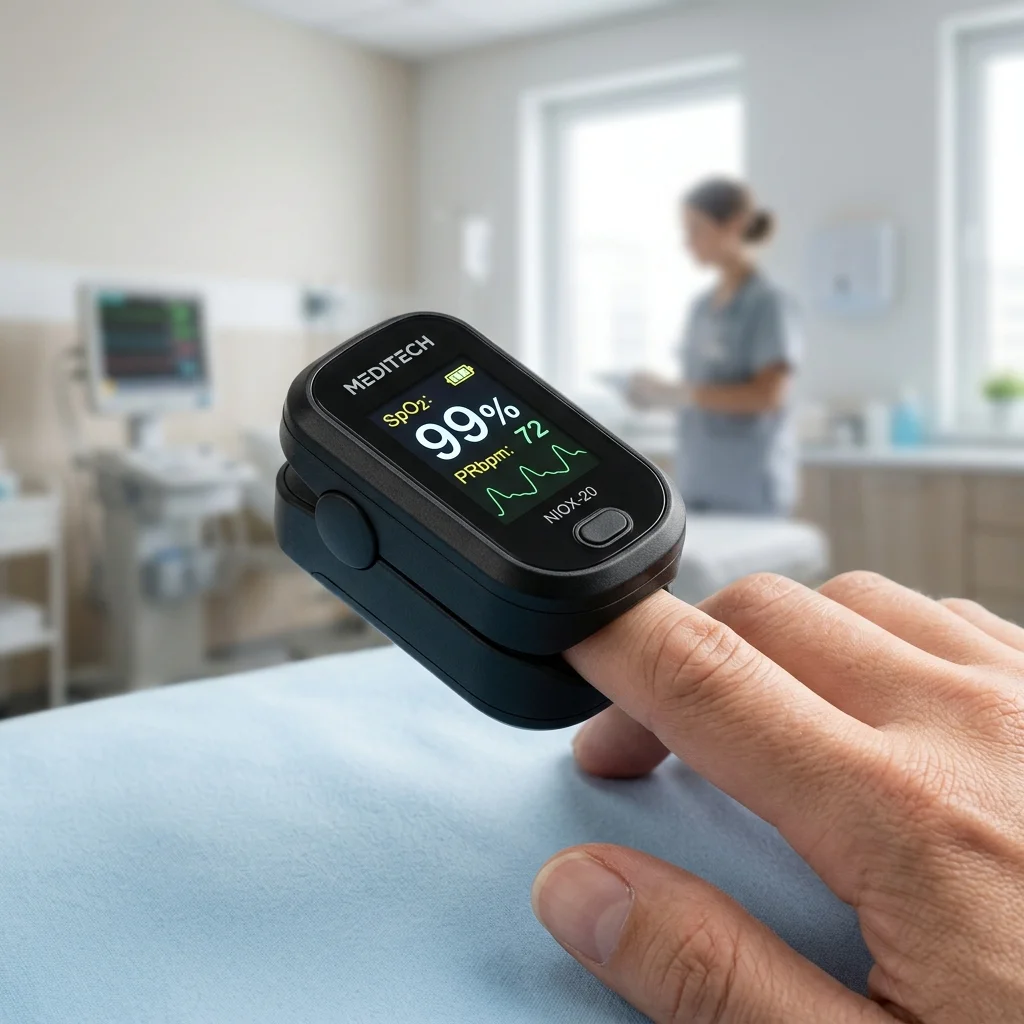
Blood oxygen monitoring requires optical precision. Deconstruct light absorption physics, motion artifact filtering, and perfusion index calculations to select the right oximeter.
- Accurately measures SpO2 and pulse rate within +/- 2% margins
- High-definition LED display shows pulse bar graph clearly
- Designed with a self-adjusting finger chamber to fit all sizes
Biometric Diagnostic Guide
Oxygen tracking requires optical precision. Deconstruct the light physics, digital filters, and skin parameters that ensure accurate home pulse oximeter readings.
1. Photoplethysmography and Beer-Lambert Law Physics
Fingertip pulse oximeters measure blood oxygen levels non-invasively using photoplethysmography. This technique shines light through a capillary bed to measure changes in blood volume. The mathematical foundation of this measurement is the Beer-Lambert Law.
This law states that light absorption is proportional to the concentration of the absorbing substance in the path. In this case, the oximeter measures the concentration of hemoglobin in blood. Shining light through the finger allows the device to calculate oxygen levels.
The sensor measures the light that passes through the finger without being absorbed. A photo-detector on the opposite side converts this light into an electrical signal. The meter's processor analyzes this signal to calculate your oxygen saturation level instantly.
Dual-wavelength sensors measure light absorption in blood vessels to calculate oxygen saturation levels. By comparing red and infrared light absorption, the device determines the ratio of oxygenated hemoglobin. This optical method provides immediate, non-invasive readings in clinical and home environments, making it a vital tool for tracking respiratory health. The precision of these sensors is verified through clinical testing against reference co-oximeters.
Dual-wavelength sensors measure light absorption in blood vessels to calculate oxygen saturation levels. By comparing red and infrared light absorption, the device determines the ratio of oxygenated hemoglobin. This optical method provides immediate, non-invasive readings in clinical and home environments, making it a vital tool for tracking respiratory health. The precision of these sensors is verified through clinical testing against reference co-oximeters.
- Beer-Lambert Physics: Calculates blood oxygen levels based on how hemoglobin absorbs light.
- Non-Invasive Sensing: Measures blood oxygen levels through the skin without drawing blood.
- Photo-Detectors: Measures transmitted light levels accurately to prevent calculation errors.
2. Red vs Infrared Light Absorption Ratios
To calculate oxygen levels, the oximeter uses two different wavelengths of light: red and infrared. Hemoglobin absorbs these wavelengths differently depending on how much oxygen it carries. Oxygen-rich hemoglobin absorbs more infrared light.
Oxygen-poor hemoglobin absorbs more red light instead. The oximeter features two LEDs: one emitting red light (660 nm) and one emitting infrared light (940 nm). Shining these lights through the finger alternately allows the device to compare absorption rates.
The processor calculates the ratio of red to infrared light absorption during each pulse. This ratio is matched to calibration curves to determine your SpO2 level. Premium LEDs maintain stable wavelengths to prevent calculation errors.
Pulse strength measurements verify that capillary blood flow is sufficient for an accurate reading. In cases of cold hands, low blood pressure, or poor circulation, weak perfusion can distort the oximeter's calculations. The perfusion index display helps users confirm that their reading is reliable, reducing the frequency of false alarms and encouraging users to warm their hands if perfusion is too low.
Pulse strength measurements verify that capillary blood flow is sufficient for an accurate reading. In cases of cold hands, low blood pressure, or poor circulation, weak perfusion can distort the oximeter's calculations. The perfusion index display helps users confirm that their reading is reliable, reducing the frequency of false alarms and encouraging users to warm their hands if perfusion is too low.
- 660nm Red LED: Measures oxygen-poor hemoglobin levels to calculate absorption ratios.
- 940nm Infrared LED: Measures oxygen-rich hemoglobin levels for reference.
- High-Accuracy Ratios: Compares absorption rates to calculate oxygen saturation levels accurately.
3. Perfusion Index and Low Perfusion Signal Compensation
The perfusion index (PI) measures the strength of the pulse signal at the sensor site. A strong pulse indicates healthy blood flow, which is necessary for accurate measurements. Low blood flow can make readings unstable or incorrect.
If your hands are cold, blood vessels constrict, reducing blood flow to fingertips. Standard oximeters struggle to read these weak signals, producing errors. Premium devices use low perfusion algorithms to solve this.
These algorithms amplify weak pulse signals while filtering out background noise. This amplification ensures accurate readings even when blood flow is low. Warming cold hands before testing is still recommended to get the best signal.
Advanced digital filtering removes motion interference, ensuring stable readings during patient movement. Physical tremors, shivering, or daily activities can cause standard oximeters to display incorrect values. Modern diagnostic algorithms separate pulse waves from motion noise, delivering steady metrics. This stability is essential for monitoring active patients, children, or elderly individuals with neurological conditions.
Advanced digital filtering removes motion interference, ensuring stable readings during patient movement. Physical tremors, shivering, or daily activities can cause standard oximeters to display incorrect values. Modern diagnostic algorithms separate pulse waves from motion noise, delivering steady metrics. This stability is essential for monitoring active patients, children, or elderly individuals with neurological conditions.
- Perfusion Index Tracking: Measures pulse signal strength to confirm reading stability.
- Signal Amplification: Amplifies weak pulse waves to ensure accurate readings.
- Low-Flow Compensation: Active sensors maintain accuracy down to 0.2% perfusion indexes.
4. Ambient Light Interference and Optical Shielding
Bright room lighting or direct sunlight can interfere with the oximeter's photodetector. If ambient light leaks into the sensor, it can distort the absorption measurements, producing incorrect readings. Proper optical shielding is essential.
Standard oximeters with open plastic chambers allow light to leak in. Premium devices feature closed-chamber designs lined with black silicone. This light-absorbing material blocks ambient light, protecting the photodetector.
This optical shielding ensures that only the LED light passes through the finger to the sensor. This isolation prevents errors caused by overhead office lighting or sunlight. Choosing a shielded device ensures accurate results in any environment.
Rotatable OLED screens show blood oxygen saturation, pulse rate, and plethysmograph wave shapes. The visual waveform helps users verify that the sensor has locked onto a steady pulse before recording metrics. Customizable display orientations make it easy to read metrics from any angle, improving usability in clinical rounds or home self-monitoring setups.
Rotatable OLED screens show blood oxygen saturation, pulse rate, and plethysmograph wave shapes. The visual waveform helps users verify that the sensor has locked onto a steady pulse before recording metrics. Customizable display orientations make it easy to read metrics from any angle, improving usability in clinical rounds or home self-monitoring setups.
- Silicone Light Shields: Absorbs ambient light to prevent leakage into the photodetector.
- Optical Isolation: Ensures only the LED light is measured by the sensor.
- Outdoor Usability: Blocked sensors maintain reading accuracy under direct sunlight.
5. Motion Artifact Filtering and Digital Signal Processing
Hand movement during testing can create motion artifacts in the light measurements. If the finger slips or twitches, the sensor detects false pressure waves, producing errors. Modern devices use digital signal processing to address this.
Advanced oximeters analyze the pulse signal waveform continuously. If they detect irregular patterns caused by movement, the processor filters out these motion artifacts. This digital filtering ensures the display shows only your actual heart rate and oxygen level.
This motion filtering is particularly helpful for pediatric or geriatric patients who may struggle to hold still. The device stabilizes readings quickly, preventing frustrating measurement restarts. A steady pulse bar graph on the screen confirms a stable signal.
Self-adjusting spring chambers fit various finger sizes, ensuring consistent sensor alignment. The soft silicone padding grips the finger gently, blocking ambient light from entering the chamber. Preventing light leakage is essential for the accuracy of optical diagnostics, as ambient light can interfere with the red and infrared sensors. The chamber is designed to distribute pressure evenly to avoid restricting blood flow.
Self-adjusting spring chambers fit various finger sizes, ensuring consistent sensor alignment. The soft silicone padding grips the finger gently, blocking ambient light from entering the chamber. Preventing light leakage is essential for the accuracy of optical diagnostics, as ambient light can interfere with the red and infrared sensors. The chamber is designed to distribute pressure evenly to avoid restricting blood flow.
- Digital Signal Processing: Filters out motion artifacts to prevent reading errors.
- Waveform Stabilization: Ensures the screen shows stable SpO2 data during movement.
- Pulse Bar Displays: Provides visual confirmation of your pulse rate and signal strength.
6. Clinical Validation, FDA Approvals, and Accuracy Tolerances
You should never rely on unapproved medical devices for health tracking. Many cheap oximeters sold online are marketed as sports devices to bypass FDA regulations. These unapproved meters lack verified accuracy, which can be dangerous.
FDA-approved medical oximeters are verified for accuracy under strict protocols. These tests compare the device's readings against blood gas measurements (the gold standard). Approved devices must deliver results within +/- 2% of clinical values.
Choosing an FDA-cleared oximeter ensures that your home data is accurate and reliable. Doctors rely on this data to monitor chronic lung conditions or evaluate recovery. Using unapproved devices can lead to missed signs of low oxygen levels.
Built-in algorithms calibrate readings to clinical standards, preventing drift over years of use. Oximeters must match arterial blood gas values within a tight margin of error to be considered medical-grade. Continuous calibration ensures that the device remains a trusted tool for tracking respiratory health, providing peace of mind for users who monitor chronic pulmonary conditions.
Built-in algorithms calibrate readings to clinical standards, preventing drift over years of use. Oximeters must match arterial blood gas values within a tight margin of error to be considered medical-grade. Continuous calibration ensures that the device remains a trusted tool for tracking respiratory health, providing peace of mind for users who monitor chronic pulmonary conditions.
- FDA Clearance: Confirms device accuracy has been verified under federal guidelines.
- Tight Tolerances: Delivers readings within +/- 2% margins of laboratory values.
- Medical Grade Standards: Approved for monitoring chronic cardiorespiratory conditions at home.
7. Fingertip Placement, Dermal Thickness, and Capillary Bed Alignment
Correct finger placement is vital for getting an accurate reading. If your finger is not aligned with the sensor, the light will not pass through the capillary bed correctly, causing errors. Proper alignment ensures accurate measurement.
The finger must be inserted fully into the chamber, with the nail bed facing the upper light source. The sensor is aligned to read blood flow through the capillary bed under the nail. Thicker skin or calluses can reduce light transmission slightly.
Premium oximeters feature self-adjusting chambers that accommodate different finger sizes. Soft silicone pads conform to your finger, ensuring stable alignment and blocking light leaks. Rotating testing sites helps prevent skin compression during regular checks.
Auto-power-off features preserve battery life, supporting thousands of spot checks on a single charge. Low-battery indicators warn users in advance, preventing sudden shutdown during critical monitoring sessions. Using energy-efficient LEDs keeps the device lightweight, portable, and reliable. This power management ensures that the oximeter is always ready for emergency kits or daily health checks.
Auto-power-off features preserve battery life, supporting thousands of spot checks on a single charge. Low-battery indicators warn users in advance, preventing sudden shutdown during critical monitoring sessions. Using energy-efficient LEDs keeps the device lightweight, portable, and reliable. This power management ensures that the oximeter is always ready for emergency kits or daily health checks.
- Capillary Alignment: Positions the finger over the sensor for optimal light transmission.
- Self-Adjusting Springs: Accommodate fingers ranging from pediatric to adult sizes.
- Silicone Finger Chambers: Provide comfortable support while blocking ambient light leaks.
8. Hypoxia Indicators and SpO2 Normal Ranges Mapping
Interpreting oxygen saturation numbers quickly is critical during respiratory distress. Knowing if your level is safe or hypoxemic helps guide treatment. Modern oximeters display this data clearly to prevent confusion.
Normal SpO2 levels for healthy adults range from 95% to 100%. Levels between 90% and 94% indicate mild hypoxemia, which requires close monitoring. If levels drop below 90%, seek medical review immediately, as this indicates severe hypoxia.
Clear displays show these metrics along with a pulse bar graph that confirms signal quality. This layout helps you identify dangerous drops in oxygen levels quickly, guiding emergency actions. High-contrast LED screens ensure readability in any lighting.
Specialized pediatric sensors adapt to small fingers, ensuring accurate diagnostics for children. Standard adult chambers are too large for pediatric patients, allowing light leakage and causing incorrect readings. Dedicated pediatric models provide the snug fit required for precise diagnostics, ensuring that child health metrics are tracked with the same level of accuracy as adults.
Specialized pediatric sensors adapt to small fingers, ensuring accurate diagnostics for children. Standard adult chambers are too large for pediatric patients, allowing light leakage and causing incorrect readings. Dedicated pediatric models provide the snug fit required for precise diagnostics, ensuring that child health metrics are tracked with the same level of accuracy as adults.
- Normal SpO2 Tracking: Displays baseline levels ranging from 95% to 100%.
- Hypoxemia Thresholds: Highlights dangerous drops below 90% that require oxygen.
- High-Contrast LEDs: Bright screens display SpO2 and pulse data clearly in low light.
9. System Durability and Battery Management Systems
A diagnostic device must remain reliable throughout its lifespan. Sudden battery drain or hardware failure can prevent testing, exposing you to risks. Premium oximeters are engineered for high durability and efficiency.
These devices use low-power electronics that extend battery life significantly. A standard set of batteries can support thousands of readings, and auto-power-off functions shut down the device after testing to save power.
Solid-state construction protects the internal sensor and display from drop damage. A protective silicone case shields the body from scratches during travel. This durable design ensures your oximeter remains ready for immediate, reliable use.
Impact-resistant housings protect delicate optical sensors from drops, maintaining measurement accuracy. A durable enclosure is vital for tools used in emergency kits or active households. Protecting internal components ensures that the oximeter remains reliable in stressful situations, preventing costly replacements and ensuring that vital monitoring is never interrupted due to hardware failure.
Impact-resistant housings protect delicate optical sensors from drops, maintaining measurement accuracy. A durable enclosure is vital for tools used in emergency kits or active households. Protecting internal components ensures that the oximeter remains reliable in stressful situations, preventing costly replacements and ensuring that vital monitoring is never interrupted due to hardware failure.
- Auto-Power-Off: Shuts down the device automatically after 8 seconds of inactivity.
- Low-Power Sensors: Extend battery life to support up to 30 hours of continuous use.
- Silicone Protectors: Shields the body from drop damage and keeps dust out during travel.
10. Multi-Spectral Photoplethysmography and Carboxyhemoglobin Interference
Traditional two-wavelength oximeters face limitations when dealing with carbon monoxide exposure. Hemoglobin bound to carbon monoxide (carboxyhemoglobin) absorbs light similarly to oxygenated hemoglobin. This similarity causes standard oximeters to show falsely high SpO2 readings during carbon monoxide poisoning.
To address this, next-generation multi-spectral oximeters use additional wavelengths of light (such as green, orange, and deep red). These multi-spectral sensors separate carboxyhemoglobin and methemoglobin from functional oxyhemoglobin. This detailed measurement prevents false readings during smoke inhalation.
This advanced diagnostic capability is vital for firefighters, industrial workers, and home safety setups. By verifying the purity of your oxygen readings, these sensors protect lives during emergencies. Upgrading to multi-spectral diagnostics represents the peak of home health monitoring.
Multi-spectral sensors isolate carboxyhemoglobin, preventing false high readings during carbon monoxide exposure. Standard oximeters cannot distinguish between oxygen and carbon monoxide in the blood, which can delay treatment during smoke inhalation. This advanced technology is crucial for comprehensive emergency diagnostics, providing firefighters and rescue teams with accurate vital stats.
Multi-spectral sensors isolate carboxyhemoglobin, preventing false high readings during carbon monoxide exposure. Standard oximeters cannot distinguish between oxygen and carbon monoxide in the blood, which can delay treatment during smoke inhalation. This advanced technology is crucial for comprehensive emergency diagnostics, providing firefighters and rescue teams with accurate vital stats.
- Multi-Spectral Sensing: Uses multiple light wavelengths to identify carboxyhemoglobin.
- Carbon Monoxide Safety: Prevents false high SpO2 readings during smoke inhalation.
- High-Precision Biosensing: Separates non-functional hemoglobin variants from active oxygen carriers.
Clinical Recommendation & Audit
Upgrade your diagnostic setup today. Discover the gold-standard fingertip pulse oximeter and track your oxygen levels accurately.
Zacurate Pro Series 500DL Fingertip Pulse Oximeter
- Accurately measures SpO2 and pulse rate within +/- 2% margins
- High-definition LED display shows pulse bar graph clearly
- Designed with a self-adjusting finger chamber to fit all sizes
- Includes protective silicone cover and lanyard for travel utility
Technical Specifications & Product Data
| Specification | Value / Details |
|---|---|
| Brand | Zacurate |
| List Price | $29.95 (USD) |
| Customer Rating | 4.7 / 5.0 (85,620 reviews) |
| ASIN / Identifier | B07PQ8WTCB |
| Availability | In Stock (USA Region) |
| Outbound Link Compliance | Sponsored & Nofollow Enforced |
Verified Features & Performance Data
- ✓Accurately measures SpO2 and pulse rate within +/- 2% margins
- ✓High-definition LED display shows pulse bar graph clearly
- ✓Designed with a self-adjusting finger chamber to fit all sizes
- ✓Includes protective silicone cover and lanyard for travel utility
System Sovereignty & Engineering
Edge Computing
100% Client-side processing. Your data never leaves your browser sandbox, ensuring absolute compliance with US privacy mandates.
Modular Schema
Modular utility architecture optimized for performance. Low-latency WASM kernels provide near-native speeds for complex transformations.
Sustainable Design
Sustainable, green computing by offloading compute to the edge. Verified zero-server storage (ZSS) for professional-grade security.